
WSJ Original Article: Department of Justice Investigates Justin Sun for Alleged Financial Crimes, CZ's Plea Deal May Provide Evidence


Original Article Title: Binance Seeks to Curb U.S. Oversight While in Deal Talks With Trump's Crypto Company
Original Article Authors: Angus Berwick, Patricia Kowsmann, Rebecca Ballhaus, Authors of The Wall Street Journal
Original Article Translation: Lawlink Deep
Editor's Note: Binance executives recently met with the U.S. Treasury Department to seek relaxation of government oversight, including the removal of the Anti-Money Laundering compliance officer supervision. At the same time, they are in talks with the Trump family's crypto company, "World Liberty Financial," planning to list its USD stablecoin. This move could bring huge profits to the Trump family, and Binance hopes to leverage Trump's presidential power to escape legal troubles and re-enter the U.S. market.
The following is the original content (slightly edited for readability):
April 11, 2025, 9:00 PM (Eastern Time)
According to sources familiar with the matter, executives from the cryptocurrency exchange Binance met with U.S. Treasury Department officials in Washington last month to discuss easing government oversight of the company, while the company is also exploring a business transaction with the Trump family's crypto enterprise.
Sources said Binance executives asked Treasury officials to waive U.S. oversight of the exchange's compliance with anti-money laundering laws. This would be the first step for the company to re-enter the U.S. market, as the company pleaded guilty to AML violations in 2023.
According to other sources, Binance is also in talks to list a new type of U.S. dollar-pegged cryptocurrency supported by the Trump family's World Liberty Financial. Listing this token, known as a stablecoin, could help it quickly penetrate the vast market and potentially bring billions of dollars in profit to the Trump family.
These transactions mark an increasingly close alliance between the Trump family and the world's largest cryptocurrency exchange, Binance. Binance has paid a record $4.3 billion fine for allowing terrorists, drug traffickers, and sanctioned entities to transfer billions of dollars through its exchange. Prior to the Treasury Department talks, Binance had already begun discussions with representatives of the Trump family.
For World Liberty Financial, Binance's market influence could help it become a key player in the crypto industry. Binance has more than 250 million users and processes around $650 billion in transactions daily.
The more US Dollar stablecoins (USD1) in circulation, the more the Trump family profits from the assets supporting the token's value. The largest stablecoin issuer, Tether, reported a $13 billion profit last year.
For Binance, Trump's presidential power may help the company get out of legal troubles. An agreement reached with US authorities in 2023 imposed strict restrictions on this once freely operating exchange, requiring it to exit all US customers, report all past suspicious transactions, and cooperate with two independent regulators appointed by the Treasury and Justice Departments, overseeing for five and three years, respectively.
According to The Wall Street Journal's previous report, Binance is also seeking a pardon for its convicted founder CZ. CZ pleaded guilty to related charges last year and served a four-month sentence, and a pardon would make it easier for the company to re-enter the US.
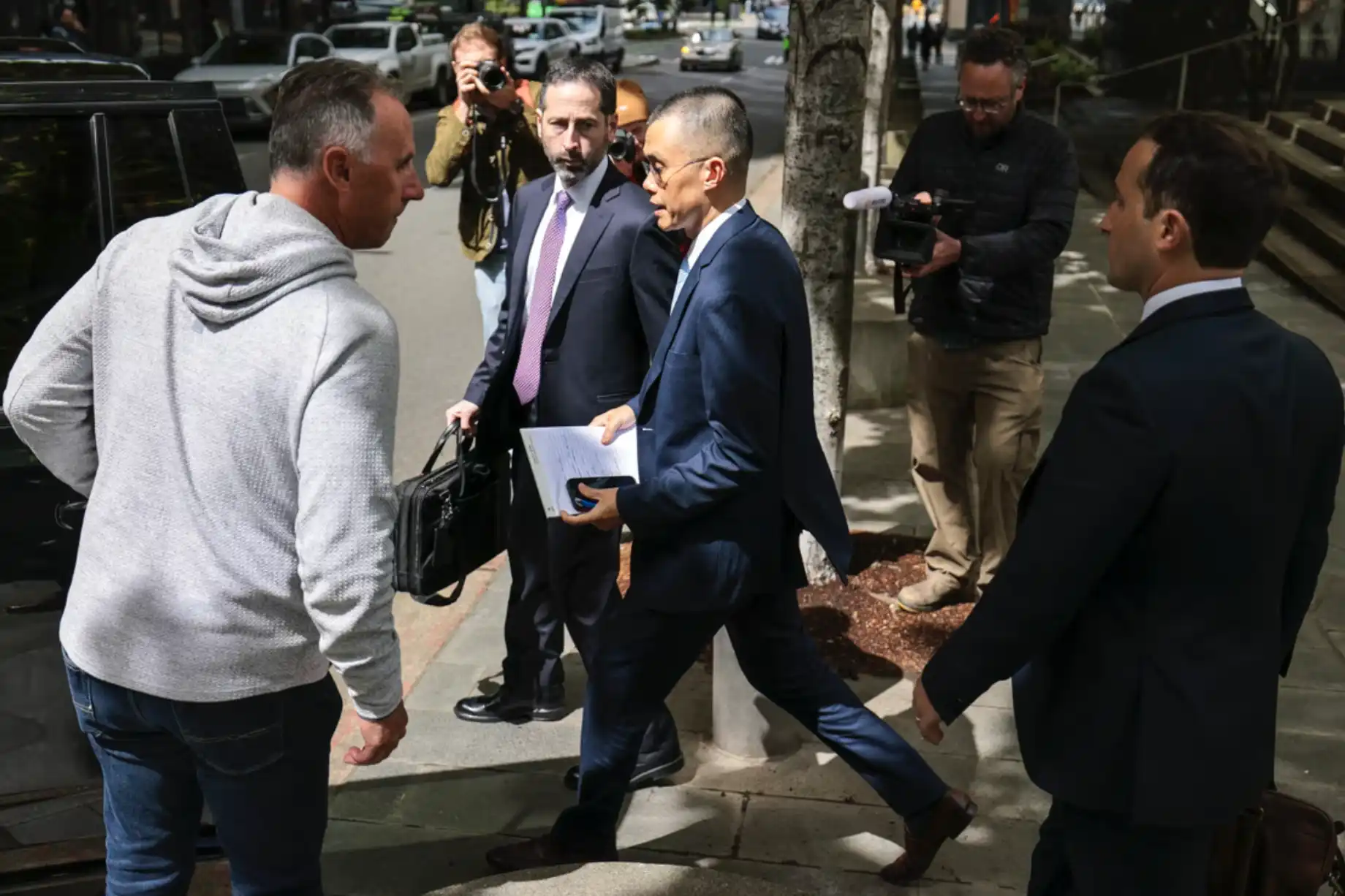
Former Binance CEO CZ leaving the courtroom after sentencing last year
Image Source: JASON REDMOND/AFP/GETTY IMAGES
The Wall Street Journal reported last month that Trump family representatives also discussed acquiring a stake in Binance US, the troubled US branch of Binance that operates independently.
A Treasury Department official stated the meeting with Binance was one of dozens the agency had with the crypto industry. A spokesperson for World Free Finance said the company aims to have the US Dollar stablecoin (USD1) "used by millions worldwide."
CZ declined to comment through a Binance spokesperson. Last month, CZ stated on the X platform that he had no business dealings with World Free Finance and had not discussed any transactions involving Binance US with anyone. He added, "No criminal minds being mindful of an amnesty."
A Binance spokesperson said, "The astonishing momentum of the US crypto movement under the new government and congressional leadership is inspiring. We are excited to support any efforts seeking to strike a balance between innovation and user protection in digital asset regulation."
A White House spokesperson said they would not disclose who is or is not being considered for pardon.
"Ending with Enforcement Rather than Regulation"
The alliance between the Trump family and Binance began at a crypto conference in Abu Dhabi in December last year, just weeks before the inauguration. In an exclusive "Whale" (VIP) backstage area accessible with a $10,000 VIP pass, attendees interacted with CZ, Trump's son Eric, and Trump ally and incoming Middle East envoy Steve Witkoff. Witkoff told attendees he would promote cryptocurrency development in the new government.
During the event, Eric promoted the upcoming era of digital currency under his father's leadership, Gold Rush, and advocated for World Free Finance, co-founded a few months ago by the Trump family with Vitkov and his son. The conference also offered a 21% discount on tickets using the discount code "TRUMPPUMP21." Both Eric and a spokesperson for the Trump organization did not respond to requests for comment.
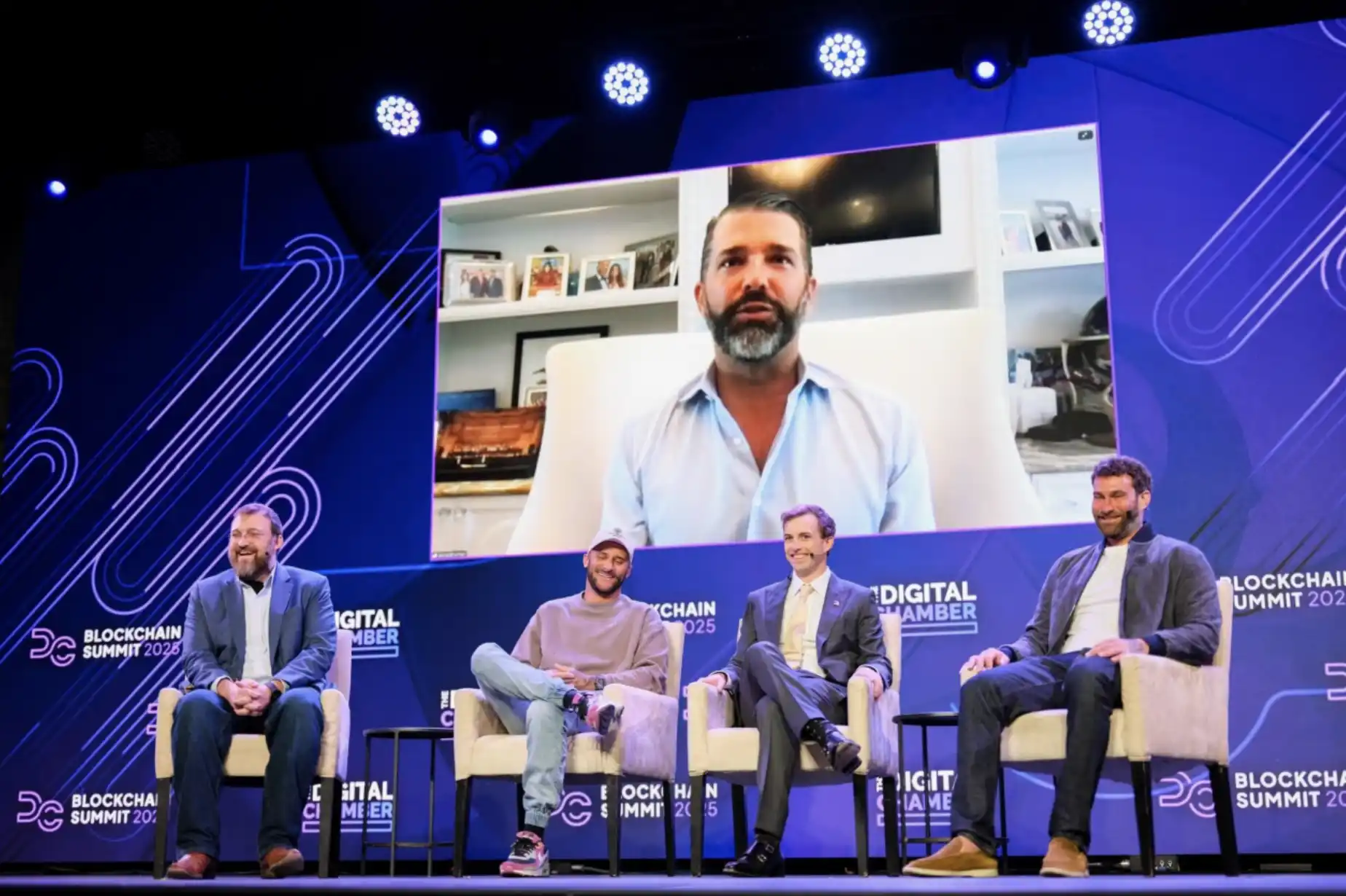
Co-founders of World Free Finance on stage, from left to right: Chase Herro, Zach Witko#, and Zak Folkman. On the screen is Donald Trump Jr.
Image Source: KENT NISHIMURA/BLOOMBERG NEWS
CZ was seeking a pardon at the time and complained about the US's excessive regulation of the crypto industry during a public speech. He said, "You have to stop using law enforcement instead of regulation."
Insiders say that after the conference, business negotiations about Binance's US equity and a USD stablecoin accelerated over the following months.
The Trump administration swiftly made progress in easing cryptocurrency regulation. In recent weeks, the Department of Justice paused its corporate oversight plans and disbanded its cryptocurrency unit, which had been instrumental in advancing the 2023 case against Binance. In a memo titled "Ending Law Enforcement Overreach," the Department of Justice announced this move.
According to insiders, Binance still has to deal with a regulatory officer appointed by the Treasury Department, which is seen as more burdensome.
Insiders say that conflicts have arisen between Binance executives and the Treasury Department's regulatory officer, with disagreements being less severe than those with the Department of Justice's regulators mainly revolving around the officer's access to the company, including the ability to interview employees and review documents.
Insiders revealed that in a meeting last month with the Treasury Department, Binance CEO Changpeng Zhao and Chief Legal Officer Eleanor Hughes asked the department to lift or shorten the regulatory oversight or reduce its scope.
Binance executives are optimistic that the Trump administration will approve their request. Insiders say that exchange employees have been discussing adjusting their anti-money laundering measures, with some employees viewing this as a move to relax checks on high-risk customers.
A Binance spokesperson stated that the regulatory officer has resulted in "an inefficient and costly burden." They added that Binance is "fine-tuning rules but not relaxing controls."
A String of Crypto Criminals
According to sources familiar with the matter, Binance began reaching out to allies of Trump around the time of the 2024 election. A special team was formed within the company to explore re-entry into the U.S. under the Trump administration and seek a pardon for CZ (CZ).
Even before the December meeting, CZ had been in contact with the World Free Finance team. Vitkov's son Zach had previously referred to CZ as a "sage" on X. In October of last year, World Free Finance hired CZ's close friend Richie Theo to assist in the launch of their stablecoin, with Theo having previously requested leniency from the judge presiding over CZ's case.
A spokesperson for World Free Finance stated, "Nearly every leading company in the digital asset industry has engaged with Binance." She added, "We are very grateful for CZ's many contributions to the cryptocurrency industry, perhaps even more so for his philanthropy."
The Trump family's embrace of Binance reflects dynamics within the White House. Helped by previous administrations, the U.S. government once pursued crypto tycoons who facilitated fund transfers for adversaries—Russian sanctions evaders, Islamic terrorist groups, Mexican drug cartels, global scam syndicates—and they are now doing business with the President and his inner circle.
Trump has already pardoned a string of crypto criminals, including BitMEX exchange co-founder Arthur Hayes, who pleaded guilty to violating the same U.S. anti-money laundering laws as CZ.
Tron blockchain network founder Justin Sun is a major external investor in World Free Finance and provides counsel to the company. According to blockchain analytics firm TRM Labs, over half of last year's illicit crypto activity—around $260 billion—occurred on the Tron network.
In February of this year, after Sun invested $75 million in World Free Finance's token, the U.S. Securities and Exchange Commission requested a court to pause its fraud lawsuit against him.
Sources revealed that during the Biden administration, the Department of Justice has been investigating Sun for financial crimes. It is currently unclear if the investigation is ongoing.
As part of CZ's plea agreement, sources say he has agreed to provide evidence about Sun to prosecutors. This arrangement had not been previously reported. The Department of Justice declined to comment.
A representative for Sun declined to comment on "baseless accusations regarding legal matters" and stated that claims of Tron fostering criminal activity are inaccurate.
In December of last year, Sun also interacted with VIPs in the backstage of an Abu Dhabi conference, distributing miniatures of a $6 million banana art piece he had recently purchased.
You may also like

Morning Report | BitMine increased its holdings by 126,971 ETH last week; trader Eugene announced his exit from the crypto market

Wang Chuan: How can one not feel anxious after the neighbor Old Wang made thirty times profit by investing in storage stocks? (Seven) - A quarter-century cycle

Cryptocurrency CEXs are flocking to sell US stocks, and traditional brokerages are facing an "uninvited guest."

$75 billion in foreign capital has fled, and South Korean retail investors have absorbed it all using leverage

Japan’s Three Megabanks Plan Joint Stablecoin Issuance in Fiscal 2026
MUFG, SMBC, and Mizuho reportedly plan to jointly issue fiat-pegged stablecoins in fiscal 2026, signaling Japan’s growing push into bank-led digital payment infrastructure.

Humanity Discloses H Token Dual-Chain Attack Details, With Losses on Ethereum and BSC Exceeding $36 Million
Humanity said the H token attack across Ethereum and BSC caused more than $36 million in losses after leaked ProxyAdmin keys enabled malicious contract upgrades and token minting.
White House Discusses CLARITY Act With Law Enforcement Ahead of Senate Vote
The White House discussed the CLARITY Act with law enforcement ahead of a Senate vote, focusing on illicit finance risks and developer protections.

Bitcoin Trading Guide 2026: Strategies for Experienced Traders

What Is XAUT and PAXG? Why Tokenized Gold Is Booming in 2026

Will the SpaceX IPO Hurt Bitcoin? Here's What Traders Are Watching

Foreign selling in the South Korean stock market accelerates, with cumulative net sales reportedly reaching $75 billion this year
On June 9, The Kobeissi Letter, citing Goldman Sachs data, reported that global investors are selling South Korean stocks at an unusually rapid pace. In the latest trading session, foreign investors sold about $801 million worth of Kospi constituent stocks again; total foreign outflows last week reached about $10 billion, and the market has been in net foreign selling on nearly every trading day over the past month. According to the data cited in the report, foreign investors have sold about $75 billion worth of South Korean stocks so far this year. Meanwhile, South Korean retail and institutional investors together recorded roughly $69 billion in net buying over the same period, suggesting that the market’s main buying support has come from domestic capital rather than returning overseas funds. The information currently disclosed still mainly comes from The Kobeissi Letter’s retelling and Goldman Sachs data summaries, while public details on the statistical period and the specific definition of “selling” remain relatively limited.

Fortune Warns of Strategy’s Financing Structure Risks as Bitcoin Premium Narrows
Fortune warned that Strategy’s Bitcoin treasury model faces growing financing risks as MSTR’s net asset premium narrows and preferred stock dividend pressure increases.

Ferrari Challenge Le Mans: Carl Moon to Dominate in WEEX Livery

Sahara AI Responds to SAHARA’s Sharp Drop: No Contract or Product Security Issues Found, Internal Investigation Underway
Sahara AI responded to SAHARA’s 60% price drop, saying no token contract or product security issues have been found and an internal investigation is underway.

WEEX Deposit/Withdrawal Dynamic Island: Your Asset Status, Always in Sight
Scaling Crypto Derivatives: The Digital Asset Infrastructure Behind High-Volume Trading
In the fast-moving digital asset ecosystem, derivatives platforms face an extreme architectural test. High-leverage futures markets demand more than just standard security—they require absolute operational precision, zero-latency matching engines, and ironclad structural scalability, all while navigating intense market volatility.
As global platforms scale to meet these demands, the industry is shifting away from rigid, monolithic setups toward a more agile, "decoupled" infrastructure philosophy.
The Blueprint for High-Volume Copy TradingFor elite global exchanges like WEEX (founded in 2018), this architectural choice becomes critical when scaling high-volume retail features like social copy trading. When thousands of users automatically mirror the real-time strategies of elite traders simultaneously, it triggers sudden, monumental spikes in concurrent transactional volume.
To prevent execution latency or settlement bottlenecks during these peak volatility events, a platform's primary engine must remain entirely dedicated to risk management, copy-trade synchronization, and order matching.
The Architectural Rule: New-generation platforms must separate front-end user execution engines from heavy backend infrastructural overhead to eliminate operational friction.
By separating these layers, platforms can maintain complete sovereignty over their trading environments and user experiences while strategically aligning with institutional-grade infrastructure ecosystems. This strategic framework allows modern exchanges to leverage advanced Digital Asset Custody infrastructure such as Cobo’s behind the scenes, ensuring that backend wallet management scales elastically alongside trading spikes.
Capitalizing on Market Momentum and 400× LeverageIn a derivatives arena where platforms offer up to 400× leverage on perpetual contracts, capital efficiency and market agility are core business metrics. To capture market momentum, an exchange needs the ability to rapidly expand its asset offerings, supporting everything from legacy crypto assets to sudden, trending altcoins across a massive library of trading pairs.
Adopting a flexible, scalable Wallet-as-a-Service (WaaS) solution such as Cobo’s could completely rewrite the development timeline for high-growth exchanges. Instead of spending months of engineering capital building out custom backend wallet architectures for every new blockchain network, platforms can deploy localized infrastructure in days.
This agility allows platforms to instantly scale their listings to over a thousand trading pairs without compromising security or delaying time-to-market. It mirrors the exact operational advantages seen during high-velocity market events, similar to how advanced wallet infrastructure empowers platforms during sudden asset surges; allowing exchanges to pass that speed and liquidity directly to their global user base.
A Mature Foundation for GrowthThe synergy between trusted infrastructure ecosystems and global trading platforms represents the natural evolution of a maturing crypto market. As WEEX continues to scale its global spot and derivatives offerings for over 6 million users, adopting robust backend paradigms proves that platforms no longer have to compromise between cutting-edge trading velocity and uncompromised structural security.

Get Paid to Onboard? Try WEEX’s New Homepage with Rewards for Registration, Deposit & Trade
WEEX Custom Layout: Build Your Perfect Trading Workspace in Seconds
Morning Report | BitMine increased its holdings by 126,971 ETH last week; trader Eugene announced his exit from the crypto market
Wang Chuan: How can one not feel anxious after the neighbor Old Wang made thirty times profit by investing in storage stocks? (Seven) - A quarter-century cycle
Cryptocurrency CEXs are flocking to sell US stocks, and traditional brokerages are facing an "uninvited guest."
$75 billion in foreign capital has fled, and South Korean retail investors have absorbed it all using leverage
Japan’s Three Megabanks Plan Joint Stablecoin Issuance in Fiscal 2026
MUFG, SMBC, and Mizuho reportedly plan to jointly issue fiat-pegged stablecoins in fiscal 2026, signaling Japan’s growing push into bank-led digital payment infrastructure.
Humanity Discloses H Token Dual-Chain Attack Details, With Losses on Ethereum and BSC Exceeding $36 Million
Humanity said the H token attack across Ethereum and BSC caused more than $36 million in losses after leaked ProxyAdmin keys enabled malicious contract upgrades and token minting.


