
WOO X Research: Raydium vs. Pump Fun Showdown, Does LaunchLab Really Have a Wealth-Building Effect?




Original Article Title: "WOO X Research: Raydium vs Pump Fun Showdown, Does LaunchLab Really Create Wealth?"
Original Source: WOO
Background: Raydium Launches Token Issuance Platform LaunchLab
Raydium is the top DEX on Solana, while Pump Fun is the largest Launchpad. Interestingly, despite their different focus and business models, they are still attacking each other in an attempt to capture more revenue.
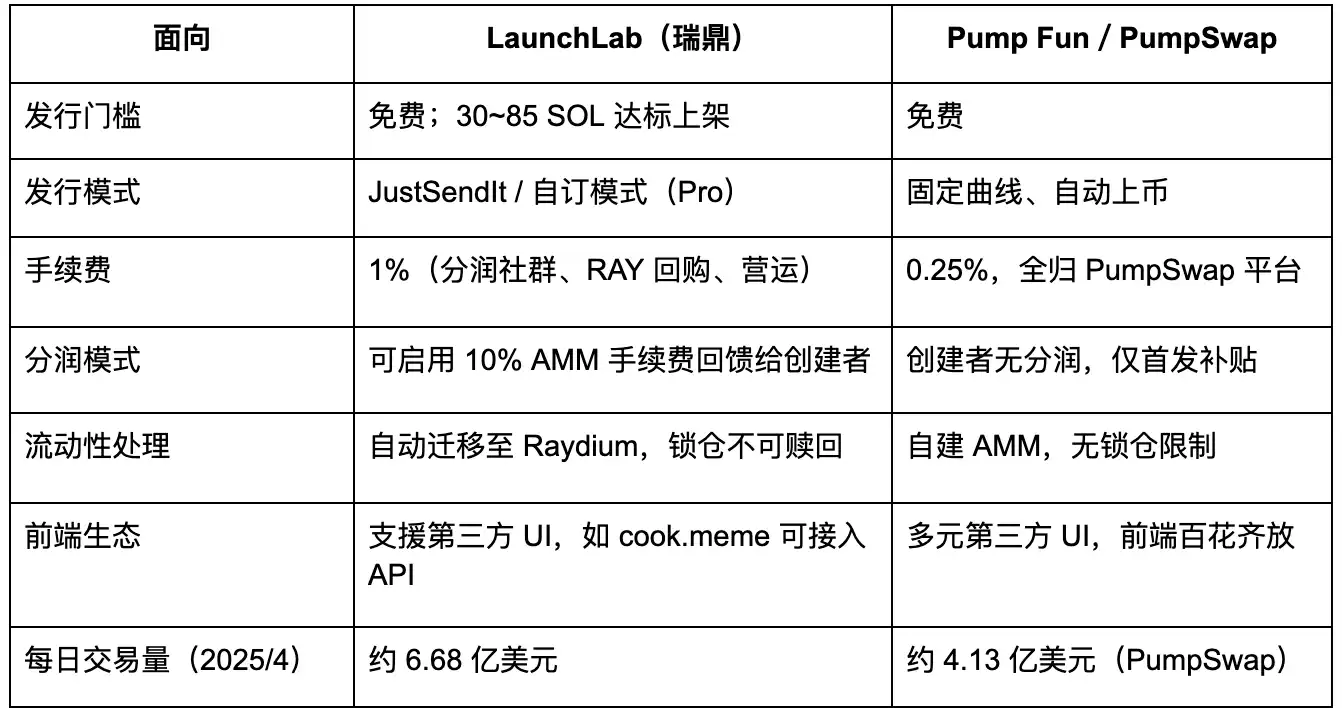
First, Pump Fun launched PumpSwap, with its daily trading volume stabilizing at around $4 billion recently, approaching Raydium's $6 billion daily trading volume. Raydium officials have pointed out that Pump Fun has contributed as much as 41% of its AMM revenue in the past month. However, after Pump Fun launched PumpSwap on its own, Raydium's traffic plummeted, forcing Raydium to launch LaunchLab to "regain liquidity dominance."
What are the differences between LaunchLab and Pump Fun? What are some notable projects to watch? Let WOO X Research show you.
LaunchLab Basic Introduction
LaunchLab, launched by Raydium, is essentially a "zero-code token issuance tool + automatic liquidity migration service" with two main usage modes:
· JustSendIt Mode: Allows users to create tokens with a single click, requiring a preset raise of 85 SOL. Upon successful fundraising, the tokens will automatically migrate to Raydium's AMM, and the LP tokens will be burned to lock liquidity.
· LaunchLab Pro Mode: Allows customization of total supply, minimum raise of 30 SOL for issuance, bonding curve slope, ownership conditions, and whether to enable AMM profit sharing (up to 10% transaction fee rebate to the project team).
In terms of the fee structure, Raydium charges a flat 1% base fee, with 50% going into the "Community Pool," 25% for $RAY buybacks, and 25% for infrastructure and operational funds.
LaunchLab also allows third-party interfaces to access its backend services and build their own coin issuance front-end. The most well-known of these is cook.meme.
cook.meme is the first "meme coin issuance platform" to use the LaunchLab contract but with a self-built UX frontend, emphasizing zero fees, instant transactions, and a clean UI. Upon its release, it attracted many developers to try it out, positioning itself somewhat like a UI replica of Pump Fun, but with the underlying liquidity tied to Raydium.


Raydium adopts this open model not just for traffic redirection but to replicate the content and ecosystem flywheel built through community frontends during Pump Fun's heyday.
LaunchLab vs. Pump Fun
Key Projects
With the launch of LaunchLab, the most direct beneficiary is undoubtedly $RAY (with a 25% fee buyback), and after the announcement of LaunchLab, the price of $RAY rose by about 8%. If LaunchLab can sustain its momentum, the buyback strength of $RAY will continue to increase. When demand exceeds supply, there is an opportunity for price appreciation.
The lifecycle of a LaunchPad depends on how many "Golden Dogs" it can generate. As the platform continues to create wealth effects, user assets will naturally converge on that platform. Once assets are concentrated, the likelihood of the emergence of "Golden Dogs" will also increase, ultimately forming a positive flywheel cycle.
Therefore, the first step of the flywheel is to have Golden Dogs. Unfortunately, within 24 hours of LaunchLab going live, only the graduation token $TIME had a market cap exceeding $1 million. Other tokens like $ARUA, $Gaydium, etc., while experiencing a surge in market value in the early stages, were eventually influenced by overall market dynamics, leading to a high valuation for a single token.
So, what are the narratives behind $TIME, $ARUA, and $Gaydium respectively?
As mentioned earlier, Raydium allows third parties to connect to their routing building platform and issue coins. Currently, three platforms—Raydium, Cook.meme, and Pump Fun Robinhood—have partnered with them, with $TIME being the first meme coin created by Cook.meme. Raydium's own issued coin is $ARUA, which, although deployed earlier than $TIME, had a later launch.
$Gaydium, in addition to the pun, is when Raydium's developers put $Gaydium's contract address on Rytdium's GitHub, but then promptly deleted it less than an hour later, causing a sharp drop in the token's price.
$TIME
· Current Market Cap: $6 million
· All-Time High Market Cap: $8.5 million
· 24 HR Trading Volume: $30.2 million
· Number of Holders: 7,600
Conclusion
Raydium's LaunchLab appears to be a "belated counterattack," but the overall design has already made a systematic response to the advantages of Pump Fun. It not only provides a customizable token issuance model but also expands into an open-front strategy represented by cook.meme, aiming to bring back traffic, fees, and narrative to the Raydium ecosystem.
However, whether LaunchLab can truly create wealth and reignite a meme frenzy depends on three core elements:
1. Whether it can produce strong meme projects;
2. Whether the fee and liquidity design is friendly to retail investors;
3. Whether the ecosystem can rapidly gather front-end tools and generate network effects.
Although it currently appears that all three elements require further effort, LaunchLab has only been open for less than a month. Declaring the platform a failure based on this would be too categorical. The cryptocurrency world is ever-changing, and perhaps the next hundredfold meme may emerge from LaunchLab, so let us wait and see.
This article is contributed content and does not represent the views of BlockBeats.
You may also like

SK Hynix Reportedly Plans U.S. ADR Listing as Early as August, With SEC Approval Possible in Late June
SK Hynix may pursue a U.S. ADR listing as early as August, with SEC approval reportedly possible in late June amid strong AI chip supply chain demand.

SpaceX vs Tesla vs xAI: Which Elon Musk Trade Has the Biggest Upside in 2026?

OpenAI Reveals It Has Confidentially Submitted an S-1 to the SEC, Keeping the Door Open for a Future IPO
On June 9, according to an OpenAI announcement, the company recently confidentially submitted a draft S-1 registration statement to the U.S. Securities and Exchange Commission (SEC), beginning the preliminary compliance process for a potential initial public offering. OpenAI said it chose to disclose this proactively because it expected the news might leak; however, the company has not yet set a specific listing timeline, and related arrangements may still take some time.

Latest research from 13 top universities including Cornell University: The current state, challenges, and misconceptions of the fusion of Crypto and AI
Deconstructing Anthropic: The Best AI Company, Possibly Also a Type of Organizational Invention
Apollo and Blackstone Reportedly Back $35 Billion Anthropic Chip Financing as Deal Details Remain Unclear
On June 9, according to currently available news alerts, Apollo and Blackstone Group participated in a $35 billion financing for an Anthropic “chip project.” Based on the original wording of the report, the funding has already been raised, but public information remains limited. The financing structure, use of proceeds, project entity, and whether Apollo and Blackstone participated through equity, debt, or project financing have not yet been disclosed.

Humanity Protocol Security Incident Escalates: More Than $31 Million Stolen From Related Addresses as Attacker Continues Selling H for ETH
On June 9, according to monitoring by Onchain Lens, more than $31 million has been stolen from addresses linked to Humanity Protocol, and the attack is still ongoing, with the hacker continuously swapping H tokens for ETH. Project founder Terence Kwok later confirmed the security incident on X, saying the issue involved a private key leak.

Bloomberg: As Bitcoin Weakens, Stablecoins and RWA Continue to Drive Expansion in Crypto Businesses
In June, Bloomberg reported that despite Bitcoin falling below $60,000 last week, wiping out about $235 billion in market value within seven days, and dropping close to 50% from last year’s peak, some core businesses in the crypto industry are still expanding, mainly in stablecoins, real-world asset tokenization (RWA), payments, and infrastructure. The report also noted that overall altcoin activity has contracted significantly: altcoin market capitalization has fallen from a peak of about $431 billion in November 2021 to around $170 billion, and among the tens of millions of tokens issued in recent years, fewer than 1,700 still maintain meaningful trading activity.

Galaxy Deep Research Report: How Hyperliquid's HIP-4 Upgrade Changes the Landscape of Prediction Markets?
Binance Research: RWA Market Expected to Expand Nearly 6x from Early 2025, with Public Equities and Onchain Payments Heating Up Together
In June, Binance Research said in its monthly market report that the real-world asset (RWA) market is expected to grow by about 589% from the beginning of 2025. Bond- and money market fund-related RWA expanded by about $6.5 billion, up 83% year over year, while publicly traded equity RWAs grew by about 422%. The report also noted that monthly crypto debit card transaction volume exceeded $747 million in May, up 48.6% year to date.

Japan to Assess a Framework for Yen Stablecoins and Crypto ETFs as Asia’s Compliant Payments Narrative Heats Up
Recently, according to the original report, Japan is considering the launch of yen stablecoins and cryptocurrency ETFs. Public information remains limited at this stage, and there is still no complete policy text, regulatory draft, or clear implementation timeline, so this is better characterized as a “policy discussion” rather than formal implementation. The original wording also noted that advancing stablecoin regulation in Asia is driving XRP usage and supporting growth in the XRPL ecosystem. However, based on currently available public information, there is not enough evidence to directly establish a clear causal relationship between this round of discussion in Japan and XRP or XRPL.

ZachXBT: Humanity private key leak and abnormal surge in H token should be viewed separately
On June 9, according to related disclosures, on-chain investigator ZachXBT posted an update on Humanity’s roughly $31 million security incident, saying that after further analyzing fund flows, he currently tends to believe the project team was not involved in an “inside job” or a self-staged attack. According to him, the official explanation about the private key leak was broadly accurate, but before the token unlock, the price of H had been artificially pushed higher, and the hacker later took advantage of that market environment; therefore, the private key leak and the earlier abnormal price pumping should be regarded as two separate and independent events. This reframing has shifted the market’s understanding of the nature of the incident. Earlier discussion around Humanity had focused on whether the team directly participated in the attack or used the security incident to cover up internal operations. ZachXBT’s latest remarks shift the focus from “whether it was self-theft” to “whether there were pre-unlock market structure issues.” He also questioned whether the team may have.

Morning Report | OpenAI has submitted an S-1 registration statement draft to the U.S. SEC; Morpho completes $175 million financing

Morning Report | BitMine increased its holdings by 126,971 ETH last week; trader Eugene announced his exit from the crypto market

Wang Chuan: How can one not feel anxious after the neighbor Old Wang made thirty times profit by investing in storage stocks? (Seven) - A quarter-century cycle
Cryptocurrency CEXs are flocking to sell US stocks, and traditional brokerages are facing an "uninvited guest."
$75 billion in foreign capital has fled, and South Korean retail investors have absorbed it all using leverage

Japan’s Three Megabanks Plan Joint Stablecoin Issuance in Fiscal 2026
MUFG, SMBC, and Mizuho reportedly plan to jointly issue fiat-pegged stablecoins in fiscal 2026, signaling Japan’s growing push into bank-led digital payment infrastructure.
SK Hynix Reportedly Plans U.S. ADR Listing as Early as August, With SEC Approval Possible in Late June
SK Hynix may pursue a U.S. ADR listing as early as August, with SEC approval reportedly possible in late June amid strong AI chip supply chain demand.
SpaceX vs Tesla vs xAI: Which Elon Musk Trade Has the Biggest Upside in 2026?
OpenAI Reveals It Has Confidentially Submitted an S-1 to the SEC, Keeping the Door Open for a Future IPO
On June 9, according to an OpenAI announcement, the company recently confidentially submitted a draft S-1 registration statement to the U.S. Securities and Exchange Commission (SEC), beginning the preliminary compliance process for a potential initial public offering. OpenAI said it chose to disclose this proactively because it expected the news might leak; however, the company has not yet set a specific listing timeline, and related arrangements may still take some time.
Latest research from 13 top universities including Cornell University: The current state, challenges, and misconceptions of the fusion of Crypto and AI
Deconstructing Anthropic: The Best AI Company, Possibly Also a Type of Organizational Invention
Apollo and Blackstone Reportedly Back $35 Billion Anthropic Chip Financing as Deal Details Remain Unclear
On June 9, according to currently available news alerts, Apollo and Blackstone Group participated in a $35 billion financing for an Anthropic “chip project.” Based on the original wording of the report, the funding has already been raised, but public information remains limited. The financing structure, use of proceeds, project entity, and whether Apollo and Blackstone participated through equity, debt, or project financing have not yet been disclosed.


