
Why Are Crypto Projects Rushing to Issue Credit Cards? A Battle Between Web3 and the Real World


Original Title: "Why Are Crypto Projects Rushing to Issue Cards? A Battle for Access between Web3 and the Real World"
Original Author: Fairy, ChainCatcher
The crypto industry is witnessing a peculiar "physicalization" movement: card issuance.
From ordering takeout and shopping on JD.com with USDT to swiping a card at a street corner convenience store, the once purely digital assets are now stealthily entering the real world through crypto cards.
Is card issuance the golden key to bridge Web3 and the real world, or is it just a short-lived traffic-boosting game? This article will dissect the driving factors, competitive landscape, and hidden risks behind this wave of crypto payment frenzy, shedding light on this industry transformation.
The Crypto Card Battle is in Full Swing
Capital is being wagered, projects are racing. According to RootData, there are currently 37 projects focusing on crypto card businesses, with many receiving significant backing from top institutions. For example, the crypto credit card project KAST completed a $10 million seed round led by Sequoia China and Sequoia India; the crypto card issuer Rain secured $24.5 million in funding with Norwest Venture Partners leading, and participation from Coinbase Ventures, Circle Ventures, among others.
Overview of Crypto Card Projects:
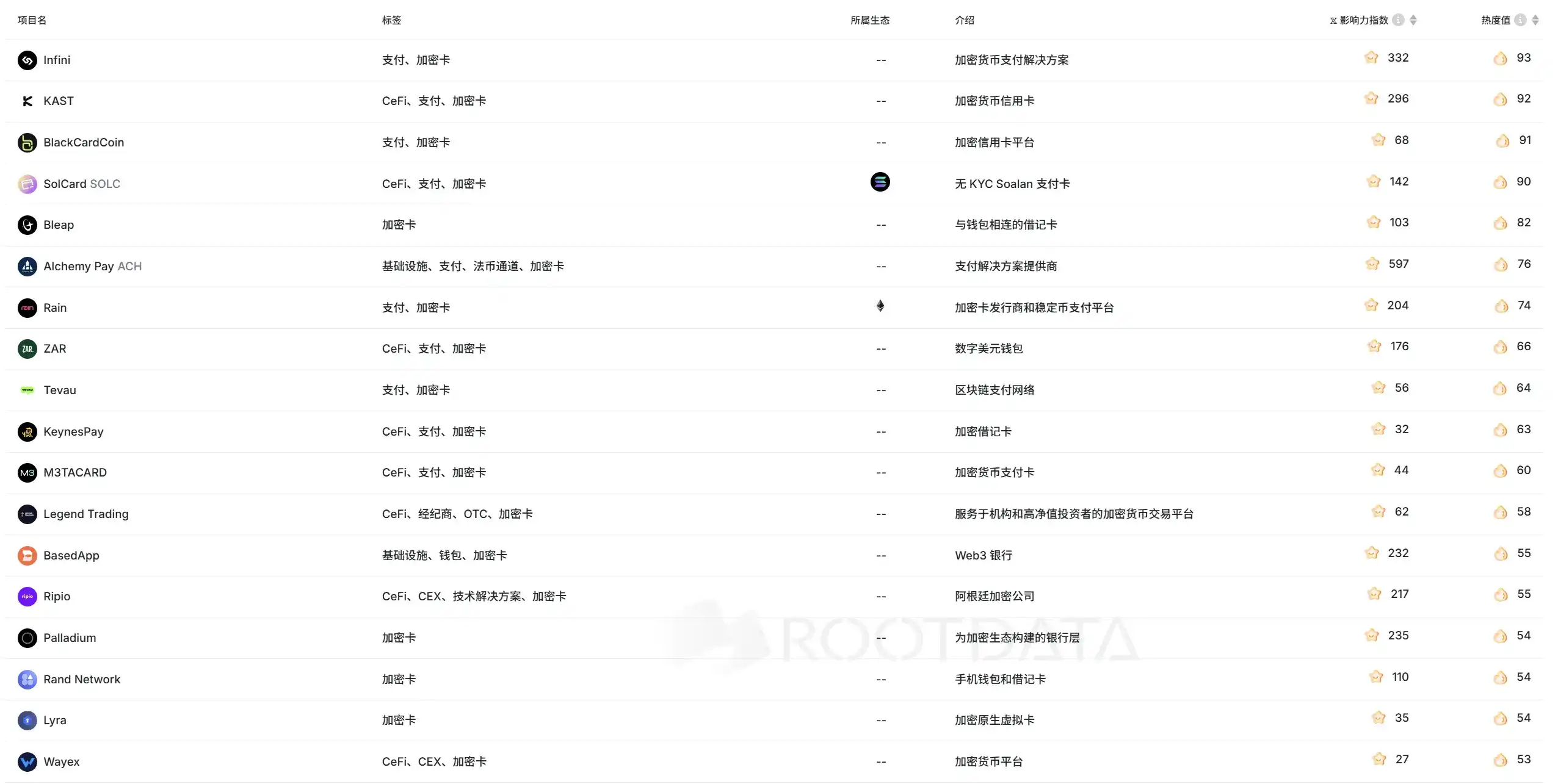
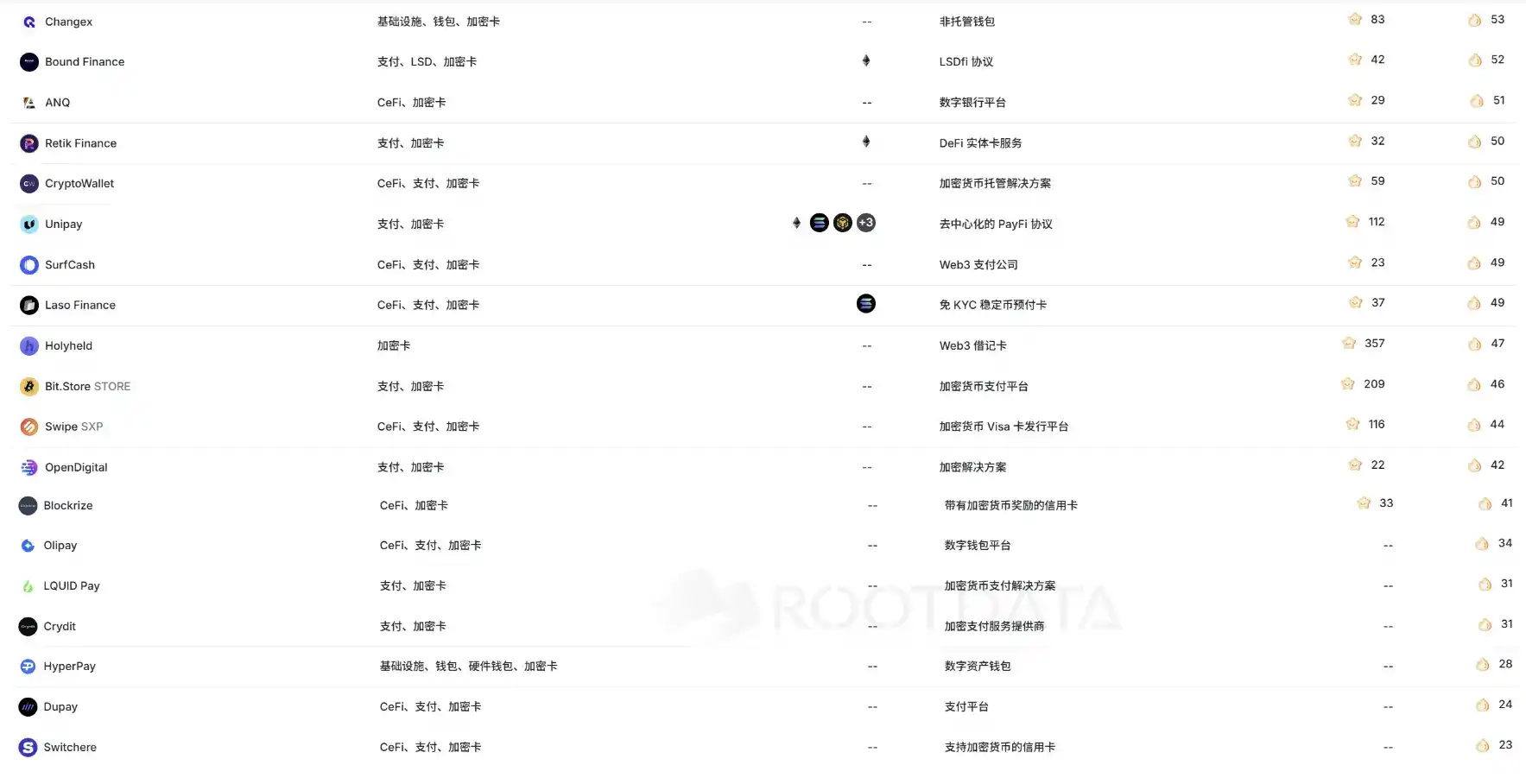
Image Source: RootData
From Metaverse, Metaverse, to now the "Cardverse Era." This competition is not just a stage for startups. More and more key players are personally entering the arena, with exchanges, wallets, and public chains unwilling to fall behind, attempting to secure a spot in the key gateway from on-chain assets to offline consumption.
The market is flooded with a variety of crypto card products; here is a comparison of some representative projects:
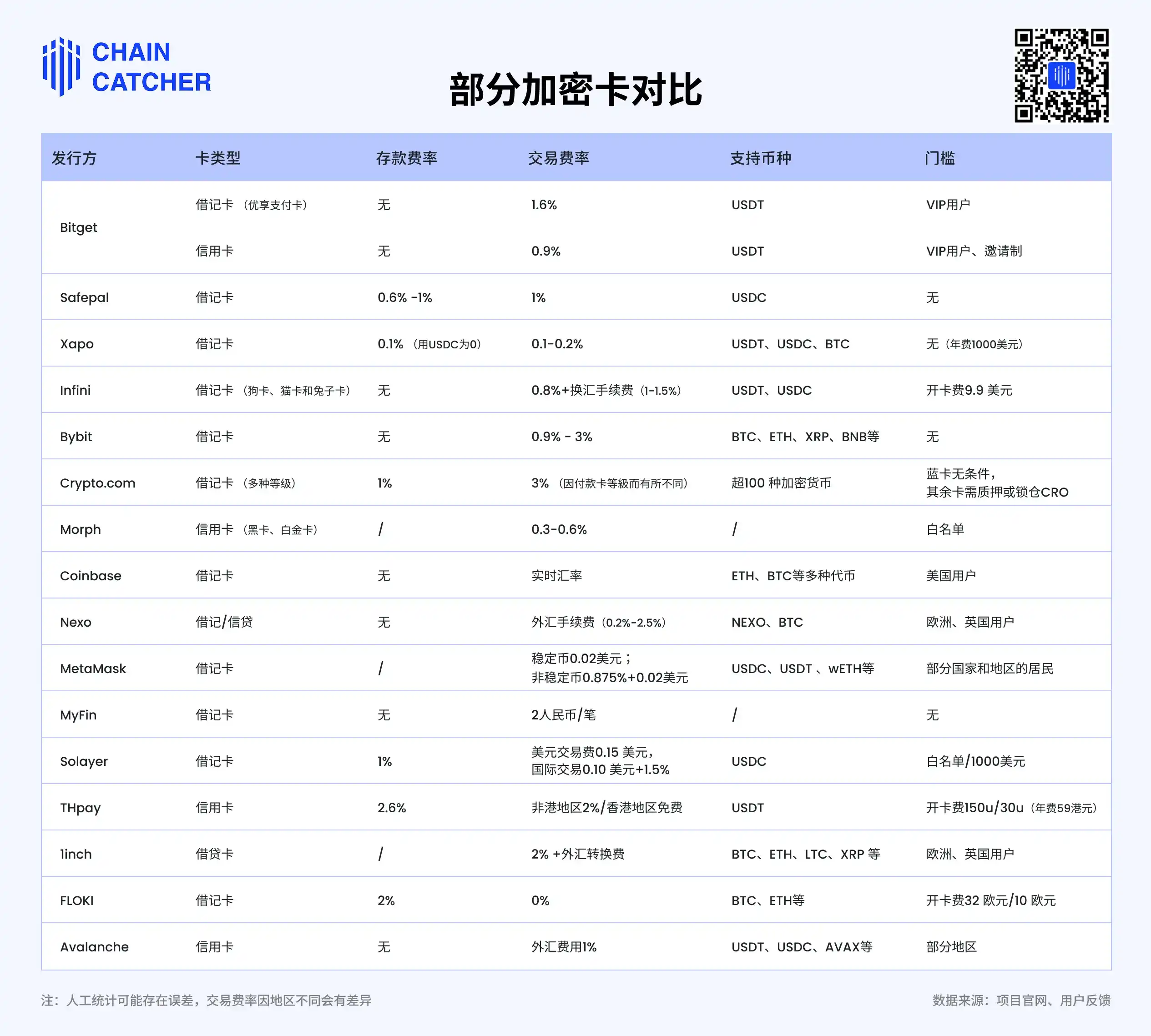
Meanwhile, more cards are on the way:
OKX will collaborate with Mastercard to launch the OKX CardKraken partners with Mastercard to release a crypto debit card MetaMask, CompoSecure, and Baanx will jointly launch a "metal card"....
A card that has become a key gateway to connect Web3 with the real world, and is also a symbol of the transformation of crypto assets from "speculative assets" to "utility assets." It serves as both a bridge and a battleground. Behind this seemingly lively card issuance trend, what is brewing?
The Business of Crypto Cards
Essentially, a crypto card is a form of prepaid card. When a user tops up this card with USDT, USDC, or other stablecoins, it does not "cash out" these assets into the card's balance. Instead, the issuing party allocates a corresponding amount to the user in a bank account opened within the Visa/Mastercard and other traditional card network systems.
The underlying operation is a highly centralized funding model, mainly consisting of three parts: asset custody (to meet user withdrawal needs), asset interest (for earning returns), and asset advance (for exchanging fiat quotas).
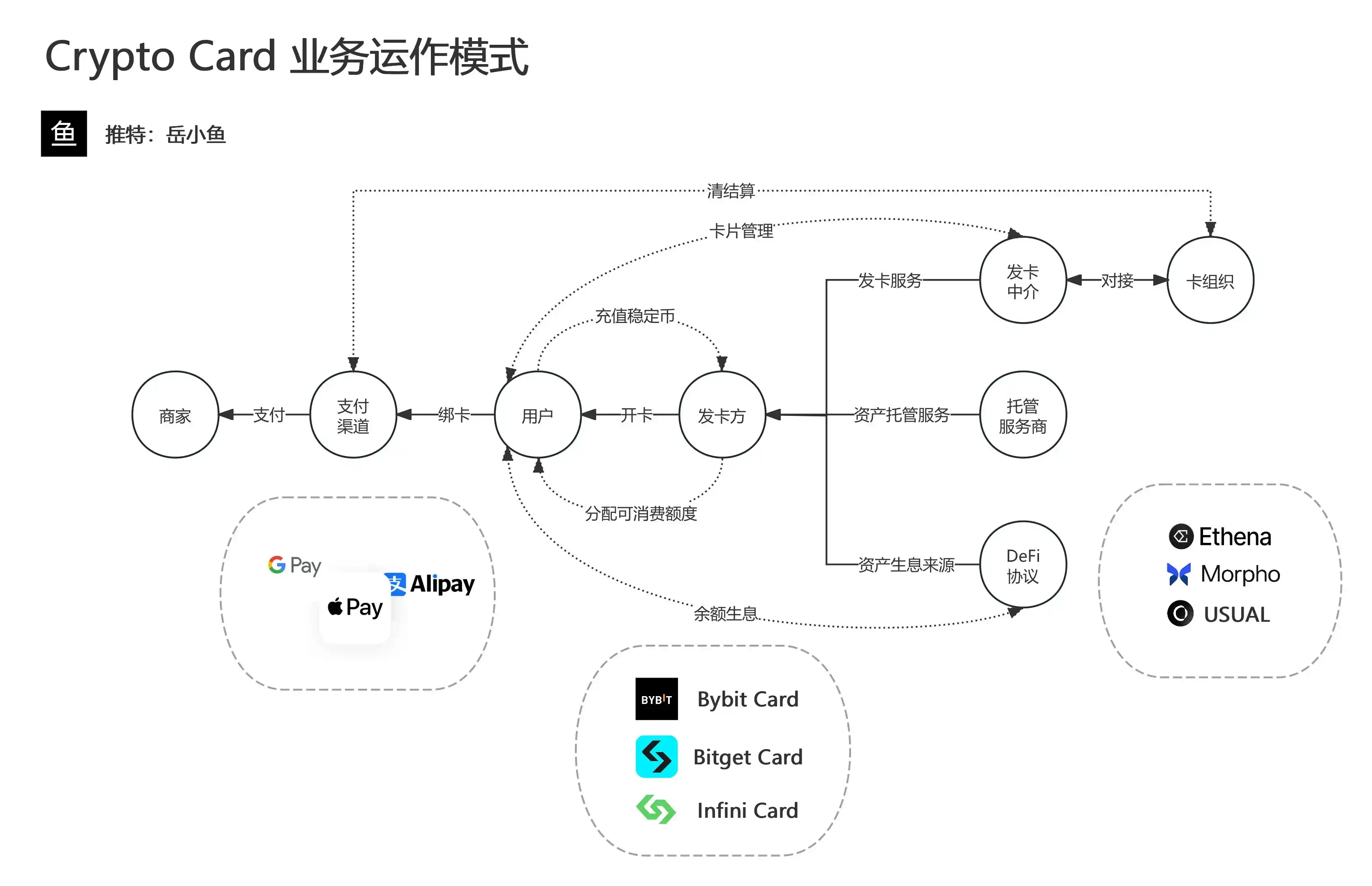
Image Source: @yuexiaoyu111
In this model, the revenue sources of the issuing platform are relatively clear. On one hand, there are card fees and exchange fees, while on the other hand, there are operational earnings from the platform's pooled funds. However, as seen in the comparison chart of crypto cards in the previous text, the competition on fees and charges is already intense, with almost all platforms lowering fee thresholds to attract users, and even adding various "sweeteners" such as airdrops, consumption rebates, and discounts.
Therefore, crypto cards are actually a low-margin business, and platforms can only achieve sustainable profitability through achieving large-scale transaction volumes and fund pooling. For platforms, the essence of this business is actually the competition for users' "payment access." The real competition lies not only in brand building and channel occupation but also in a game centered around user traffic.
Moreover, the natural advantages of payment platforms and wallet extensions in this business not only help enrich their business matrices but also enhance market potential and development prospects.
Trend and Challenges
This "card issuance trend" has brought many opportunities, but it also hides many challenges and risks. There have been various interpretations within the industry regarding the value and challenges of crypto cards.
From a regional perspective, different markets have varying degrees of acceptance for crypto cards. Researcher @sjbtc9 pointed out that in Australia, Europe, the Americas, and Latin America, crypto cards are widely popular due to their ability to avoid high inflation and compensate for inadequate local financial services. In contrast, in regions like Singapore with relatively complete regulatory systems, users already have smooth withdrawal channels, so the demand for crypto cards is relatively tepid. In the domestic market, crypto cards are often used for paying for overseas services subscriptions such as ChatGPT.
In addition, in some regions, crypto cards have also taken on the role of "alternative intermediaries." For example, in the context of high-risk OTC trades, the U Card has to some extent provided a more direct and stable fund gateway.
However, challenges lie ahead. Compliance and risk control have always been inevitable challenges for crypto cards. Crypto influencer Yue Xiaoyu once shared that the OneKey Card rapidly gained popularity due to its excellent product experience, but under compliance pressure, it successively suspended Mainland China KYC and completely shut down its Card business. This not only exposed the high uncertainty under policy regulation but also reflected the difficulty of crypto card businesses in sustaining expansion under weak user growth.
As community user @agintender stated, beneath the surface of crypto cards lies a "risk control hell": how to deal with frozen, stolen, or recovered funds, how to cooperate with investigations, how to hierarchically manage the flow of user funds, and how to establish reasonable customer-side narratives and storytelling abilities are all core issues that crypto cards must address.
Security risks are also a significant concern. In February of this year, card merchant Infini was attacked, resulting in a loss of over $49 million. Crypto influencer @_FORAB revealed that after the incident, multiple U Card service providers entered maintenance mode, and even suspended card issuance. This event highlights that security and risk prevention are key factors for the continuous development of crypto cards.

The wave of card issuance is not just a competition of cards but also a struggle for passage between Web3 and the real world. Each shimmering metal card not only displays a brand logo but also echoes the knock of the crypto economy on mainstream society's door.
Success or failure, who will stand out, time will provide the answer.
You may also like

Morning Report | OpenAI has submitted an S-1 registration statement draft to the U.S. SEC; Morpho completes $175 million financing

Galaxy Deep Research Report: How Hyperliquid's HIP-4 Upgrade Changes the Landscape of Prediction Markets?

Latest research from 13 top universities including Cornell University: The current state, challenges, and misconceptions of the fusion of Crypto and AI

Deconstructing Anthropic: The Best AI Company, Possibly Also a Type of Organizational Invention

Every exchange is a "Universal Exchange."

The counterattack of traditional finance: Alliance chains are quietly reviving
Pantera Capital Partner: How Tokenization is Restructuring the Private Equity and Early Investment Ecosystem?

Mastercard Launches Agent Pay for AI, Plans to Record AI Agent Payment Authorizations on Polygon
Mastercard launched Agent Pay for AI, a new payment protocol designed to help AI agents make small payments such as pay-per-use access to data and APIs. The system plans to record human-granted AI agent permissions on Polygon, focusing on verifiable authorization, identity, and payment controls.

Curve Deploys Llamalend v2 on Optimism With 250,000 OP Incentives
Curve launched Llamalend v2 on Optimism with 250,000 OP incentives from the Optimism Foundation. The upgrade expands Llamalend beyond its earlier crvUSD-focused model, adding broader collateral support, LlamaRisk market reviews, and the ability to use Curve LP tokens as collateral.

Raydium Old Liquidity Pool Reportedly Exploited, With $1.34 Million Moved to Ethereum and Tornado Cash
An old Raydium liquidity pool was reportedly exploited for around $1.34 million in USDC, RAY, and wSOL, with the stolen funds bridged to Ethereum and deposited into Tornado Cash. The incident highlights the tail risks of legacy DeFi pools, old contracts, and cross-chain fund laundering paths.
Kalshi Executive Challenges “SBF Backed AI Unicorns” Narrative, Says Leopold Aschenbrenner Was Key Figure
Kalshi executive John Wang questioned the “SBF backed AI unicorns” narrative, saying Leopold Aschenbrenner was the key figure behind major AI investment decisions.

New York Proposes Stricter Stablecoin Issuer Rules Aligned With Federal GENIUS Act
NYDFS proposed stricter stablecoin issuer rules aligned with the GENIUS Act, covering reserves, custody, redemption timelines, audits, and capital buffers.

CryptoQuant Says Bitcoin Profitable Supply Is Near 45% Pressure Zone as On-Chain Data Points to Market Repricing
CryptoQuant said Bitcoin’s profitable supply is nearing the 45% pressure zone, signaling rising market stress, unrealized losses, and a possible on-chain repricing phase.

Bitcoin Falls Below 200-Week Moving Average as On-Chain Data Shows Over Half of Supply in Loss
Bitcoin dropped below its 200-week moving average as on-chain data showed over 50% of circulating supply is now in loss, signaling rising market stress.

CFTC Reportedly Plans New Prediction Market Rules Focused on Manipulation Risk and Public Interest Review
The CFTC is reportedly preparing new prediction market rules focused on manipulation risk, public interest review, and retail trader protections.

Meet the new WEEX trial fund—your gateway to greater profits

WEEX Labs Lands at Dutch Blockchain Week: A Disruptive Crypto × AI Conversation Sets Sail in Amsterdam
SK Hynix Reportedly Plans U.S. ADR Listing as Early as August, With SEC Approval Possible in Late June
SK Hynix may pursue a U.S. ADR listing as early as August, with SEC approval reportedly possible in late June amid strong AI chip supply chain demand.
Morning Report | OpenAI has submitted an S-1 registration statement draft to the U.S. SEC; Morpho completes $175 million financing
Galaxy Deep Research Report: How Hyperliquid's HIP-4 Upgrade Changes the Landscape of Prediction Markets?
Latest research from 13 top universities including Cornell University: The current state, challenges, and misconceptions of the fusion of Crypto and AI
Deconstructing Anthropic: The Best AI Company, Possibly Also a Type of Organizational Invention
Every exchange is a "Universal Exchange."
The counterattack of traditional finance: Alliance chains are quietly reviving


