
U.S. Tariff Truce Fiasco: BTC Flash Crashes Below $81K, May Rate Cut Expectation Soars


Original Article Title: "Trump Halts Tariff Roller Coaster Event - Bitcoin Surges to $81K, US Stocks on Wild Ride, Fed Rate Cut Expectation Soars in May"
Original Article Author: Joe, BlockTempo
After a "Black Monday" in Asian stock and cryptocurrency markets yesterday, news broke last night that the Trump administration might pause matching tariffs for 90 days, sparking a strong market rebound and pushing Bitcoin above $80,000.
However, the White House quickly denied this as fake news, causing an instant market confidence collapse and a sharp decline in stocks and Bitcoin. Subsequently, US President Trump issued a tough threat to China once again, stating that if China does not withdraw retaliatory tariffs (China announced a 34% retaliatory tariff last night), the US will raise the existing tariff rate to 50% on the 9th, causing another market shock.
The Dow Jones Index plunged more than 1,700 points intraday, although the closing losses narrowed, and the S&P 500 Index also recorded its worst three-day performance since the 2020 pandemic outbreak. Meanwhile, the EU is waving the flag of negotiation priority but is also prepared to counter with tariffs, casting a shadow over the global trade war.
Bitcoin Surges Above $81K Before Retracing
The cryptocurrency market also experienced volatility last night due to the Trump tariff suspension fake news, with Bitcoin reaching a high of $81,213 but quickly falling back after the White House clarification. As of 9:30 am Taipei time on April 8th, the Bitcoin price is around $79,670, and the Ethereum price is around $1,574. Whether the rebound can continue remains to be seen.
Overall, the current market trend highlights the high uncertainty of the current global economic environment, bringing tremendous pressure to the risk market. Investors must be more cautious when assessing risks and opportunities, closely monitoring subsequent policy directions and economic data changes.

US Stocks See Saw Movement, Nvidia Rebounds
As for US stocks, Apple (AAPL-US) closed at $181.46, plummeting 3.67%. The company's stock price has accumulated a 19% decline over the past three trading days, evaporating nearly $640 billion in market value. There are market rumors that, in order to replenish stock ahead of a potential tariff effective date on the 9th, Apple has initiated emergency logistics plans and is using cargo planes to transport a large number of iPhones and other products from India and China to the US.
Nvidia (NVDA) closed at $97.64, up 3.53%. A Bernstein analyst is bullish on Nvidia, reiterating an "outperform" rating with a target price of $185, expecting its AI server products to potentially be exempt from the latest tariffs under the "USMCA" agreement.
The Dow Industrial Average intraday plunged 1703 points, eventually closing down 349.26 points, a decrease of 0.91%, at 37,965.6 points
The S&P 500 Index fell 11.83 points, or 0.23%, to 5,062.25 points, marking a cumulative decline of over 10% in the past three days, the most severe downturn since the market crash triggered by the early 2020 pandemic
Tech stocks showed resilience as bargain hunters stepped in, with the Nasdaq Composite Index rising 15.48 points, or 0.1%, to 15,603.26 points
Benefiting from a strong rebound in semiconductor stocks, the Philadelphia Semiconductor Index surged against the trend by 97.29 points, or 2.70%, to close at 3,694.95 points
Fed's Closed-Door Meeting Adds Suspense, Rate Cut Expectations Soar
Amid market jitters over tariff news, the Federal Reserve unexpectedly held a previously unannounced closed-door board meeting last night. While the specific discussion topics of the meeting have not been disclosed, this rare move at such a sensitive time has intensified market tension and speculation.
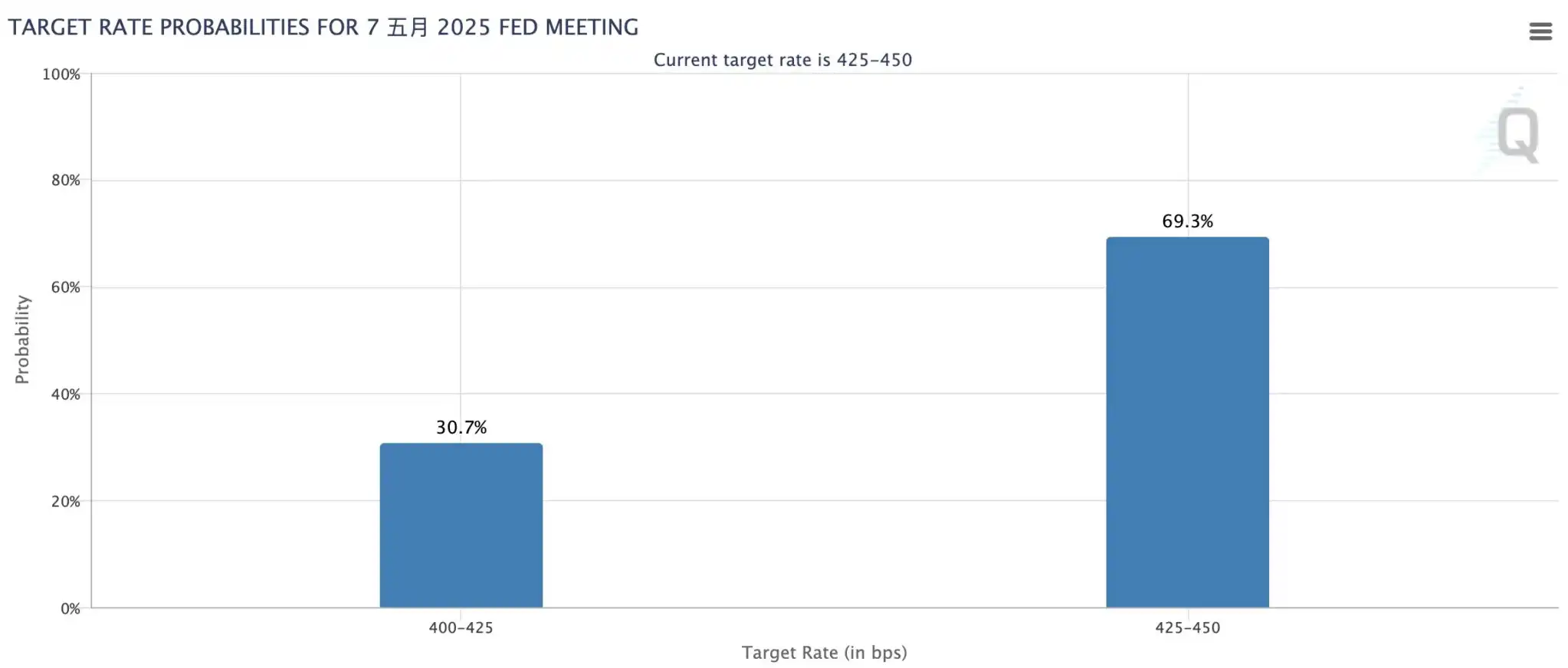
According to the Chicago Mercantile Exchange's (CME) FedWatch tool, market traders currently expect the Fed to cut rates as early as May, with the likelihood increasing from 14% a week ago to 30.7%. This reflects a strong market expectation that, amidst trade war fears and concerns of a potential economic slowdown, the Fed will take a more dovish stance to support the economy.
EU Adopts "Fight-and-Talk" Strategy, Proposes Zero-for-Zero Tariffs
Facing U.S. tariff pressures, the EU reached a consensus at a trade ministers' meeting of the 27 member states held in Luxembourg to prioritize resolving trade disputes through negotiation. EU Trade Commissioner Maros Sefcovic stated that the EU has proposed industrial product "zero-for-zero" tariff negotiations to the U.S., meaning both sides would completely exempt each other from industrial goods tariffs.
However, the EU also made it clear that it would not wait indefinitely. Sefcovic outlined the EU's three key positions:
1. Recognizing the importance of cooperation with the U.S. in strategic areas (such as addressing overcapacity from non-market economies, semiconductor competition, critical raw material supply, etc.)
2. Acknowledging that negotiations with the U.S. will be protracted, currently only in the preliminary stage, as the U.S. sees tariffs as "corrective measures" rather than negotiation chips
3. Pursuing open-ended negotiations while adopting a "three-track approach": defending interests through retaliatory measures, diversifying the market through new trade agreements, and preventing harmful trade diversion effects
In terms of specific actions, regarding the U.S.'s previous tariffs on steel and aluminum products, the European Union is expected to implement the first wave of retaliatory tariffs on April 15, with the related list already submitted to member states and set for a vote on the 9th. The second wave of counterbalancing tariffs is expected to be introduced on May 15.
Currently, the EU's strategy clearly prioritizes "negotiation first, while engaging in talks alongside actions," actively seeking to diversify its trading partners. Dombrovskis specifically mentioned India, Indonesia, Thailand, the Philippines, and Gulf countries, urging to expedite ongoing free trade agreement negotiations. The President of the European Commission vividly expressed that the EU would "focus like a laser beam on 83% of global trade, excluding the United States."
At the same time, the EU is also highly alert to trade diversion risks, especially the potential influx of Chinese products into the EU market due to U.S. tariffs. Dombrovskis recently visited China, with one of the key focuses being on addressing trade imbalances with China, overcapacity, market access, and issues related to Chinese investments in Europe.
You may also like

Japan’s Three Megabanks Plan Joint Stablecoin Issuance in Fiscal 2026
MUFG, SMBC, and Mizuho reportedly plan to jointly issue fiat-pegged stablecoins in fiscal 2026, signaling Japan’s growing push into bank-led digital payment infrastructure.

Humanity Discloses H Token Dual-Chain Attack Details, With Losses on Ethereum and BSC Exceeding $36 Million
Humanity said the H token attack across Ethereum and BSC caused more than $36 million in losses after leaked ProxyAdmin keys enabled malicious contract upgrades and token minting.

White House Discusses CLARITY Act With Law Enforcement Ahead of Senate Vote
The White House discussed the CLARITY Act with law enforcement ahead of a Senate vote, focusing on illicit finance risks and developer protections.

$75 billion in foreign capital has fled, and South Korean retail investors have absorbed it all using leverage

Bitcoin Trading Guide 2026: Strategies for Experienced Traders

What Is XAUT and PAXG? Why Tokenized Gold Is Booming in 2026

Cryptocurrency CEXs are flocking to sell US stocks, and traditional brokerages are facing an "uninvited guest."

Will the SpaceX IPO Hurt Bitcoin? Here's What Traders Are Watching
Foreign selling in the South Korean stock market accelerates, with cumulative net sales reportedly reaching $75 billion this year
On June 9, The Kobeissi Letter, citing Goldman Sachs data, reported that global investors are selling South Korean stocks at an unusually rapid pace. In the latest trading session, foreign investors sold about $801 million worth of Kospi constituent stocks again; total foreign outflows last week reached about $10 billion, and the market has been in net foreign selling on nearly every trading day over the past month. According to the data cited in the report, foreign investors have sold about $75 billion worth of South Korean stocks so far this year. Meanwhile, South Korean retail and institutional investors together recorded roughly $69 billion in net buying over the same period, suggesting that the market’s main buying support has come from domestic capital rather than returning overseas funds. The information currently disclosed still mainly comes from The Kobeissi Letter’s retelling and Goldman Sachs data summaries, while public details on the statistical period and the specific definition of “selling” remain relatively limited.

Fortune Warns of Strategy’s Financing Structure Risks as Bitcoin Premium Narrows
Fortune warned that Strategy’s Bitcoin treasury model faces growing financing risks as MSTR’s net asset premium narrows and preferred stock dividend pressure increases.

Ferrari Challenge Le Mans: Carl Moon to Dominate in WEEX Livery

Sahara AI Responds to SAHARA’s Sharp Drop: No Contract or Product Security Issues Found, Internal Investigation Underway
Sahara AI responded to SAHARA’s 60% price drop, saying no token contract or product security issues have been found and an internal investigation is underway.

WEEX Deposit/Withdrawal Dynamic Island: Your Asset Status, Always in Sight
Scaling Crypto Derivatives: The Digital Asset Infrastructure Behind High-Volume Trading
In the fast-moving digital asset ecosystem, derivatives platforms face an extreme architectural test. High-leverage futures markets demand more than just standard security—they require absolute operational precision, zero-latency matching engines, and ironclad structural scalability, all while navigating intense market volatility.
As global platforms scale to meet these demands, the industry is shifting away from rigid, monolithic setups toward a more agile, "decoupled" infrastructure philosophy.
The Blueprint for High-Volume Copy TradingFor elite global exchanges like WEEX (founded in 2018), this architectural choice becomes critical when scaling high-volume retail features like social copy trading. When thousands of users automatically mirror the real-time strategies of elite traders simultaneously, it triggers sudden, monumental spikes in concurrent transactional volume.
To prevent execution latency or settlement bottlenecks during these peak volatility events, a platform's primary engine must remain entirely dedicated to risk management, copy-trade synchronization, and order matching.
The Architectural Rule: New-generation platforms must separate front-end user execution engines from heavy backend infrastructural overhead to eliminate operational friction.
By separating these layers, platforms can maintain complete sovereignty over their trading environments and user experiences while strategically aligning with institutional-grade infrastructure ecosystems. This strategic framework allows modern exchanges to leverage advanced Digital Asset Custody infrastructure such as Cobo’s behind the scenes, ensuring that backend wallet management scales elastically alongside trading spikes.
Capitalizing on Market Momentum and 400× LeverageIn a derivatives arena where platforms offer up to 400× leverage on perpetual contracts, capital efficiency and market agility are core business metrics. To capture market momentum, an exchange needs the ability to rapidly expand its asset offerings, supporting everything from legacy crypto assets to sudden, trending altcoins across a massive library of trading pairs.
Adopting a flexible, scalable Wallet-as-a-Service (WaaS) solution such as Cobo’s could completely rewrite the development timeline for high-growth exchanges. Instead of spending months of engineering capital building out custom backend wallet architectures for every new blockchain network, platforms can deploy localized infrastructure in days.
This agility allows platforms to instantly scale their listings to over a thousand trading pairs without compromising security or delaying time-to-market. It mirrors the exact operational advantages seen during high-velocity market events, similar to how advanced wallet infrastructure empowers platforms during sudden asset surges; allowing exchanges to pass that speed and liquidity directly to their global user base.
A Mature Foundation for GrowthThe synergy between trusted infrastructure ecosystems and global trading platforms represents the natural evolution of a maturing crypto market. As WEEX continues to scale its global spot and derivatives offerings for over 6 million users, adopting robust backend paradigms proves that platforms no longer have to compromise between cutting-edge trading velocity and uncompromised structural security.

Morning Report | BitMine increased its holdings by 126,971 ETH last week; trader Eugene announced his exit from the crypto market

Wang Chuan: How can one not feel anxious after the neighbor Old Wang made thirty times profit by investing in storage stocks? (Seven) - A quarter-century cycle

Get Paid to Onboard? Try WEEX’s New Homepage with Rewards for Registration, Deposit & Trade
WEEX Custom Layout: Build Your Perfect Trading Workspace in Seconds
Japan’s Three Megabanks Plan Joint Stablecoin Issuance in Fiscal 2026
MUFG, SMBC, and Mizuho reportedly plan to jointly issue fiat-pegged stablecoins in fiscal 2026, signaling Japan’s growing push into bank-led digital payment infrastructure.
Humanity Discloses H Token Dual-Chain Attack Details, With Losses on Ethereum and BSC Exceeding $36 Million
Humanity said the H token attack across Ethereum and BSC caused more than $36 million in losses after leaked ProxyAdmin keys enabled malicious contract upgrades and token minting.
White House Discusses CLARITY Act With Law Enforcement Ahead of Senate Vote
The White House discussed the CLARITY Act with law enforcement ahead of a Senate vote, focusing on illicit finance risks and developer protections.
$75 billion in foreign capital has fled, and South Korean retail investors have absorbed it all using leverage
Bitcoin Trading Guide 2026: Strategies for Experienced Traders
What Is XAUT and PAXG? Why Tokenized Gold Is Booming in 2026


