
Unveiling the U.S. Tariffs 'Invisible Hand' Peter Navarro: From Obscure Professor to White House Policy Driver


Original Title: "Peter Navarro, the Driving Force behind Trump's Extreme Tariff Policy, a 'Heterodox' Economist"
Original Source: DeepTech TechFlow
The global financial market is currently being hit by a sudden and severe cold spell.
Following Trump's announcement of an extreme policy imposing "reciprocal tariffs" on almost all trading partners, global capital markets reached a peak of panic:
On April 7, as of 10:00 PM Eastern Time, S&P 500 index futures fell by 5.98%, Nasdaq 100 index futures fell by 6.2%, and Dow Jones index futures fell by 5.5%.
The Asian markets were filled with risk aversion sentiment, with the Nikkei index plummeting by 8.9% in early trading. The Taiwan Weighted Index experienced a nearly 10% freefall after a two-day holiday, triggering circuit breakers on major stocks such as TSMC and Foxconn.
The crypto market was not spared either.
Investors watched helplessly as their assets shrank, with red lines on crypto trading screens acting as alarms, heralding an even larger upheaval.
According to CoinGlass data, cryptocurrency liquidation volume has surged to around $8.92 billion, including over $3 billion in Bitcoin long and short positions.
BTC has dropped to around $77,000, while ETH has plummeted to $1,500.
The trumpet of a trade war has sounded once again, and standing at the forefront is Trump's top trade adviser, Peter Navarro.
On April 6, Navarro appeared on Fox News for an interview.
He attempted to calm investor sentiment and resorted to a somewhat laughable language artistry during the interview:
"The first principle, especially for small investors, is --- unless you sell your stocks now, you will not lose money. The wise strategy is not to panic and hold on."
Realized losses are not losses, and not selling is equivalent to not losing.
It is hard to imagine that this almost spirit-of-victory-inspired ineffective comfort stems from a senior presidential trade adviser and university economics professor.
This statement clearly failed to quell the market's anxiety, instead directing attention towards him — this individual who is sarcastically referred to by the outside world as a "heterodox economist," a Harvard Ph.D., who seems to be not just a policy spokesperson but an undeniable driving force behind extreme trade protectionism.
Even Musk, who was on good terms with President Trump, publicly criticized and ridiculed this presidential advisor on social media a few days ago, bluntly stating that "earning a Ph.D. in Economics from Harvard is not a good thing and may lead to decision-making mistakes due to excessive self-confidence"; and questioning whether Navarro has ever personally created any substantial results.
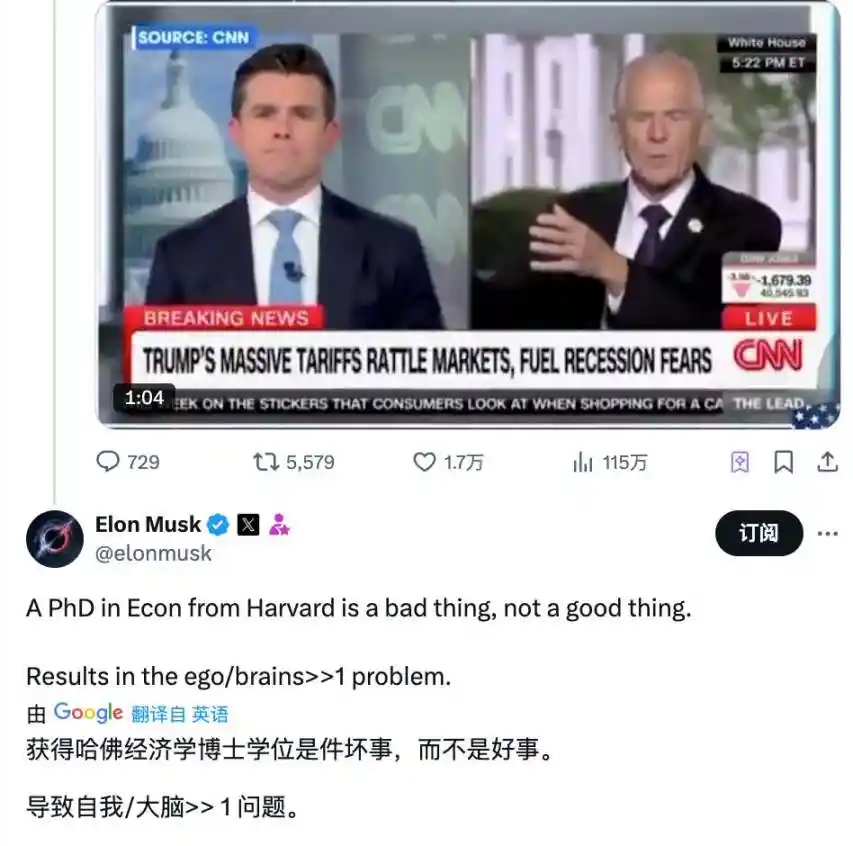
Who is this economist standing behind Trump? How has he driven this global tariff policy storm?
From the edge of academia to the decision-making core of the White House, Navarro's life intersects with Trump's protectionist ideology, perhaps jointly brewing this crisis.
From Academic to Political Outsider
Peter Navarro's story began on July 15, 1959, in a typical family in Cambridge, Massachusetts.
His father, Albert "Al" Navarro, was a saxophone and clarinet player, and his mother, Evelyn Littell John, was a secretary on Sax Fifth Avenue.
However, this family time was short-lived and tumultuous, as his parents divorced when he was 9 or 10, leaving Navarro and his mother to move between Palm Beach, Florida, and Bethesda, Maryland.
The experience of growing up in a single-parent household may have planted in him a desire for stability and self-reliance, which eventually blossomed when he completed his studies at Bethesda-Chevy Chase High School in Maryland.
In 1972, with an academic scholarship, Navarro entered Tufts University and earned a Bachelor's degree. That same year, he joined the Peace Corps and served in Thailand for three years. This experience exposed him to the complexity of the international community for the first time, possibly laying the groundwork for his later focus on global trade imbalances.
In 1979, he obtained a Master's in Public Administration from Harvard University, and then in 1986, under the guidance of the economics guru Richard E. Caves, he earned his Ph.D. Having obtained his degree, he chose to remain in academia and has been a professor of economics and public policy at the University of California, Irvine since 1989, eventually becoming a distinguished professor.
However, Navarro was not content to be just an academic. He ran for office five times, trying to put his ideas into practice.
In 1992, he ran for Mayor of San Diego, leading in the primary with 38.2% of the vote but narrowly losing in the runoff with 48%;
Subsequently, he ran for City Council, Board of Supervisors, and Congress, all ending in failure—receiving 41.9% of the vote in the 1996 Congressional election and only 7.85% in the 2001 special City Council election. These failures did not make him retreat but instead highlighted his perseverance and outsider qualities.
Throughout his campaign, he repeatedly emphasized economic protectionism and job priority, echoing what would later become Trump's "America First" policy, yet he failed to win the voters' favor at that time.
From a teenager from a single-parent family to a Harvard Ph.D. in economics, and then to a perennially unsuccessful political figure on the edge, Navarro's trajectory is full of contradictions.
He appears to be a meticulous scholar, yet he is also a radical activist; he has left a mark in academia while facing repeated setbacks in politics.
In the twists and turns between academia and politics, it seems that the seeds of trade protectionism and a tough stance on China were already planted.
The China Threat Theory Has Long Been Evident
From the moment Peter Navarro received his Ph.D. in economics from Harvard University, it was clear that he would not be content with the tranquility of the ivory tower.
His subsequent trajectory shows that this new Ph.D. has had a keen interest in the global economic landscape.
In 1989, when he joined the University of California, Irvine, Navarro began to transform his academic enthusiasm into sharp criticisms. His target was squarely aimed at an increasingly rising power—China.
What truly made him stand out was a series of works promoting the China threat theory.
In 2006, he published "The Coming China Wars," issuing almost prophetic warnings that China's economic expansion was not just commercial competition but a threat to the survival of American manufacturing.
The book revealed a kind of almost prejudiced stubbornness, such as "China's development is a threat to humanity, which will bring more conflict and destabilizing factors to the world."
At that time, many Amazon online reader reviews suspected the book of intentional sensationalism and alarmism.
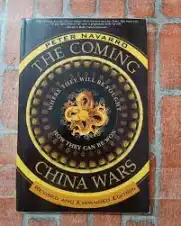
While this book did not resonate widely in the mainstream economic community, it stirred up ripples within certain conservative circles.
Five years later, in 2011, "Death by China" took Navarro's criticism to a climax. This book was not just an academic analysis but more like an indictment.
His radical accusations pointed to China systematically destroying the economic foundation of the United States through illegal export subsidies, production subsidies, currency manipulation, and intellectual property theft...
However, Navarro's views were not without controversy.
Mainstream economists, such as Simon Johnson of MIT, publicly criticized his analysis as "too one-sided, overlooking the complexity of the global supply chain"; and Navarro's strong language in the book, contrasting sharply with the generally perceived genteel academic image, also earned him the label of "eccentric" in the economics community.
However, Navarro, with over a decade of academic accumulation, constructed a set of trade confrontation theories aimed at China. The U.S. must reverse the trade deficit by forceful means to protect domestic industries. This theory also laid the groundwork for his future entry into Trump's decision-making circle.
His pen had long been pointing towards China, and fate would open a bigger door for him in 2016.
Gaining Trump's Son-in-law's Favor, Entering the Inner Circle
His book, "Death by China," did not cause a stir in the mainstream economic community but unexpectedly knocked on the door of the Trump campaign team.
Reportedly, in 2016, during Trump's campaign before his first term, his son-in-law, Jared Kushner, accidentally discovered it on Amazon, attracted by its sharp criticism of China's trade practices, and promptly recommended the book to Donald Trump.
Trump greatly appreciated the read and said, "This guy understands my thoughts."
Navarro later recalled that his role from the beginning was to "provide analytical support for Trump's trade intuition." With Trump's background as a businessman well-versed in trade, the two might have coincided at a fundamental logic level, and thus, fate was ignited.
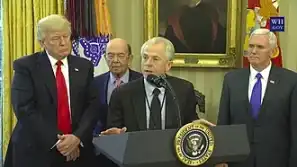
On January 20, 2017, the same day Trump was sworn in, Navarro officially entered the White House as the Director of the newly established National Trade Council.
His first task was unsurprising: against China. He promptly pushed for a 43% tariff on Chinese goods and spearheaded the policy of imposing a 25% additional tax on steel and aluminum imports.
When the U.S.-China trade war broke out in 2018, Navarro was ubiquitous. He declared at a White House briefing, "China must pay the price for its unfair trade."
That year, he also assisted in drafting Trump's tariffs on global steel and aluminum imports, leading directly to trade disputes with the EU and Canada. Navarro's toughness not only catered to Trump's "America First" agenda but also solidified his position in the White House.
However, Navarro's days in the inner circle were not without challenges.
In 2020, he published a report alleging election fraud and participated in the January 6, 2021, "Green Bay Sweep" plan, ultimately leading to a 4-month prison sentence in 2023 for contempt of Congress. Nevertheless, Trump's trust in him did not waver, even referring to him as a "loyal warrior" while in jail.
On January 20, 2025, Trump returned to the White House, with Navarro also returning as Senior Trade and Manufacturing Advisor. This time, his goals were more radical.
In February, he co-led tariff economic discussions with Canada, China, and Mexico alongside Stephen Miller, which drove the trade policy memorandum signed by Trump on his first day.
Navarro's spearheaded "Reciprocal Tariffs" plan — based on calculating additional tax rates based on trade deficits, such as 46% for Vietnam, 20% for the EU — became the cornerstone of the new policy. He defended this approach in an interview with CNBC: "These are not negotiation chips but essential items in a national emergency."
This stance is in line with his academic advocacy over a decade ago.
From a book in 2016 to the trade war strategist in 2025, Navarro's connection with Trump is no coincidence.
His protectionist ideology aligns with Trump's disdain for trade deficits; his tough personality perfectly matches Trump's policy style.
Despite controversies, and even a brief prison stint, Navarro has always been a key figure in Trump's trade war strategy. Transitioning from the academic fringe to the center of power, he relied not only on luck but also on his steadfast commitment to trade confrontation.
Opportunities multiply as they are seized
The culmination of Trump and Navarro's intersection is about to face its most severe test in the global market of 2025.
Returning to Navarro's initial statement, "You don't lose money if you don't sell stocks," does this unconventional economist truly understand the workings of the economy?
Navarro may be well-versed in tariff data but seems to have not grasped the essence of military strategy.
Sun Tzu's The Art of War states: "Opportunities multiply as they are seized; the city must be attacked only when victory is assured." The pinnacle is to subdue the enemy without fighting.
Our ancestors' wisdom emphasized winning through strategy and diplomacy, not direct conflict.
However, Navarro and Trump's tariff declaration of war is precisely the opposite — choosing direct confrontation, incurring a high economic cost in exchange for so-called "fairness."
This head-on approach not only failed to weaken the opponent but also put American businesses and consumers at the forefront. Economists estimate that 60% of tariffs on China will raise import prices, ultimately paid by the American people.
Reality is far from theoretical discussions.
Plunging the global economy into chaos. His role as the driving force is undisputed, but whether the cost of this war is worthwhile remains an unknown.
You may also like

Japan’s Three Megabanks Plan Joint Stablecoin Issuance in Fiscal 2026
MUFG, SMBC, and Mizuho reportedly plan to jointly issue fiat-pegged stablecoins in fiscal 2026, signaling Japan’s growing push into bank-led digital payment infrastructure.

Humanity Discloses H Token Dual-Chain Attack Details, With Losses on Ethereum and BSC Exceeding $36 Million
Humanity said the H token attack across Ethereum and BSC caused more than $36 million in losses after leaked ProxyAdmin keys enabled malicious contract upgrades and token minting.

White House Discusses CLARITY Act With Law Enforcement Ahead of Senate Vote
The White House discussed the CLARITY Act with law enforcement ahead of a Senate vote, focusing on illicit finance risks and developer protections.

$75 billion in foreign capital has fled, and South Korean retail investors have absorbed it all using leverage

Bitcoin Trading Guide 2026: Strategies for Experienced Traders

What Is XAUT and PAXG? Why Tokenized Gold Is Booming in 2026

Cryptocurrency CEXs are flocking to sell US stocks, and traditional brokerages are facing an "uninvited guest."

Will the SpaceX IPO Hurt Bitcoin? Here's What Traders Are Watching
Foreign selling in the South Korean stock market accelerates, with cumulative net sales reportedly reaching $75 billion this year
On June 9, The Kobeissi Letter, citing Goldman Sachs data, reported that global investors are selling South Korean stocks at an unusually rapid pace. In the latest trading session, foreign investors sold about $801 million worth of Kospi constituent stocks again; total foreign outflows last week reached about $10 billion, and the market has been in net foreign selling on nearly every trading day over the past month. According to the data cited in the report, foreign investors have sold about $75 billion worth of South Korean stocks so far this year. Meanwhile, South Korean retail and institutional investors together recorded roughly $69 billion in net buying over the same period, suggesting that the market’s main buying support has come from domestic capital rather than returning overseas funds. The information currently disclosed still mainly comes from The Kobeissi Letter’s retelling and Goldman Sachs data summaries, while public details on the statistical period and the specific definition of “selling” remain relatively limited.

Fortune Warns of Strategy’s Financing Structure Risks as Bitcoin Premium Narrows
Fortune warned that Strategy’s Bitcoin treasury model faces growing financing risks as MSTR’s net asset premium narrows and preferred stock dividend pressure increases.

Ferrari Challenge Le Mans: Carl Moon to Dominate in WEEX Livery

Sahara AI Responds to SAHARA’s Sharp Drop: No Contract or Product Security Issues Found, Internal Investigation Underway
Sahara AI responded to SAHARA’s 60% price drop, saying no token contract or product security issues have been found and an internal investigation is underway.

WEEX Deposit/Withdrawal Dynamic Island: Your Asset Status, Always in Sight
Scaling Crypto Derivatives: The Digital Asset Infrastructure Behind High-Volume Trading
In the fast-moving digital asset ecosystem, derivatives platforms face an extreme architectural test. High-leverage futures markets demand more than just standard security—they require absolute operational precision, zero-latency matching engines, and ironclad structural scalability, all while navigating intense market volatility.
As global platforms scale to meet these demands, the industry is shifting away from rigid, monolithic setups toward a more agile, "decoupled" infrastructure philosophy.
The Blueprint for High-Volume Copy TradingFor elite global exchanges like WEEX (founded in 2018), this architectural choice becomes critical when scaling high-volume retail features like social copy trading. When thousands of users automatically mirror the real-time strategies of elite traders simultaneously, it triggers sudden, monumental spikes in concurrent transactional volume.
To prevent execution latency or settlement bottlenecks during these peak volatility events, a platform's primary engine must remain entirely dedicated to risk management, copy-trade synchronization, and order matching.
The Architectural Rule: New-generation platforms must separate front-end user execution engines from heavy backend infrastructural overhead to eliminate operational friction.
By separating these layers, platforms can maintain complete sovereignty over their trading environments and user experiences while strategically aligning with institutional-grade infrastructure ecosystems. This strategic framework allows modern exchanges to leverage advanced Digital Asset Custody infrastructure such as Cobo’s behind the scenes, ensuring that backend wallet management scales elastically alongside trading spikes.
Capitalizing on Market Momentum and 400× LeverageIn a derivatives arena where platforms offer up to 400× leverage on perpetual contracts, capital efficiency and market agility are core business metrics. To capture market momentum, an exchange needs the ability to rapidly expand its asset offerings, supporting everything from legacy crypto assets to sudden, trending altcoins across a massive library of trading pairs.
Adopting a flexible, scalable Wallet-as-a-Service (WaaS) solution such as Cobo’s could completely rewrite the development timeline for high-growth exchanges. Instead of spending months of engineering capital building out custom backend wallet architectures for every new blockchain network, platforms can deploy localized infrastructure in days.
This agility allows platforms to instantly scale their listings to over a thousand trading pairs without compromising security or delaying time-to-market. It mirrors the exact operational advantages seen during high-velocity market events, similar to how advanced wallet infrastructure empowers platforms during sudden asset surges; allowing exchanges to pass that speed and liquidity directly to their global user base.
A Mature Foundation for GrowthThe synergy between trusted infrastructure ecosystems and global trading platforms represents the natural evolution of a maturing crypto market. As WEEX continues to scale its global spot and derivatives offerings for over 6 million users, adopting robust backend paradigms proves that platforms no longer have to compromise between cutting-edge trading velocity and uncompromised structural security.

Morning Report | BitMine increased its holdings by 126,971 ETH last week; trader Eugene announced his exit from the crypto market

Wang Chuan: How can one not feel anxious after the neighbor Old Wang made thirty times profit by investing in storage stocks? (Seven) - A quarter-century cycle

Get Paid to Onboard? Try WEEX’s New Homepage with Rewards for Registration, Deposit & Trade
WEEX Custom Layout: Build Your Perfect Trading Workspace in Seconds
Japan’s Three Megabanks Plan Joint Stablecoin Issuance in Fiscal 2026
MUFG, SMBC, and Mizuho reportedly plan to jointly issue fiat-pegged stablecoins in fiscal 2026, signaling Japan’s growing push into bank-led digital payment infrastructure.
Humanity Discloses H Token Dual-Chain Attack Details, With Losses on Ethereum and BSC Exceeding $36 Million
Humanity said the H token attack across Ethereum and BSC caused more than $36 million in losses after leaked ProxyAdmin keys enabled malicious contract upgrades and token minting.
White House Discusses CLARITY Act With Law Enforcement Ahead of Senate Vote
The White House discussed the CLARITY Act with law enforcement ahead of a Senate vote, focusing on illicit finance risks and developer protections.
$75 billion in foreign capital has fled, and South Korean retail investors have absorbed it all using leverage
Bitcoin Trading Guide 2026: Strategies for Experienced Traders
What Is XAUT and PAXG? Why Tokenized Gold Is Booming in 2026


