
The Trump Family Project WLFI Sells Off ETH at a Loss of Millions, How Many Chips Does It Still Hold?


Original Article Title: "The Behind-the-Scenes of WLFI's ETH Dump: Stop Loss or Another Scheme?"
Original Article Author: Luke, Mars Finance
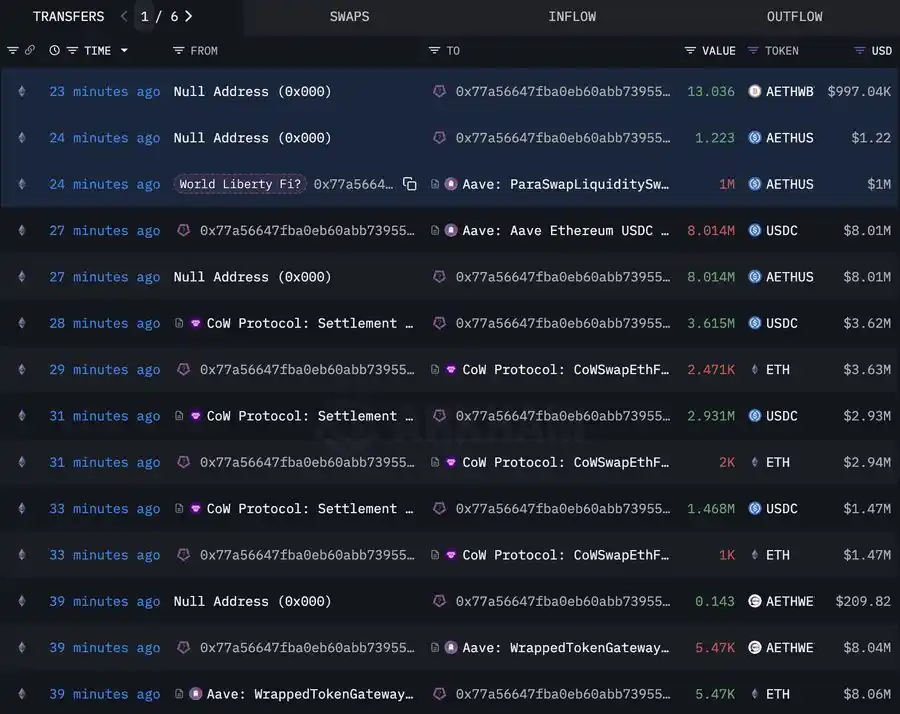
On April 9, 2025, a wallet allegedly linked to World Liberty Financial (WLFI) dumped 5,471 ETH at an average price of $1,465, cashing out approximately $8.01 million. This was no small matter—this wallet had previously splurged $210 million to accumulate 67,498 ETH at an average price of $3,259, now facing an unrealized loss of $125 million. As a DeFi star project endorsed by the Trump family, WLFI's move is puzzling: why liquidate at this critical moment? How much more ETH can be sold? Will there be more dumps in the future?
A Tough Decision in the Chilling Market
Currently, the crypto market seems to be shrouded in cold air, with ETH price fluctuating between $1,465 and $1,503, more than halving from WLFI's purchase price. Looking back to the beginning of 2025, the optimism brought by Trump's inauguration had prompted WLFI to significantly increase its ETH holdings, seemingly attempting to soar with the policy tailwind. Unfortunately, the good times did not last long, and the continued slump of ETH turned this enthusiasm into a massive $125 million unrealized loss. From $89 million in March to $125 million now, the snowball of losses keeps growing.
The timing of the sell-off is intriguing. On the same day, a whale scooped up 4,677 ETH at $1,481, intensifying the market's long vs. short game. WLFI's decision to act at this moment may indicate a sense of a short-term bottom or a fear of further price decline. Regardless, this $8.01 million cash-out is like selling an old coat in the winter—it's reluctant but inevitable.
Why Sell: Stop Loss or Another Plan?
Why did WLFI cut losses at this point? The answer may not be simple.
Firstly, the logic of stop-loss is obvious. With each ETH dropping by $1,794, selling 5,471 ETH may incur a near-million-dollar loss, but it's better than watching the remaining 62,027 ETH continue to depreciate. It's like cutting off a "deadbeat stock" in the stock market, securing cash first. After all, if fully liquidated at the current price, the loss would almost hit $111 million—who can bear that?
Furthermore, the pressure on cash flow cannot be ignored. WLFI basked in the glory of a $590 million token sale for a while, but expenses for operations, partnerships, and new projects will not stop. While $8.01 million may not be a lot, it can provide relief in a market downturn. Just think, a project backed by the Trump family surely cannot let its wallet run dry, right?
Moreover, this may be an attempt at a strategic pivot. WLFI's asset pool contains not only ETH but also "veterans" like WBTC, TRX, and "rising stars" in the RWA space. By reducing ETH holdings, freeing up funds to invest in partners like Ondo Finance or betting on the potential of Layer 2 could be a way to prepare for the future. After all, the stage of DeFi is large, and ETH is just one of the players.
Lastly, don't forget about external perception. As the "favorite son" of the Trump family, WLFI shines with prestige but also carries controversy. With 75% of profits in the whitepaper going to the family while risks are shifted to token holders, this model has long raised suspicions. Could this sell-off be due to investor pressure to prove that they are not solely relying on the "celebrity effect" to thrive? It's unlikely, but not entirely unreasonable.
Overall, stop-losses and liquidity are the most immediate driving forces, while strategic adjustments may hint at what's to come. As for external pressures, perhaps they are just the background music of this drama.
How Much More Can Be Sold: Trump Card and Bottom Line
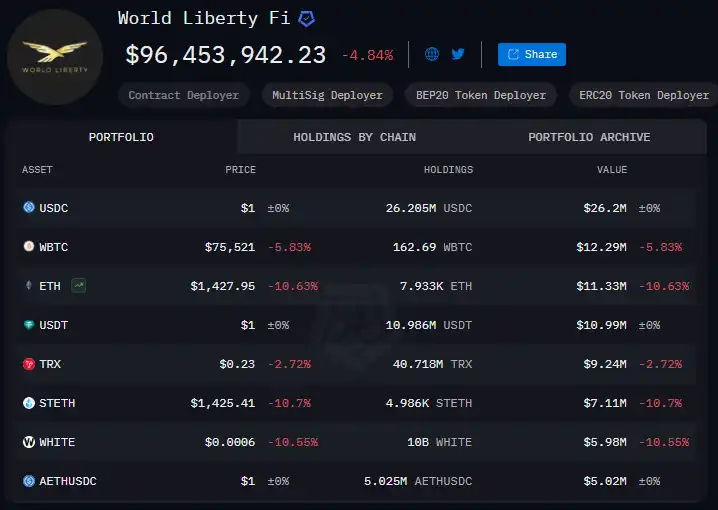
After selling 5,471 tokens, WLFI still holds 62,027 ETH, which is worth approximately $90.9 million at the current price. How much more can this trump card reveal?
From a funding perspective, if each sale targets around $8 million in cash flow, selling another approximately 5,000 tokens would suffice, leaving a "safety net" of $56 million in holdings. However, if there is a larger funding gap, such as for a new project launch or debt maturity, selling a few tens of thousands of tokens is not out of the question. However, doing this would undoubtedly raise doubts about ETH's core position.
The market's ability to handle this is also crucial. The recent $8.01 million sale did not cause much of a stir, and the daily trading volume of ETH at $5 billion seems able to absorb it. But if WLFI were to dump tens of millions of dollars' worth of assets in one go, panic could further drive down prices. For precaution, selling in small batches appears to be their style.
Much more crucial is the strategic bottom line. WLFI views ETH as a "strategic reserve," and if holdings drop below half (around 33.74 million tokens), its image as a DeFi leader may be at risk. Unless absolutely necessary, they are unlikely to easily deplete this reserve. In the short term, selling another 5,000 to 10,000 tokens (approximately $7.3 million to $14.65 million) is a reasonable estimate, both quenching thirst and avoiding harm.
Will the Sell-off Continue?
In the future, will WLFI continue to sell off? The answer lies within three key clues.
First, watch the market sentiment. If ETH drops below $1,400 and the unrealized losses increase by another one or two hundred million, the urge to sell off may be unstoppable. However, if the price rebounds to $1,800, and unrealized losses shrink to $90 million, they might hold onto their assets tightly, even regaining confidence to buy back. Currently, the $1,450 support level and $1,600 resistance level serve as indicators.
Second, internal calculations are also crucial. If WLFI still aims to play a leading role in the DeFi space, they cannot afford to see ETH's position heavily impacted. In this case, the sell-off may gradually slow down. However, if they set their sights on other trends, such as RWA or emerging tokens, ETH may become a "cash machine," accelerating the sell-off pace.
Third, external factors matter. The pro-crypto stance of the Trump administration acts as a shield for WLFI. If a significant move is made in the second quarter leading to market recovery, they might sit comfortably on the sidelines. Yet, if the family is caught up in political turmoil or investors demand transparency, the pressure to cash out will be inevitable.
In the short term (one to two months), there is a possibility of small-scale sell-offs, with the total amount ranging from $10 to $20 million. If the market continues to slump, a mid-term sell-off could account for 30% to 50% of the remaining holdings, totaling $27 to $45 million. Looking ahead, unless ETH stages a complete turnaround, WLFI may gradually fade from this field, moving their chips to a new battleground.
Ethereum Fundamental Transition: Why Are Whales Turning Bearish?
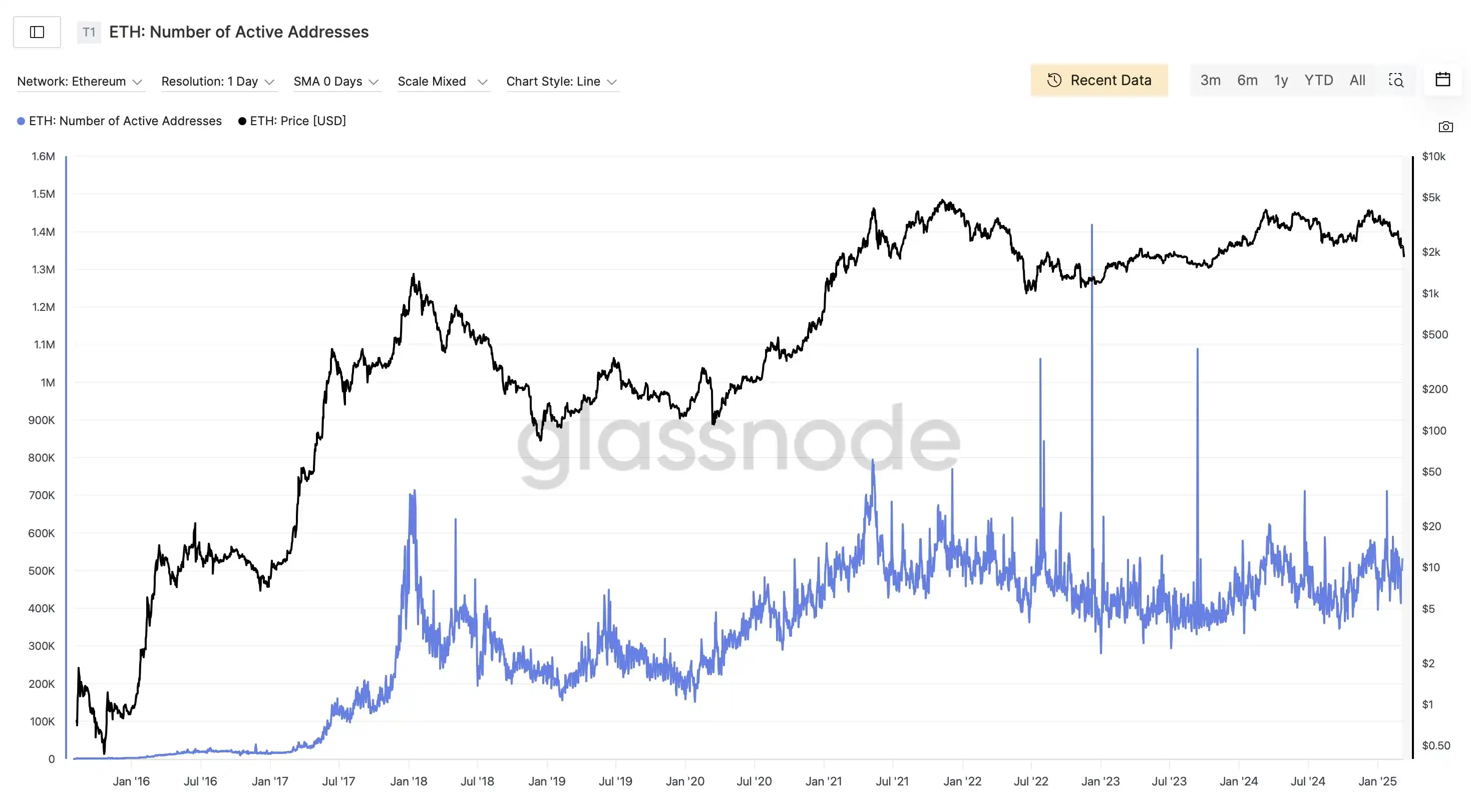
In recent years, Ethereum's fundamentals seem to be undergoing a quiet transition, which may be a crucial reason why whales are becoming pessimistic about ETH's future. Glassnode data shows that over the past four years, Ethereum's active address count has remained almost stagnant, hovering around the same level, failing to significantly grow alongside market trends. This is not the "efficiency range" of technical optimization but rather resembles a depletion of growth momentum, indicating Ethereum's fatigue in attracting new users and developers.
Meanwhile, the emergence of Layer 2 (L2) solutions was supposed to bring new vitality to Ethereum but unexpectedly weakened its value capture ability. L2 significantly reduced mainnet Gas fees by diverting transaction volume (Gas fees dropped over 70% in March 2025). While this is user-friendly, it allows L2 to intercept the value that was supposed to be fed back to ETH holders through the EIP-1559 burning mechanism, further squeezing Ethereum's "profit space." Some analyses suggest that unless the mainnet can revitalize its demand for block space through large-scale tokenization, Ethereum's long-term competitiveness may be at risk.
The perspective of institutions also reflects this concern. In a report, CoinShares pointed out that the frequent adjustments to the Ethereum protocol (such as the Dencun hard fork) have brought about uncertainty, hindering institutional investors from building reliable valuation models, thereby diminishing its attractiveness. In March 2025, Standard Chartered lowered its price target for Ethereum in 2025 to $4,000, citing structural decay as the reason.
Jon Charbonneau, Co-Founder of the crypto investment firm DBA, also stated that Ethereum's issuance model under the Proof of Stake (PoS) mechanism faces fundamental trade-off issues, with adjustment being difficult to resolve the core contradiction. On the X platform, some users even bluntly said that Ethereum has "barely changed since 2016," with upgrades being slow and missing the window for rapid transformation, seemingly becoming a "victim" of its own success.
Meanwhile, EigenLayer's Stakedrop event also left the market disappointed, as the narrative of enhancing ETH holding rewards through Restaking was shattered due to unfair distribution, further undermining the confidence of large holders. These signals collectively point to a reality: Ethereum's fundamentals are being eroded by internal and external factors, with its once growth engine now showing signs of fatigue, and the pessimism of large holders may indeed be a direct response to this trend.
Summary
This sell-off event not only revealed WLFI's struggle in the market downturn but also highlighted Ethereum's deeper predicament. The stagnant growth of active addresses, L2 value diversion, signals of institutional pessimism, all contribute to casting a shadow over Ethereum's fundamentals, with the confidence of large holders wavering. WLFI's next move, whether to continue selling or strategically pivot, will unfold in the dual game of markets and policies.
For investors, while chasing the hype may be enticing, a more composed judgment is needed: Can Ethereum's future be revitalized? Where will WLFI's bold gamble lead? The answer, perhaps, can only be revealed with time.
You may also like

Japan’s Three Megabanks Plan Joint Stablecoin Issuance in Fiscal 2026
MUFG, SMBC, and Mizuho reportedly plan to jointly issue fiat-pegged stablecoins in fiscal 2026, signaling Japan’s growing push into bank-led digital payment infrastructure.

Humanity Discloses H Token Dual-Chain Attack Details, With Losses on Ethereum and BSC Exceeding $36 Million
Humanity said the H token attack across Ethereum and BSC caused more than $36 million in losses after leaked ProxyAdmin keys enabled malicious contract upgrades and token minting.

White House Discusses CLARITY Act With Law Enforcement Ahead of Senate Vote
The White House discussed the CLARITY Act with law enforcement ahead of a Senate vote, focusing on illicit finance risks and developer protections.

$75 billion in foreign capital has fled, and South Korean retail investors have absorbed it all using leverage

Bitcoin Trading Guide 2026: Strategies for Experienced Traders

What Is XAUT and PAXG? Why Tokenized Gold Is Booming in 2026

Cryptocurrency CEXs are flocking to sell US stocks, and traditional brokerages are facing an "uninvited guest."

Will the SpaceX IPO Hurt Bitcoin? Here's What Traders Are Watching
Foreign selling in the South Korean stock market accelerates, with cumulative net sales reportedly reaching $75 billion this year
On June 9, The Kobeissi Letter, citing Goldman Sachs data, reported that global investors are selling South Korean stocks at an unusually rapid pace. In the latest trading session, foreign investors sold about $801 million worth of Kospi constituent stocks again; total foreign outflows last week reached about $10 billion, and the market has been in net foreign selling on nearly every trading day over the past month. According to the data cited in the report, foreign investors have sold about $75 billion worth of South Korean stocks so far this year. Meanwhile, South Korean retail and institutional investors together recorded roughly $69 billion in net buying over the same period, suggesting that the market’s main buying support has come from domestic capital rather than returning overseas funds. The information currently disclosed still mainly comes from The Kobeissi Letter’s retelling and Goldman Sachs data summaries, while public details on the statistical period and the specific definition of “selling” remain relatively limited.

Fortune Warns of Strategy’s Financing Structure Risks as Bitcoin Premium Narrows
Fortune warned that Strategy’s Bitcoin treasury model faces growing financing risks as MSTR’s net asset premium narrows and preferred stock dividend pressure increases.

Ferrari Challenge Le Mans: Carl Moon to Dominate in WEEX Livery

Sahara AI Responds to SAHARA’s Sharp Drop: No Contract or Product Security Issues Found, Internal Investigation Underway
Sahara AI responded to SAHARA’s 60% price drop, saying no token contract or product security issues have been found and an internal investigation is underway.

WEEX Deposit/Withdrawal Dynamic Island: Your Asset Status, Always in Sight
Scaling Crypto Derivatives: The Digital Asset Infrastructure Behind High-Volume Trading
In the fast-moving digital asset ecosystem, derivatives platforms face an extreme architectural test. High-leverage futures markets demand more than just standard security—they require absolute operational precision, zero-latency matching engines, and ironclad structural scalability, all while navigating intense market volatility.
As global platforms scale to meet these demands, the industry is shifting away from rigid, monolithic setups toward a more agile, "decoupled" infrastructure philosophy.
The Blueprint for High-Volume Copy TradingFor elite global exchanges like WEEX (founded in 2018), this architectural choice becomes critical when scaling high-volume retail features like social copy trading. When thousands of users automatically mirror the real-time strategies of elite traders simultaneously, it triggers sudden, monumental spikes in concurrent transactional volume.
To prevent execution latency or settlement bottlenecks during these peak volatility events, a platform's primary engine must remain entirely dedicated to risk management, copy-trade synchronization, and order matching.
The Architectural Rule: New-generation platforms must separate front-end user execution engines from heavy backend infrastructural overhead to eliminate operational friction.
By separating these layers, platforms can maintain complete sovereignty over their trading environments and user experiences while strategically aligning with institutional-grade infrastructure ecosystems. This strategic framework allows modern exchanges to leverage advanced Digital Asset Custody infrastructure such as Cobo’s behind the scenes, ensuring that backend wallet management scales elastically alongside trading spikes.
Capitalizing on Market Momentum and 400× LeverageIn a derivatives arena where platforms offer up to 400× leverage on perpetual contracts, capital efficiency and market agility are core business metrics. To capture market momentum, an exchange needs the ability to rapidly expand its asset offerings, supporting everything from legacy crypto assets to sudden, trending altcoins across a massive library of trading pairs.
Adopting a flexible, scalable Wallet-as-a-Service (WaaS) solution such as Cobo’s could completely rewrite the development timeline for high-growth exchanges. Instead of spending months of engineering capital building out custom backend wallet architectures for every new blockchain network, platforms can deploy localized infrastructure in days.
This agility allows platforms to instantly scale their listings to over a thousand trading pairs without compromising security or delaying time-to-market. It mirrors the exact operational advantages seen during high-velocity market events, similar to how advanced wallet infrastructure empowers platforms during sudden asset surges; allowing exchanges to pass that speed and liquidity directly to their global user base.
A Mature Foundation for GrowthThe synergy between trusted infrastructure ecosystems and global trading platforms represents the natural evolution of a maturing crypto market. As WEEX continues to scale its global spot and derivatives offerings for over 6 million users, adopting robust backend paradigms proves that platforms no longer have to compromise between cutting-edge trading velocity and uncompromised structural security.

Morning Report | BitMine increased its holdings by 126,971 ETH last week; trader Eugene announced his exit from the crypto market

Wang Chuan: How can one not feel anxious after the neighbor Old Wang made thirty times profit by investing in storage stocks? (Seven) - A quarter-century cycle

Get Paid to Onboard? Try WEEX’s New Homepage with Rewards for Registration, Deposit & Trade
WEEX Custom Layout: Build Your Perfect Trading Workspace in Seconds
Japan’s Three Megabanks Plan Joint Stablecoin Issuance in Fiscal 2026
MUFG, SMBC, and Mizuho reportedly plan to jointly issue fiat-pegged stablecoins in fiscal 2026, signaling Japan’s growing push into bank-led digital payment infrastructure.
Humanity Discloses H Token Dual-Chain Attack Details, With Losses on Ethereum and BSC Exceeding $36 Million
Humanity said the H token attack across Ethereum and BSC caused more than $36 million in losses after leaked ProxyAdmin keys enabled malicious contract upgrades and token minting.
White House Discusses CLARITY Act With Law Enforcement Ahead of Senate Vote
The White House discussed the CLARITY Act with law enforcement ahead of a Senate vote, focusing on illicit finance risks and developer protections.
$75 billion in foreign capital has fled, and South Korean retail investors have absorbed it all using leverage
Bitcoin Trading Guide 2026: Strategies for Experienced Traders
What Is XAUT and PAXG? Why Tokenized Gold Is Booming in 2026


