
The Tokenomics of the legendary game "MapleStory" Generation One has been revealed, perhaps the most anticipated blockchain game of the year.






After 2 years of waiting, the blockchain version of "MapleStory" (referred to as MSU) is finally entering public testing and its Token Generation Event (TGE). This is by far the most prestigious traditional game to enter the blockchain space, having been in operation for over 20 years, with total revenue exceeding $5 billion and a cumulative total of over 250 million players. (For more background on this game, please refer to: "Why did the classic game 'MapleStory+NFT,' with over 180 million registered players, choose to go on-chain?")

Last week, the MSU team released the whitepaper for the in-game token $NXPC, detailing the game economy of the blockchain version of "MapleStory." This article will elaborate on the whitepaper content, so let's take a look at how this top-tier traditional MMORPG is designing a Web3 game economy.
1 Asset, 3 Different Forms
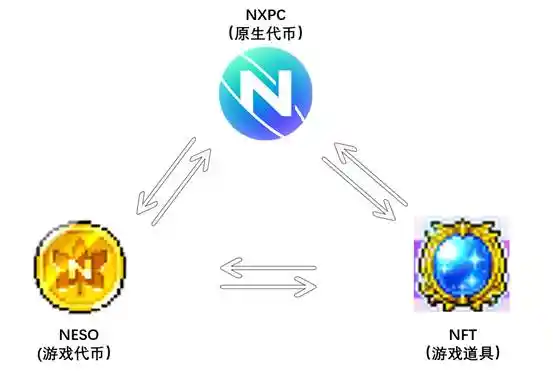
The MSU economy consists of $NXPC, $NESO, and NFT, all of which can be exchanged bidirectionally.
$NXPC - This is both the native token used to pay for MSU Layer1 network gas fees and can be exchanged for $NESO or NFT.
$NESO - Used for various in-game functions (such as weapon enhancement) and can also be exchanged for $NXPC or used to purchase items in the official NFT marketplace.
NFT – In-game items like characters, equipment, and consumables will appear in the form of NFTs, which can be exchanged bidirectionally with $NXPC and traded with $NESO on the official marketplace.
This does not mean that the MSU adopts a dual-token or tri-token model. In fact, the entire economic mechanism is "1 asset with 3 different forms."
If we consider in-game items as a kind of "token," then in the original MapleStory and most MMORPGs, this "token" is somewhat akin to Ethereum—there is no capped supply, it rewards contributors (by dropping items from monsters in the game), and there are channels for burning (low-level items may be consumed through item synthesis, etc.).
The similarity also exists in that in-game items are subject to "network attacks," where the studio's intervention greatly accelerates the generation of in-game items, leading to severe item inflation.
In MSU, all assets originate from $NXPC. The in-game currency $NESO and $NXPC have a fixed exchange rate and can only be minted by exchanging $NXPC. All in-game items (NFTs), such as weapons, armor, and cosmetic items, in MSU are centrally managed by the official team and stored in the official "MSU Item Pool." These items require the use of $NXPC to enter circulation.
In the game, $NESO and in-game items (NFTs) do drop, but this does not mean they are independent assets; their source is also $NXPC:

NESO can only be minted by exchanging NXPC; due to the fixed exchange rate, the theoretical maximum supply of $NESO is the same as that of $NXPC

MapleStory N receives $NXPC as an ecological contribution reward and may exchange some $NXPC for NFTs as in-game rewards, which players can obtain through various in-game activities such as hunting monsters and bosses
It can be said that $NXPC is like liquid water, while $NESO is like ubiquitous water vapor, needed in all aspects of the game, especially in enhancing weapons to help players improve their combat power for better monster hunting, leveling up, and item acquisition in the game. NFTs, on the other hand, are like solid ice, with lower liquidity compared to FTs, and as weapons are enhanced, the prices of the same equipment may differ.
"$NXPC Splitting" and "Item Fusion"
The "$NXPC Splitting" mechanism refers to players being able to use $NXPC to exchange for in-game items (NFTs). This mechanism is similar to a FCFS (First-Come, First-Served) process of purchasing NFTs, where players do not exchange for a specific item but rather a fixed percentage of the maximum supply of all available item types remaining in the "MSU Item Pool."
The exchange rate between $NXPC and NFT will be fixed, and the rate will only increase when new items are introduced in future game updates and enter the "MSU Item Pool." Exchanging NFTs will not result in the destruction of $$NXPC.
The "Item Fusion" mechanism is somewhat like an NFT market having a Bid Pool. If a player wants to quickly sell their item (NFT), they can directly sell it to the pool. However, players do not choose the bid price themselves on the official market; instead, they receive their earnings in the in-game currency $NESO. The official system will fetch the corresponding item prices from the secondary market and determine how much $NXPC the player will receive based on the weighted average price's median.
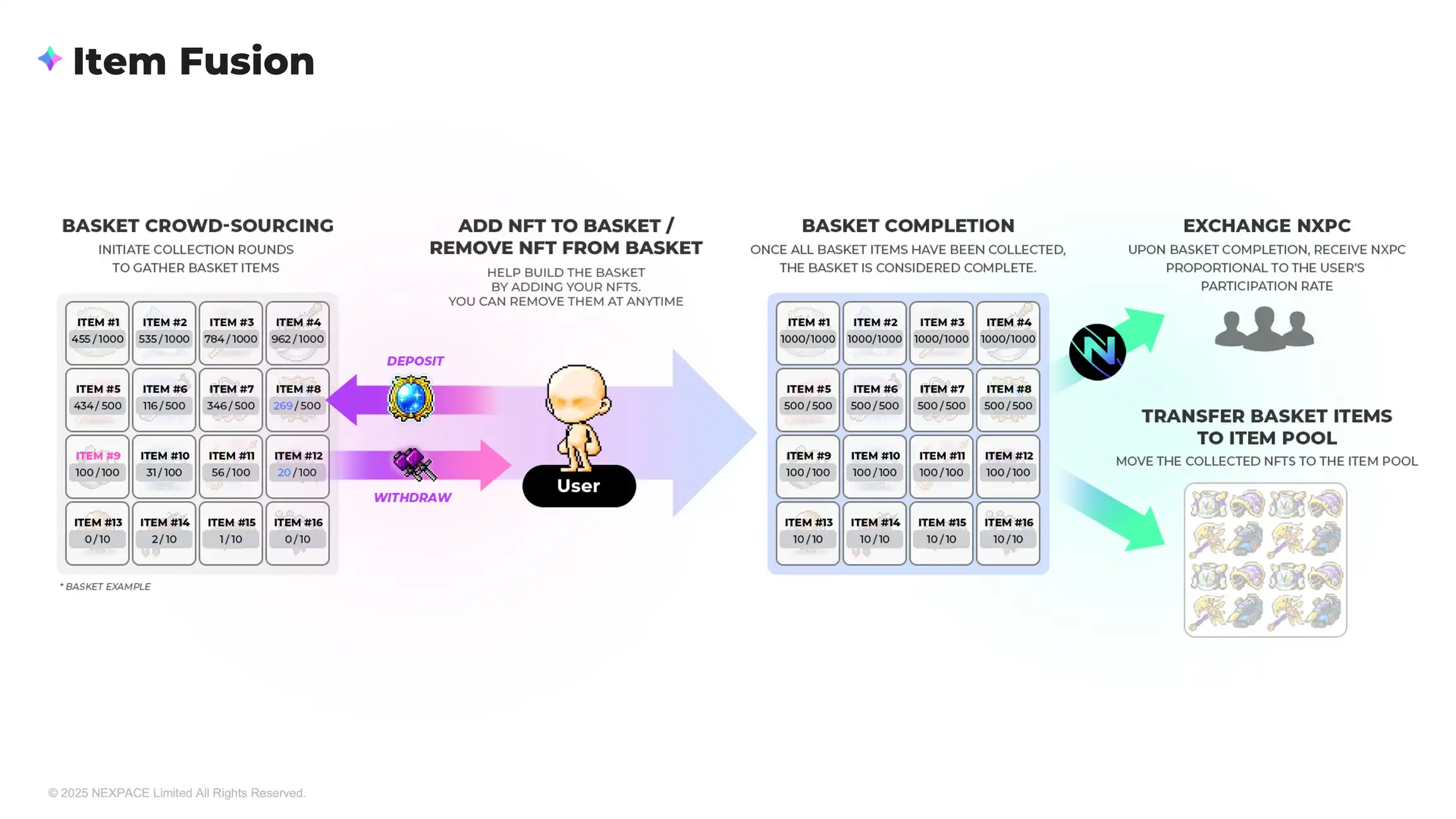
These two mechanisms make the whole game have a strong "GameFi" flavor. In fact, the blockchain version of MapleStory may not have an in-game store or a traditional "NX Cash Shop." Instead, there will be a unified consumption asset, $NXPC—either used for item exchange or converted to $NESO to purchase items on the official NFT market (this is more likely to occur with enhanced premium items with better attributes).
When using $NXPC to exchange items, players will be required to purchase items they do not need. This has the benefit of promoting overall item liquidity (such as items for unpopular classes, low-rarity items, and low-attribute items).
The ideal effect is a "left foot stepping on the right foot"—players use $NXPC to exchange items to enhance the efficiency of obtaining advanced items in the game -> $NXPC price rises -> Returns from "Item Fusion" (gold farming) increase -> More $NXPC buy orders reinvested in gold farming.
However, the expected downside is that the strong "GameFi" flavor may cause a certain degree of attenuation in the game's inherent fun and diversity. Because of the value anchor of $NXPC and the unique characteristics of blockchain users, even with special mechanisms like "NXPC Splitting" to avoid extreme hype around specific items and prevent most items from being worthless, players may still choose the easiest path to maximize $NXPC gains. Many maps, quests, and dungeons that offer low efficiency in terms of leveling or gameplay may be overlooked, affecting the game's diversity. If the "Item Fusion" mechanism is monopolized by the studio, it could likely lead to overall weak consumer spending in the game.
Nevertheless, from a gaming revenue perspective, this is indeed a very bold attempt. MapleStory, originally based its revenue on in-game sales of outfits, enhancement scrolls, and other in-game items to make money, but this blockchain version has no in-game purchases at all, with everything relying on the value of $NXPC. The in-game gold ($NESO) and items (NFTs) are also regulated by $NXPC.
$NXPC
The total supply of $NXPC is 1 billion tokens. 80% is allocated for MSU ecosystem contribution rewards. Of the remaining 20%, 16.317% is airdropped to the early community, 0.437% is used for liquidity providing, 0.15% is used for Gas fee exemption, and a total of 16.904% is fully unlocked at TGE.
Of the remaining 3.096%, 2% goes to the IP rights holder, 0.696% to the MSU team, both locked for 9 months and vested quarterly for 3 years after the lock-up period. 0.4% goes to advisors, locked for 12 months, with unlocking subject to project development progress.
Conclusion
Since the emergence of GameFi, the discussion about the blend of gaming and finance has never ceased. If a truly good game appears in the crypto space, will GameFi break out of its death spiral? This question, MapleStory may provide an answer through its performance.
Furthermore, as MapleStory is an MMORPG game that focuses more on social fun> exploration fun (solely personal opinion), when the audience shifts to one primarily in the crypto space (blockchain special edition), will the game's social fun and the resulting strong virality through community-driven growth change? This question equally makes me very curious and looking forward to it.
But undoubtedly, this is indeed a good game that can make the crypto space happier.
You may also like

Mastercard Launches Agent Pay for AI, Plans to Record AI Agent Payment Authorizations on Polygon
Mastercard launched Agent Pay for AI, a new payment protocol designed to help AI agents make small payments such as pay-per-use access to data and APIs. The system plans to record human-granted AI agent permissions on Polygon, focusing on verifiable authorization, identity, and payment controls.

Curve Deploys Llamalend v2 on Optimism With 250,000 OP Incentives
Curve launched Llamalend v2 on Optimism with 250,000 OP incentives from the Optimism Foundation. The upgrade expands Llamalend beyond its earlier crvUSD-focused model, adding broader collateral support, LlamaRisk market reviews, and the ability to use Curve LP tokens as collateral.

Raydium Old Liquidity Pool Reportedly Exploited, With $1.34 Million Moved to Ethereum and Tornado Cash
An old Raydium liquidity pool was reportedly exploited for around $1.34 million in USDC, RAY, and wSOL, with the stolen funds bridged to Ethereum and deposited into Tornado Cash. The incident highlights the tail risks of legacy DeFi pools, old contracts, and cross-chain fund laundering paths.

Kalshi Executive Challenges “SBF Backed AI Unicorns” Narrative, Says Leopold Aschenbrenner Was Key Figure
Kalshi executive John Wang questioned the “SBF backed AI unicorns” narrative, saying Leopold Aschenbrenner was the key figure behind major AI investment decisions.

Pantera Capital Partner: How Tokenization is Restructuring the Private Equity and Early Investment Ecosystem?

New York Proposes Stricter Stablecoin Issuer Rules Aligned With Federal GENIUS Act
NYDFS proposed stricter stablecoin issuer rules aligned with the GENIUS Act, covering reserves, custody, redemption timelines, audits, and capital buffers.
Every exchange is a "Universal Exchange."

The counterattack of traditional finance: Alliance chains are quietly reviving

CryptoQuant Says Bitcoin Profitable Supply Is Near 45% Pressure Zone as On-Chain Data Points to Market Repricing
CryptoQuant said Bitcoin’s profitable supply is nearing the 45% pressure zone, signaling rising market stress, unrealized losses, and a possible on-chain repricing phase.

Bitcoin Falls Below 200-Week Moving Average as On-Chain Data Shows Over Half of Supply in Loss
Bitcoin dropped below its 200-week moving average as on-chain data showed over 50% of circulating supply is now in loss, signaling rising market stress.

CFTC Reportedly Plans New Prediction Market Rules Focused on Manipulation Risk and Public Interest Review
The CFTC is reportedly preparing new prediction market rules focused on manipulation risk, public interest review, and retail trader protections.

Meet the new WEEX trial fund—your gateway to greater profits

WEEX Labs Lands at Dutch Blockchain Week: A Disruptive Crypto × AI Conversation Sets Sail in Amsterdam
SK Hynix Reportedly Plans U.S. ADR Listing as Early as August, With SEC Approval Possible in Late June
SK Hynix may pursue a U.S. ADR listing as early as August, with SEC approval reportedly possible in late June amid strong AI chip supply chain demand.

SpaceX vs Tesla vs xAI: Which Elon Musk Trade Has the Biggest Upside in 2026?
OpenAI Reveals It Has Confidentially Submitted an S-1 to the SEC, Keeping the Door Open for a Future IPO
On June 9, according to an OpenAI announcement, the company recently confidentially submitted a draft S-1 registration statement to the U.S. Securities and Exchange Commission (SEC), beginning the preliminary compliance process for a potential initial public offering. OpenAI said it chose to disclose this proactively because it expected the news might leak; however, the company has not yet set a specific listing timeline, and related arrangements may still take some time.
Latest research from 13 top universities including Cornell University: The current state, challenges, and misconceptions of the fusion of Crypto and AI
Deconstructing Anthropic: The Best AI Company, Possibly Also a Type of Organizational Invention
Mastercard Launches Agent Pay for AI, Plans to Record AI Agent Payment Authorizations on Polygon
Mastercard launched Agent Pay for AI, a new payment protocol designed to help AI agents make small payments such as pay-per-use access to data and APIs. The system plans to record human-granted AI agent permissions on Polygon, focusing on verifiable authorization, identity, and payment controls.
Curve Deploys Llamalend v2 on Optimism With 250,000 OP Incentives
Curve launched Llamalend v2 on Optimism with 250,000 OP incentives from the Optimism Foundation. The upgrade expands Llamalend beyond its earlier crvUSD-focused model, adding broader collateral support, LlamaRisk market reviews, and the ability to use Curve LP tokens as collateral.
Raydium Old Liquidity Pool Reportedly Exploited, With $1.34 Million Moved to Ethereum and Tornado Cash
An old Raydium liquidity pool was reportedly exploited for around $1.34 million in USDC, RAY, and wSOL, with the stolen funds bridged to Ethereum and deposited into Tornado Cash. The incident highlights the tail risks of legacy DeFi pools, old contracts, and cross-chain fund laundering paths.
Kalshi Executive Challenges “SBF Backed AI Unicorns” Narrative, Says Leopold Aschenbrenner Was Key Figure
Kalshi executive John Wang questioned the “SBF backed AI unicorns” narrative, saying Leopold Aschenbrenner was the key figure behind major AI investment decisions.
Pantera Capital Partner: How Tokenization is Restructuring the Private Equity and Early Investment Ecosystem?
New York Proposes Stricter Stablecoin Issuer Rules Aligned With Federal GENIUS Act
NYDFS proposed stricter stablecoin issuer rules aligned with the GENIUS Act, covering reserves, custody, redemption timelines, audits, and capital buffers.


