
Stablecoins Driving Global B2B Payment Innovation: How to Break Through Workflow Bottlenecks and Unlock Trillion-Dollar Market Potential?


Original Article Title: Stablecoin B2B Payment is all about Workflows, not Payment itself
Original Article Author: @DeFi_Cheetah
Original Article Translation: zhouzhou, BlockBeats
Editor's Note: This article emphasizes that the main obstacle to cross-border B2B payments is not the payment itself, but the incomplete workflow, including issues such as data management, regulatory complexity, taxation, and approval chains. While stablecoins can improve payment execution, they alone cannot solve complex workflows. Truly successful projects should integrate stablecoins through automated processes, optimize workflows, enhance transparency, reduce errors, and achieve efficient and compliant global payments. This comprehensive approach will drive the development of the global payment business and create significant market opportunities.
The following is the original content (reorganized for better readability):
B2B payment systems are often seen as simply pressing the "send" button to move funds from one entity to another. Many stablecoin projects approach this with a focus on improving transaction channels—such as checks, wire transfers, or digital transfers—but overlook the crucial, domain-specific processes before and after the transfer. In reality:
B2B payments are the end result of extensive workflows, most of which focus on data validation, compliance or regulatory steps, and multi-party approvals before funds can be transferred.
The gap between the notion of "we just need to pay someone" and the reality of "we must first confirm multiple contracts and operational details" becomes particularly evident in cross-border transactions, where unique legal frameworks, local tax regulations, and exchange rate fluctuations escalate the operational complexity. In fact, digital assets—especially stablecoins (like @hadickM)—are increasingly intersecting with these workflows, and when combined with robust workflow automation, they could provide a potential simplification path for fund flows.
This article aims to argue that the introduction of stablecoins should not be seen merely as an efficiency improvement at the "payment execution" level; instead, it must be integrated into a workflow-centric solution to unlock the trillion-dollar opportunity as per @PanteraCapital's statement. I believe the most valuable layer in the stablecoin payment stack is the orchestration layer, as mentioned by @robbiepetersen_, which can streamline complex workflows and cover as many regions as possible.
Hierarchy of Needs for B2B Payments
A useful conceptual tool is to view B2B payments as a hierarchical "Hierarchy of Needs." These levels include:
· Data Collection and Invoice Management
B2B transactions typically involve aggregating supplier information, parsing invoices, and reconciling them with purchase orders or delivery records.
· Compliance and Regulatory Checks
Companies must verify that suppliers comply with local or international regulations, including KYC (Know Your Customer) and AML (Anti-Money Laundering) requirements.
· Tax Reconciliation
Determining the correct local and cross-border tax obligations—such as withholding tax or value-added tax—can be highly complex, especially when transporting goods across borders.
· Approval and Audit
Many organizations require multi-level approval chains. Audit trails of approvals and real-time visibility further complicate the workflow.
· Payment Execution
The final transfer of funds—traditionally done through checks, ACH, wire transfers, or other channels—sits atop this structure.
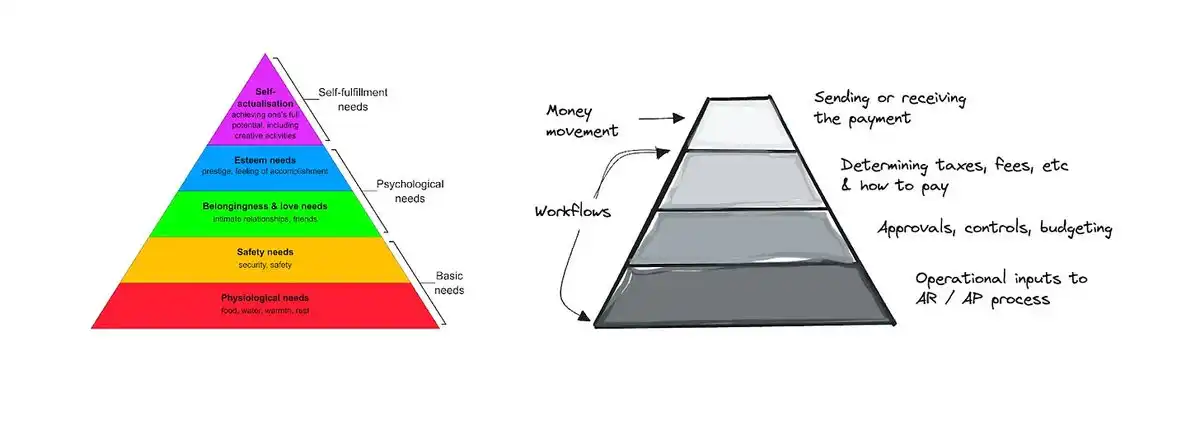
By recognizing that payment execution relies on each link in its underlying levels, solution providers can design comprehensive systems that address all stages, thereby avoiding failures or delays due to inadequate data tracking, non-compliance, or incomplete approval chains.
Cross-Border Payment Workflow: Some Real Bottlenecks
Cross-border B2B payments amplify the challenges present in domestic payment environments:
1. Regulatory Complexity
Each jurisdiction has unique requirements for foreign exchange transactions, involving not only AML/KYC but often specific documents related to trade law and customs.
2. Detailed Tax Obligations
From import duties to value-added tax, cross-border transactions require precise tracking, sometimes necessitating the apportionment of tax responsibilities across multiple parties in different regions.
3. Extended Approval Hierarchies
Subsidiaries and parent companies often have complex signing processes. Any mismatches in local compliance, product classification, or documentation may result in payment delays.
In many cases, these complexities serve as greater barriers to timely and accurate payments than friction within the payment channels themselves.
Industry Example Illustration
Freight and Logistics: Freight Audit and Others
Background: In freight and logistics, multiple carriers charge for transportation, loading/unloading, surcharges, and even fines for early/late arrivals. Fluctuating fuel costs, complex multi-leg shipping arrangements can result in very intricate invoices.
Workflow Pain Point: The core challenge is not pressing the "Pay to Trucking Company" button, but rather how to reliably match these expenses with the agreement, validate that the product weight and shipping distance are correctly calculated, and consider potential exceptions.
Why It Matters: Solely focusing on a seamless payment interface in B2B payment solutions overlooks the larger issue of validating invoice details—this step is typically still managed by large teams or outsourced Business Process Outsourcing (BPO) companies. A better approach is to integrate with shipping documents, track changes in plans or goods, and discover invoice errors before payment.
Real-World Example: Loop first focuses on auditing and workflow logic before adding payment functionality. Another example could be an AI solution that automatically scans and parses shipping documents, pushes exceptions to a queue, and only then unlocks the payment mechanism.
Construction and Upstream Supply Chain
Background: Construction projects involve multiple layers of suppliers (from lumber, cement to electrical and mechanical subsystems). Tax burdens vary by region and project type.
Workflow Pain Point: Contractors not only need to pay for "50 cubic yards of concrete" but also need to confirm that this purchase is related to a specific project or permit, apply the correct local taxes, and confirm that the purchase is authorized under the correct work code.
Why It's Important: Merely speeding up transactions—a tool without capturing or automating these approvals—does not solve the larger puzzle. Automating these checks, integrating with building permits, coordinating subcontractor budgets, and simplifying partial deliveries in a B2B solution can bring more lasting value to end-users.
Real-World Example: Nickel integrates with a tax computation engine, managing the complexity of different tax rates on the same item depending on usage, buyer classification, and location. Other vendors may embed material usage forms and generate compliance documents before triggering any payment.
Fuel Card and Expense Management
Background: Fleet management involving trucks, cars, equipment, or company vehicles entails controlling significant operational expenses.
Workflow Pain Point: Fuel is a clear expense, but drivers are equally prone to spending on non-category items (such as snacks, personal fuel, or company-unapproved items). Therefore, control and visualization are more important than just "paying for fuel."
Why It Matters: Tools like Wex, Fleetcor, Mudflap, AtoB, and Coast effectively combine purchase transactions with real-time policy controls, enabling supervisors to see if drivers are purchasing non-fleet-related items—and optimize choosing cheaper gas stations.
Real-World Example: One solution may integrate in-vehicle communication and route optimization software, detect anomalies in mileage or fuel consumption, flag suspicious purchase behavior, and only allow transaction flow once the relevant approvals or checks pass.
Vendor Management and Invoice Approval
Background: Large companies may have thousands of vendors with invoices in various formats—some digital, some in PDF, and even some in paper form.
Workflow Pain Points: The accounts payable team must ensure each invoice is valid, non-duplicate, allocated to the correct budget code, and compliant with relevant vendor agreements.
Why It's Important: The "payment" step might be the simplest part—just cut a check or send an ACH. But verifying if a $3500 invoice is correct or if $100 is an overcharge can consume a lot of manual work.
Real-World Example: Solutions like Tipalti, Coupa, or SAP Concur embed invoice receipt, expense management, and vendor onboarding processes. They transform messy data into standardized entries, allow multi-level approvals, handle necessary currency conversions, and only trigger fund release afterward.
Sales Commission on a SaaS Platform
Background: SaaS companies typically set up complex commission structures for their sales teams, with different percentages and bonuses based on product type, region, or subscription tier.
Workflow Pain Points: Calculating and verifying each commission can be more intricate than issuing a bonus check to a salesperson. Discrepancies can lead to disputes and dissatisfaction.
Why It's Important: Automating a correct and transparent commission structure requires a robust system that integrates with CRM data, tracks subscription usage or expansion, and considers allocations among multiple sales reps.
Real-World Example: Platforms like CaptivateIQ or Spiff focus on addressing data and workflow challenges in commission calculation. By the time payment preparation is complete, the system has streamlined vast amounts of data and handled exceptions automatically, avoiding error-prone spreadsheets.
Integrating Stablecoin Payments into Workflows for Enhanced Efficiency
While traditional payment methods (such as checks, ACH, SWIFT) can be slow and costly, especially in cross-border payments, stablecoins have emerged as a robust alternative for settlement in digital payments. Here are some key considerations (as mentioned by @proofofnathan):
Reduced Settlement Times
Stablecoins can offer near-instant settlement, bypassing the multiple intermediary banks typically involved in cross-border transfers. This feature is particularly advantageous in workflows where all operational conditions have been met and approvals are in place, helping prevent unnecessary payment delays.
Automated Compliance Checks
Workflow platforms integrated with stablecoin transfers can be designed to initiate on-chain payments only when specific smart contract conditions are met—such as supplier identity verification, compliance document clearance, or proof of delivery. This automated compliance process reduces manual intervention and errors.
Transparent Forex Management
In many stablecoin arrangements, assets are usually pegged to a major currency (such as the US dollar), reducing the impact of exchange rate fluctuations. This transparency can simplify payment reconciliation and accounting. Furthermore, integrating stablecoin payment channels with advanced workflows can automatically convert stablecoins to local currency for the final recipient's use, reducing the complexity of manual financial management.
Micro-Transaction Cost Savings
If a B2B transaction involves cross-border small periodic payments—such as paying a micro-invoice to an overseas contractor—stablecoins can reduce fixed transaction costs. A workflow-based approach can bundle or schedule these payments to optimize gas fees or network costs on certain blockchain infrastructures.
Expanded Value-Added Services
Once a company integrates stablecoins into its payment workflows, new opportunities become feasible. For example, features such as instant financing support, real-time invoice discounting, or embedded dynamic discounts can all be encoded in workflows. Stablecoin-based systems can facilitate these functions with minimal friction.
Advantages of Workflow-Centric Strategies in Cross-Border Payments
Enhanced Transparency and Auditability
By emphasizing documented automated approvals, organizations ensure thorough traceability of every step from KYC and AML checks to contract matching. This process reduces disputes and compliance risks.
Minimization of Manual Touchpoints
Human oversight at each stage can lead to delays and errors. Adopting an end-to-end workflow approach—potentially settled via stablecoin at the final stage—automates and simplifies interactions, significantly reducing the overall cycle time.
Scalable Solutions for Global Expansion
Companies relying on ad-hoc cross-border payment methods often struggle to expand their business. In contrast, workflow platforms integrated with stablecoin payment channels and dynamic compliance management enable quicker and more cost-effective entry into new markets.
Bundled Value Proposition
Companies that solely offer payment functions have limited differentiation. Those able to handle documents, compliance burdens, and payment flows on a single integrated platform will become indispensable partners to clients, ensuring more stable, profitable business relationships.
Conclusion
While the traditional view mainly considers B2B payments as an efficient fund transfer issue, the true barrier to cross-border payment efficiency lies in imperfect or incomplete workflows.
These limitations stem from fragmented data management, complex regulatory requirements, extended approval workflows, and ambiguous tax obligations. While many stablecoin projects aim to improve existing payment channels, stablecoins themselves cannot address these multifaceted workflow issues.
While these stablecoin projects position themselves as the payment execution layer, I believe that adopting a systematic, workflow-centric mindset to address these foundational issues and achieve a project for faster, more transparent, and less error-prone global payments is what will make winners take the largest share in the payment market.
These projects need to build robust tools, embed thorough automation processes, validate supplier qualifications, reconcile invoices, manage taxes, and conduct multi-level approvals.
Belonging to a trillion-dollar opportunity are those projects that take a holistic approach—optimizing workflow orchestration and leveraging stablecoin efficiency. They can not only provide faster and more cost-effective international payment services but also seamlessly integrate compliance, taxation, and documentation requirements.
This synergistic effect not only enhances day-to-day payment operations but also enables companies to explore emerging markets, launch new financial products, and create enduring competitive differentiation in the global B2B finance space.
You may also like

Morning Report | OpenAI has submitted an S-1 registration statement draft to the U.S. SEC; Morpho completes $175 million financing

Galaxy Deep Research Report: How Hyperliquid's HIP-4 Upgrade Changes the Landscape of Prediction Markets?

Latest research from 13 top universities including Cornell University: The current state, challenges, and misconceptions of the fusion of Crypto and AI

Deconstructing Anthropic: The Best AI Company, Possibly Also a Type of Organizational Invention

Every exchange is a "Universal Exchange."

The counterattack of traditional finance: Alliance chains are quietly reviving
Pantera Capital Partner: How Tokenization is Restructuring the Private Equity and Early Investment Ecosystem?

Mastercard Launches Agent Pay for AI, Plans to Record AI Agent Payment Authorizations on Polygon
Mastercard launched Agent Pay for AI, a new payment protocol designed to help AI agents make small payments such as pay-per-use access to data and APIs. The system plans to record human-granted AI agent permissions on Polygon, focusing on verifiable authorization, identity, and payment controls.

Curve Deploys Llamalend v2 on Optimism With 250,000 OP Incentives
Curve launched Llamalend v2 on Optimism with 250,000 OP incentives from the Optimism Foundation. The upgrade expands Llamalend beyond its earlier crvUSD-focused model, adding broader collateral support, LlamaRisk market reviews, and the ability to use Curve LP tokens as collateral.

Raydium Old Liquidity Pool Reportedly Exploited, With $1.34 Million Moved to Ethereum and Tornado Cash
An old Raydium liquidity pool was reportedly exploited for around $1.34 million in USDC, RAY, and wSOL, with the stolen funds bridged to Ethereum and deposited into Tornado Cash. The incident highlights the tail risks of legacy DeFi pools, old contracts, and cross-chain fund laundering paths.
Kalshi Executive Challenges “SBF Backed AI Unicorns” Narrative, Says Leopold Aschenbrenner Was Key Figure
Kalshi executive John Wang questioned the “SBF backed AI unicorns” narrative, saying Leopold Aschenbrenner was the key figure behind major AI investment decisions.

New York Proposes Stricter Stablecoin Issuer Rules Aligned With Federal GENIUS Act
NYDFS proposed stricter stablecoin issuer rules aligned with the GENIUS Act, covering reserves, custody, redemption timelines, audits, and capital buffers.

CryptoQuant Says Bitcoin Profitable Supply Is Near 45% Pressure Zone as On-Chain Data Points to Market Repricing
CryptoQuant said Bitcoin’s profitable supply is nearing the 45% pressure zone, signaling rising market stress, unrealized losses, and a possible on-chain repricing phase.

Bitcoin Falls Below 200-Week Moving Average as On-Chain Data Shows Over Half of Supply in Loss
Bitcoin dropped below its 200-week moving average as on-chain data showed over 50% of circulating supply is now in loss, signaling rising market stress.

CFTC Reportedly Plans New Prediction Market Rules Focused on Manipulation Risk and Public Interest Review
The CFTC is reportedly preparing new prediction market rules focused on manipulation risk, public interest review, and retail trader protections.

Meet the new WEEX trial fund—your gateway to greater profits

WEEX Labs Lands at Dutch Blockchain Week: A Disruptive Crypto × AI Conversation Sets Sail in Amsterdam
SK Hynix Reportedly Plans U.S. ADR Listing as Early as August, With SEC Approval Possible in Late June
SK Hynix may pursue a U.S. ADR listing as early as August, with SEC approval reportedly possible in late June amid strong AI chip supply chain demand.
Morning Report | OpenAI has submitted an S-1 registration statement draft to the U.S. SEC; Morpho completes $175 million financing
Galaxy Deep Research Report: How Hyperliquid's HIP-4 Upgrade Changes the Landscape of Prediction Markets?
Latest research from 13 top universities including Cornell University: The current state, challenges, and misconceptions of the fusion of Crypto and AI
Deconstructing Anthropic: The Best AI Company, Possibly Also a Type of Organizational Invention
Every exchange is a "Universal Exchange."
The counterattack of traditional finance: Alliance chains are quietly reviving


