
Roam Enterprise eSIM Launched, All-in-One Back Office System, Global Roaming Costs Reduced by Up to 80%

Article Source: Roam

Roam has officially launched its Enterprise eSIM Plan, providing a seamless, efficient, and flexible global data connectivity solution for international teams, especially Web3 industry professionals. Enterprise users can enjoy local data plans in over 180 countries worldwide with no roaming fees, easy setup process, no physical SIM card swapping required, and up to an 80% reduction in global roaming costs. The Roam Enterprise eSIM caters perfectly to distributed workforces, international enterprises, and particularly the Web3 industry, fulfilling the communication needs for remote collaboration and global conferences. Compared to traditional international roaming plans, the Roam Enterprise eSIM offers a more cost-effective and flexible connectivity solution, delivering an outstanding global communication experience for enterprise users.
All-in-One Back-end Management System to Help Enterprise Users Achieve Cost Efficiency
For highly efficient international teams constantly moving between countries while needing to stay connected online, the inconvenience of swapping SIM cards, activating new international roaming plans, and bearing high roaming charges often hinders productivity due to the limitations of traditional international roaming services. Global communication urgently requires a unified data connectivity solution to ensure that users can seamlessly switch to local data and pricing wherever they are in the world, eliminating the hassle of frequent card swapping and enjoying universal data usage with no roaming fees. This is the core problem that the Roam Enterprise eSIM is dedicated to solving.
The Roam Enterprise eSIM Plan offers enterprise users high-speed data network connectivity in over 180 countries globally without the need for a physical SIM card. The setup is simple, with one-click activation that connects instantly upon arrival, completely eliminating high roaming charges and issues like expired data. It is flexible to adapt to various work scenarios. Unlike traditional data plan retailers, Roam provides enterprises with a unified back-end management account where managers can have real-time visibility of the account balance and can flexibly allocate budget caps based on employee travel destinations, trip durations, and work schedules. The enterprise-level back-end management system also supports customized member access. Through this unified data usage management solution, enterprises can achieve effective budget management and cost control.
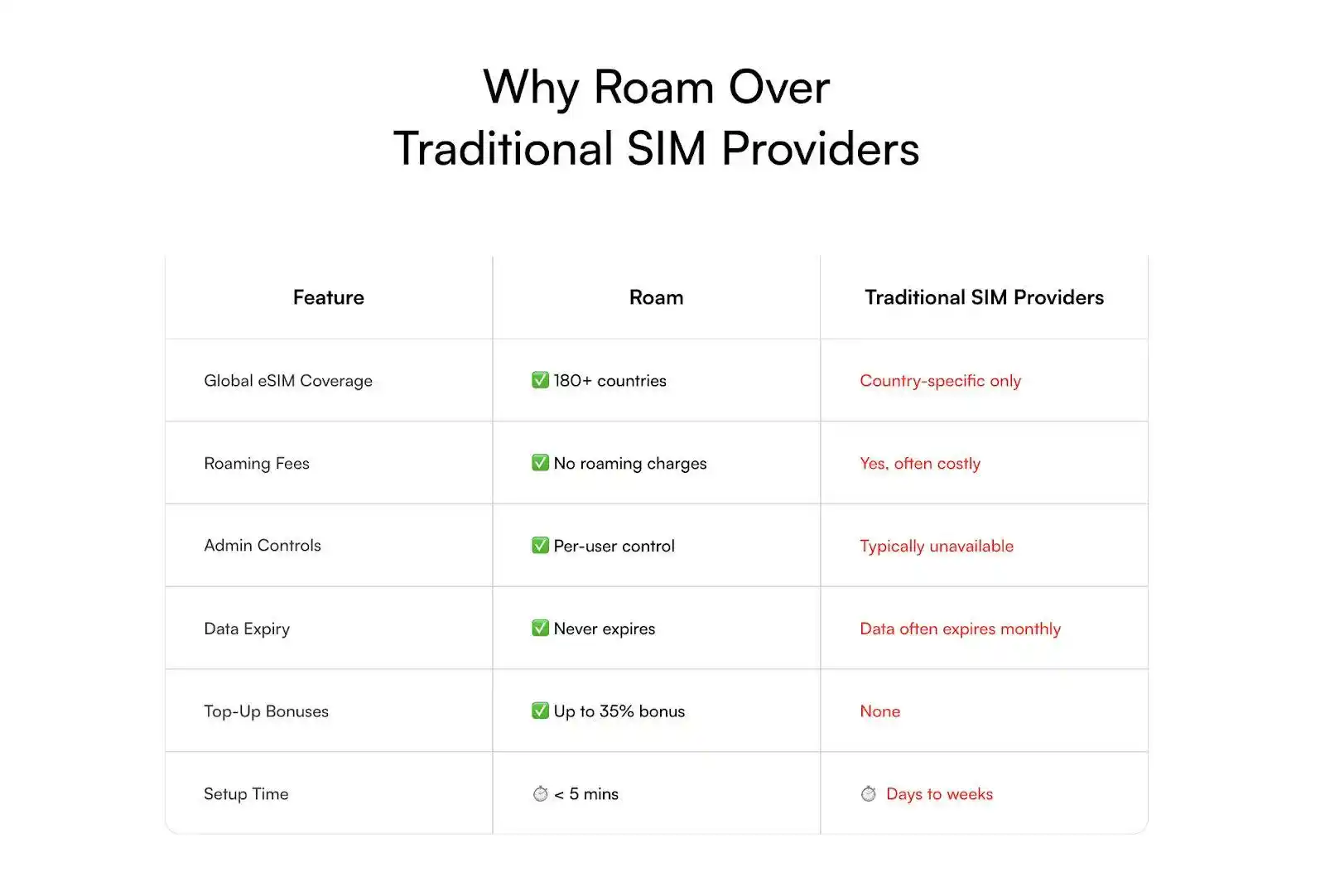
△ Compared to traditional data plan retailers, the Roam Enterprise eSIM not only enables global data usage but also provides a customized back-end management system for team account real-time management, effective budget management, and cost control.
In addition, Roam Enterprise eSIM offers real-time recharge functionality, ensuring that the data connection will not be interrupted due to insufficient funds. It also provides multiple recharge methods, including credit card, bank transfer, and cryptocurrency payment. Recharging with $ROAM will enjoy a 10% discount. Furthermore, enterprise users can also enjoy up to a 35% additional bonus when recharging, according to the three recharge plans listed on the official website: recharge $500, actual amount received $550; recharge $1000, actual amount received $1150; recharge $2000, actual amount received $2400.
Efficient financial consolidation is essential for enterprise account management. Therefore, Roam's Enterprise backend system provides real-time invoice downloads and monthly bill consolidation. Enterprise users can export invoices from the backend at any time or download bill files in CSV format, streamlining the financial reconciliation process and ensuring clear and transparent data.
Roam eSIM operation is convenient, significantly simplifying the complex activation process of traditional SIM cards. Users can quickly activate through the Roam App, supporting various eSIM-compatible mobile devices (Android and iOS). To meet the needs of enterprise users, Roam offers 24/7 multilingual customer support, where users can contact the team via Telegram, Discord, or email to receive timely and professional assistance.
Ending the International "Roaming" Era, Achieving Global Traffic Universality, Roam Redefines Global Data Connectivity
The launch of Roam Enterprise eSIM marks a significant step for Roam towards building a decentralized global open wireless network. For both enterprises and a broader user base, this not only signifies the end of the international "roaming era" but also the beginning of a new stage of "global traffic universality," with the transformative significance therein evident. Roam offers not just a data service but an open wireless network supporting ecosystem collaboration, remote work, and global real-time operations. Through a unified backend management system and secure seamless data connectivity service, Roam will help enterprises break through geographical limitations, enhance operational efficiency, and embrace a new paradigm of globalized work.
This article is contributed content and does not represent the views of BlockBeats.
You may also like

Meet the new WEEX trial fund—your gateway to greater profits

WEEX Labs Lands at Dutch Blockchain Week: A Disruptive Crypto × AI Conversation Sets Sail in Amsterdam

SK Hynix Reportedly Plans U.S. ADR Listing as Early as August, With SEC Approval Possible in Late June
SK Hynix may pursue a U.S. ADR listing as early as August, with SEC approval reportedly possible in late June amid strong AI chip supply chain demand.

SpaceX vs Tesla vs xAI: Which Elon Musk Trade Has the Biggest Upside in 2026?
OpenAI Reveals It Has Confidentially Submitted an S-1 to the SEC, Keeping the Door Open for a Future IPO
On June 9, according to an OpenAI announcement, the company recently confidentially submitted a draft S-1 registration statement to the U.S. Securities and Exchange Commission (SEC), beginning the preliminary compliance process for a potential initial public offering. OpenAI said it chose to disclose this proactively because it expected the news might leak; however, the company has not yet set a specific listing timeline, and related arrangements may still take some time.

Latest research from 13 top universities including Cornell University: The current state, challenges, and misconceptions of the fusion of Crypto and AI
Deconstructing Anthropic: The Best AI Company, Possibly Also a Type of Organizational Invention
Apollo and Blackstone Reportedly Back $35 Billion Anthropic Chip Financing as Deal Details Remain Unclear
On June 9, according to currently available news alerts, Apollo and Blackstone Group participated in a $35 billion financing for an Anthropic “chip project.” Based on the original wording of the report, the funding has already been raised, but public information remains limited. The financing structure, use of proceeds, project entity, and whether Apollo and Blackstone participated through equity, debt, or project financing have not yet been disclosed.

Humanity Protocol Security Incident Escalates: More Than $31 Million Stolen From Related Addresses as Attacker Continues Selling H for ETH
On June 9, according to monitoring by Onchain Lens, more than $31 million has been stolen from addresses linked to Humanity Protocol, and the attack is still ongoing, with the hacker continuously swapping H tokens for ETH. Project founder Terence Kwok later confirmed the security incident on X, saying the issue involved a private key leak.

Bloomberg: As Bitcoin Weakens, Stablecoins and RWA Continue to Drive Expansion in Crypto Businesses
In June, Bloomberg reported that despite Bitcoin falling below $60,000 last week, wiping out about $235 billion in market value within seven days, and dropping close to 50% from last year’s peak, some core businesses in the crypto industry are still expanding, mainly in stablecoins, real-world asset tokenization (RWA), payments, and infrastructure. The report also noted that overall altcoin activity has contracted significantly: altcoin market capitalization has fallen from a peak of about $431 billion in November 2021 to around $170 billion, and among the tens of millions of tokens issued in recent years, fewer than 1,700 still maintain meaningful trading activity.

Galaxy Deep Research Report: How Hyperliquid's HIP-4 Upgrade Changes the Landscape of Prediction Markets?
Binance Research: RWA Market Expected to Expand Nearly 6x from Early 2025, with Public Equities and Onchain Payments Heating Up Together
In June, Binance Research said in its monthly market report that the real-world asset (RWA) market is expected to grow by about 589% from the beginning of 2025. Bond- and money market fund-related RWA expanded by about $6.5 billion, up 83% year over year, while publicly traded equity RWAs grew by about 422%. The report also noted that monthly crypto debit card transaction volume exceeded $747 million in May, up 48.6% year to date.

Japan to Assess a Framework for Yen Stablecoins and Crypto ETFs as Asia’s Compliant Payments Narrative Heats Up
Recently, according to the original report, Japan is considering the launch of yen stablecoins and cryptocurrency ETFs. Public information remains limited at this stage, and there is still no complete policy text, regulatory draft, or clear implementation timeline, so this is better characterized as a “policy discussion” rather than formal implementation. The original wording also noted that advancing stablecoin regulation in Asia is driving XRP usage and supporting growth in the XRPL ecosystem. However, based on currently available public information, there is not enough evidence to directly establish a clear causal relationship between this round of discussion in Japan and XRP or XRPL.

ZachXBT: Humanity private key leak and abnormal surge in H token should be viewed separately
On June 9, according to related disclosures, on-chain investigator ZachXBT posted an update on Humanity’s roughly $31 million security incident, saying that after further analyzing fund flows, he currently tends to believe the project team was not involved in an “inside job” or a self-staged attack. According to him, the official explanation about the private key leak was broadly accurate, but before the token unlock, the price of H had been artificially pushed higher, and the hacker later took advantage of that market environment; therefore, the private key leak and the earlier abnormal price pumping should be regarded as two separate and independent events. This reframing has shifted the market’s understanding of the nature of the incident. Earlier discussion around Humanity had focused on whether the team directly participated in the attack or used the security incident to cover up internal operations. ZachXBT’s latest remarks shift the focus from “whether it was self-theft” to “whether there were pre-unlock market structure issues.” He also questioned whether the team may have.

Morning Report | OpenAI has submitted an S-1 registration statement draft to the U.S. SEC; Morpho completes $175 million financing

Morning Report | BitMine increased its holdings by 126,971 ETH last week; trader Eugene announced his exit from the crypto market

Wang Chuan: How can one not feel anxious after the neighbor Old Wang made thirty times profit by investing in storage stocks? (Seven) - A quarter-century cycle
Cryptocurrency CEXs are flocking to sell US stocks, and traditional brokerages are facing an "uninvited guest."
Meet the new WEEX trial fund—your gateway to greater profits
WEEX Labs Lands at Dutch Blockchain Week: A Disruptive Crypto × AI Conversation Sets Sail in Amsterdam
SK Hynix Reportedly Plans U.S. ADR Listing as Early as August, With SEC Approval Possible in Late June
SK Hynix may pursue a U.S. ADR listing as early as August, with SEC approval reportedly possible in late June amid strong AI chip supply chain demand.
SpaceX vs Tesla vs xAI: Which Elon Musk Trade Has the Biggest Upside in 2026?
OpenAI Reveals It Has Confidentially Submitted an S-1 to the SEC, Keeping the Door Open for a Future IPO
On June 9, according to an OpenAI announcement, the company recently confidentially submitted a draft S-1 registration statement to the U.S. Securities and Exchange Commission (SEC), beginning the preliminary compliance process for a potential initial public offering. OpenAI said it chose to disclose this proactively because it expected the news might leak; however, the company has not yet set a specific listing timeline, and related arrangements may still take some time.
Latest research from 13 top universities including Cornell University: The current state, challenges, and misconceptions of the fusion of Crypto and AI


