
Publicly Traded Company Initiates $5 Billion 'Buy Buy Buy' Mode, SOL Becomes MicroStrategy's Next BTC


Canadian publicly traded company SOL Strategies Inc. announced on April 23, 2025, that it had signed an independent agreement with ATW Partners on the same day to establish a convertible note financing mechanism of up to $5 billion. The funding will be specifically used to purchase SOL tokens, which will be staked through validation nodes operated directly by SOL Strategies, with the resulting rewards shared by both parties.
According to the company's disclosed financing mechanism, the initial issuance will be a total principal amount of $20 million in convertible notes, with the possibility of accessing up to $4.8 billion in tranches based on specific conditions. The first settlement is expected to take place around May 1, 2025, with the exact timing subject to standard settlement conditions. Under this innovative structure, note interest will be paid in SOL tokens, calculated as 85% of the staking rewards generated by SOL tokens purchased through this mechanism and staked by SOL Strategies.

Who Is SOL Strategies?
SOL Strategies Inc., formerly known as Cypherpunk Holdings Inc., was established in 2002, headquartered in Toronto, Canada. It was listed on the Italian Stock Exchange in 1998 and moved to the Canadian Securities Exchange in 2012, trading under the symbol HODL.
On July 9, 2024, Leah Wald was appointed as CEO. Under her leadership, the company shifted its focus entirely to the Solana blockchain ecosystem, with SOL tokens as a core asset on its balance sheet, operating cutting-edge validation nodes, and developing advanced staking tools. To reflect this strategic transformation, the company officially changed its name from Cypherpunk Holdings Inc. to SOL Strategies Inc. on September 9, 2024. The company submitted an application for listing on NASDAQ by the end of 2024, but the listing process has not been completed yet. Currently, its shares are still trading on the Canadian Securities Exchange and on the U.S. OTC market under the symbol CYFRF.

After establishing its transformation goals, SOL Strategies began increasing its Solana holdings, reducing its Bitcoin exposure, and disposing of other non-core assets. According to its Q1 2025 financial report, as of now, SOL holdings have increased from zero to 267,151 tokens, while Bitcoin holdings decreased from 215.37 tokens as of September 30, 2023, to 56.25 tokens as of September 30, 2024, and further reduced to the current 3.21 tokens, demonstrating a strategic shift of resources to the Solana ecosystem projects. Additionally, the company liquidated its Animoca Brands shares, realizing a $1.8 million gain, and reallocated funds to core business areas through the sale of other non-core assets.
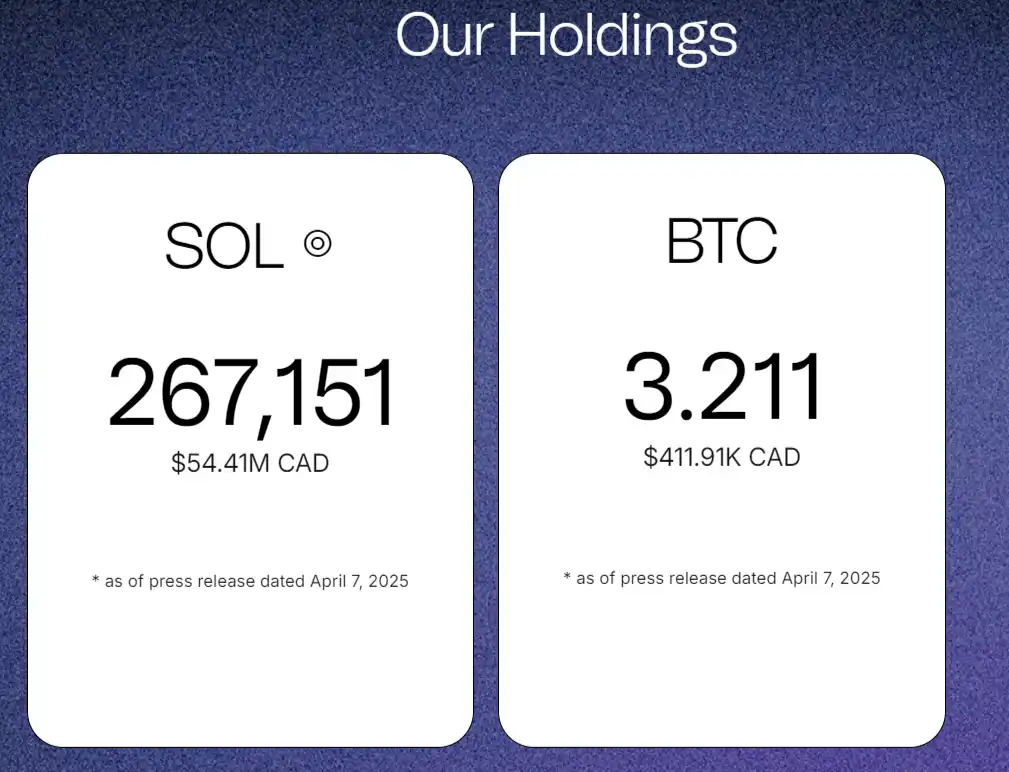
In addition to asset swapping, SOL Strategies has made significant progress and stable growth in validator node acquisition and revenue, as well as staking business:
Regarding validator node acquisition and growth, as of March 3, 2025, the company's validator nodes staked 1,653,752 SOL tokens, a 1434% increase from the end of 2024, with the company's own SOL tokens amounting to 239,607. These validator nodes are optimally designed for high scalability, high availability, and competitive staking rewards, ensuring operational efficiency;
Concerning staking business revenue growth, out of the 239,623 SOL tokens held by SOL Strategies, 239,607 tokens are specifically staked in its self-operated high-performance validator nodes, achieving a significant 137% increase from the staking amount of 101,200 tokens as of September 30, 2024. These staked SOL tokens generate an annual staking yield of 12,800 SOL, with an average annual staking reward rate of approximately 7% for validator nodes.
Regarding validator node revenue, starting from January 1, 2025 (the first day SOL Strategies took full control of the three major Solana validator nodes), the validator nodes achieved an annual revenue of 26,512 SOL. This income is derived from the commission generated by the SOL tokens delegated by the company and third parties to SOL Strategies' high-performance validator nodes.
Public Companies Rush to Invest, Is Spring Coming for Solana?
Perhaps influenced by Canada's approval of a staking-based SOL ETF, a large amount of funds flowed into the SOL ecosystem this week, and SOL Strategies is not the first company to implement a "SOL-version MicroStrategy."
On April 21, cryptocurrency trading and investment company GSR announced a lead investment of $100 million in equity financing into Nasdaq-listed company Upexi, Inc. Upexi is a brand owner focused on consumer product development, manufacturing, and distribution. This investment comes after Upexi announced a strategic shift to a cryptocurrency-based financial strategy, aiming to create long-term shareholder value and returns. Upexi has committed to implementing a Solana financial strategy, including increasing holdings and staking in Solana. Subsequently, Upexi's stock price surged by 659.91% to reach $17.25, reflecting the market's positive response to the Solana strategy.
In addition, on April 22nd local time, the DeFi Development Corporation (NASDAQ: JNVR) announced that it had purchased 88,164 SOL tokens, worth approximately $11.5 million. On April 23rd, it made another purchase of 65,305 SOL, worth $9.9 million, increasing the total holdings to 317,273 SOL, valued at $48.2 million.
Meanwhile, as the first and largest Solana-native public company in North America, SOL Strategies has bridged a broader path between traditional finance and blockchain innovation, providing investors with a scalable and compliant Solana ecosystem investment channel to continuously support the development and expansion of the Solana ecosystem.
SOL Strategies shares a strategic similarity with MicroStrategy. MicroStrategy holds a significant amount of Bitcoin as a core asset on its balance sheet, providing investors with an indirect route to invest in Bitcoin. Similarly, SOL Strategies, by holding SOL and operating validation nodes, has provided investors with an indirect opportunity to invest in Solana. Both have taken the form of publicly listed companies to offer traditional investors a way to access cryptocurrency.
However, SOL Strategies not only holds SOL but also actively participates in the Solana ecosystem, earning additional revenue through operating validation nodes and investing in Solana projects. Active engagement in the SOL ecosystem can, in turn, enhance the company's asset value. As stated by SOL Strategies CEO Leah Wald, SOL Strategies is the largest-scale funding mechanism in the Solana ecosystem, where each investment instantly generates returns, simultaneously boosting the company's assets and supporting the development of the validation node business.
Solana's printing press seems to be getting into gear as the SOL ETF is approved in Canada, expectations for the SOL ecosystem are improving, the meme sector is becoming more active, and traditional financial funds are pouring in. Whether it's the $500 million funding of SOL Strategies, GSR's $100 million investment in UPXI, or the DeFi Development Corporation purchasing over $20 million worth of SOL in two days, all indicate a broader development space for the Solana ecosystem in the future. When will the SOL ecosystem experience a renaissance? Let's wait and see.
You may also like

Pantera Capital Partner: How Tokenization is Restructuring the Private Equity and Early Investment Ecosystem?

New York Proposes Stricter Stablecoin Issuer Rules Aligned With Federal GENIUS Act
NYDFS proposed stricter stablecoin issuer rules aligned with the GENIUS Act, covering reserves, custody, redemption timelines, audits, and capital buffers.
Every exchange is a "Universal Exchange."

The counterattack of traditional finance: Alliance chains are quietly reviving

CryptoQuant Says Bitcoin Profitable Supply Is Near 45% Pressure Zone as On-Chain Data Points to Market Repricing
CryptoQuant said Bitcoin’s profitable supply is nearing the 45% pressure zone, signaling rising market stress, unrealized losses, and a possible on-chain repricing phase.

Bitcoin Falls Below 200-Week Moving Average as On-Chain Data Shows Over Half of Supply in Loss
Bitcoin dropped below its 200-week moving average as on-chain data showed over 50% of circulating supply is now in loss, signaling rising market stress.

CFTC Reportedly Plans New Prediction Market Rules Focused on Manipulation Risk and Public Interest Review
The CFTC is reportedly preparing new prediction market rules focused on manipulation risk, public interest review, and retail trader protections.

Meet the new WEEX trial fund—your gateway to greater profits

WEEX Labs Lands at Dutch Blockchain Week: A Disruptive Crypto × AI Conversation Sets Sail in Amsterdam

SK Hynix Reportedly Plans U.S. ADR Listing as Early as August, With SEC Approval Possible in Late June
SK Hynix may pursue a U.S. ADR listing as early as August, with SEC approval reportedly possible in late June amid strong AI chip supply chain demand.

SpaceX vs Tesla vs xAI: Which Elon Musk Trade Has the Biggest Upside in 2026?
OpenAI Reveals It Has Confidentially Submitted an S-1 to the SEC, Keeping the Door Open for a Future IPO
On June 9, according to an OpenAI announcement, the company recently confidentially submitted a draft S-1 registration statement to the U.S. Securities and Exchange Commission (SEC), beginning the preliminary compliance process for a potential initial public offering. OpenAI said it chose to disclose this proactively because it expected the news might leak; however, the company has not yet set a specific listing timeline, and related arrangements may still take some time.

Latest research from 13 top universities including Cornell University: The current state, challenges, and misconceptions of the fusion of Crypto and AI
Deconstructing Anthropic: The Best AI Company, Possibly Also a Type of Organizational Invention
Apollo and Blackstone Reportedly Back $35 Billion Anthropic Chip Financing as Deal Details Remain Unclear
On June 9, according to currently available news alerts, Apollo and Blackstone Group participated in a $35 billion financing for an Anthropic “chip project.” Based on the original wording of the report, the funding has already been raised, but public information remains limited. The financing structure, use of proceeds, project entity, and whether Apollo and Blackstone participated through equity, debt, or project financing have not yet been disclosed.

Humanity Protocol Security Incident Escalates: More Than $31 Million Stolen From Related Addresses as Attacker Continues Selling H for ETH
On June 9, according to monitoring by Onchain Lens, more than $31 million has been stolen from addresses linked to Humanity Protocol, and the attack is still ongoing, with the hacker continuously swapping H tokens for ETH. Project founder Terence Kwok later confirmed the security incident on X, saying the issue involved a private key leak.

Bloomberg: As Bitcoin Weakens, Stablecoins and RWA Continue to Drive Expansion in Crypto Businesses
In June, Bloomberg reported that despite Bitcoin falling below $60,000 last week, wiping out about $235 billion in market value within seven days, and dropping close to 50% from last year’s peak, some core businesses in the crypto industry are still expanding, mainly in stablecoins, real-world asset tokenization (RWA), payments, and infrastructure. The report also noted that overall altcoin activity has contracted significantly: altcoin market capitalization has fallen from a peak of about $431 billion in November 2021 to around $170 billion, and among the tens of millions of tokens issued in recent years, fewer than 1,700 still maintain meaningful trading activity.

Galaxy Deep Research Report: How Hyperliquid's HIP-4 Upgrade Changes the Landscape of Prediction Markets?
Pantera Capital Partner: How Tokenization is Restructuring the Private Equity and Early Investment Ecosystem?
New York Proposes Stricter Stablecoin Issuer Rules Aligned With Federal GENIUS Act
NYDFS proposed stricter stablecoin issuer rules aligned with the GENIUS Act, covering reserves, custody, redemption timelines, audits, and capital buffers.
Every exchange is a "Universal Exchange."
The counterattack of traditional finance: Alliance chains are quietly reviving
CryptoQuant Says Bitcoin Profitable Supply Is Near 45% Pressure Zone as On-Chain Data Points to Market Repricing
CryptoQuant said Bitcoin’s profitable supply is nearing the 45% pressure zone, signaling rising market stress, unrealized losses, and a possible on-chain repricing phase.
Bitcoin Falls Below 200-Week Moving Average as On-Chain Data Shows Over Half of Supply in Loss
Bitcoin dropped below its 200-week moving average as on-chain data showed over 50% of circulating supply is now in loss, signaling rising market stress.


