
Please have all trading platforms immediately cease promoting contract trial funding behavior to college students

Recently, ETHPanda and LXDAO co-founder Brucexu.eth revealed on social media that some cryptocurrency exchanges are offering so-called "Contract Experience Funds" to college students. This type of fund cannot be withdrawn directly; however, any profits made belong to the student. If there is a loss, there is no need to repay the fund, and sharing high returns on social media can even earn additional rewards.
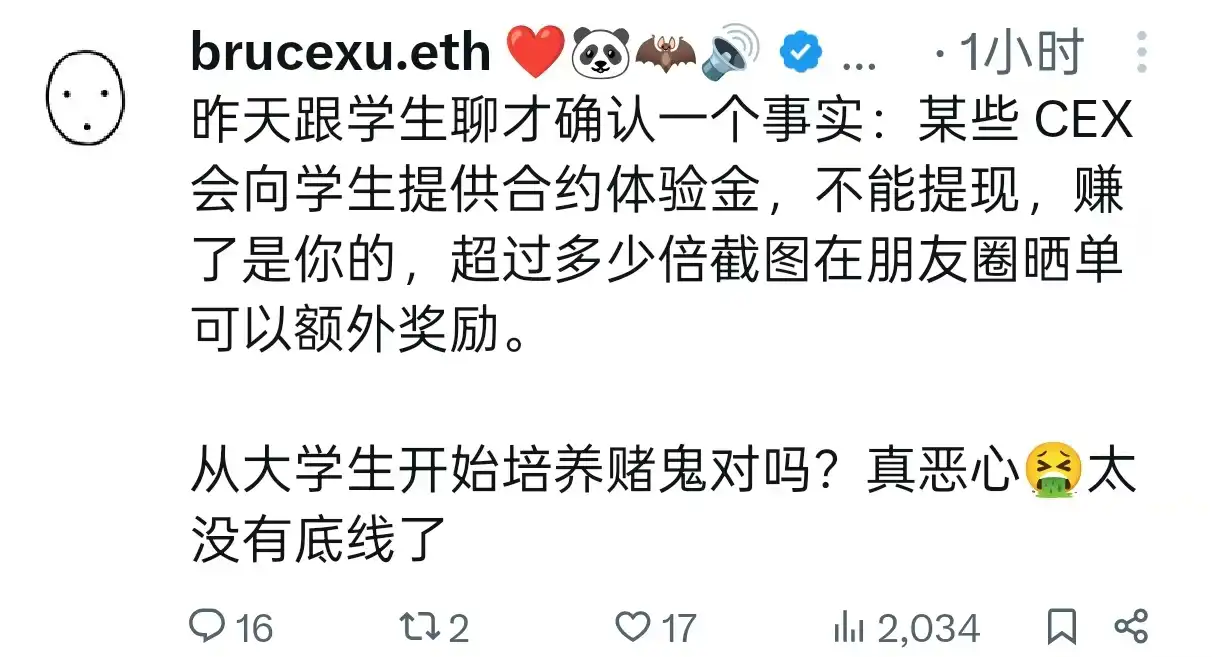
From providing the principal amount to leveraging incentives, and then to social splitting, this entire process is precisely targeting college students for harvesting. This behavior is essentially not about spreading contract knowledge or educating users but rather a gambling inducement disguised as "financial enlightenment," effectively preying on college students with weak risk awareness and inadequate fund management.
Even though the overall cryptocurrency trading platforms are facing a user growth bottleneck, this does not mean that targeting college students for business expansion is acceptable. Such behavior not only poses regulatory risks but also has a long-term negative impact on the industry's image.
High-Risk Financial Instruments Should Not Target College Students
After the integration of technology and finance, the "precise inducement" of young people has become a nearly global issue. Whether it is the structurally designed over-borrowing inducement in the U.S. student loan system or the proliferation of high-interest loans for young people in Internet financial products in Indonesia, the Philippines, and other countries, countless young people worldwide are trapped in debt.
In 2015, just as mobile payments were on the rise in China, consumerism among young people was quietly spreading. At the same time, a group of "Internet finance companies" represented by Qufenqi, Fenqile, and Aiyomi, under the guise of "advance consumption and credit growth," vigorously entered universities.
Qufenqi was the most representative player, penetrating campuses through offline promotion teams and collaborating with mobile phones, computers, and cosmetic vendors to hold "campus sales events" to attract students to use their platform for installment purchases. With just an ID card and student ID, one could "freeload" an iPhone with a monthly payment of less than 300 yuan.

However, the frenzy of this "financial innovation" soon revealed its fangs. Issues such as opaque interest rates, high fees, and unreasonable repayment dates quickly pushed many students into the debt trap of advance consumption. To repay their debts, many students were forced to borrow from different platforms and create a snowball effect of debt.
Even worse, as the difficulty of collection increased, some platforms or underground collection organizations evolved extreme and oppressive methods such as "naked loans," demanding that female students provide indecent photos as "collateral," threatening to expose them if they default. When this event was exposed by the media, it caused shock in Chinese society.

From an ethical standpoint, this trend has completely crossed society's bottom line. Once a hot commodity, FunPay, even in later attempts to transform into a "installment e-commerce platform" and a "B2B financial technology service provider," still carried the label of "campus loan initiator" and faced widespread resistance.
FunPay, later renamed Qudian, launched an auto finance project in 2018, aiming to provide young people with car installment services through a "lease-to-own" model. It also faced resistance. In 2022, Qudian's founder, Luo Min, made a high-profile announcement to enter the market for pre-packaged meals and promoted it through platforms like Douyin (TikTok). However, due to its "campus loan" history attracting public scrutiny, Chinese celebrities who had partnerships with Qudian, such as Jia Nailiang and Fu Seoul, have distanced themselves.
This is a memory of an era and also a painful lesson. There was no clear regulation at that time, no one stood up to stop it, until millions of families paid the price, finally bringing it to an end.
Now, in the cryptocurrency field, contract experience funds are openly promoted to college students, which seems to be the beginning of another disaster—it's not using high-interest loans but rather cultivating a more secretive and harder-to-detect gambling addiction.
Contracts Are Neutral, But Greed Should Not Target Campuses
During this cycle, college students briefly became the focus of Web3 discourse, and many projects and VCs tended to recruit hardworking, eager-to-learn college students as interns. Even crypto exchanges launched campus ambassador referral programs, where students could apply to join and earn commission rewards for referring active users and receive benefits like job opportunities. However, shortly after the launch of this program, it was suspended due to community backlash, and the official platform no longer features this activity.
Today, some exchanges have escalated by directly using contract vouchers to lure college students into "joining the game." Compared to the campus loans of the past, this round of cryptocurrency contract promotion has not even touched basic regulatory red lines.
Many centralized exchanges have servers distributed across various countries, filled with disclaimers in their terms of service, and their employees are located globally. They often do not comply with full regulation from any single country but operate globally, especially expanding aggressively in countries and regions where financial education is not widespread.
In this vacuum, it's hard to expect short-term policies to effectively intervene. This means that public moral constraints and collective action by users are the most realistic and powerful "regulatory tools." Every user, every practitioner, should not remain silent about behaviors that lure college students into participating in contract trading.
As a financial instrument, smart contract transactions are justified, but distinctions must be made in different scenarios. The following three scenarios can be considered morally acceptable use cases:
First is risk hedging, which was the original design purpose of smart contracts. Institutions or sophisticated investors use contracts to hedge against spot price fluctuations, such as miners locking in mining rewards, traders managing position risk, etc. This is a professional practice based on clear assets and risk strategies.
Second is small-scale speculative entertainment by independent and self-responsible adults. Some individual users may use a tiny portion of their funds for short-term trading as a high-risk form of entertainment. The premise here is that they have a certain risk awareness, a complete financial safety net, and a clear understanding of the consequences they face.
Finally, there are the "gamblers" who engage in contract trading akin to visiting a casino in a two-way manner. This is the most common type of contract trading user at present—they do not hedge, do not analyze, and purely rely on gut feelings for trading. While this behavior is not encouraged, if adults are fully aware that they are "gambling," the trades they make on the platform can be seen as a "willing gamble."
However, college students are not gamblers.
They have not yet entered society, do not have sufficient income, risk awareness, or financial literacy. They should be developing their mindset on campus rather than being induced by platforms to build a leveraging logic. Any trading platform that extends its reach to college students is doing something extremely unethical.
Take Action and Pressure Centralized Exchanges (CEX)
Faced with the inducement of college students to participate in high-risk contract trading, the industry can no longer remain silent. This not only deviates from the original intention of financial technology inclusivity but also seriously damages the credibility of the entire crypto industry. Therefore, there must be clear and continuous social feedback to resist these behaviors that involve giving away demo funds, encouraging showing off gains, and guiding leverage operations.
Therefore, we must voice our refusal and draw a line through action:
We can—boycott CEX businesses conducting this type of inducement on social media platforms, refuse to register or deposit on such platforms, utilizing our absence of real money as a reminder that users are not ATMs;
We can—continuously exert public pressure on companies that are still implementing such marketing strategies;
We can—encourage industry KOLs and media personalities to publicly expose and sternly criticize these predatory tactics.
Only by doing so is it possible to pressure platforms into realizing that a regulatory gap does not equate to a moral gap, and the student population should not be the industry's recruitment breakthrough. If the industry genuinely seeks long-term development, it must first abandon growth tactics that come at the expense of destroying the future of a generation. This will not only fail to lead to industry growth or new highs in cryptocurrency prices but will further stigmatize the sector, hindering the industry's progress toward global regulatory compliance and deviating from the true vision of crypto.
This is not the first time we have seen the industry probing the boundaries of ethics. Today it's college student experience funds, tomorrow it could be "contract-based lending," or a personalized "low-value, high-frequency leverage recommendation system" tailored to newcomers to the world of cryptocurrency. There is always someone designing traps specifically for young people who have not yet developed risk awareness.
If we do not want to witness a "naked margin loan" disaster replaying in the crypto world, if we do not want to see young people being groomed into gamblers one by one, we must act from this moment on to resist this behavior. If platforms continue to turn a blind eye, we will unite more KOLs and media to continue exposing these practices until it is all put to an end.
You may also like

Morning Report | BitMine increased its holdings by 126,971 ETH last week; trader Eugene announced his exit from the crypto market

Wang Chuan: How can one not feel anxious after the neighbor Old Wang made thirty times profit by investing in storage stocks? (Seven) - A quarter-century cycle

Cryptocurrency CEXs are flocking to sell US stocks, and traditional brokerages are facing an "uninvited guest."

$75 billion in foreign capital has fled, and South Korean retail investors have absorbed it all using leverage

Japan’s Three Megabanks Plan Joint Stablecoin Issuance in Fiscal 2026
MUFG, SMBC, and Mizuho reportedly plan to jointly issue fiat-pegged stablecoins in fiscal 2026, signaling Japan’s growing push into bank-led digital payment infrastructure.

Humanity Discloses H Token Dual-Chain Attack Details, With Losses on Ethereum and BSC Exceeding $36 Million
Humanity said the H token attack across Ethereum and BSC caused more than $36 million in losses after leaked ProxyAdmin keys enabled malicious contract upgrades and token minting.
White House Discusses CLARITY Act With Law Enforcement Ahead of Senate Vote
The White House discussed the CLARITY Act with law enforcement ahead of a Senate vote, focusing on illicit finance risks and developer protections.

Bitcoin Trading Guide 2026: Strategies for Experienced Traders

What Is XAUT and PAXG? Why Tokenized Gold Is Booming in 2026

Will the SpaceX IPO Hurt Bitcoin? Here's What Traders Are Watching

Foreign selling in the South Korean stock market accelerates, with cumulative net sales reportedly reaching $75 billion this year
On June 9, The Kobeissi Letter, citing Goldman Sachs data, reported that global investors are selling South Korean stocks at an unusually rapid pace. In the latest trading session, foreign investors sold about $801 million worth of Kospi constituent stocks again; total foreign outflows last week reached about $10 billion, and the market has been in net foreign selling on nearly every trading day over the past month. According to the data cited in the report, foreign investors have sold about $75 billion worth of South Korean stocks so far this year. Meanwhile, South Korean retail and institutional investors together recorded roughly $69 billion in net buying over the same period, suggesting that the market’s main buying support has come from domestic capital rather than returning overseas funds. The information currently disclosed still mainly comes from The Kobeissi Letter’s retelling and Goldman Sachs data summaries, while public details on the statistical period and the specific definition of “selling” remain relatively limited.

Fortune Warns of Strategy’s Financing Structure Risks as Bitcoin Premium Narrows
Fortune warned that Strategy’s Bitcoin treasury model faces growing financing risks as MSTR’s net asset premium narrows and preferred stock dividend pressure increases.

Ferrari Challenge Le Mans: Carl Moon to Dominate in WEEX Livery

Sahara AI Responds to SAHARA’s Sharp Drop: No Contract or Product Security Issues Found, Internal Investigation Underway
Sahara AI responded to SAHARA’s 60% price drop, saying no token contract or product security issues have been found and an internal investigation is underway.

WEEX Deposit/Withdrawal Dynamic Island: Your Asset Status, Always in Sight
Scaling Crypto Derivatives: The Digital Asset Infrastructure Behind High-Volume Trading
In the fast-moving digital asset ecosystem, derivatives platforms face an extreme architectural test. High-leverage futures markets demand more than just standard security—they require absolute operational precision, zero-latency matching engines, and ironclad structural scalability, all while navigating intense market volatility.
As global platforms scale to meet these demands, the industry is shifting away from rigid, monolithic setups toward a more agile, "decoupled" infrastructure philosophy.
The Blueprint for High-Volume Copy TradingFor elite global exchanges like WEEX (founded in 2018), this architectural choice becomes critical when scaling high-volume retail features like social copy trading. When thousands of users automatically mirror the real-time strategies of elite traders simultaneously, it triggers sudden, monumental spikes in concurrent transactional volume.
To prevent execution latency or settlement bottlenecks during these peak volatility events, a platform's primary engine must remain entirely dedicated to risk management, copy-trade synchronization, and order matching.
The Architectural Rule: New-generation platforms must separate front-end user execution engines from heavy backend infrastructural overhead to eliminate operational friction.
By separating these layers, platforms can maintain complete sovereignty over their trading environments and user experiences while strategically aligning with institutional-grade infrastructure ecosystems. This strategic framework allows modern exchanges to leverage advanced Digital Asset Custody infrastructure such as Cobo’s behind the scenes, ensuring that backend wallet management scales elastically alongside trading spikes.
Capitalizing on Market Momentum and 400× LeverageIn a derivatives arena where platforms offer up to 400× leverage on perpetual contracts, capital efficiency and market agility are core business metrics. To capture market momentum, an exchange needs the ability to rapidly expand its asset offerings, supporting everything from legacy crypto assets to sudden, trending altcoins across a massive library of trading pairs.
Adopting a flexible, scalable Wallet-as-a-Service (WaaS) solution such as Cobo’s could completely rewrite the development timeline for high-growth exchanges. Instead of spending months of engineering capital building out custom backend wallet architectures for every new blockchain network, platforms can deploy localized infrastructure in days.
This agility allows platforms to instantly scale their listings to over a thousand trading pairs without compromising security or delaying time-to-market. It mirrors the exact operational advantages seen during high-velocity market events, similar to how advanced wallet infrastructure empowers platforms during sudden asset surges; allowing exchanges to pass that speed and liquidity directly to their global user base.
A Mature Foundation for GrowthThe synergy between trusted infrastructure ecosystems and global trading platforms represents the natural evolution of a maturing crypto market. As WEEX continues to scale its global spot and derivatives offerings for over 6 million users, adopting robust backend paradigms proves that platforms no longer have to compromise between cutting-edge trading velocity and uncompromised structural security.

Get Paid to Onboard? Try WEEX’s New Homepage with Rewards for Registration, Deposit & Trade
WEEX Custom Layout: Build Your Perfect Trading Workspace in Seconds
Morning Report | BitMine increased its holdings by 126,971 ETH last week; trader Eugene announced his exit from the crypto market
Wang Chuan: How can one not feel anxious after the neighbor Old Wang made thirty times profit by investing in storage stocks? (Seven) - A quarter-century cycle
Cryptocurrency CEXs are flocking to sell US stocks, and traditional brokerages are facing an "uninvited guest."
$75 billion in foreign capital has fled, and South Korean retail investors have absorbed it all using leverage
Japan’s Three Megabanks Plan Joint Stablecoin Issuance in Fiscal 2026
MUFG, SMBC, and Mizuho reportedly plan to jointly issue fiat-pegged stablecoins in fiscal 2026, signaling Japan’s growing push into bank-led digital payment infrastructure.
Humanity Discloses H Token Dual-Chain Attack Details, With Losses on Ethereum and BSC Exceeding $36 Million
Humanity said the H token attack across Ethereum and BSC caused more than $36 million in losses after leaked ProxyAdmin keys enabled malicious contract upgrades and token minting.


