
Opinion: Why Bittensor is a Scam, and TAO is Heading Towards Zero?

Original Author: WeirdMind
Starting a long post to document my thoughts: Why is #Bittensor a scam, and $TAO is heading to zero?
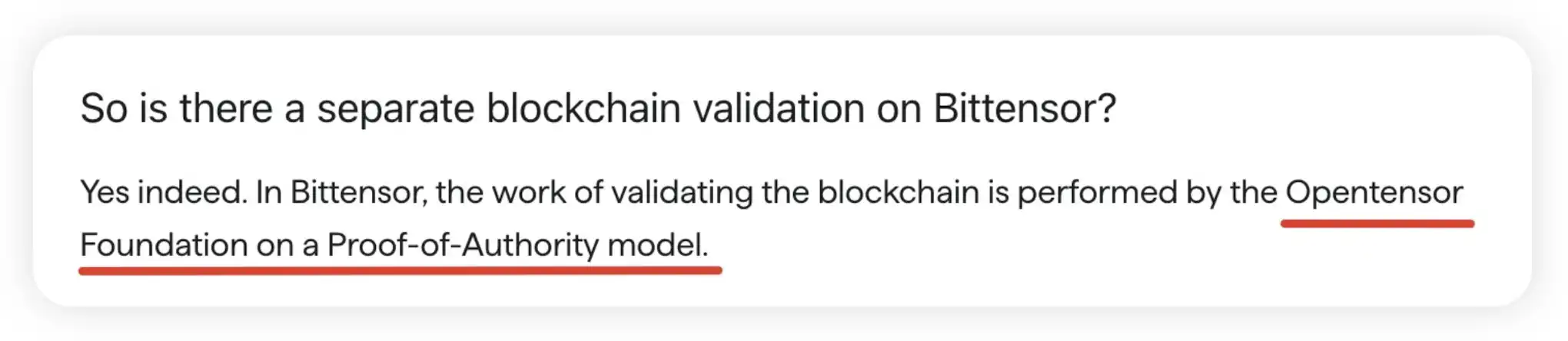
First of all, although Bittensor has always touted itself as a "fair mining" project, the underlying Subtensor is neither a PoW chain nor a PoS chain; it is a single-chain network managed by the Opentensor Foundation (Bittensor's foundation), with a very opaque mechanism.
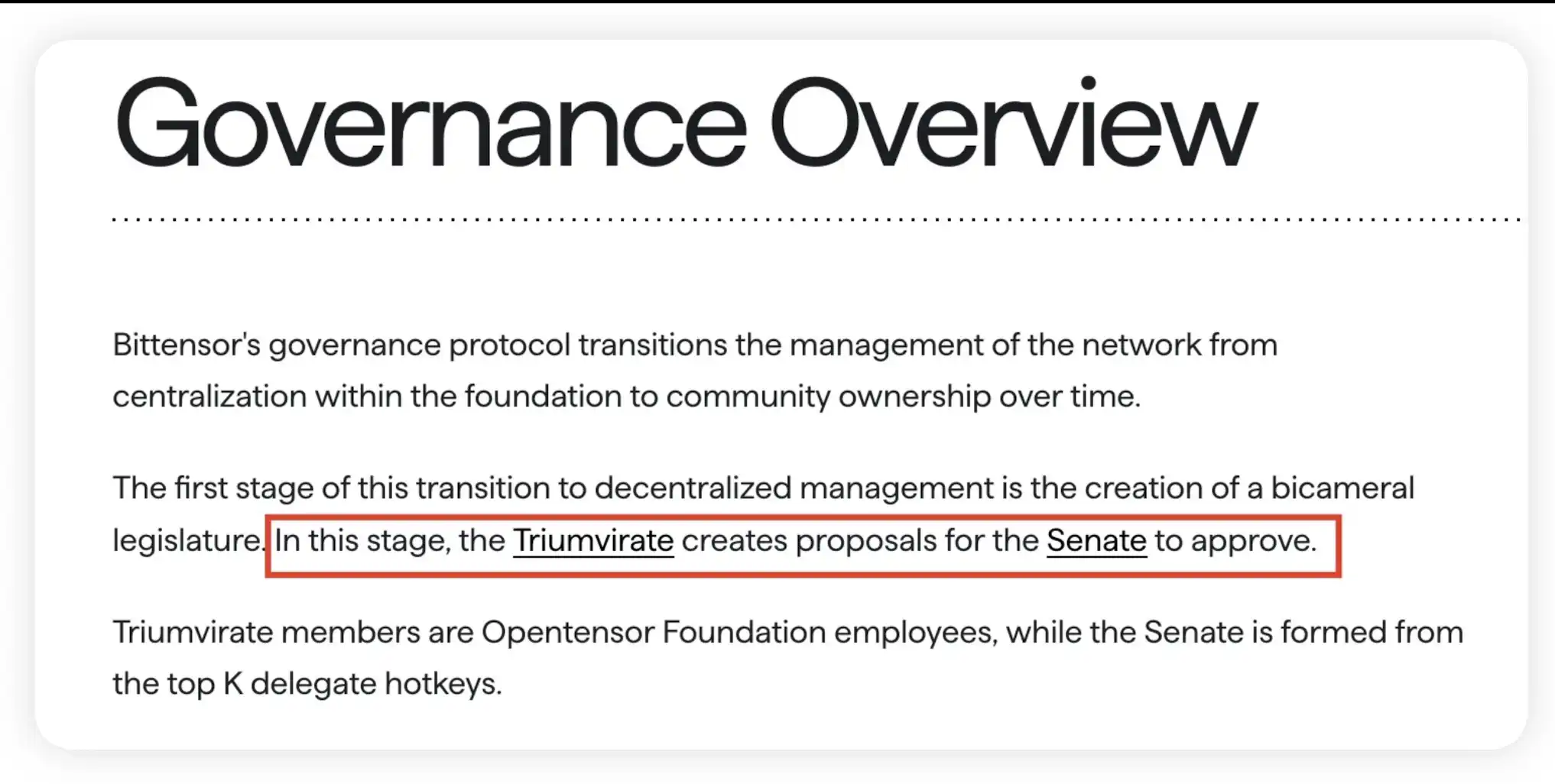
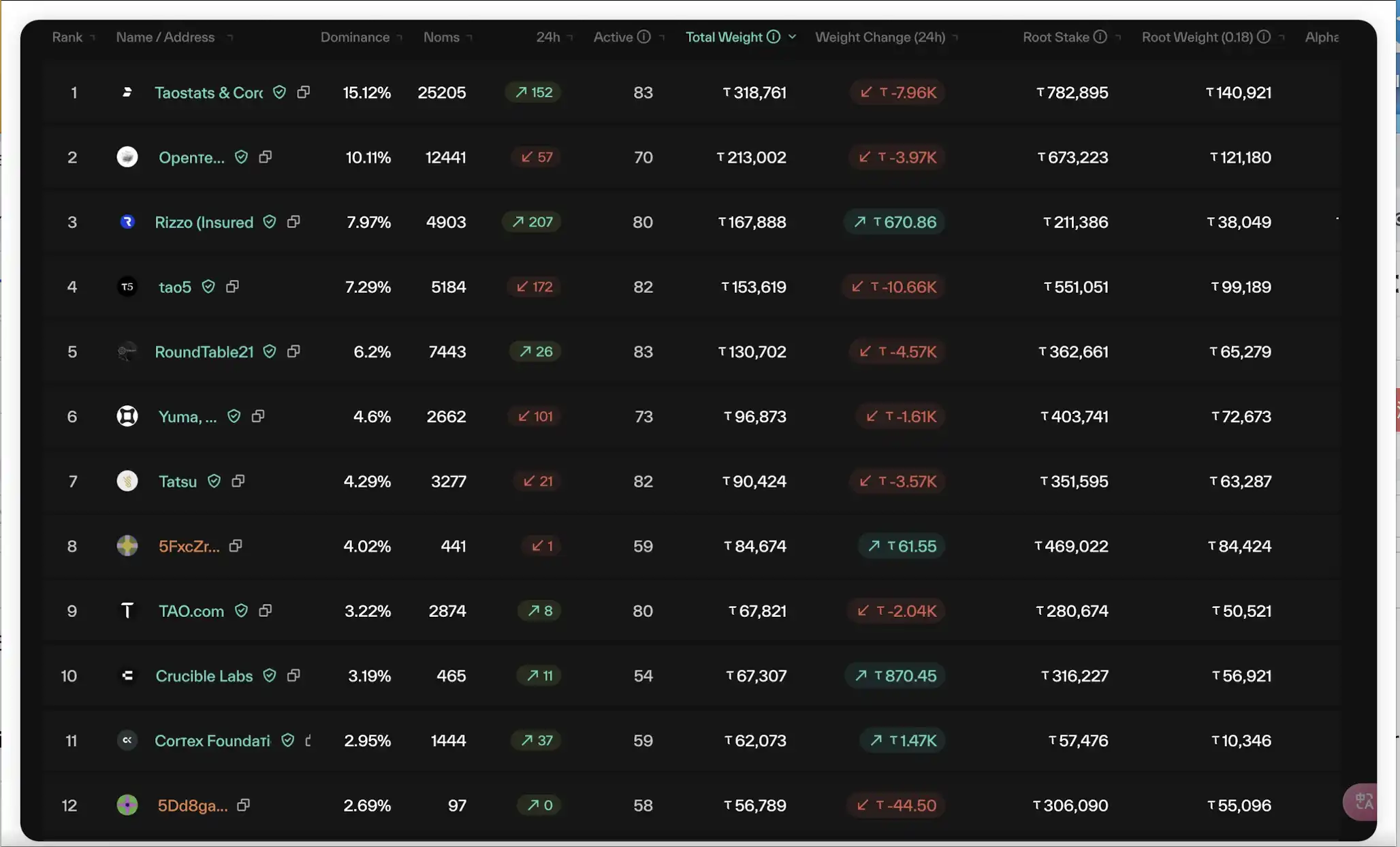
As for the so-called "Triumvirate + Senate" binary governance structure, the triumvirate consists of three Opentensor Foundation employees, and the Senate consists of the top 12 ranked validation nodes, all of whom are insiders or stakeholders.
Secondly, on January 3, 2021, the "Kusanagi" release marked the activation of the Bittensor network, allowing miners and validators to start receiving the first batch of TAO rewards. From network activation to the launch of the subnet on October 2, 2023, a total of 5.38 million TAO have been mined by Bittensor in the 2 years and 9 months. However, there is no documentation or information indicating how the tokens generated during the period from January 3, 2021, to October 2, 2023, when the subnet went live, were distributed according to what rules and where they ultimately ended up.
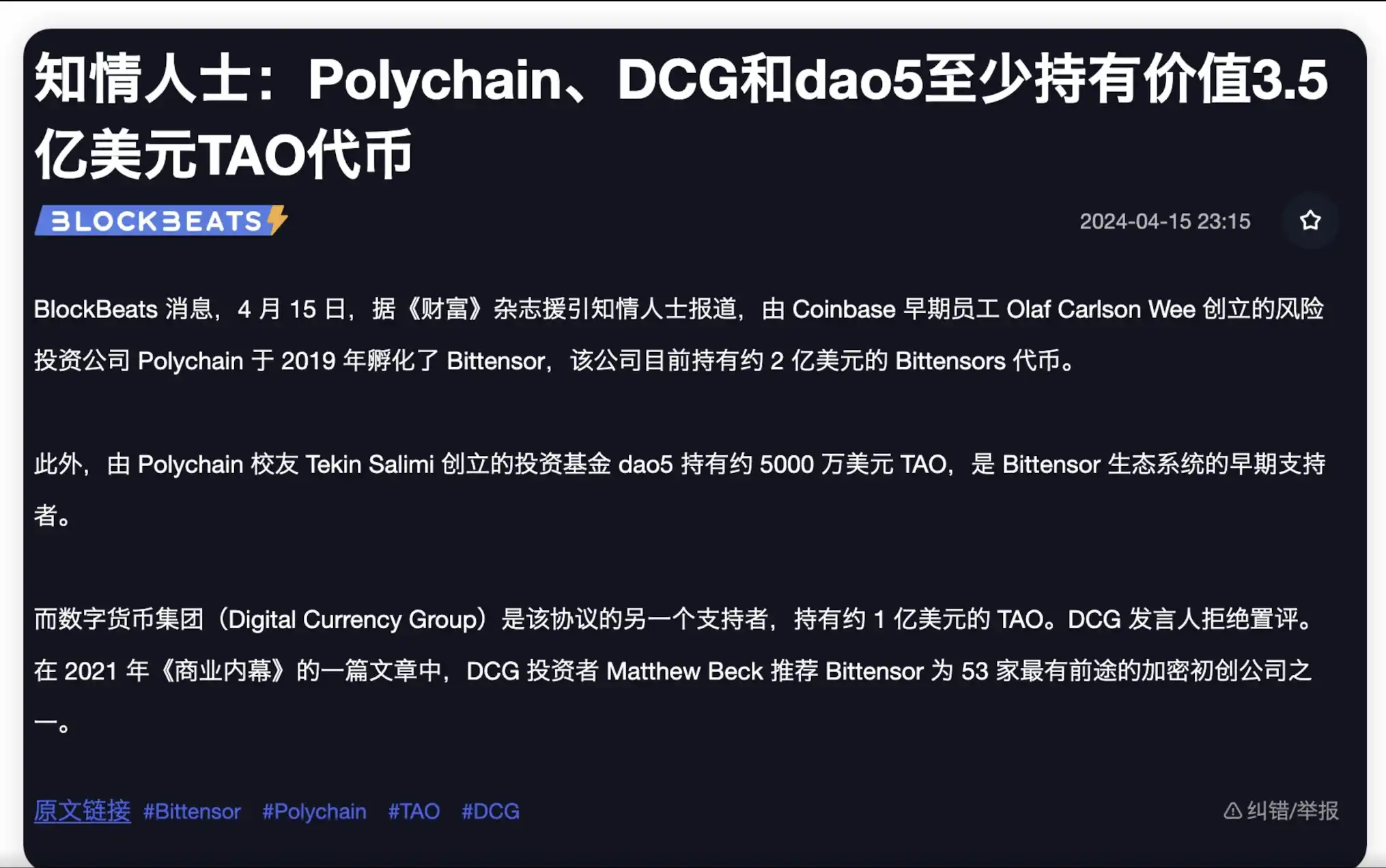
It can be reasonably speculated that these tokens were divided among internal members and interest groups because, unlike Bitcoin, Bittensor was hatched and invested by VCs.
If you take this portion of the tokens and divide it by the current circulation of 8.61 million, at least 62.5% of TAO is in the hands of internal members and interest groups. Furthermore, the Opentensor Foundation and some VC investors also operate validation node businesses on Bittensor, so the percentage of chips in their hands will only be higher than this 62.5% figure.
Similar to the recent Avalanche of OM a few days ago, all projects with an inexplicably high market cap, their distorted market cap is often due to poor circulation.
Billions market cap backed by poor liquidity.
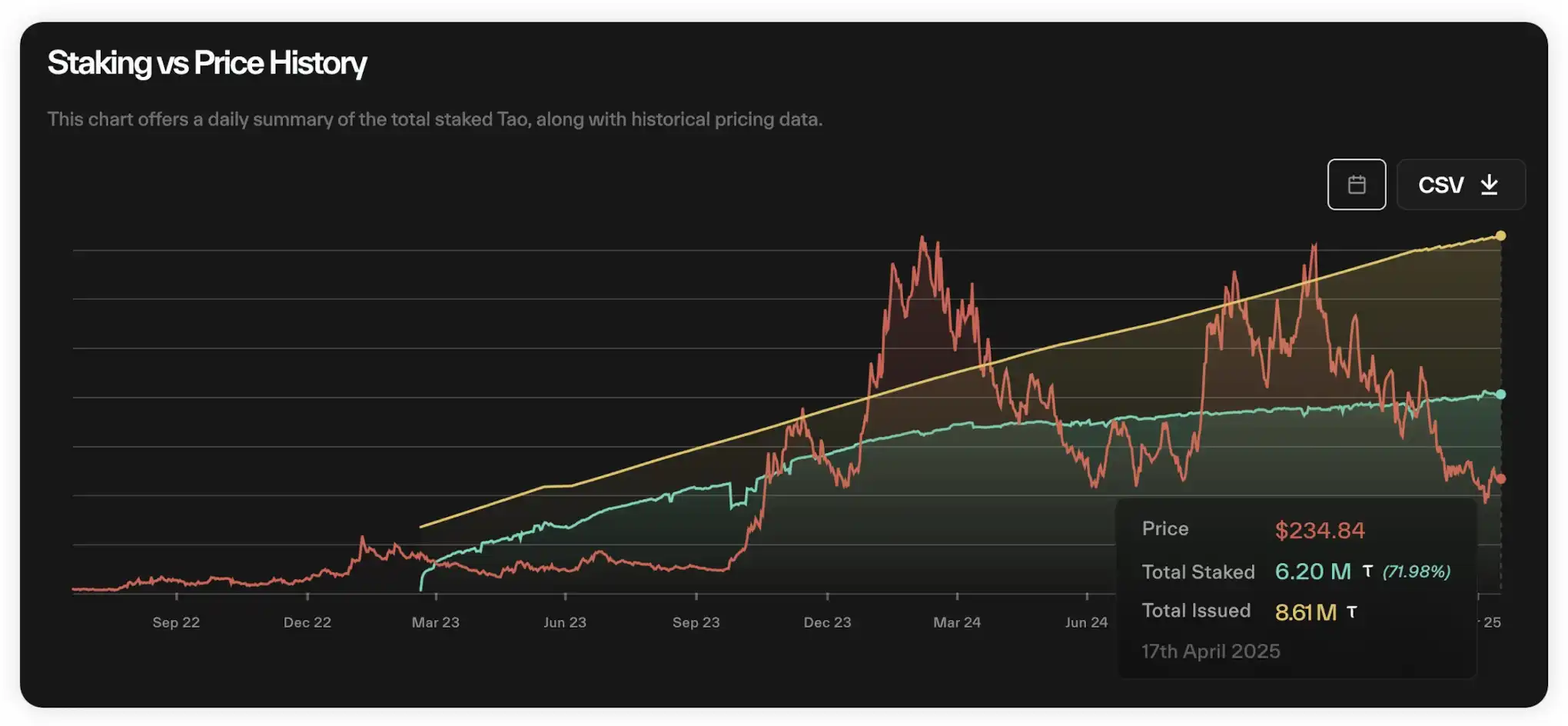
The following chart illustrates the historical staking status of TAO. Don't be fooled into thinking that TAO's staking rate has gradually increased from low to high. The reason it is depicted this way is due to TAO's intense inflation.
In reality, TAO's staking rate has never been below 70%, reaching close to 90% at its highest. Based on TAO's current market cap of 2 billion USD, it means that at least 1.4 billion USD worth of TAO has never entered circulation. The actual market cap of TAO is around 600 million USD, with a corresponding FDV of up to 5 billion USD, a typical project with low circulation and high market cap.
The so-called AI project ranked first by market cap, how its bubble was inflated by whales, is worth pondering.
Lastly, the so-called dTAO upgrade is more like providing OGs with an opportunity to exit liquidity. It allows you to buy subnetwork tokens with high leverage and take over the TAO held by the vested interests.
According to the three-disc theory, Bittensor's dTAO upgrade in February of this year introduced new Ponzi scheme models, the "Split Disc" and the "Mutual Aid Disc," in a situation where the "Bonus Disc" was no longer sustainable. The core purpose is to leverage down in a weakening old narrative and an external liquidity almost squeezed dry by fabricating a new narrative to attract new external liquidity.
First is the "Split Disc": By allowing all subnets to issue tokens, TAO has successfully positioned itself as the base currency for all Bittensor subnet tokens, whose value is supported by tokens from several dozen (and increasingly more) subnets.
Due to differences in the depth of trading pools, subnet tokens often experience astonishing price surges. With this, Bittensor has showcased to the outside world a disguised eco-system that offers high ROI opportunities. The exaggerated nominal ROI provided by Subnet Alpha tokens artificially created significant buying pressure for TAO and acted as a camouflage for the root network validation nodes' TAO sell-off.
Unfortunately, due to Bittensor's closed ecosystem and the market transition from bull to bear, the dTAO upgrade failed to attract sufficient external liquidity, and even internal liquidity (those staked in the root network) was not adequately mobilized and activated.
Simultaneously, the lowered entry barriers and unlimited token issuance for subnets have excessively diluted the overall liquidity of Bittensor's already limited ecosystem.
Second is the "Mutual Aid Disc." Unfortunately, Bittensor's subnet token issuance does not establish a highly circulating mutual-aid model as seen in Pump.fun on Solana, as Bittensor's network infrastructure is very poor, and even different subnet tokens cannot be exchanged, making it difficult for subnet token participants to migrate liquidity between different subnets. This further exacerbates the liquidity dilution issue brought about by a high split ratio, preventing funds from remaining engaged in the ecosystem for continuous speculation.
Once the whales of the root network start collectively fleeing, both on-chain and off-chain liquidity will quickly dry up.
The moment you sell, game over.
So are the whales fleeing? The answer is "they are fleeing"!
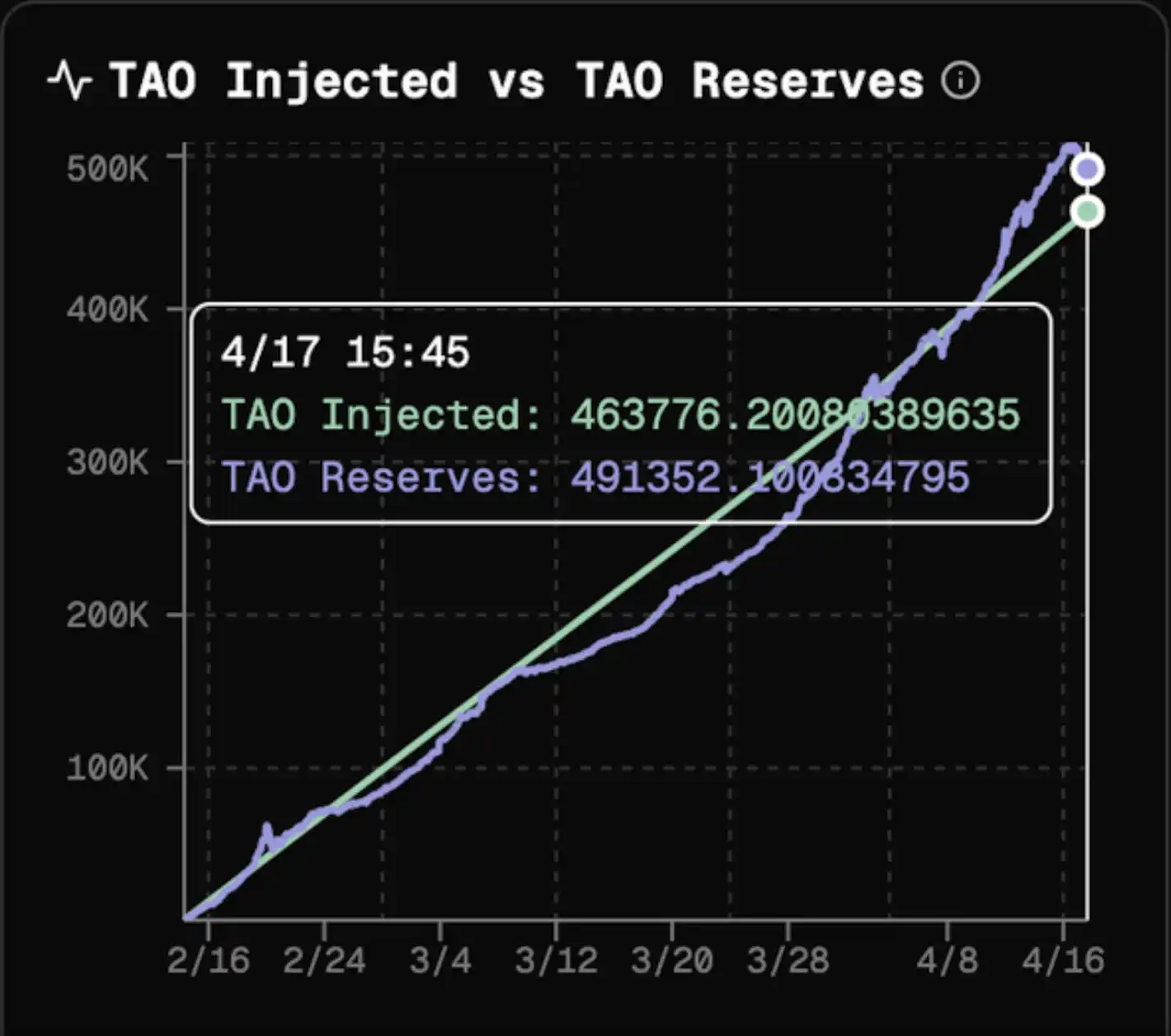
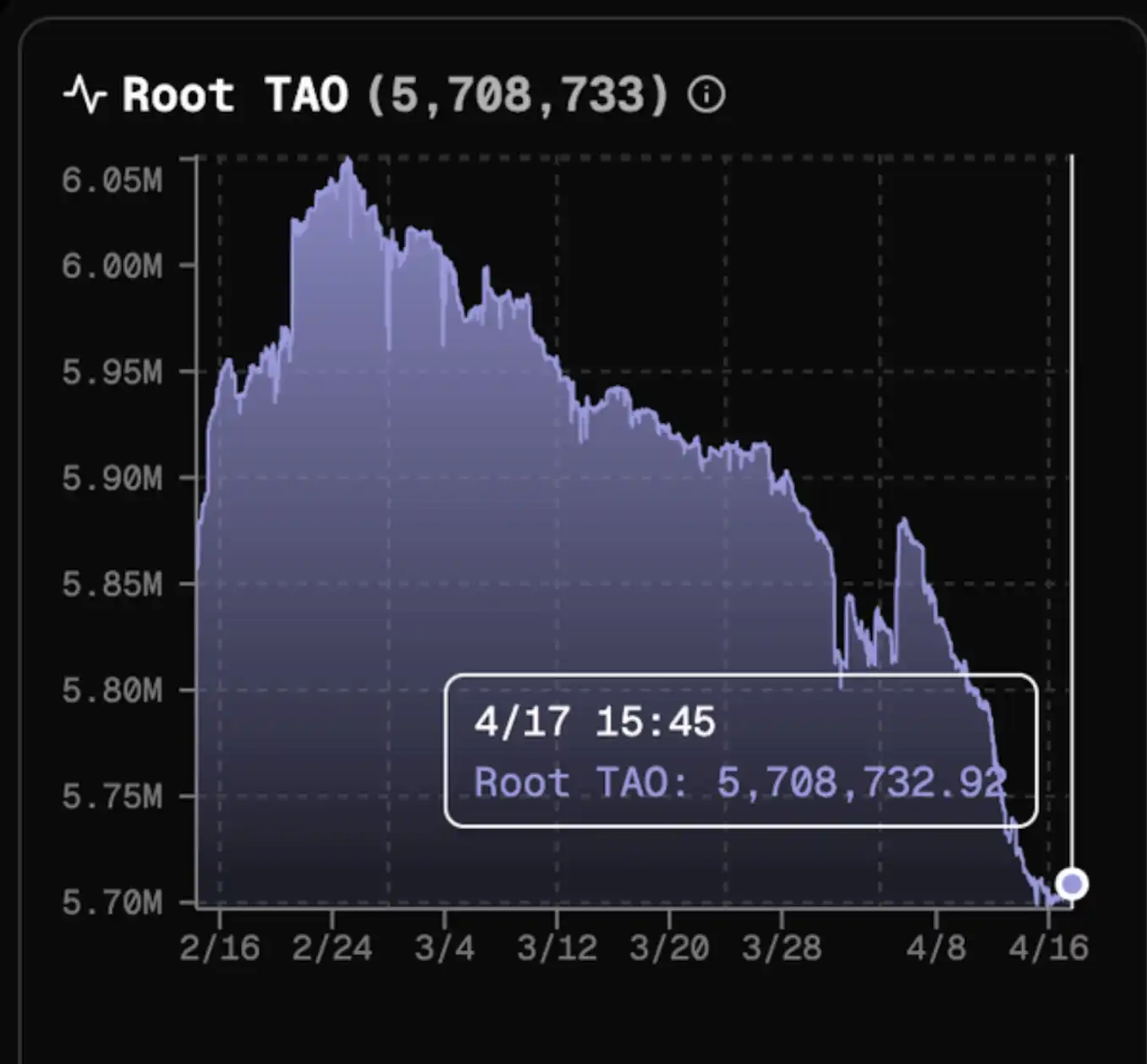
Since the launch of dTAO:
➤ The Bittensor protocol injected 450,000 TAO into the subnet pool
➤ 150,000 TAO (33%) flowed to the root network validation nodes through an "automatic sell-off" mechanism
➤ The root network staking amount (τ₀) decreased by 150,000 TAO (5,860,000 → 5,710,000)
This means:
300,000 TAO (≈70 million USD) successfully fled from the root network and may be liquidated on a CEX.
Moreover, Bittensor's base before was the subnet and miners. Bittensor's previous pattern was like a VC, providing funds to projects to focus on building a valuable business model first without immediately worrying about making money to ensure a balance of income and expenditure. This is the core reason why projects are attracted to build subnets on Bittensor.
Projects attracted to Bittensor brought miners who provide computing power (in Bittensor's terms, "intelligence"). This "you scratch my back, I scratch yours" situation is the core reason why Bittensor could become the leading cryptocurrency AI project by market capitalization.
However, after the dTAO upgrade, the interests of subnet projects, miners, and validation nodes are no longer aligned, and the previous mutual benefit scenario is no more. The dTAO model does not bring any benefits to subnet projects, and the collapse of the economic model is currently the biggest and most fundamental problem for Bittensor.
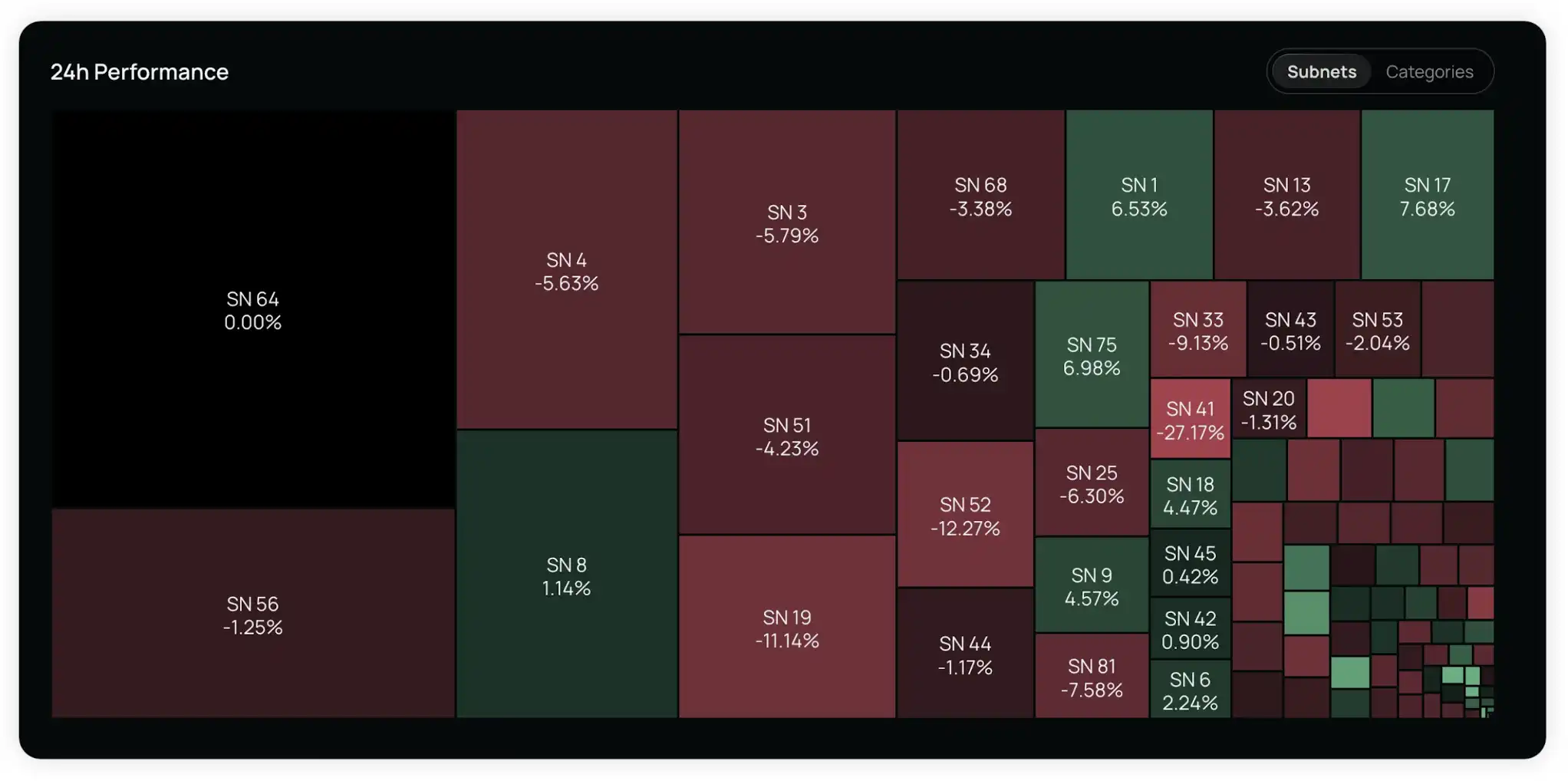
In Bittensor's dTAO model, the Subnet Alpha token is a kind of "voucher" we receive for staking TAO in the subnet, not a Token that can circulate in the general sense. This makes it difficult for subnet projects to invent any effective Tokenomics for these tokens. Besides being able to mint more Alpha tokens, these Alpha tokens have no utility for retail holders. From what I have observed, the most common way subnet projects are trying to pump the token price now is by announcing that project revenue will be used to buy back Alpha tokens, for example, Chutes (SN64).
However, if the Subnet Owner can only empower the Alpha token in this way, then the funny thing happens. The 18% Alpha tokens dTAO allocated to the Subnet project will forever stay in the hands of the project itself. After all, if you have announced a buyback of tokens using project revenue, why would you sell your own tokens?
Selling and buying back are contradictory.
Therefore, not only can the Subnet Owner not receive any income from the dTAO model, but they even have to subsidize it: create external revenue and inject it into their Subnet's Alpha tokens. This means that Subnet projects and miners are essentially working for the validators. Validators, as the privileged class of the Bittensor network, not only cannot do anything of value but can continuously sell Subnet Alpha tokens from the start of the dTAO upgrade, with up to 1/3 of the daily emission flowing back to the root network's TAO.
The reason Bittensor can attract other projects to build Subnets on top of them is fundamentally because the previous TAO emission was a good subsidy mechanism for emerging projects without income, allowing these projects to focus solely on their operational models that needed to be run.
If not only does this subsidy mechanism disappear, but it even reverses, then why would Subnet projects still want to build Subnets on Bittensor? Going solo, keeping all the income for themselves, isn't that better?
Therefore, the dTAO model, as a means for interest groups to dump their holdings, is harming the foundation of Bittensor's development to date. Although most of the Subnet business models in the Bittensor ecosystem are a mess that can't even be looked at, without them, Bittensor would also lose its last fig leaf.
References:
1. Bittensor Official Documentation: docs.bittensor.com
2. Report by @harry_xymeng "Bittensor: When the Music Stops": prism-pancake-61a.notion.site/Bittensor-432c…
3. Guide by @thecryptoskanda "The Three Pan Principle - The Ultimate Guide to Ponzi Construction": x.com/thecryptoskand…
You may also like

Latest research from 13 top universities including Cornell University: The current state, challenges, and misconceptions of the fusion of Crypto and AI
Deconstructing Anthropic: The Best AI Company, Possibly Also a Type of Organizational Invention
Apollo and Blackstone Reportedly Back $35 Billion Anthropic Chip Financing as Deal Details Remain Unclear
On June 9, according to currently available news alerts, Apollo and Blackstone Group participated in a $35 billion financing for an Anthropic “chip project.” Based on the original wording of the report, the funding has already been raised, but public information remains limited. The financing structure, use of proceeds, project entity, and whether Apollo and Blackstone participated through equity, debt, or project financing have not yet been disclosed.

Humanity Protocol Security Incident Escalates: More Than $31 Million Stolen From Related Addresses as Attacker Continues Selling H for ETH
On June 9, according to monitoring by Onchain Lens, more than $31 million has been stolen from addresses linked to Humanity Protocol, and the attack is still ongoing, with the hacker continuously swapping H tokens for ETH. Project founder Terence Kwok later confirmed the security incident on X, saying the issue involved a private key leak.

Bloomberg: As Bitcoin Weakens, Stablecoins and RWA Continue to Drive Expansion in Crypto Businesses
In June, Bloomberg reported that despite Bitcoin falling below $60,000 last week, wiping out about $235 billion in market value within seven days, and dropping close to 50% from last year’s peak, some core businesses in the crypto industry are still expanding, mainly in stablecoins, real-world asset tokenization (RWA), payments, and infrastructure. The report also noted that overall altcoin activity has contracted significantly: altcoin market capitalization has fallen from a peak of about $431 billion in November 2021 to around $170 billion, and among the tens of millions of tokens issued in recent years, fewer than 1,700 still maintain meaningful trading activity.

Galaxy Deep Research Report: How Hyperliquid's HIP-4 Upgrade Changes the Landscape of Prediction Markets?
Binance Research: RWA Market Expected to Expand Nearly 6x from Early 2025, with Public Equities and Onchain Payments Heating Up Together
In June, Binance Research said in its monthly market report that the real-world asset (RWA) market is expected to grow by about 589% from the beginning of 2025. Bond- and money market fund-related RWA expanded by about $6.5 billion, up 83% year over year, while publicly traded equity RWAs grew by about 422%. The report also noted that monthly crypto debit card transaction volume exceeded $747 million in May, up 48.6% year to date.

Japan to Assess a Framework for Yen Stablecoins and Crypto ETFs as Asia’s Compliant Payments Narrative Heats Up
Recently, according to the original report, Japan is considering the launch of yen stablecoins and cryptocurrency ETFs. Public information remains limited at this stage, and there is still no complete policy text, regulatory draft, or clear implementation timeline, so this is better characterized as a “policy discussion” rather than formal implementation. The original wording also noted that advancing stablecoin regulation in Asia is driving XRP usage and supporting growth in the XRPL ecosystem. However, based on currently available public information, there is not enough evidence to directly establish a clear causal relationship between this round of discussion in Japan and XRP or XRPL.

ZachXBT: Humanity private key leak and abnormal surge in H token should be viewed separately
On June 9, according to related disclosures, on-chain investigator ZachXBT posted an update on Humanity’s roughly $31 million security incident, saying that after further analyzing fund flows, he currently tends to believe the project team was not involved in an “inside job” or a self-staged attack. According to him, the official explanation about the private key leak was broadly accurate, but before the token unlock, the price of H had been artificially pushed higher, and the hacker later took advantage of that market environment; therefore, the private key leak and the earlier abnormal price pumping should be regarded as two separate and independent events. This reframing has shifted the market’s understanding of the nature of the incident. Earlier discussion around Humanity had focused on whether the team directly participated in the attack or used the security incident to cover up internal operations. ZachXBT’s latest remarks shift the focus from “whether it was self-theft” to “whether there were pre-unlock market structure issues.” He also questioned whether the team may have.

Morning Report | OpenAI has submitted an S-1 registration statement draft to the U.S. SEC; Morpho completes $175 million financing

Morning Report | BitMine increased its holdings by 126,971 ETH last week; trader Eugene announced his exit from the crypto market

Wang Chuan: How can one not feel anxious after the neighbor Old Wang made thirty times profit by investing in storage stocks? (Seven) - A quarter-century cycle
Cryptocurrency CEXs are flocking to sell US stocks, and traditional brokerages are facing an "uninvited guest."
$75 billion in foreign capital has fled, and South Korean retail investors have absorbed it all using leverage

Japan’s Three Megabanks Plan Joint Stablecoin Issuance in Fiscal 2026
MUFG, SMBC, and Mizuho reportedly plan to jointly issue fiat-pegged stablecoins in fiscal 2026, signaling Japan’s growing push into bank-led digital payment infrastructure.

Humanity Discloses H Token Dual-Chain Attack Details, With Losses on Ethereum and BSC Exceeding $36 Million
Humanity said the H token attack across Ethereum and BSC caused more than $36 million in losses after leaked ProxyAdmin keys enabled malicious contract upgrades and token minting.
White House Discusses CLARITY Act With Law Enforcement Ahead of Senate Vote
The White House discussed the CLARITY Act with law enforcement ahead of a Senate vote, focusing on illicit finance risks and developer protections.

Bitcoin Trading Guide 2026: Strategies for Experienced Traders
Latest research from 13 top universities including Cornell University: The current state, challenges, and misconceptions of the fusion of Crypto and AI
Deconstructing Anthropic: The Best AI Company, Possibly Also a Type of Organizational Invention
Apollo and Blackstone Reportedly Back $35 Billion Anthropic Chip Financing as Deal Details Remain Unclear
On June 9, according to currently available news alerts, Apollo and Blackstone Group participated in a $35 billion financing for an Anthropic “chip project.” Based on the original wording of the report, the funding has already been raised, but public information remains limited. The financing structure, use of proceeds, project entity, and whether Apollo and Blackstone participated through equity, debt, or project financing have not yet been disclosed.
Humanity Protocol Security Incident Escalates: More Than $31 Million Stolen From Related Addresses as Attacker Continues Selling H for ETH
On June 9, according to monitoring by Onchain Lens, more than $31 million has been stolen from addresses linked to Humanity Protocol, and the attack is still ongoing, with the hacker continuously swapping H tokens for ETH. Project founder Terence Kwok later confirmed the security incident on X, saying the issue involved a private key leak.
Bloomberg: As Bitcoin Weakens, Stablecoins and RWA Continue to Drive Expansion in Crypto Businesses
In June, Bloomberg reported that despite Bitcoin falling below $60,000 last week, wiping out about $235 billion in market value within seven days, and dropping close to 50% from last year’s peak, some core businesses in the crypto industry are still expanding, mainly in stablecoins, real-world asset tokenization (RWA), payments, and infrastructure. The report also noted that overall altcoin activity has contracted significantly: altcoin market capitalization has fallen from a peak of about $431 billion in November 2021 to around $170 billion, and among the tens of millions of tokens issued in recent years, fewer than 1,700 still maintain meaningful trading activity.
Galaxy Deep Research Report: How Hyperliquid's HIP-4 Upgrade Changes the Landscape of Prediction Markets?

Popular coins
Latest Crypto News


