
On-Chain Data School (Part 6): A Brand New, Ark-Participated BTC Magical Pricing Methodology (I)

Original Title: "On-chain Data Academy (Part 6): A Brand New, Ark-Participated $BTC Magical Pricing Methodology (I)"
Original Author: Mr. Berg, On-chain Data Analyst
Cointime Price has advanced significantly compared to the previous five articles. If this is your first time reading this series of articles and you want to learn about on-chain knowledge, it is recommended to start by reading the first five articles.
Related Reading: "On-chain Data Academy (Part 5): How Many People Are Really Making Money? A Five-Minute Guide to the Objective Sentiment Index PSIP"
Reading a long article is not easy. Readers are advised to first select the content of interest based on the major headings.
If you want to directly understand the application part, you can read the second and third parts first.
TLDR
- The Cointime Price series consists of three articles, and this article is the first one.
- Introducing the basic principles and buy-the-dip application of Cointime Price
- Cointime Price is a new and efficient $BTC pricing method
- It is stricter than Realized Price and more sensitive than LTH-RP
1. Introduction to Cointime Price
The concept of Cointime Price originated on August 23, 2023, proposed by "Cointime Economics," a collaboration between Ark Invest and Glassnode.
The calculation logic of Cointime Price is relatively complex, and this article will try to explain the principle in a simple and clear manner.
Cointime Price = Pricing Model Designed for the Unique UTXO Structure of $BTC
In traditional pricing methods, when BTC, as a blockchain network, is involved in block creation or transaction transfers, it goes through a validation process. However, Cointime Price differs from traditional pricing methods by using a "time-weighted" calculation approach.
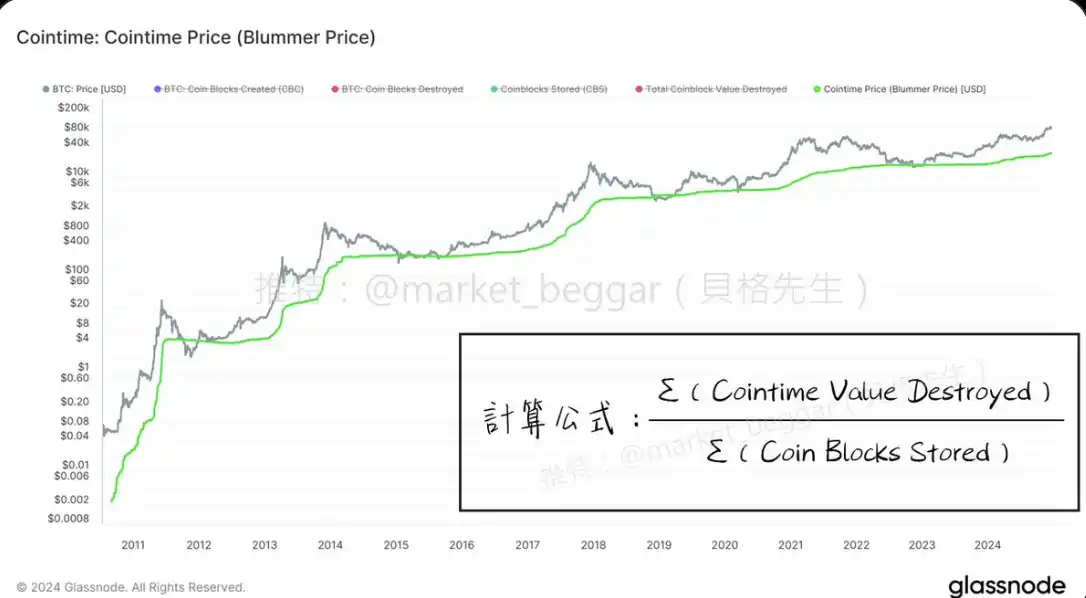
Cointime Price Calculation Logic (as shown in Figure 2, where the green line represents Cointime Price)
The Cointime Price calculation involves three key concepts:
· Coin Blocks Created (CBC):
CBC = The total circulating BTC supply when Block N is generated.
· Coin Blocks Destroyed (CBD):
When BTC is transferred, it is considered destroyed. The calculation is as follows: Transferred BTC amount × Holding time (number of blocks elapsed). This yields CBD (time-weighted BTC amount).
· Coin Blocks Stored (CBS):
CBS = CBC - CBD, which can be understood as the "total time-weighted BTC amount unspent."
In the formula calculation, the numerator's Cointime Value Destroyed is obtained by multiplying CBD by the BTC price at the time of transfer, resulting in the "BTC spent U-value at the time of transaction."
· Key Features of Cointime Price
· Time-weighted design: When long-term holders transfer large amounts of BTC (distribute), the Cointime Price change rate will accelerate.
· Buyer's perspective analysis: The numerator in the formula represents the "total time-weighted spending amount" in the market. Dividing it by CBS yields the market's time-weighted average cost of chips.
· Excluding lost chip impact: Since CBD calculates transfer behavior, BTC that has not been transferred is not counted, so it is not affected by ancient lost BTC.
II. Comparison with LTH-RP
In a previous article, I introduced LTH-RP (Long-Term Holder's Average Holding Cost). Readers interested in this topic can refer to the following post: [Introduction to LTH-RP](https://x.com/market_beggar/status/1864600434129948724)
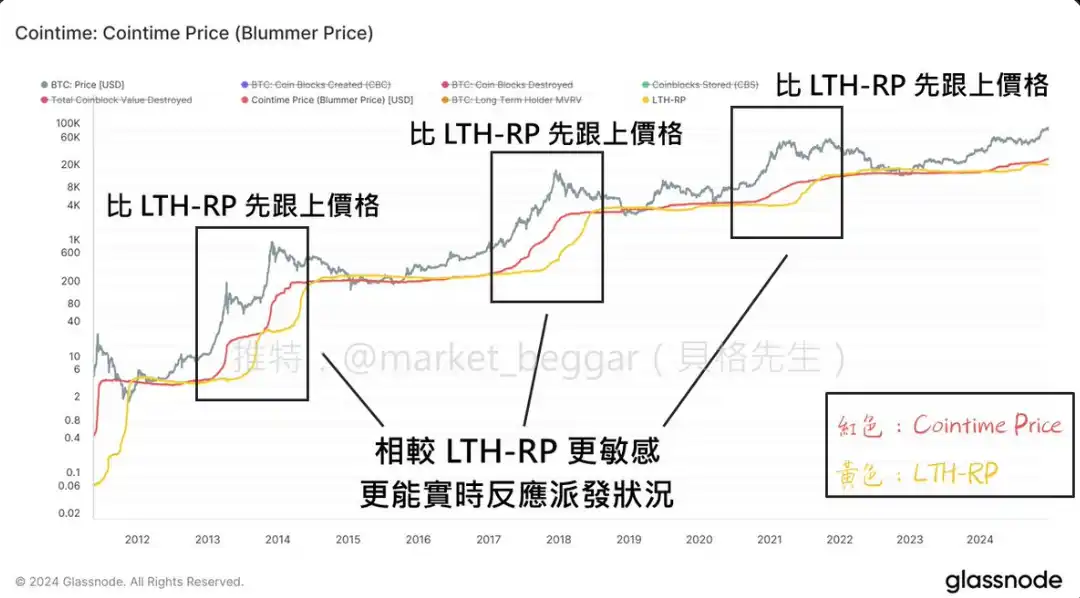
LTH-RP vs. Cointime Price
· Calculation Method of LTH-RP:
- Glassnode defines LTH as BTC held for>155 days
- LTH-RP = Average cost of these LTH BTC
- Limitation: Only for long-term holders, relatively rough definition.
· Calculation Method of Cointime Price:
- Considers the holding time each time BTC is transferred
- More precise and sensitive than LTH-RP
Performance of Cointime Price vs. LTH-RP in Market Trends
As shown in Chart Three, before each market uptrend, Cointime Price always reacts earlier than LTH-RP, better reflecting the real-time occurrence of supply distribution behavior.
Therefore, in my personal analysis, I tend to use Cointime Price for market judgment. The peak model I designed in my weekly market report also includes the Cointime Price indicator.
Application One: Bottom Fishing
Cointime Price = Time-weighted fair valuation of BTC, so when the market price falls below the Cointime Price, it means the market price is below the true value of BTC, usually a good bottom fishing opportunity.
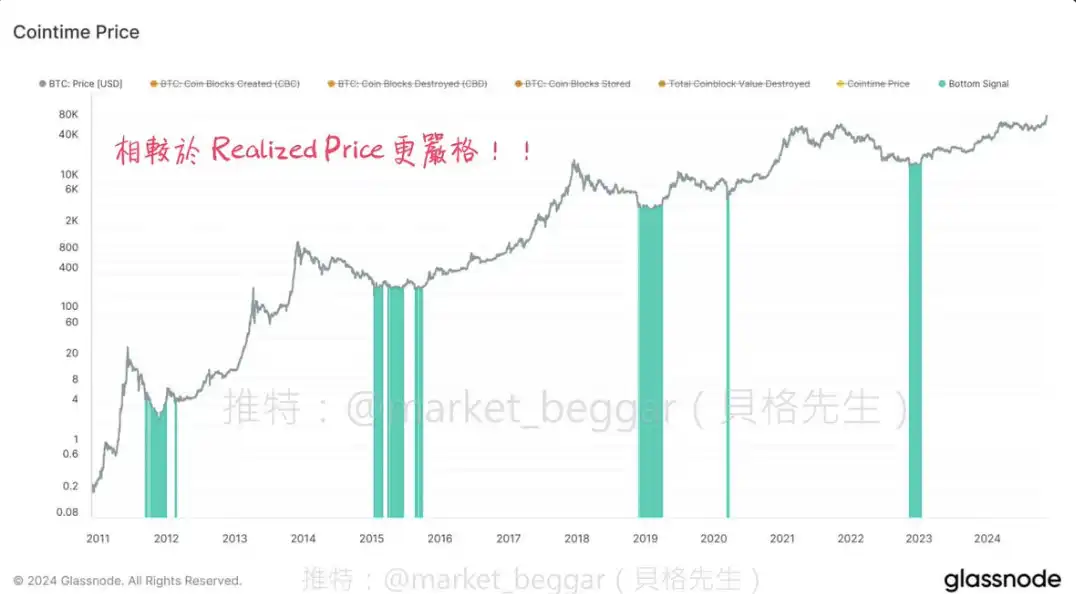
· Historical Data Validation
As shown in Chart Four, I marked the times when the BTC price was below the Cointime Price, and these moments were often good entry points.
Conclusion
This article is the first in the Cointime Price series, introducing the basic concept of Cointime Price and its bottom fishing application.
The next two articles will focus on the application of Cointime Price in Rug Pull scenarios, stay tuned
You may also like

$75 billion in foreign capital has fled, and South Korean retail investors have absorbed it all using leverage

Bitcoin Trading Guide 2026: Strategies for Experienced Traders

What Is XAUT and PAXG? Why Tokenized Gold Is Booming in 2026

Cryptocurrency CEXs are flocking to sell US stocks, and traditional brokerages are facing an "uninvited guest."

Will the SpaceX IPO Hurt Bitcoin? Here's What Traders Are Watching
Foreign selling in the South Korean stock market accelerates, with cumulative net sales reportedly reaching $75 billion this year
On June 9, The Kobeissi Letter, citing Goldman Sachs data, reported that global investors are selling South Korean stocks at an unusually rapid pace. In the latest trading session, foreign investors sold about $801 million worth of Kospi constituent stocks again; total foreign outflows last week reached about $10 billion, and the market has been in net foreign selling on nearly every trading day over the past month. According to the data cited in the report, foreign investors have sold about $75 billion worth of South Korean stocks so far this year. Meanwhile, South Korean retail and institutional investors together recorded roughly $69 billion in net buying over the same period, suggesting that the market’s main buying support has come from domestic capital rather than returning overseas funds. The information currently disclosed still mainly comes from The Kobeissi Letter’s retelling and Goldman Sachs data summaries, while public details on the statistical period and the specific definition of “selling” remain relatively limited.

Fortune Warns of Strategy’s Financing Structure Risks as Bitcoin Premium Narrows
Fortune warned that Strategy’s Bitcoin treasury model faces growing financing risks as MSTR’s net asset premium narrows and preferred stock dividend pressure increases.

Ferrari Challenge Le Mans: Carl Moon to Dominate in WEEX Livery

Sahara AI Responds to SAHARA’s Sharp Drop: No Contract or Product Security Issues Found, Internal Investigation Underway
Sahara AI responded to SAHARA’s 60% price drop, saying no token contract or product security issues have been found and an internal investigation is underway.

WEEX Deposit/Withdrawal Dynamic Island: Your Asset Status, Always in Sight

Scaling Crypto Derivatives: The Digital Asset Infrastructure Behind High-Volume Trading
In the fast-moving digital asset ecosystem, derivatives platforms face an extreme architectural test. High-leverage futures markets demand more than just standard security—they require absolute operational precision, zero-latency matching engines, and ironclad structural scalability, all while navigating intense market volatility.
As global platforms scale to meet these demands, the industry is shifting away from rigid, monolithic setups toward a more agile, "decoupled" infrastructure philosophy.
The Blueprint for High-Volume Copy TradingFor elite global exchanges like WEEX (founded in 2018), this architectural choice becomes critical when scaling high-volume retail features like social copy trading. When thousands of users automatically mirror the real-time strategies of elite traders simultaneously, it triggers sudden, monumental spikes in concurrent transactional volume.
To prevent execution latency or settlement bottlenecks during these peak volatility events, a platform's primary engine must remain entirely dedicated to risk management, copy-trade synchronization, and order matching.
The Architectural Rule: New-generation platforms must separate front-end user execution engines from heavy backend infrastructural overhead to eliminate operational friction.
By separating these layers, platforms can maintain complete sovereignty over their trading environments and user experiences while strategically aligning with institutional-grade infrastructure ecosystems. This strategic framework allows modern exchanges to leverage advanced Digital Asset Custody infrastructure such as Cobo’s behind the scenes, ensuring that backend wallet management scales elastically alongside trading spikes.
Capitalizing on Market Momentum and 400× LeverageIn a derivatives arena where platforms offer up to 400× leverage on perpetual contracts, capital efficiency and market agility are core business metrics. To capture market momentum, an exchange needs the ability to rapidly expand its asset offerings, supporting everything from legacy crypto assets to sudden, trending altcoins across a massive library of trading pairs.
Adopting a flexible, scalable Wallet-as-a-Service (WaaS) solution such as Cobo’s could completely rewrite the development timeline for high-growth exchanges. Instead of spending months of engineering capital building out custom backend wallet architectures for every new blockchain network, platforms can deploy localized infrastructure in days.
This agility allows platforms to instantly scale their listings to over a thousand trading pairs without compromising security or delaying time-to-market. It mirrors the exact operational advantages seen during high-velocity market events, similar to how advanced wallet infrastructure empowers platforms during sudden asset surges; allowing exchanges to pass that speed and liquidity directly to their global user base.
A Mature Foundation for GrowthThe synergy between trusted infrastructure ecosystems and global trading platforms represents the natural evolution of a maturing crypto market. As WEEX continues to scale its global spot and derivatives offerings for over 6 million users, adopting robust backend paradigms proves that platforms no longer have to compromise between cutting-edge trading velocity and uncompromised structural security.

Morning Report | BitMine increased its holdings by 126,971 ETH last week; trader Eugene announced his exit from the crypto market

Wang Chuan: How can one not feel anxious after the neighbor Old Wang made thirty times profit by investing in storage stocks? (Seven) - A quarter-century cycle

Get Paid to Onboard? Try WEEX’s New Homepage with Rewards for Registration, Deposit & Trade

WEEX Custom Layout: Build Your Perfect Trading Workspace in Seconds

See “Buy Walls” & “Sell Walls” Instantly: WEEX Launches the Depth Chart for Smarter Trades

What Is Quick Trade on WEEX? 2 Ways WEEX Ends Chart-Panel Jumping
Morning News | Five major virtual asset platforms in South Korea have experienced 57 incidents of hacking and system failures in six years; Grayscale submits registration application for Canton ETF
$75 billion in foreign capital has fled, and South Korean retail investors have absorbed it all using leverage
Bitcoin Trading Guide 2026: Strategies for Experienced Traders
What Is XAUT and PAXG? Why Tokenized Gold Is Booming in 2026
Cryptocurrency CEXs are flocking to sell US stocks, and traditional brokerages are facing an "uninvited guest."
Will the SpaceX IPO Hurt Bitcoin? Here's What Traders Are Watching
Foreign selling in the South Korean stock market accelerates, with cumulative net sales reportedly reaching $75 billion this year
On June 9, The Kobeissi Letter, citing Goldman Sachs data, reported that global investors are selling South Korean stocks at an unusually rapid pace. In the latest trading session, foreign investors sold about $801 million worth of Kospi constituent stocks again; total foreign outflows last week reached about $10 billion, and the market has been in net foreign selling on nearly every trading day over the past month. According to the data cited in the report, foreign investors have sold about $75 billion worth of South Korean stocks so far this year. Meanwhile, South Korean retail and institutional investors together recorded roughly $69 billion in net buying over the same period, suggesting that the market’s main buying support has come from domestic capital rather than returning overseas funds. The information currently disclosed still mainly comes from The Kobeissi Letter’s retelling and Goldman Sachs data summaries, while public details on the statistical period and the specific definition of “selling” remain relatively limited.


