
meme Coin Crashes 50% Across the Board, Did Binance Pull an April Fools' Day Prank on the Market?




On April 1st, Binance had a rough April Fools' Day, and the market fell victim to a costly joke. First, $GUN was suspected by the community to be engaging in rug pulling or whale dumping, but this matter has yet to be conclusively resolved. Following one announcement, a more serious chain reaction crash occurred later that night. What kind of joke did Binance play on us this April Fools' Day?

Announcement Turmoil
Initial Announcement
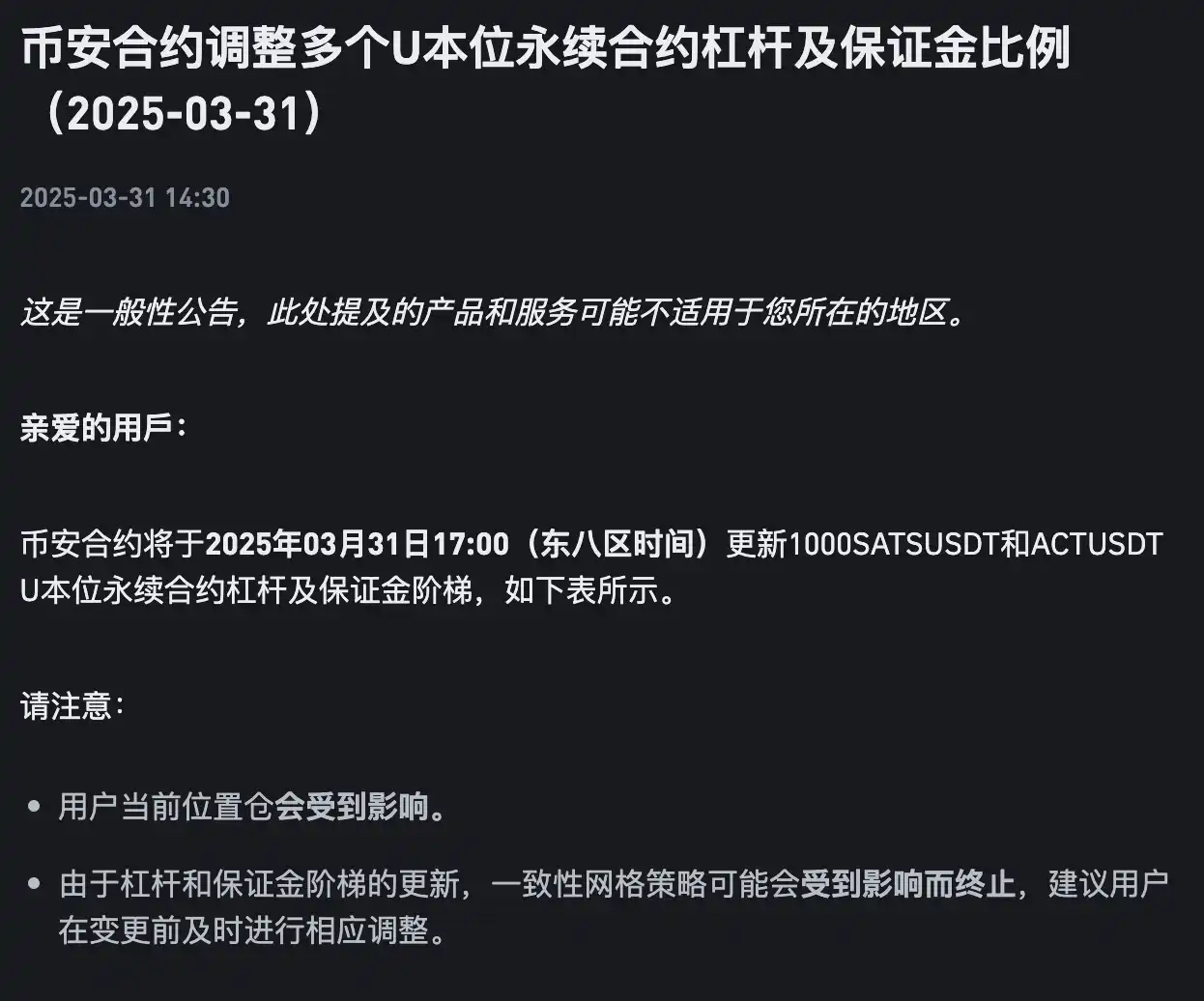
The genesis of this plummet can be traced back to an announcement made yesterday. On March 31st at 14:30, Binance released the announcement "Binance Futures will update 1000SATSUSDT and ACTUSDT U perpetual contract leverage and margin tier at 17:00 on the same day," warning users that their current position might be affected and that due to the leverage and margin tier update, the consistency grid strategy may be terminated. Users were advised to make necessary adjustments promptly before the change.
Subsequent Amendment Announcement
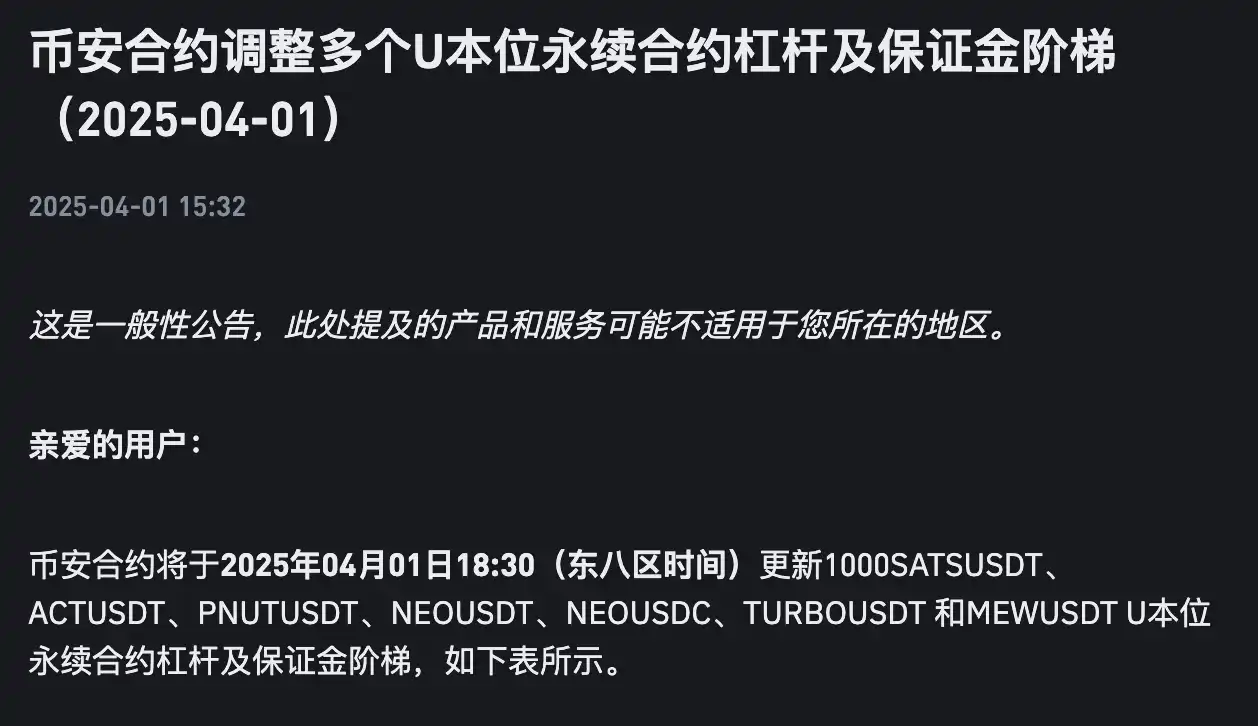
Just one day later, on April 1st at 15:32, Binance once again issued an announcement stating, "Binance Futures will update 1000SATSUSDT, ACTUSDT, PNUTUSDT, NEOUSDT, NEOUSDC, TURBOUSDT, and MEWUSDT U perpetual contract leverage and margin tier on April 1, 2025, at 18:30". This announcement not only further modified the previous day's newly updated $ACT position limit "by further reducing the lower leverage position limit by 50%," but also gave users less than a 3-hour reaction time.
Marketwide Meltdown
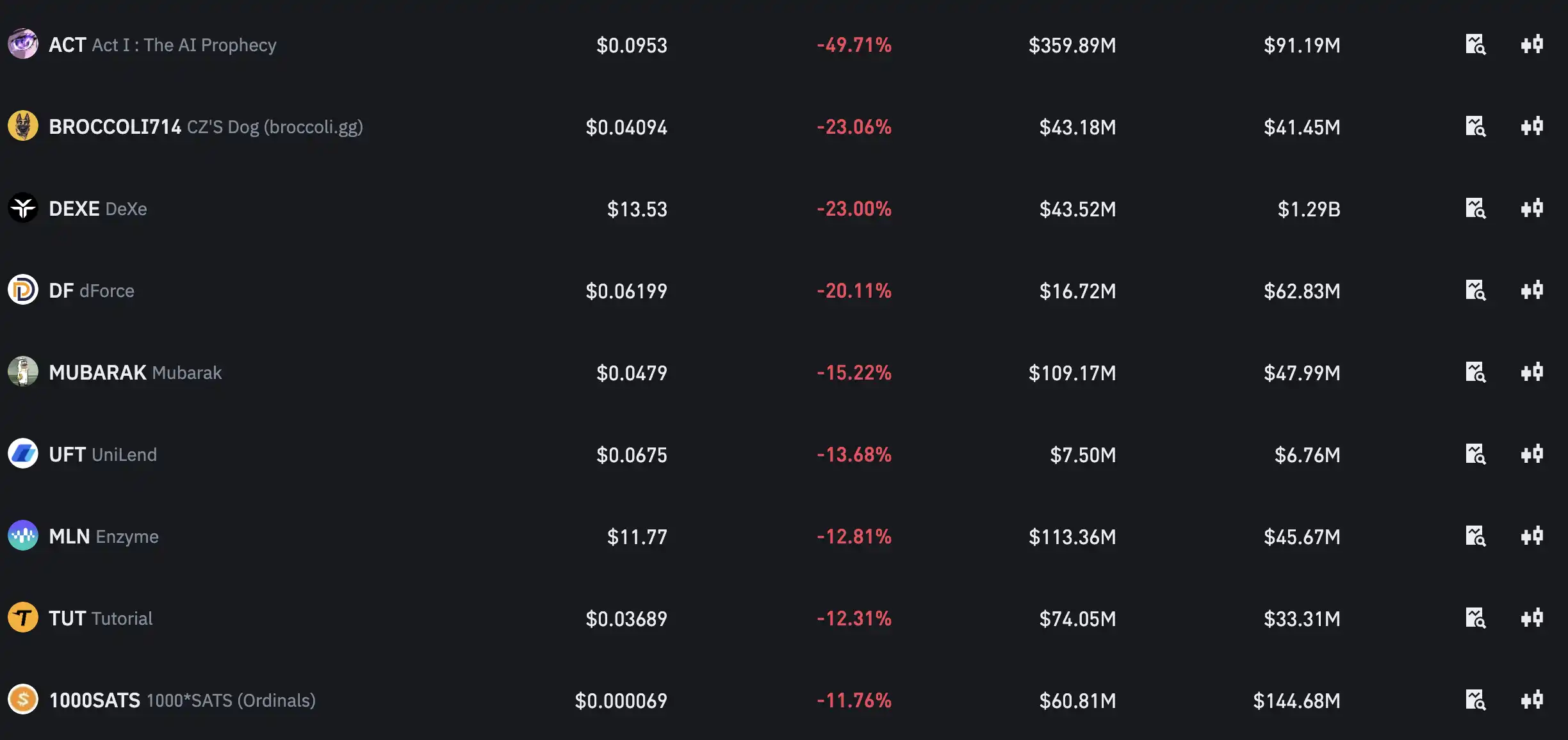
Several tokens such as ACT, DEXE, HIPPO, BANANAS31, TST, PNUT, and others experienced nearly simultaneous drops of up to 50%. Within a span of just 5 minutes from 18:30 to 18:35, the total value of ACT contract holdings on the Binance platform plummeted by 76.53%, dropping from $94.1286 million to $22.0932 million. This instantly ignited the community, clearly indicating that the impact of Binance's rule changes far exceeded everyone's expectations, leading to widespread speculation about the cause of the crash.
Liquidity Provider Suspicion
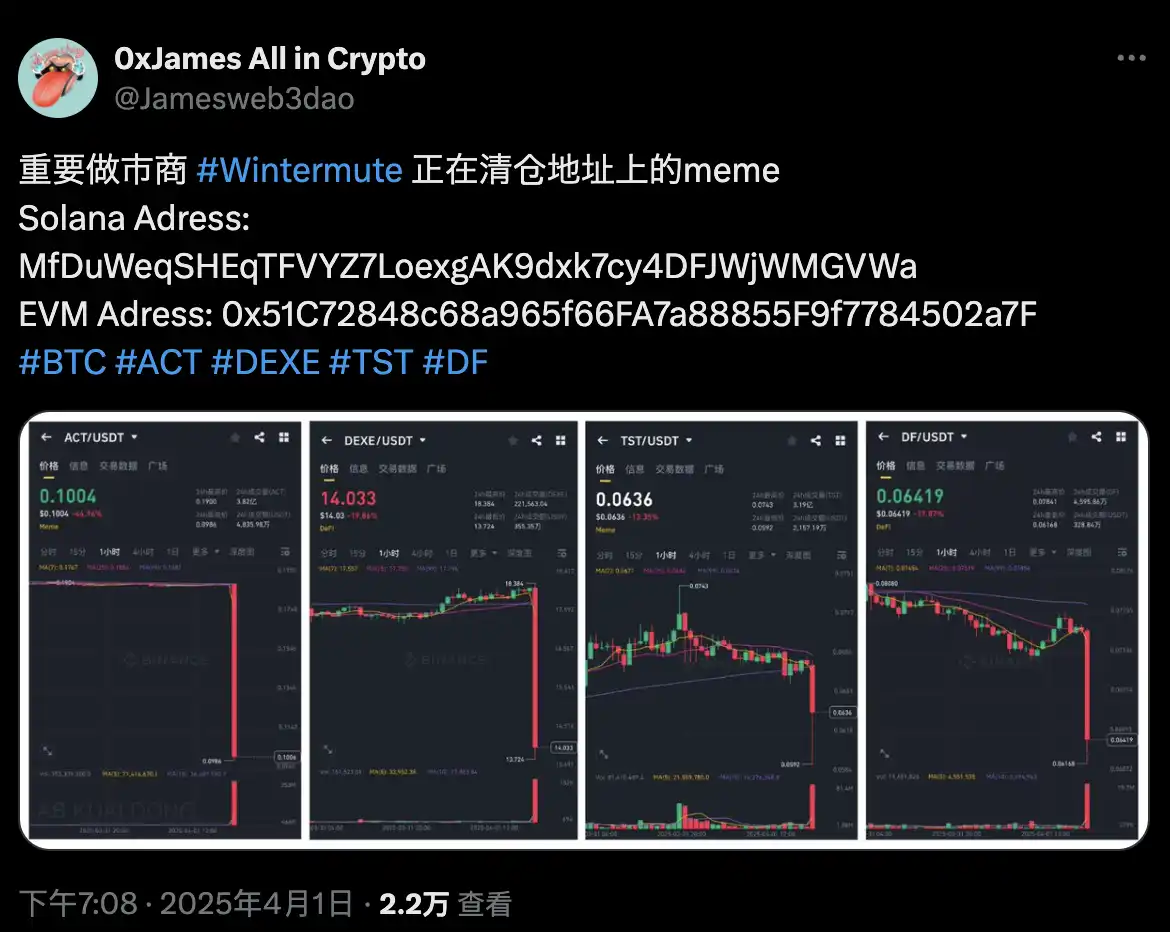
The first to be suspected was the liquidity provider, with WinterMute as the liquidity provider for the biggest loser $ACT and multiple MemeCoins thrust into the spotlight. Twitter KOL 0xJames observed addresses related to WinterMute were liquidating their Meme positions on-chain. Wintermute dumped approximately $250,000 worth of ACT tokens in half an hour through Raydium.
Liquidity Provider Clarification
However, some people, after analyzing the situation, don't believe this to be the case. A Web3 philosopher stated, "There is a clear time delay between CEX dumping and on-chain liquidation behavior. If WinterMute wanted to liquidate Meme, it would not align with the principle of maximizing profits."

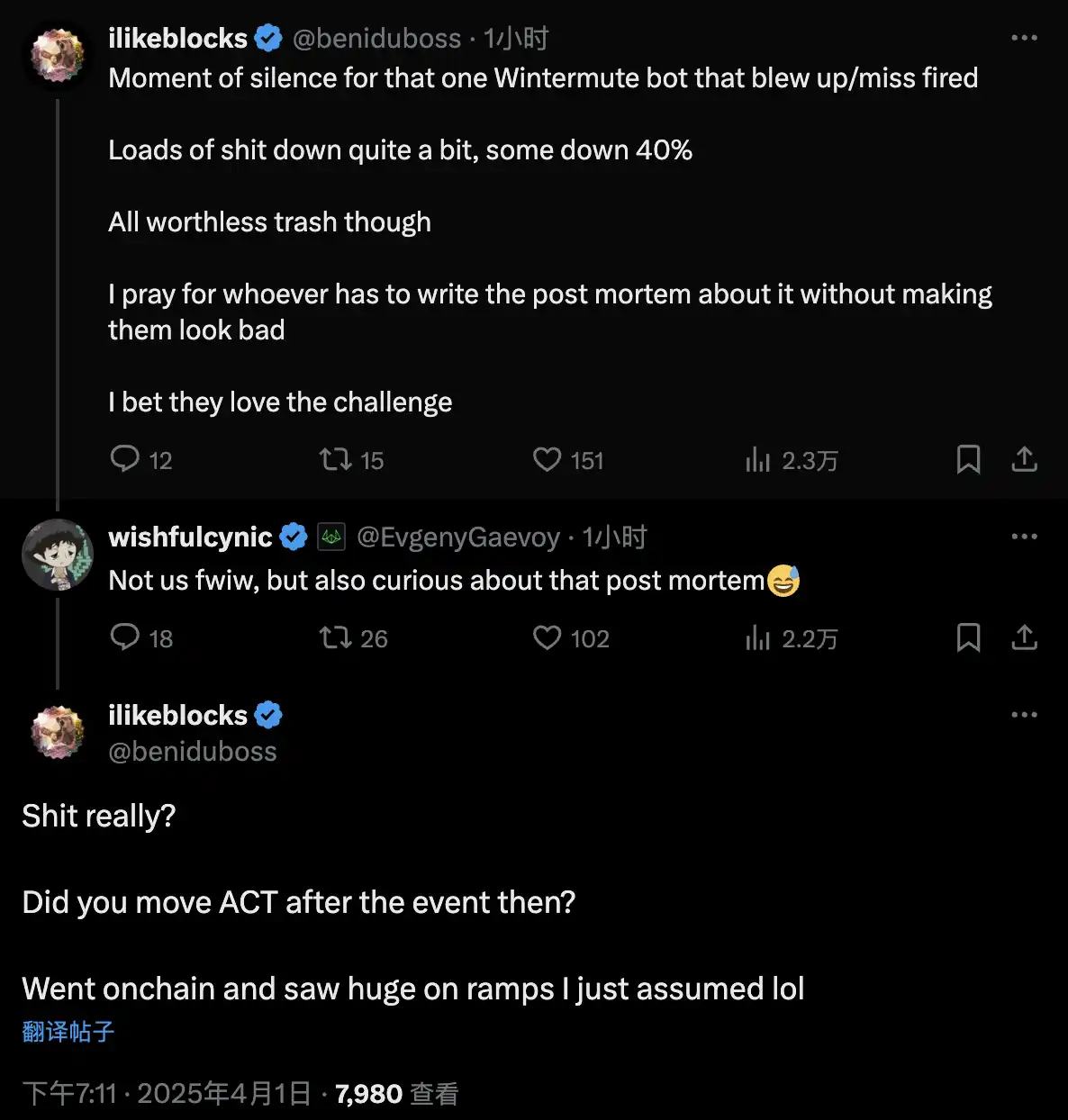
WinterMute's founder and CEO, Evgeny Gaevoy, later responded to a skeptic and left a remark saying, "It's not our thing, and we are also curious about the post-mortem analysis of what actually happened," indicating that the on-chain selling behavior was a reaction to drastic token price fluctuations and automated arbitrage in the AMM pool.
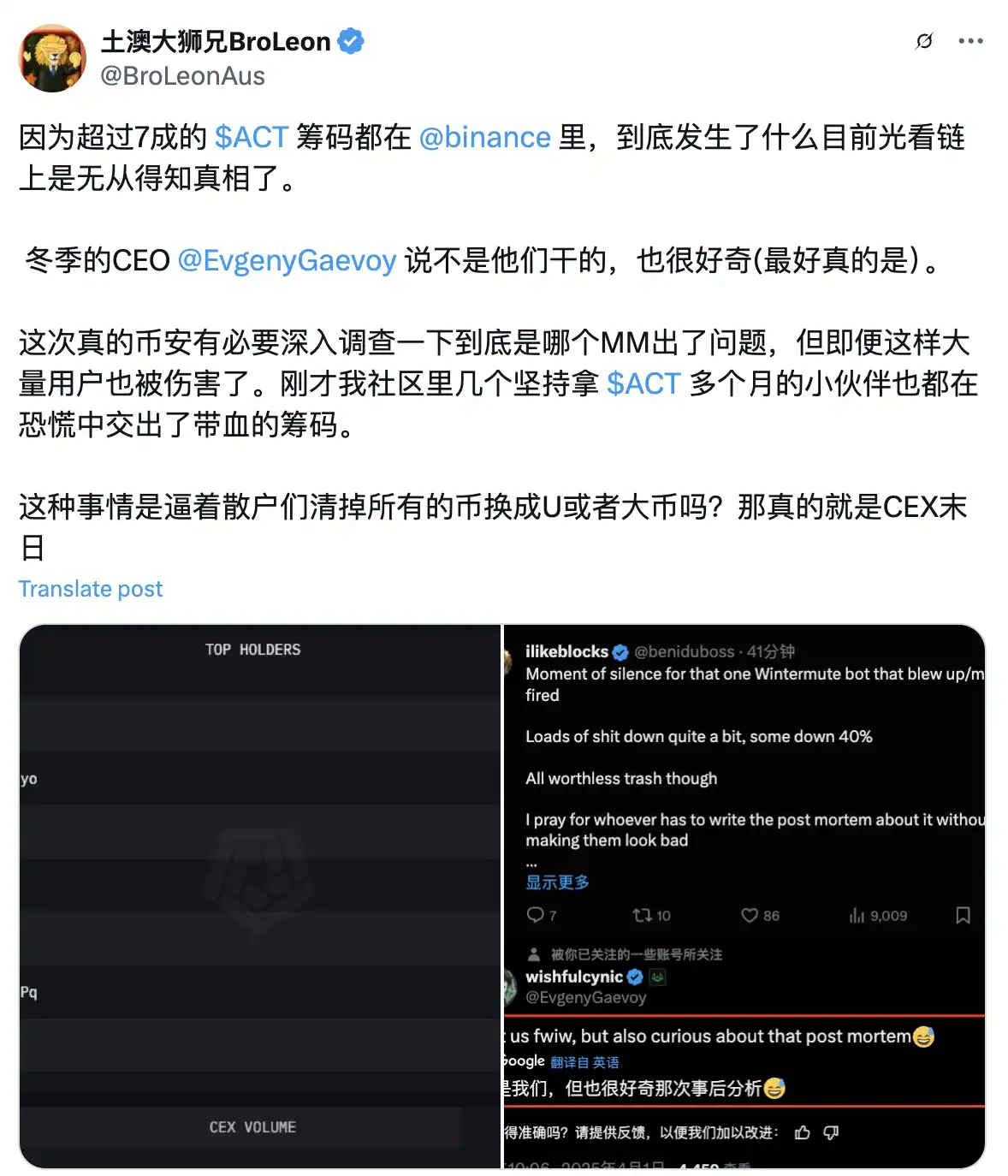
Australian lion BroLeon expressed skepticism towards Gaevoy's explanation, mentioning that 70% of $ACT chips are on exchanges, and the truth cannot be ascertained only from on-chain data. He hopes Binance can conduct a thorough investigation and provide a satisfactory answer; otherwise, it will have a highly negative impact on the market.
Binance Rule Change Factor
Of course, some also believe it was not a liquidity provider dumping but a change in Binance's rules. Firstly, the rule adjustment directly affected market liquidity. Binance adjusted the contract's position limit and leverage multiplier to reduce market risk. However, this had a significant impact on liquidity providers. The lowered position limit forced them to reduce their holdings, even leading to forced liquidation. The reduced leverage also compelled them to decrease leveraged positions. Liquidity providers typically hold spot and contract positions to hedge risks. If their holdings exceed the new limit or if funds are insufficient after leverage reduction, the system forcibly liquidates, selling in the contract market and reducing the contract price.
As the spot and contract price spreads continued to widen, coupled with arbitrage bots buying low in the contract market and selling high in the spot market, profiting from the narrowing spread, the bots sold extensively in the spot market, further depressing the spot price. As the liquidity providers were liquidated, causing the contract price to fall, coupled with arbitrage bots causing the spot price to drop, the overall market sentiment turned to panic, with retail investors following suit, leading to a chain reaction crash, resulting in a complete collapse of the Memecoin market.
Crypto KOL and former FTX Community Partner Benson Sun commented on this, saying, "Before Binance changes the rules, it should first assess how many positions will be liquidated. If the position of a market maker is large, they should also be notified in advance. As an industry leader, I hope Binance can handle this incident properly."
The Truth Remains a Mystery
After experiencing suspicions from the market regarding market makers, Binance rule mistakes, and even internal misconduct, KOL Zishi stated that none of this is related and only stated the facts. Meanwhile, He Yi commented with a sigh under this tweet, showing his helplessness.
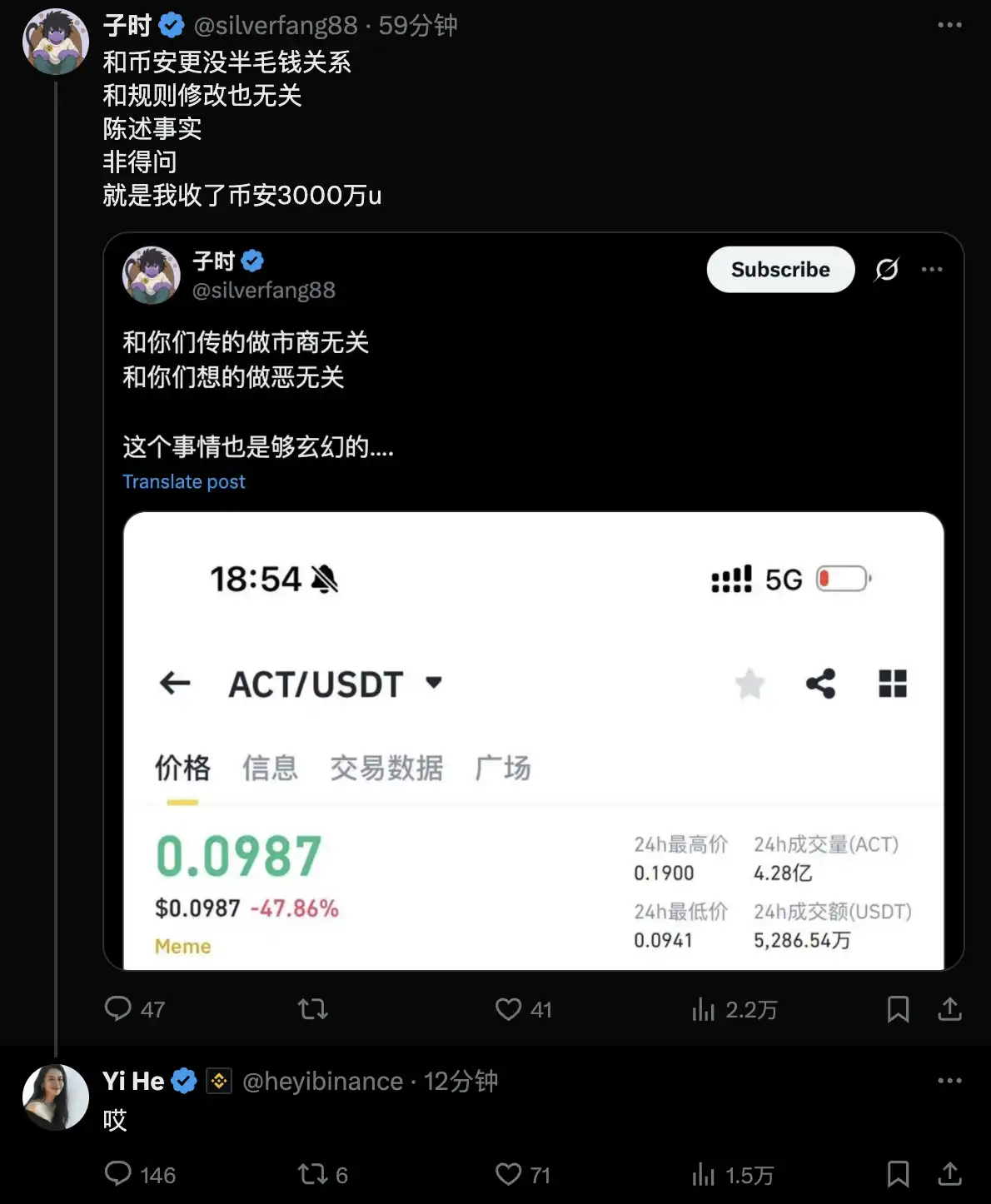
At the time of publication, He Yi tweeted that the corresponding team is preparing a detailed response, and it is still impossible to make a judgment at present. Recently, the beleaguered Binance has indeed encountered some issues that need to be addressed. BlockBeats will continue to follow this matter and report on it.
You may also like

Cryptocurrency CEXs are flocking to sell US stocks, and traditional brokerages are facing an "uninvited guest."

Will the SpaceX IPO Hurt Bitcoin? Here's What Traders Are Watching
Foreign selling in the South Korean stock market accelerates, with cumulative net sales reportedly reaching $75 billion this year
On June 9, The Kobeissi Letter, citing Goldman Sachs data, reported that global investors are selling South Korean stocks at an unusually rapid pace. In the latest trading session, foreign investors sold about $801 million worth of Kospi constituent stocks again; total foreign outflows last week reached about $10 billion, and the market has been in net foreign selling on nearly every trading day over the past month. According to the data cited in the report, foreign investors have sold about $75 billion worth of South Korean stocks so far this year. Meanwhile, South Korean retail and institutional investors together recorded roughly $69 billion in net buying over the same period, suggesting that the market’s main buying support has come from domestic capital rather than returning overseas funds. The information currently disclosed still mainly comes from The Kobeissi Letter’s retelling and Goldman Sachs data summaries, while public details on the statistical period and the specific definition of “selling” remain relatively limited.

Fortune Warns of Strategy’s Financing Structure Risks as Bitcoin Premium Narrows
Fortune warned that Strategy’s Bitcoin treasury model faces growing financing risks as MSTR’s net asset premium narrows and preferred stock dividend pressure increases.

Ferrari Challenge Le Mans: Carl Moon to Dominate in WEEX Livery

Sahara AI Responds to SAHARA’s Sharp Drop: No Contract or Product Security Issues Found, Internal Investigation Underway
Sahara AI responded to SAHARA’s 60% price drop, saying no token contract or product security issues have been found and an internal investigation is underway.

WEEX Deposit/Withdrawal Dynamic Island: Your Asset Status, Always in Sight

Scaling Crypto Derivatives: The Digital Asset Infrastructure Behind High-Volume Trading
In the fast-moving digital asset ecosystem, derivatives platforms face an extreme architectural test. High-leverage futures markets demand more than just standard security—they require absolute operational precision, zero-latency matching engines, and ironclad structural scalability, all while navigating intense market volatility.
As global platforms scale to meet these demands, the industry is shifting away from rigid, monolithic setups toward a more agile, "decoupled" infrastructure philosophy.
The Blueprint for High-Volume Copy TradingFor elite global exchanges like WEEX (founded in 2018), this architectural choice becomes critical when scaling high-volume retail features like social copy trading. When thousands of users automatically mirror the real-time strategies of elite traders simultaneously, it triggers sudden, monumental spikes in concurrent transactional volume.
To prevent execution latency or settlement bottlenecks during these peak volatility events, a platform's primary engine must remain entirely dedicated to risk management, copy-trade synchronization, and order matching.
The Architectural Rule: New-generation platforms must separate front-end user execution engines from heavy backend infrastructural overhead to eliminate operational friction.
By separating these layers, platforms can maintain complete sovereignty over their trading environments and user experiences while strategically aligning with institutional-grade infrastructure ecosystems. This strategic framework allows modern exchanges to leverage advanced Digital Asset Custody infrastructure such as Cobo’s behind the scenes, ensuring that backend wallet management scales elastically alongside trading spikes.
Capitalizing on Market Momentum and 400× LeverageIn a derivatives arena where platforms offer up to 400× leverage on perpetual contracts, capital efficiency and market agility are core business metrics. To capture market momentum, an exchange needs the ability to rapidly expand its asset offerings, supporting everything from legacy crypto assets to sudden, trending altcoins across a massive library of trading pairs.
Adopting a flexible, scalable Wallet-as-a-Service (WaaS) solution such as Cobo’s could completely rewrite the development timeline for high-growth exchanges. Instead of spending months of engineering capital building out custom backend wallet architectures for every new blockchain network, platforms can deploy localized infrastructure in days.
This agility allows platforms to instantly scale their listings to over a thousand trading pairs without compromising security or delaying time-to-market. It mirrors the exact operational advantages seen during high-velocity market events, similar to how advanced wallet infrastructure empowers platforms during sudden asset surges; allowing exchanges to pass that speed and liquidity directly to their global user base.
A Mature Foundation for GrowthThe synergy between trusted infrastructure ecosystems and global trading platforms represents the natural evolution of a maturing crypto market. As WEEX continues to scale its global spot and derivatives offerings for over 6 million users, adopting robust backend paradigms proves that platforms no longer have to compromise between cutting-edge trading velocity and uncompromised structural security.

Morning Report | BitMine increased its holdings by 126,971 ETH last week; trader Eugene announced his exit from the crypto market

Wang Chuan: How can one not feel anxious after the neighbor Old Wang made thirty times profit by investing in storage stocks? (Seven) - A quarter-century cycle

Get Paid to Onboard? Try WEEX’s New Homepage with Rewards for Registration, Deposit & Trade

WEEX Custom Layout: Build Your Perfect Trading Workspace in Seconds

See “Buy Walls” & “Sell Walls” Instantly: WEEX Launches the Depth Chart for Smarter Trades

What Is Quick Trade on WEEX? 2 Ways WEEX Ends Chart-Panel Jumping
Morning News | Five major virtual asset platforms in South Korea have experienced 57 incidents of hacking and system failures in six years; Grayscale submits registration application for Canton ETF

Should we escape the peak? The principle of the tail-end market in the stock market

RootData: May 2026 Cryptocurrency Exchange Transparency Research Report

Founder of Baixing.com: My Experience with Claude Code in Fourteen Points
Cryptocurrency CEXs are flocking to sell US stocks, and traditional brokerages are facing an "uninvited guest."
Will the SpaceX IPO Hurt Bitcoin? Here's What Traders Are Watching
Foreign selling in the South Korean stock market accelerates, with cumulative net sales reportedly reaching $75 billion this year
On June 9, The Kobeissi Letter, citing Goldman Sachs data, reported that global investors are selling South Korean stocks at an unusually rapid pace. In the latest trading session, foreign investors sold about $801 million worth of Kospi constituent stocks again; total foreign outflows last week reached about $10 billion, and the market has been in net foreign selling on nearly every trading day over the past month. According to the data cited in the report, foreign investors have sold about $75 billion worth of South Korean stocks so far this year. Meanwhile, South Korean retail and institutional investors together recorded roughly $69 billion in net buying over the same period, suggesting that the market’s main buying support has come from domestic capital rather than returning overseas funds. The information currently disclosed still mainly comes from The Kobeissi Letter’s retelling and Goldman Sachs data summaries, while public details on the statistical period and the specific definition of “selling” remain relatively limited.
Fortune Warns of Strategy’s Financing Structure Risks as Bitcoin Premium Narrows
Fortune warned that Strategy’s Bitcoin treasury model faces growing financing risks as MSTR’s net asset premium narrows and preferred stock dividend pressure increases.
Ferrari Challenge Le Mans: Carl Moon to Dominate in WEEX Livery
Sahara AI Responds to SAHARA’s Sharp Drop: No Contract or Product Security Issues Found, Internal Investigation Underway
Sahara AI responded to SAHARA’s 60% price drop, saying no token contract or product security issues have been found and an internal investigation is underway.


