
Life and Death Struggle of the Primary Market: How Does Blockchain Venture Capital Navigate the Value Winter Cycle?





Original Title: "Blockchain Primary Market Dilemma and Breakthrough: From Value Confusion to Ecosystem Reconstruction"
Original Author: Lawrence, Mars Finance
1. Industry Mirror of Du Jun's Manifesto: Structural Contradictions in the Primary Market Exposed
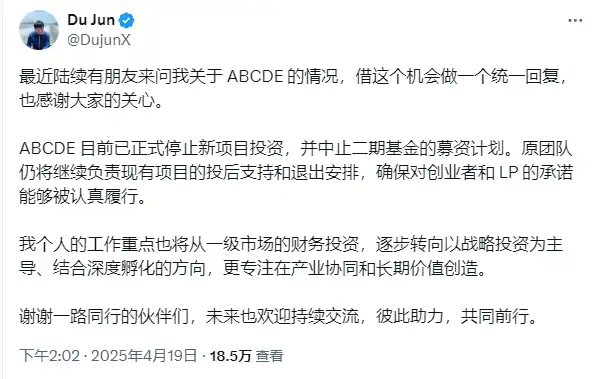
Founder of ABCDE Capital, Du Jun, announced the decision to suspend new investments and the second-phase fundraising plan, resembling a touchstone plunged into the depths of the blockchain industry, sparking ripples that reflect the systemic contradictions existing in the primary market.
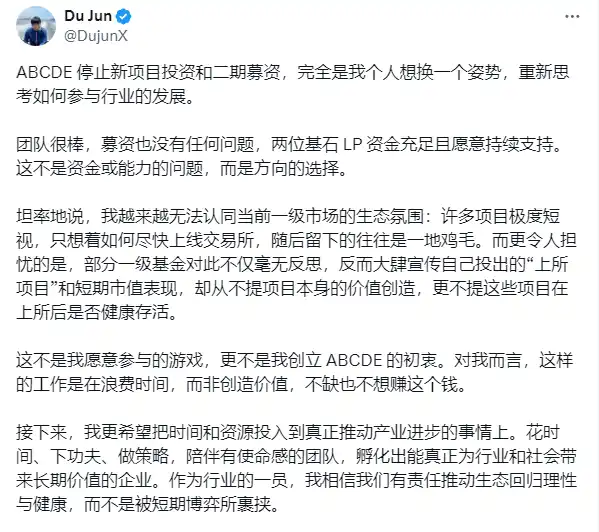
This industry veteran, who has been involved in heavyweight institutions such as Huobi and Node Capital, used sharp expressions like "short-sighted game" and "value creation loss" to pinpoint the industry's core malaise: in the frenzy of token liquidity, the original intention of the blockchain technology revolution is being alienated by exchange platform market value management and institutional arbitrage games.
This alienation exhibits significant features at the data level: according to CoinMarketCap statistics, in the first quarter of 2025, there were 327 new exchange platform projects launched globally, but only 12% of these projects continued positive technical iterations three months after listing, with the average token price falling by 67% compared to the opening price.
Of more concern is that some institutions, through the industrialized assembly line operation of "private placement - listing - market value management - exit," have compressed the investment cycle to 6-8 months, causing numerous projects to devolve into abnormal products of "code shells + economic model packaging."
The deep-rooted cause of this phenomenon lies in the blockchain industry's unique "triple misalignment":
· Temporal Value Misalignment: The traditional VC's 7-10 year exit cycle has been compressed to 18-24 months under the impact of token liquidity, causing a reversal in the technology incubation period and capital return period.
· Valuation System Misalignment: Network effects of protocol projects have not yet materialized, while market value has already pre-assumed the future 5-10 year value through token models.
· Responsibility Boundary Misalignment: Institutions have simplified post-investment management into exchange platform docking services, neglecting technical roadmap adjustments and ecosystem co-building responsibilities.
This systemic distortion is devouring the industry's innovative momentum.
As indicated by data from the Gitcoin developer forum, blockchain original protocol code commits in Q1 of 2025 saw a 23% year-on-year decline, while the number of token economic model whitepapers surged by 178%. We must face the fact that the industry is transitioning from a technology-driven value internet to a liquidity casino dominated by financial engineering.
2. Value Reconstruction Coordinate System: Technological Anchors and Investment Logic Reset for the Next 3-5 Years
Amidst the fog of liquidity abundance and value disorientation, reconstructing investment logic requires a return to the fundamental attributes of blockchain technology—creating a new trust infrastructure through cryptography and distributed consensus. Based on technological evolution trends and real-world economic needs, the key areas worthy of focused investment in the future exhibit three main characteristics:
(1) Breakthrough Innovation at the Protocol Layer
Interoperability Protocol
The current "island effect" in the public chain ecosystem severely restricts application implementation. Cross-chain protocols such as Cosmos IBC and Polkadot XCM need to achieve a qualitative breakthrough. The next-generation protocols should possess:
· Sub-second atomic swap capability (currently averaging 3-8 seconds)
· Heterogeneous chain smart contract interoperability framework
· Dynamic fee model to resist sandwich attacks
· Such technological breakthroughs will unlock trillions of dollars in cross-chain liquidity, giving rise to new financial protocols and data markets.
Commercialization Engine for Zero-Knowledge Proofs
Privacy computing technologies like zk-SNARKs are transitioning from being a "cryptographic toy" to business infrastructure. Investment focus should shift towards:
· Hardware-accelerated zkVM (e.g., RISC Zero architecture optimization)
· Composable privacy data markets (e.g., healthcare data, supply chain finance scenarios)
· Compliance-auditable proof systems
· According to ABI Research, the market size related to zero-knowledge proofs is expected to exceed $4.7 billion by 2028, with a CAGR of 62%.
Decentralized Storage Protocol Reconstruction
The security crisis of traditional centralized cloud storage (e.g., the 2024 AWS outage resulting in a $3.7 billion loss) has spurred new demands:
· Content-addressed permanent storage protocols
· Storage proof and economic model innovations (e.g., Filecoin Virtual Machine)
· Enterprise-grade storage compliance solutions
· This field will give birth to the "digital Noah's Ark" of the Web3 era.
(2) Value Capture Revolution at the Middleware Layer
DeFi 3.0 Liquidity Protocol
Going beyond the current AMM/DEX paradigm, the next-generation protocol needs to address:
· Impermanent Loss Dynamic Hedging Mechanism
· Cross-chain Liquidity Aggregator
· Compliant Stablecoin Payment Rail (e.g., Fully Reserved Collateralized Stablecoin) 9
· Circle's Q1 2025 report shows a 320% year-on-year growth in cross-border payments using compliant stablecoins, validating the potential of this direction 9.
DAO Governance Infrastructure
The current dilemma of DAOs with less than 15% voter turnout calls for technological breakthroughs:
· Behavior-based Dynamic Reputation System
· Multi-Level Delegated Proxy Framework
· On-chain/Off-chain Governance Hybrid Engine
· Such tools will propel DAOs from being a "governance toy" to a "digital economic operating system".
Physical Asset Tokenization Protocol
Bringing traditional financial assets onto the blockchain requires overcoming three major bottlenecks:
· Legal Entity to Smart Contract Rights Mapping
· Dynamic Valuation Oracle Network
· Compliance Settlement Mechanism
· The Boston Consulting Group predicts that by 2030, the market size of Real World Asset (RWA) tokenization will reach $16 trillion, nurturing structural opportunities.
(III) Application Layer Paradigm Shift Opportunities
Decentralized Social Graph
The data monopoly of Web2 social platforms is driving new demands:
· User Sovereign Data Storage Protocol
· Social Relationship On-chain Credential System
· Anti-censorship Content Distribution Network 7
· Protocols like Farcaster have proven that decentralized social networks can achieve a DAU comparable to traditional platforms at 18%.
AI + Blockchain Integration Protocol
A critical breakthrough in the era of large models:
· Distributed Computing Power Marketplace (e.g., Render Network upgrade)
· Model Training Data Ownership Protocol
· AI Behavior Audit Chain 7
· Such protocols will reshape the $300 billion AI infrastructure market.
Energy Web Protocol
Investment Blue Ocean in Carbon Neutrality Context:
· Green Energy Traceability and Carbon Credit Tokenization
· Distributed Energy Trading Market
· Grid Resilience Prediction Model 8
· According to the International Energy Agency data, the global distributed energy market will exceed $1.2 trillion in 2028.
III. Navigating Through the Fog of Cycles: Screening Logic of High-Quality Tracks and Investment Strategy
In concrete investment practice, it is recommended to use the "TSVC Three-dimensional Evaluation Model":
Technology Dimension
· Whether the core protocol solves the "impossible triangle" of specific boundaries (e.g., Aptos improves TPS through parallel execution)
· Code originality and patent barrier (reject Fork projects)
· Balance between the academic background of the development team and engineering capabilities
Social Value
· Whether it creates new trust production relationships (e.g., Helium restructuring telecommunications infrastructure)
· Reasonableness of user value capture mechanism (avoid Ponzi token models)
· Compliance-inclusive design (reserve regulatory interfaces)
Economic Model
· Positive correlation between token utility and protocol revenue (e.g., dYdX transaction fee burning mechanism)
· Dynamic balance of inflation model and network effects
· On-chain architecture design to resist MEV attacks
By evaluating with this model, the following tracks have the potential for excess returns:
· Modular Blockchain Middleware
Similar to Celestia's data availability layer, by decoupling the execution layer from the consensus layer to enhance scalability, according to Messari's prediction, modular blockchain will host 58% of new-generation protocols by 2027.
· Intent-Centered Execution Network
The "Intent Pool" architecture built by the Anoma protocol can improve transaction efficiency by 5-8 times while reducing Gas costs by 60%.
· Decentralized Science (DeSci) Infrastructure
In the areas of research data empowerment and peer review incentive protocols, it is expected to reshape the $200 billion research funding allocation system.
IV. Future Declaration to Investors
As Du Jun and others choose to break free from the quagmire of short-term speculation, the industry is ushering in a historical turning point of value resurgence. Projects that truly focus on underlying technological innovation, are dedicated to expanding the boundaries of trust, and dare to reshape production relationships will gain the vitality to cross the cycle.
In the next 3-5 years, blockchain investment should no longer be the financial alchemy disguised in code packaging, but should return to its essential mission—rebuilding the cornerstone of trust in the transmission of value in the digital world through a distributed ledger and cryptographic protocols. This requires investors to maintain sharp insights into technological frontiers and possess the resolve to combat human greed. Only in this way can they capture the great protocols that are truly changing the world in this ongoing digital economic revolution.
You may also like

SK Hynix Reportedly Plans U.S. ADR Listing as Early as August, With SEC Approval Possible in Late June
SK Hynix may pursue a U.S. ADR listing as early as August, with SEC approval reportedly possible in late June amid strong AI chip supply chain demand.

SpaceX vs Tesla vs xAI: Which Elon Musk Trade Has the Biggest Upside in 2026?

OpenAI Reveals It Has Confidentially Submitted an S-1 to the SEC, Keeping the Door Open for a Future IPO
On June 9, according to an OpenAI announcement, the company recently confidentially submitted a draft S-1 registration statement to the U.S. Securities and Exchange Commission (SEC), beginning the preliminary compliance process for a potential initial public offering. OpenAI said it chose to disclose this proactively because it expected the news might leak; however, the company has not yet set a specific listing timeline, and related arrangements may still take some time.

Latest research from 13 top universities including Cornell University: The current state, challenges, and misconceptions of the fusion of Crypto and AI
Deconstructing Anthropic: The Best AI Company, Possibly Also a Type of Organizational Invention
Apollo and Blackstone Reportedly Back $35 Billion Anthropic Chip Financing as Deal Details Remain Unclear
On June 9, according to currently available news alerts, Apollo and Blackstone Group participated in a $35 billion financing for an Anthropic “chip project.” Based on the original wording of the report, the funding has already been raised, but public information remains limited. The financing structure, use of proceeds, project entity, and whether Apollo and Blackstone participated through equity, debt, or project financing have not yet been disclosed.

Humanity Protocol Security Incident Escalates: More Than $31 Million Stolen From Related Addresses as Attacker Continues Selling H for ETH
On June 9, according to monitoring by Onchain Lens, more than $31 million has been stolen from addresses linked to Humanity Protocol, and the attack is still ongoing, with the hacker continuously swapping H tokens for ETH. Project founder Terence Kwok later confirmed the security incident on X, saying the issue involved a private key leak.

Bloomberg: As Bitcoin Weakens, Stablecoins and RWA Continue to Drive Expansion in Crypto Businesses
In June, Bloomberg reported that despite Bitcoin falling below $60,000 last week, wiping out about $235 billion in market value within seven days, and dropping close to 50% from last year’s peak, some core businesses in the crypto industry are still expanding, mainly in stablecoins, real-world asset tokenization (RWA), payments, and infrastructure. The report also noted that overall altcoin activity has contracted significantly: altcoin market capitalization has fallen from a peak of about $431 billion in November 2021 to around $170 billion, and among the tens of millions of tokens issued in recent years, fewer than 1,700 still maintain meaningful trading activity.

Galaxy Deep Research Report: How Hyperliquid's HIP-4 Upgrade Changes the Landscape of Prediction Markets?
Binance Research: RWA Market Expected to Expand Nearly 6x from Early 2025, with Public Equities and Onchain Payments Heating Up Together
In June, Binance Research said in its monthly market report that the real-world asset (RWA) market is expected to grow by about 589% from the beginning of 2025. Bond- and money market fund-related RWA expanded by about $6.5 billion, up 83% year over year, while publicly traded equity RWAs grew by about 422%. The report also noted that monthly crypto debit card transaction volume exceeded $747 million in May, up 48.6% year to date.

Japan to Assess a Framework for Yen Stablecoins and Crypto ETFs as Asia’s Compliant Payments Narrative Heats Up
Recently, according to the original report, Japan is considering the launch of yen stablecoins and cryptocurrency ETFs. Public information remains limited at this stage, and there is still no complete policy text, regulatory draft, or clear implementation timeline, so this is better characterized as a “policy discussion” rather than formal implementation. The original wording also noted that advancing stablecoin regulation in Asia is driving XRP usage and supporting growth in the XRPL ecosystem. However, based on currently available public information, there is not enough evidence to directly establish a clear causal relationship between this round of discussion in Japan and XRP or XRPL.

ZachXBT: Humanity private key leak and abnormal surge in H token should be viewed separately
On June 9, according to related disclosures, on-chain investigator ZachXBT posted an update on Humanity’s roughly $31 million security incident, saying that after further analyzing fund flows, he currently tends to believe the project team was not involved in an “inside job” or a self-staged attack. According to him, the official explanation about the private key leak was broadly accurate, but before the token unlock, the price of H had been artificially pushed higher, and the hacker later took advantage of that market environment; therefore, the private key leak and the earlier abnormal price pumping should be regarded as two separate and independent events. This reframing has shifted the market’s understanding of the nature of the incident. Earlier discussion around Humanity had focused on whether the team directly participated in the attack or used the security incident to cover up internal operations. ZachXBT’s latest remarks shift the focus from “whether it was self-theft” to “whether there were pre-unlock market structure issues.” He also questioned whether the team may have.

Morning Report | OpenAI has submitted an S-1 registration statement draft to the U.S. SEC; Morpho completes $175 million financing

Morning Report | BitMine increased its holdings by 126,971 ETH last week; trader Eugene announced his exit from the crypto market

Wang Chuan: How can one not feel anxious after the neighbor Old Wang made thirty times profit by investing in storage stocks? (Seven) - A quarter-century cycle
Cryptocurrency CEXs are flocking to sell US stocks, and traditional brokerages are facing an "uninvited guest."
$75 billion in foreign capital has fled, and South Korean retail investors have absorbed it all using leverage

Japan’s Three Megabanks Plan Joint Stablecoin Issuance in Fiscal 2026
MUFG, SMBC, and Mizuho reportedly plan to jointly issue fiat-pegged stablecoins in fiscal 2026, signaling Japan’s growing push into bank-led digital payment infrastructure.
SK Hynix Reportedly Plans U.S. ADR Listing as Early as August, With SEC Approval Possible in Late June
SK Hynix may pursue a U.S. ADR listing as early as August, with SEC approval reportedly possible in late June amid strong AI chip supply chain demand.
SpaceX vs Tesla vs xAI: Which Elon Musk Trade Has the Biggest Upside in 2026?
OpenAI Reveals It Has Confidentially Submitted an S-1 to the SEC, Keeping the Door Open for a Future IPO
On June 9, according to an OpenAI announcement, the company recently confidentially submitted a draft S-1 registration statement to the U.S. Securities and Exchange Commission (SEC), beginning the preliminary compliance process for a potential initial public offering. OpenAI said it chose to disclose this proactively because it expected the news might leak; however, the company has not yet set a specific listing timeline, and related arrangements may still take some time.
Latest research from 13 top universities including Cornell University: The current state, challenges, and misconceptions of the fusion of Crypto and AI
Deconstructing Anthropic: The Best AI Company, Possibly Also a Type of Organizational Invention
Apollo and Blackstone Reportedly Back $35 Billion Anthropic Chip Financing as Deal Details Remain Unclear
On June 9, according to currently available news alerts, Apollo and Blackstone Group participated in a $35 billion financing for an Anthropic “chip project.” Based on the original wording of the report, the funding has already been raised, but public information remains limited. The financing structure, use of proceeds, project entity, and whether Apollo and Blackstone participated through equity, debt, or project financing have not yet been disclosed.


