
Large companies buying Bitcoin has become a trend, but Asian companies hold less than 1% of the total supply


Original Article Title: "Big Companies Buying Bitcoin Is Trending, But Asian Enterprises Hold Less Than 1% of BTC"
Original Source: Tiger Research Reports
Key Points Summary
· The Trend of Corporate Bitcoin Investment is Expanding: Since the approval of a Bitcoin spot ETF by the U.S. Securities and Exchange Commission (SEC), corporate investment strategies have been heating up. This trend is not limited to Western markets and is extending to the Asian region.
· Why Companies Choose Bitcoin: Bitcoin has shown significant appeal in diversifying asset allocation, improving fund management efficiency, and enhancing corporate value.
· Participation and Development Prospects in the Asian Market: Asian enterprises' investment in Bitcoin is still in its early stages, but successful cases like Metaplanet indicate tremendous market expansion potential. However, regulatory uncertainty and lack of institutional support remain major barriers.
1. Introduction
This year, the U.S. Securities and Exchange Commission (SEC) approved a Bitcoin spot ETF. This move became a milestone event in the institutionalization of crypto assets. Since then, an increasing number of companies have started incorporating Bitcoin into their investment strategies. For example, MicroStrategy has already made Bitcoin one of its key financial assets. This trend is rapidly expanding from Western markets to Asian markets, gradually becoming a global phenomenon. This article will analyze the key strategies driving companies to adopt Bitcoin and the underlying factors.
2. The Craze of Corporate Bitcoin Investment
As Bitcoin's value is gradually being recognized, its attractiveness is also constantly increasing. At the national level, some governments have begun discussing Bitcoin investments. For example, El Salvador has taken proactive action by continuously purchasing Bitcoin. In the U.S., discussions about President-elect Trump's plan to reserve Bitcoin have become a focal point. Additionally, Poland and Suriname are also exploring the possibility of using Bitcoin as a strategic asset.
However, except for El Salvador, most countries' Bitcoin investments are still in the policy discussion or election promise stage, with some time before actual implementation. The U.S. has not directly invested in Bitcoin yet but holds some Bitcoin to recover proceeds from crime. Furthermore, due to significant price volatility of Bitcoin, many central banks still prefer choosing gold as a more stable reserve asset.
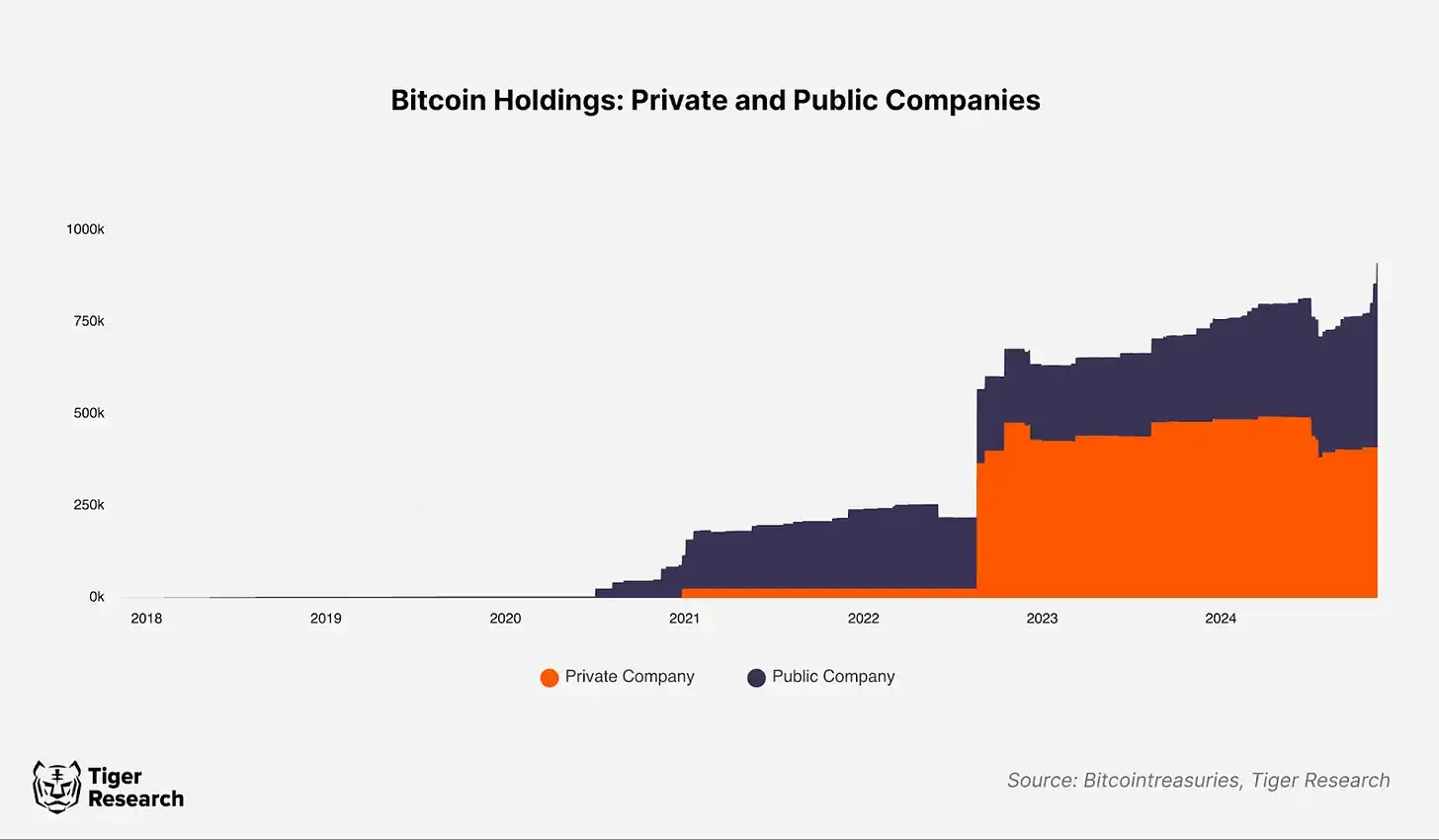
The government's action on Bitcoin has been slow and limited, but corporate involvement is accelerating. Companies such as MicroStrategy, Semler Scientific, and Tesla have made bold investments in the Bitcoin space. This contrasts sharply with the cautious approach taken by most governments.
3. Three Key Reasons Corporations Are Interested in Bitcoin
Investing in Bitcoin is no longer just a trend; it is gradually becoming a core financial strategy for corporations. Bitcoin has attracted corporate attention due to its unique characteristics, with its value primarily manifesting in the following three areas:
3.1. Achieving Asset Diversification
Traditionally, a company's financial assets are typically allocated around stable options such as cash and government bonds. These assets can ensure liquidity and help mitigate risks, but their low yield often struggles to outpace inflation, potentially leading to a shrinkage in real asset value.
Source: Michael Saylor X
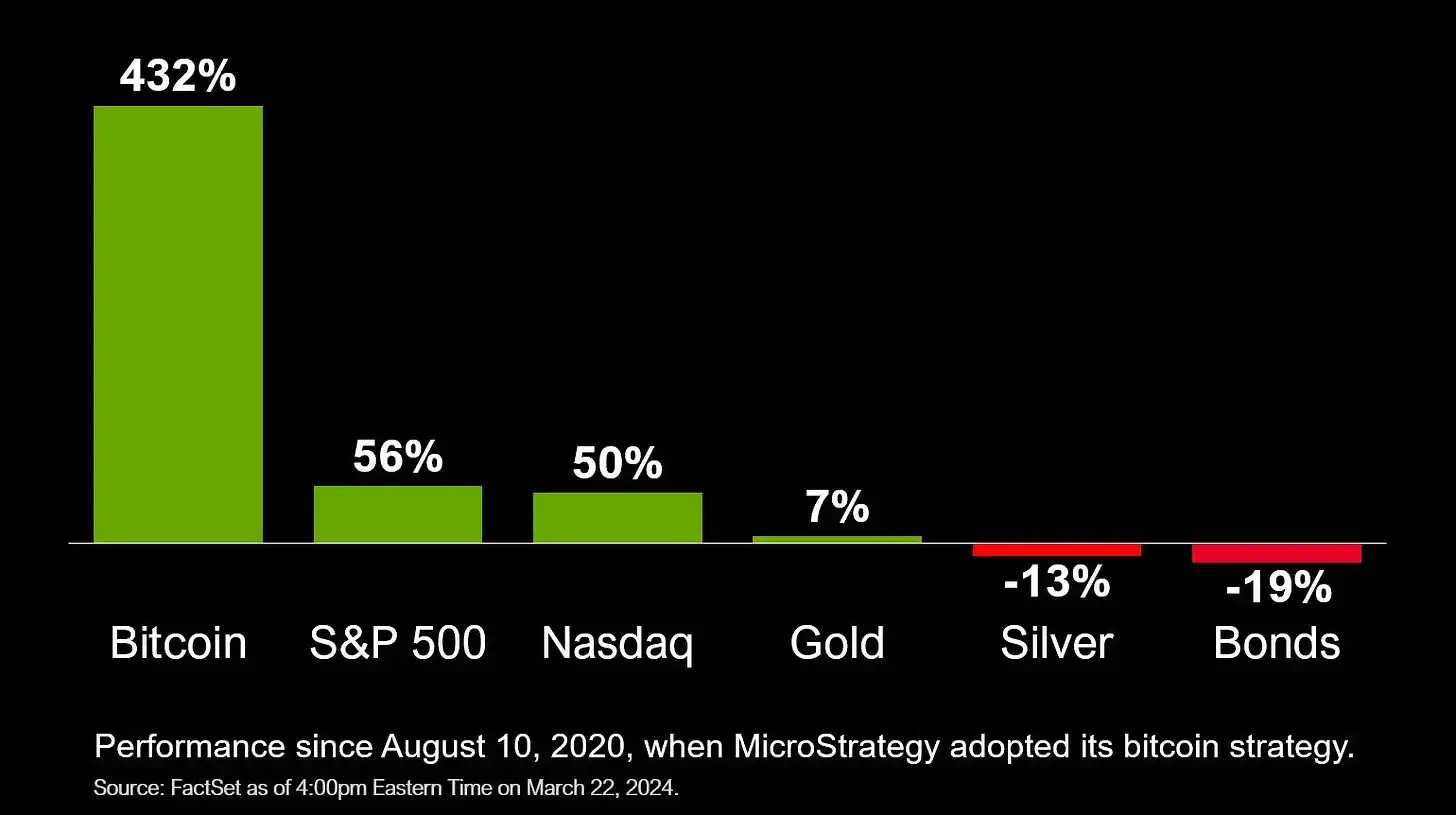
Bitcoin, as an emerging alternative asset, can effectively address these shortcomings. It not only has high return potential but also can diversify investment risks, providing companies with a new asset allocation choice. Over the past five years, Bitcoin has significantly outperformed traditional assets such as the S&P 500 Index, gold, and bonds, even surpassing junk bonds considered high-risk high-return. This indicates that Bitcoin is not only an alternative option but also a crucial tool in corporate financial strategy.
3.2. Enhancing Asset Management Efficiency
Another significant reason Bitcoin attracts companies is its efficient asset management characteristics. Bitcoin supports 24/7 trading, providing companies with great flexibility to adjust asset allocations at any time. Furthermore, compared to traditional financial institutions, Bitcoin's liquidation process is more convenient, not restricted by bank hours or cumbersome operational procedures.
Source: Kaiko
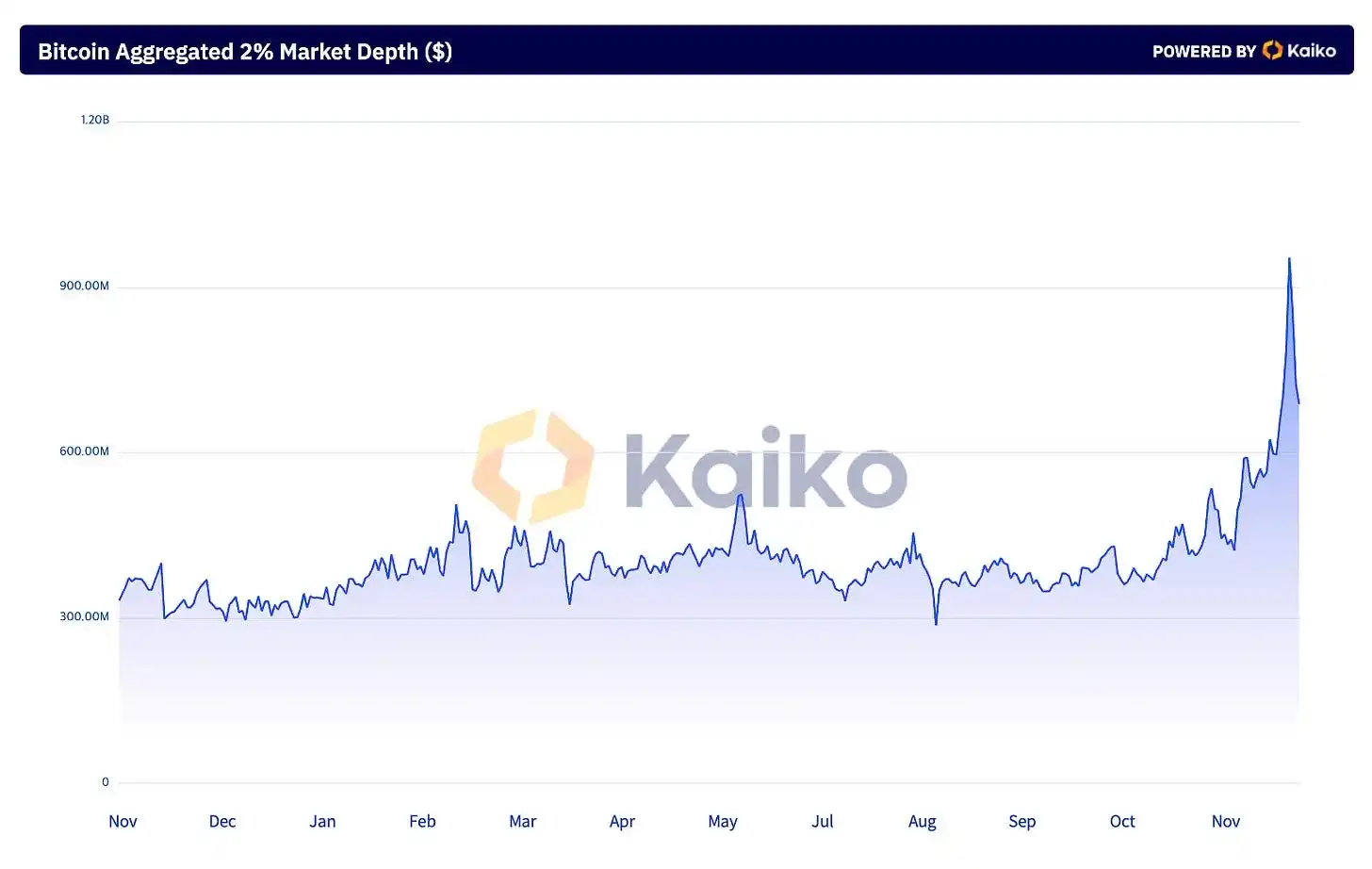
While companies remain concerned about potential price impact when liquidating Bitcoin, this issue is gradually being alleviated as market depth increases. According to Kaiko data, Bitcoin's "2% market depth" (the total amount of buy and sell orders within a 2% range above and below the current market price) has steadily grown over the past year, with the daily average market depth reaching around $4 million. This indicates that the liquidity and stability of the Bitcoin market are continuously improving, creating a more favorable environment for companies to use Bitcoin.
3.3. Enhancing Enterprise Value
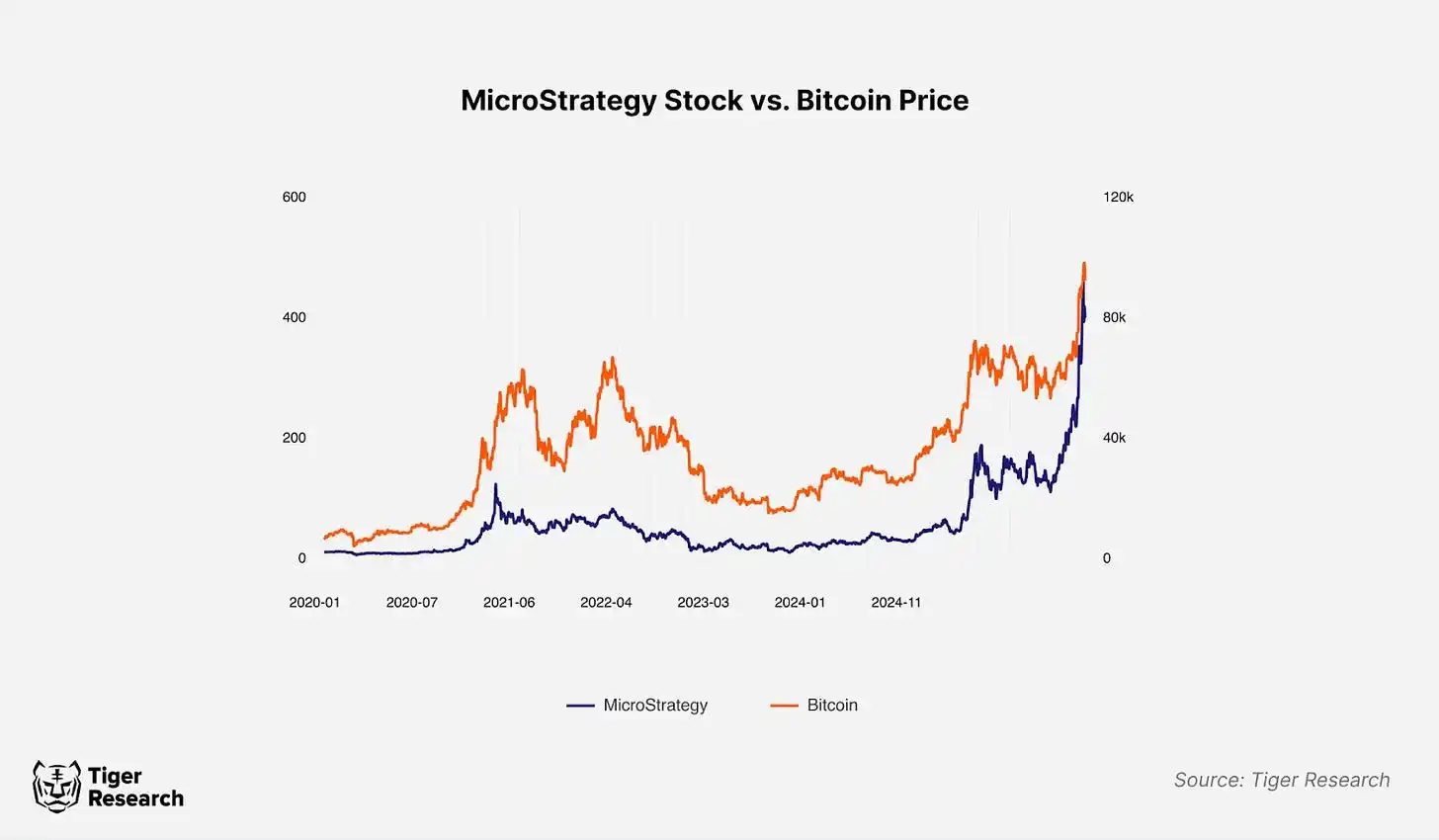
Holding Bitcoin is not only a financial choice, but it can also significantly enhance enterprise value and stock price. For example, after announcing the acquisition of Bitcoin, both MicroStrategy and Metaplanet saw a substantial increase in their stock prices. This strategy is not only an effective marketing tool in the digital asset industry, but also provides a way for enterprises to seize the growth opportunity in this field.
4. Increasing Investments in Bitcoin by Asian Enterprises
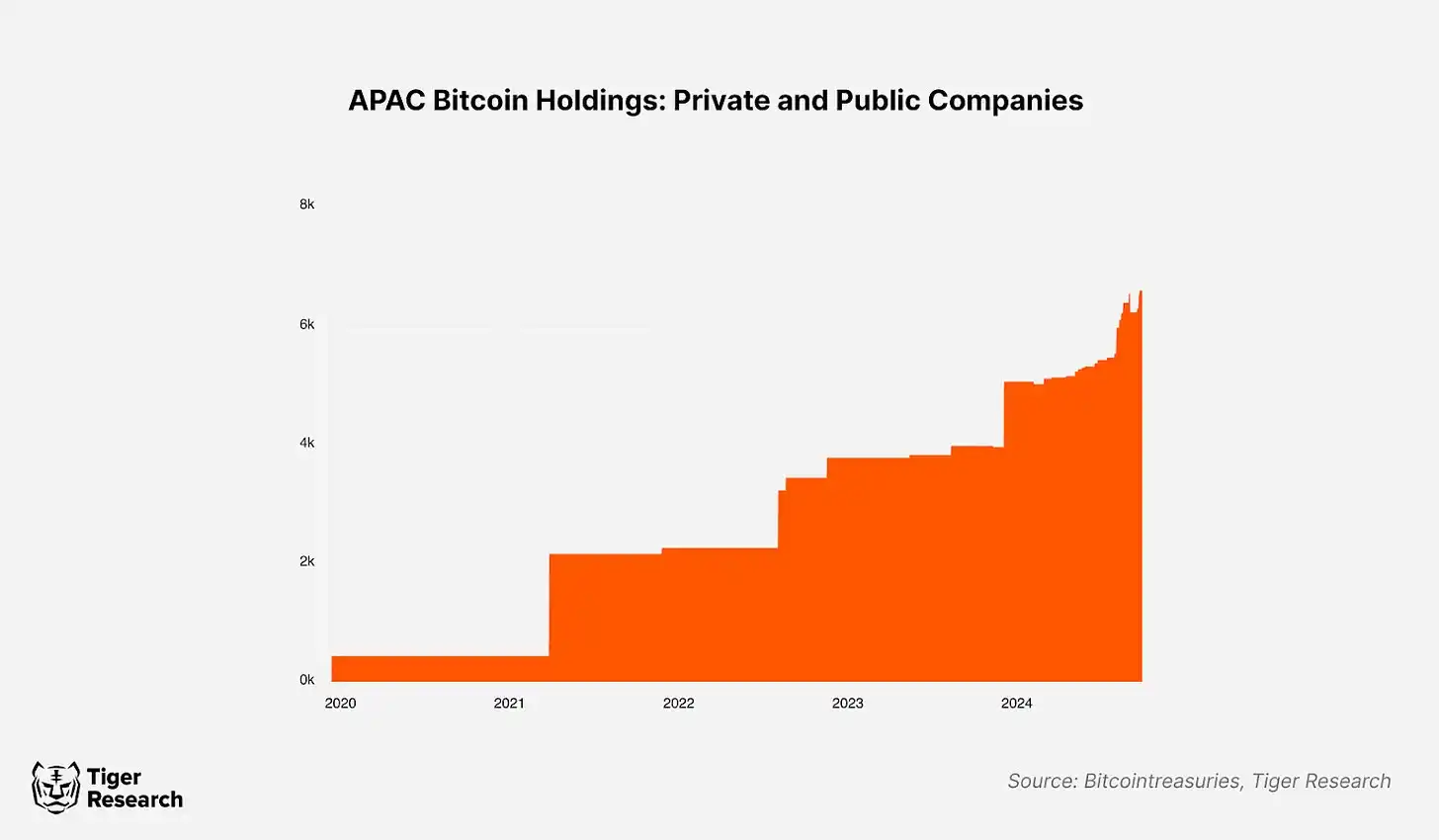
Although Asian enterprises are still in the early stages of Bitcoin investment, they are gradually increasing their holdings. For example, companies like Meitu in China, Metaplanet in Japan, and Brooker Group in Thailand have considered Bitcoin as a strategic financial asset. Nexon has also made large-scale Bitcoin purchases. Metaplanet, in particular, has been very active, acquiring 1,142 Bitcoins in the past six months.
However, the current level of participation of Asian enterprises in the Bitcoin market remains relatively low. According to statistics, the total amount of Bitcoin held by Asian companies accounts for less than 1% of the global total, primarily due to regulatory restrictions in many countries. For instance, in South Korea, companies are unable to open accounts on cryptocurrency exchanges and face numerous obstacles to investing in overseas Bitcoin ETFs or launching funds related to cryptocurrency trading. Consequently, these companies can hardly invest in Bitcoin through official channels.
Despite the challenges posed by the regulatory environment, the potential for Asian enterprises to participate in the Bitcoin market is still promising. Some companies have set up overseas subsidiaries to bypass regulatory restrictions for investment. Meanwhile, countries like Japan have made some progress in relaxing relevant policies. Leading enterprise investment cases like Metaplanet are attracting more market attention. These positive changes may pave the way for broader Asian enterprise participation in the Bitcoin market in the future.
5. Conclusion
Bitcoin investment is gradually becoming a popular financial strategy adopted by enterprises. However, its price volatility remains a significant challenge for enterprises, especially under the influence of external factors like international politics. The market crash event in 2022 clearly exposed the potential risks of enterprises holding Bitcoin. Therefore, enterprises should exercise caution when investing in Bitcoin and strategically diversify it with safer assets to mitigate overall risk.
Furthermore, for Bitcoin to further develop in enterprise portfolios, a clear institutional framework is needed. Currently, there is a lack of clear guidance on the holding and accounting of cryptocurrency assets, which often leads enterprises to confusion in practical operations. Once these uncertainties are resolved, Bitcoin may play a more significant role in enterprise asset diversification.
You may also like

Mastercard Launches Agent Pay for AI, Plans to Record AI Agent Payment Authorizations on Polygon
Mastercard launched Agent Pay for AI, a new payment protocol designed to help AI agents make small payments such as pay-per-use access to data and APIs. The system plans to record human-granted AI agent permissions on Polygon, focusing on verifiable authorization, identity, and payment controls.

Curve Deploys Llamalend v2 on Optimism With 250,000 OP Incentives
Curve launched Llamalend v2 on Optimism with 250,000 OP incentives from the Optimism Foundation. The upgrade expands Llamalend beyond its earlier crvUSD-focused model, adding broader collateral support, LlamaRisk market reviews, and the ability to use Curve LP tokens as collateral.

Raydium Old Liquidity Pool Reportedly Exploited, With $1.34 Million Moved to Ethereum and Tornado Cash
An old Raydium liquidity pool was reportedly exploited for around $1.34 million in USDC, RAY, and wSOL, with the stolen funds bridged to Ethereum and deposited into Tornado Cash. The incident highlights the tail risks of legacy DeFi pools, old contracts, and cross-chain fund laundering paths.

Kalshi Executive Challenges “SBF Backed AI Unicorns” Narrative, Says Leopold Aschenbrenner Was Key Figure
Kalshi executive John Wang questioned the “SBF backed AI unicorns” narrative, saying Leopold Aschenbrenner was the key figure behind major AI investment decisions.

Pantera Capital Partner: How Tokenization is Restructuring the Private Equity and Early Investment Ecosystem?

New York Proposes Stricter Stablecoin Issuer Rules Aligned With Federal GENIUS Act
NYDFS proposed stricter stablecoin issuer rules aligned with the GENIUS Act, covering reserves, custody, redemption timelines, audits, and capital buffers.
Every exchange is a "Universal Exchange."

The counterattack of traditional finance: Alliance chains are quietly reviving

CryptoQuant Says Bitcoin Profitable Supply Is Near 45% Pressure Zone as On-Chain Data Points to Market Repricing
CryptoQuant said Bitcoin’s profitable supply is nearing the 45% pressure zone, signaling rising market stress, unrealized losses, and a possible on-chain repricing phase.

Bitcoin Falls Below 200-Week Moving Average as On-Chain Data Shows Over Half of Supply in Loss
Bitcoin dropped below its 200-week moving average as on-chain data showed over 50% of circulating supply is now in loss, signaling rising market stress.

CFTC Reportedly Plans New Prediction Market Rules Focused on Manipulation Risk and Public Interest Review
The CFTC is reportedly preparing new prediction market rules focused on manipulation risk, public interest review, and retail trader protections.

Meet the new WEEX trial fund—your gateway to greater profits

WEEX Labs Lands at Dutch Blockchain Week: A Disruptive Crypto × AI Conversation Sets Sail in Amsterdam
SK Hynix Reportedly Plans U.S. ADR Listing as Early as August, With SEC Approval Possible in Late June
SK Hynix may pursue a U.S. ADR listing as early as August, with SEC approval reportedly possible in late June amid strong AI chip supply chain demand.

SpaceX vs Tesla vs xAI: Which Elon Musk Trade Has the Biggest Upside in 2026?
OpenAI Reveals It Has Confidentially Submitted an S-1 to the SEC, Keeping the Door Open for a Future IPO
On June 9, according to an OpenAI announcement, the company recently confidentially submitted a draft S-1 registration statement to the U.S. Securities and Exchange Commission (SEC), beginning the preliminary compliance process for a potential initial public offering. OpenAI said it chose to disclose this proactively because it expected the news might leak; however, the company has not yet set a specific listing timeline, and related arrangements may still take some time.
Latest research from 13 top universities including Cornell University: The current state, challenges, and misconceptions of the fusion of Crypto and AI
Deconstructing Anthropic: The Best AI Company, Possibly Also a Type of Organizational Invention
Mastercard Launches Agent Pay for AI, Plans to Record AI Agent Payment Authorizations on Polygon
Mastercard launched Agent Pay for AI, a new payment protocol designed to help AI agents make small payments such as pay-per-use access to data and APIs. The system plans to record human-granted AI agent permissions on Polygon, focusing on verifiable authorization, identity, and payment controls.
Curve Deploys Llamalend v2 on Optimism With 250,000 OP Incentives
Curve launched Llamalend v2 on Optimism with 250,000 OP incentives from the Optimism Foundation. The upgrade expands Llamalend beyond its earlier crvUSD-focused model, adding broader collateral support, LlamaRisk market reviews, and the ability to use Curve LP tokens as collateral.
Raydium Old Liquidity Pool Reportedly Exploited, With $1.34 Million Moved to Ethereum and Tornado Cash
An old Raydium liquidity pool was reportedly exploited for around $1.34 million in USDC, RAY, and wSOL, with the stolen funds bridged to Ethereum and deposited into Tornado Cash. The incident highlights the tail risks of legacy DeFi pools, old contracts, and cross-chain fund laundering paths.
Kalshi Executive Challenges “SBF Backed AI Unicorns” Narrative, Says Leopold Aschenbrenner Was Key Figure
Kalshi executive John Wang questioned the “SBF backed AI unicorns” narrative, saying Leopold Aschenbrenner was the key figure behind major AI investment decisions.
Pantera Capital Partner: How Tokenization is Restructuring the Private Equity and Early Investment Ecosystem?
New York Proposes Stricter Stablecoin Issuer Rules Aligned With Federal GENIUS Act
NYDFS proposed stricter stablecoin issuer rules aligned with the GENIUS Act, covering reserves, custody, redemption timelines, audits, and capital buffers.


