
Is Solana About to Recover? Analyzing On-Chain MEME Whale Movement

Original Article Title: "Local Frenzy or Full Recovery? Data Analysis of Solana Chain MEME Whale Activity and Market Divergence"
Original Article Author: Frank, PANews
The MEME market seems to have heated up once again, starting in mid-March, with Fartcoin starting to rebound from its low, experiencing an approximately 349% increase over about a month, reaching a peak total market value of nearly 9.85 billion US dollars. At the same time, the on-chain activity of MEME whales has also attracted attention, with some whales investing millions of dollars in Fartcoin, RFC, and other MEME coins, leading to a rapid increase in related token market values.
Behind these movements, on April 11, the number of active addresses on the Solana chain once again surpassed 5.1 million, nearing the peak level seen in January.
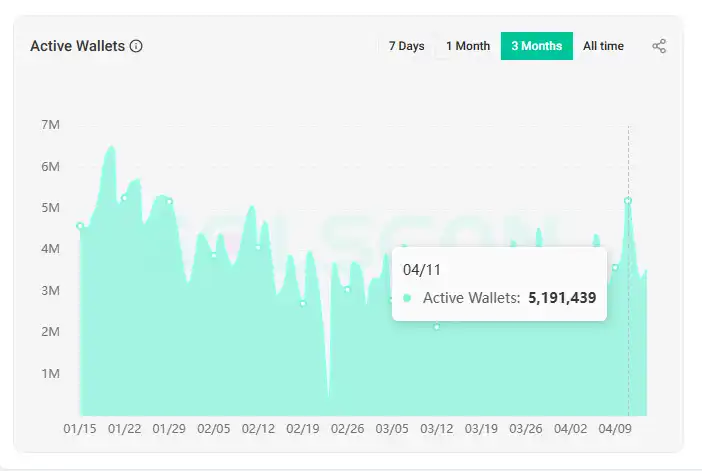
The minor outbreak of this MEME market rally, is it a return of the MEME bull market or a speculative resurgence in a boring market environment? PANews conducted data analysis on the large holder addresses of several recently surging MEME coins in hopes of finding some clues.
Fartcoin Analysis: Whale Entry in Mid-March, Average Cost Around $0.62
Firstly, after observing several previously high market cap tokens, PANews found that this round of MEME frenzy is not universal but rather concentrated in a few specific tokens. Most of the MEME tokens that previously had market caps over a billion (such as Trump, BONK, WIF, POPCAT) are still in a decline or bottoming phase. Among the tokens observed by PANews, except for Fartcoin, the other tokens are either new coins created in the past 1 to 2 months or tokens that have been lukewarm since their issuance. Here are several tokens observed by PANews: RFC, Fartcoin, ALCH, GOHOME, DARK, House, FAT.

The token selection criterion is a market cap ranging from 10 million to over 100 million US dollars, with tokens that have experienced significant increases or rebounds in the past 1 to 3 months. Among these, RFC has seen the largest increase, with a maximum increase of 54 times in the past month.
The leading token of this round is Fartcoin, which, after hitting a low on March 10, began a new upward trend. Its market cap once reached 9.48 billion US dollars, once again becoming the leader of the MEME trend.
Analysis of the first-time purchase time of whales reveals that the collective entry time of whales in this round started from mid-March and continued until April 10, with whale entry maintaining an upward trend.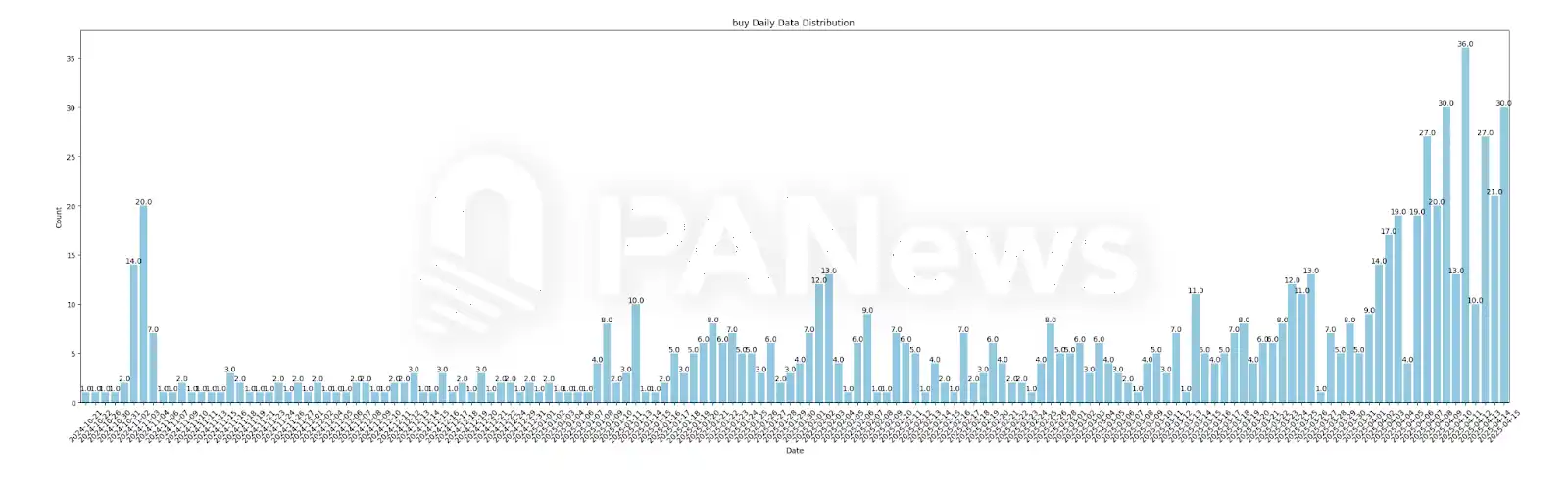
Fartcoin Whale Entry Time Distribution
In terms of cost, the initial purchases of the top 1000 whales are mostly concentrated between $0.2-$0.6 and $0.6-$0.9. Looking at the Fartcoin chart, the percentage of whales still trapped above $1 is relatively small. Overall analysis shows that the current holding whales mostly entered the market after the price low on March 12.
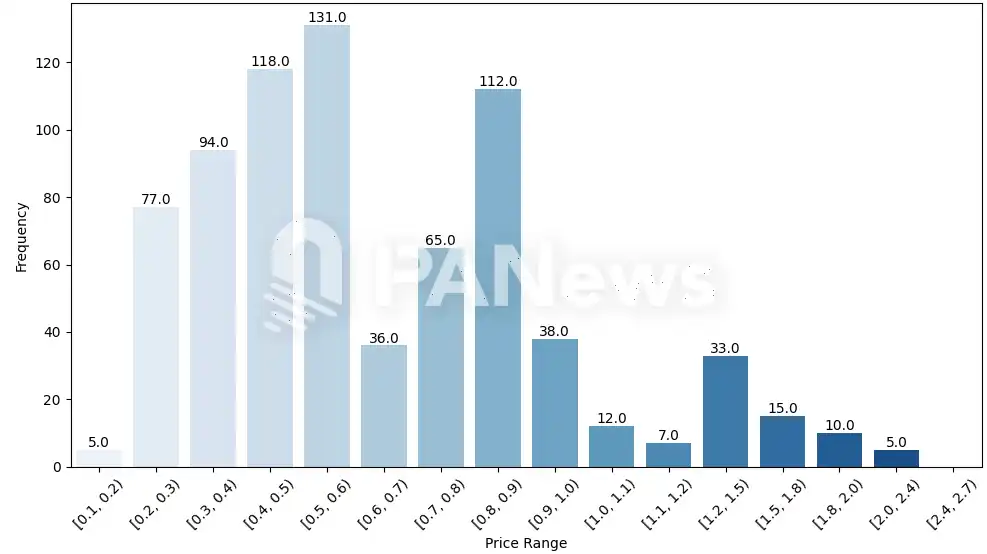
Fartcoin Whale Holding Cost Distribution
In total, the average holding cost of Fartcoin whales' initial purchases is about $0.62. Based on the current price of $0.844, these new whales have an average profit margin of about 36%.
23% of Addresses Have Cross-Asset Holdings, DARK and RFC Replay the Same Story
Looking at the overall picture, by comparing the top 1000 whale holders of these tokens, it is found that 23% of whale addresses hold at least 2 or more different tokens. Among them, the most held token by whales is DARK, a token with the shortest creation time, but 116 whales hold this token repeatedly.
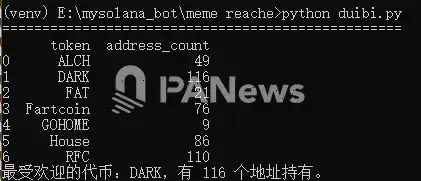
Next, RFC has the highest number of repeat occurrences, reaching 110 times. Fartcoin has recently received high market attention and also has the highest market value among the analyzed tokens, but it has only appeared 76 times in repetitions. However, according to PANews analysis, the reason for this may be that Fartcoin's market value has already risen to a relatively high level, and many large holders have exited or switched tokens. As specific historical information of whale holdings at a particular time cannot be tracked, we currently cannot provide a definitive answer.
However, from the analysis of RFC and DARK, it seems that these two tokens have a somewhat similar storyline.
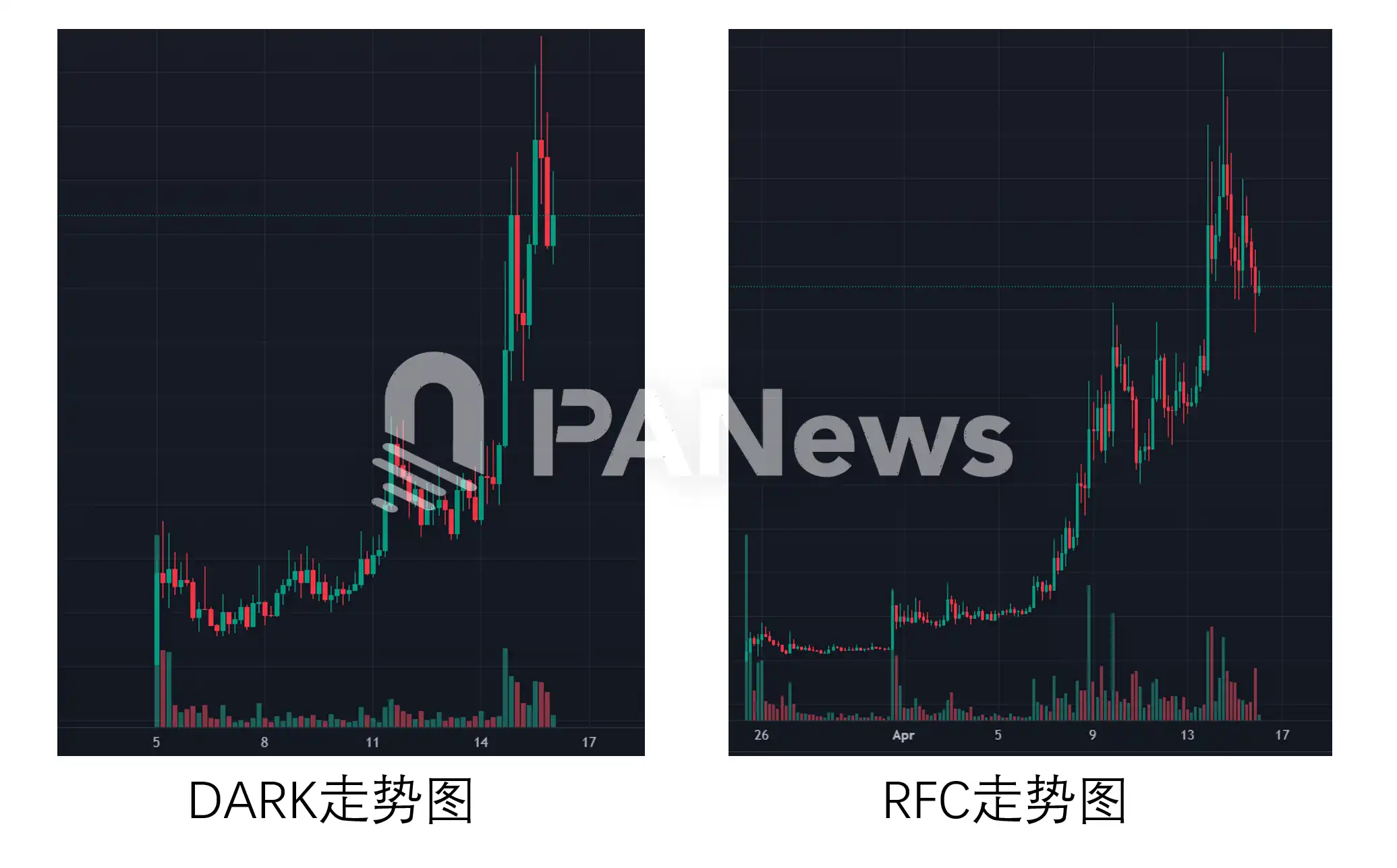
First of all, let's look at the candlestick chart trends of the two. Apart from the difference in creation time, the trends, including pullback patterns, tend to be similar.
Furthermore, the data on whale holdings of these two tokens are also quite similar, both being above 110. In a more detailed analysis, PANews observed that there are 75 addresses simultaneously holding the DARK and RFC tokens, which is the largest number in the whale holding combinations. The next is the Fartcoin and House combination, with 35 addresses simultaneously holding these two tokens.
Looking further into the timing of these addresses holding RFC and DARK simultaneously, most whale addresses initially bought these two tokens on April 13th and April 14th, respectively.
From the perspective of the candlestick chart trends, April 13th was precisely the date of RFC's rapid surge, with a one-day increase of 65% and a swing of 107%. On April 14th, DARK saw a similar market movement, with a one-day increase of 80% and a swing of 218%. This significant surge one after another appears to be a coordinated pumping action.
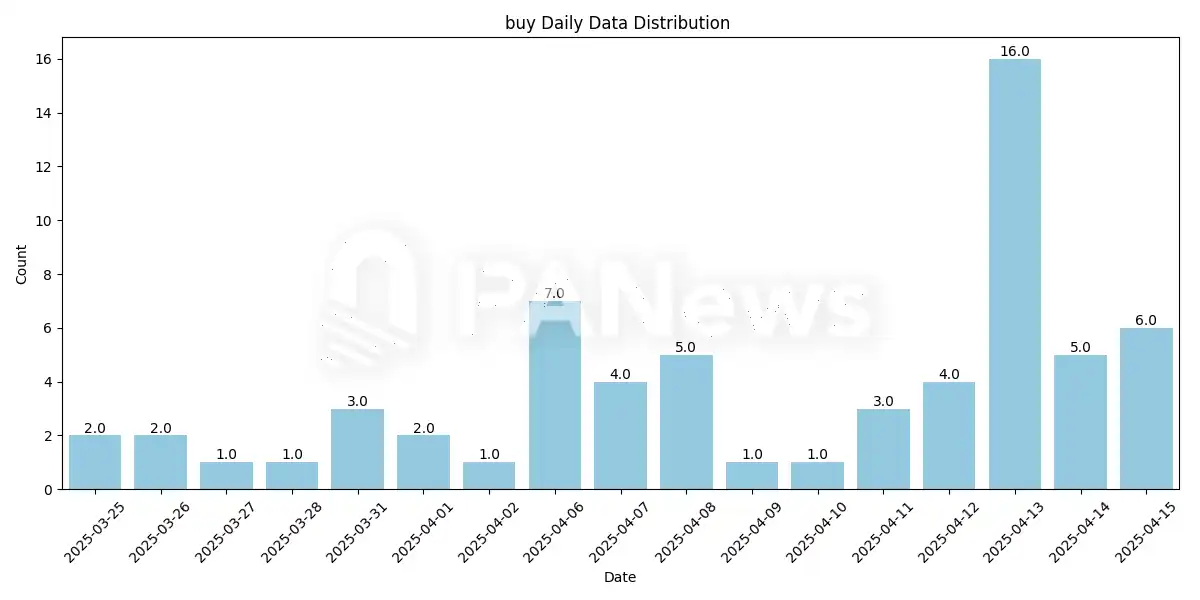
Whale First Purchase Distribution Date of RFC
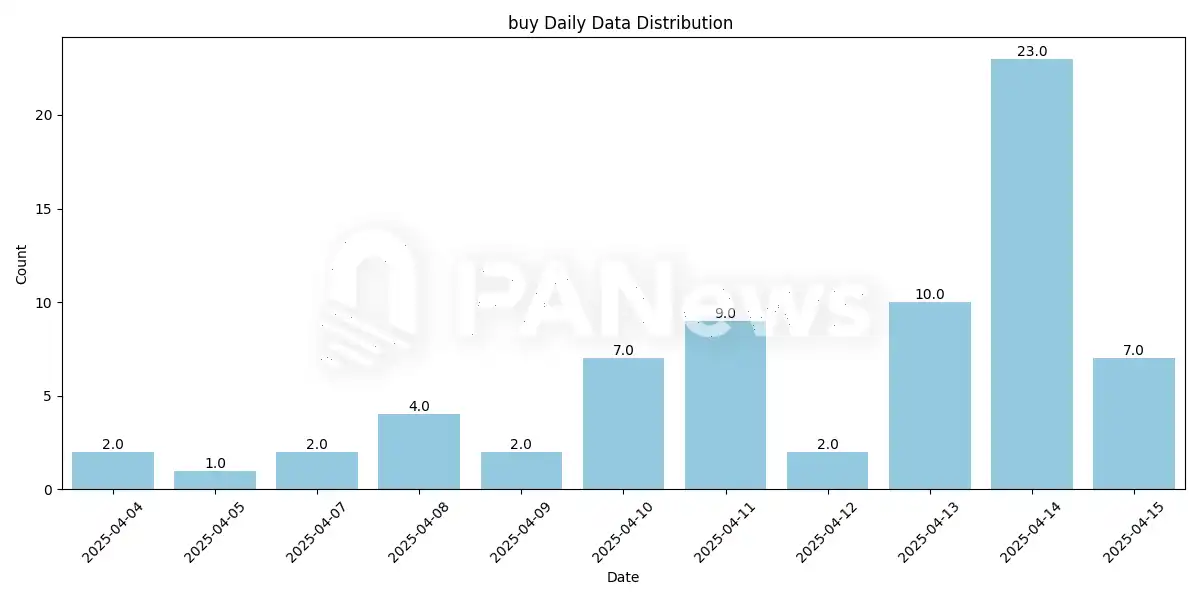
Whale First Purchase Distribution Date of DARK
Of course, it is worth noting that the market value of RFC reached as high as $138 million, while DARK's peak market value was only $23 million. It seems that the whales behind these tokens are not the absolute dominant force in the market, or the whales' expectations for these two tokens are not the same. Therefore, it cannot be assumed that DARK will replicate RFC's market value.
Additionally, tokens such as Fartcoin and House or DARK and House appear frequently in whale holdings.
“Artificial Bull” Embraces MEME Culture and AI
In the overall data, the total holding amount of these whale addresses with repeated holdings in these 7 tokens is approximately $100 million (excluding holdings by major exchanges such as Gate, Bitget, Raydium), accounting for 8.47% of the market value of these tokens.
As of early April 16, these tokens have also experienced a certain degree of pullback. Among them, FAT has retraced by 72.51% from its peak, House has retraced by 50%, with an overall average retracement of 37.12%. Among them, only ALCH has seen a smaller retracement, which, from its nature, is the only AI-related token with practical applications. However, from a cyclical perspective, ALCH may just happen to be in a phase of market rotation without entering a selling cycle.
Behind this MEME rotation surge, there seems to be some traces of an artificial MEME bull market. KOL @MasonCanoe stated on Twitter that the whale address responsible for the rise in RFC is associated with addresses that have engaged in market-making activities for previous tokens such as TRUMP, VIRTUAL, LIBRA, and is also associated with several addresses that were early stakeholders in RFC. Based on this, @MasonCanoe believes that the pump in RFC is by no means accidental and may be a signal of careful positioning by large funds.
From a data perspective, MEME on Solana's blockchain does seem to be once again capturing market attention under the impetus of some whales. However, since this driving effect cannot benefit all MEME tokens, it can only be judged by tracking the real-time dynamics of these main funds. Additionally, from the classification of several tokens, tokens with cat, dog, and frog themes seem to have not occupied a significant position in the recent surge, mainly with AI and MEME culture tokens showing outstanding performance.
Overall, this recent MEME craze on Solana's blockchain has not blossomed across the board but has been highly concentrated on a few specific tokens, with Fartcoin as the leader attracting a large number of new high-net-worth individuals who entered the market in mid-March. Of greater note is the fact that behind the trends of RFC and DARK, two highly similar tokens, there are numerous overlapping whale addresses holding both tokens, with their main buying times concentrated around the sharp surges on April 13 and 14, strongly implying possible coordinated actions or main fund rotation behavior. This surge seems to be not purely a result of organic market behavior but carries traces of an "artificial bull market," and whether this "artificial rain" can evolve into natural capital inflows is still to be observed.
You may also like

Morning Report | OpenAI has submitted an S-1 registration statement draft to the U.S. SEC; Morpho completes $175 million financing

Morning Report | BitMine increased its holdings by 126,971 ETH last week; trader Eugene announced his exit from the crypto market

Wang Chuan: How can one not feel anxious after the neighbor Old Wang made thirty times profit by investing in storage stocks? (Seven) - A quarter-century cycle

Cryptocurrency CEXs are flocking to sell US stocks, and traditional brokerages are facing an "uninvited guest."

$75 billion in foreign capital has fled, and South Korean retail investors have absorbed it all using leverage

Japan’s Three Megabanks Plan Joint Stablecoin Issuance in Fiscal 2026
MUFG, SMBC, and Mizuho reportedly plan to jointly issue fiat-pegged stablecoins in fiscal 2026, signaling Japan’s growing push into bank-led digital payment infrastructure.

Humanity Discloses H Token Dual-Chain Attack Details, With Losses on Ethereum and BSC Exceeding $36 Million
Humanity said the H token attack across Ethereum and BSC caused more than $36 million in losses after leaked ProxyAdmin keys enabled malicious contract upgrades and token minting.
White House Discusses CLARITY Act With Law Enforcement Ahead of Senate Vote
The White House discussed the CLARITY Act with law enforcement ahead of a Senate vote, focusing on illicit finance risks and developer protections.

Bitcoin Trading Guide 2026: Strategies for Experienced Traders

What Is XAUT and PAXG? Why Tokenized Gold Is Booming in 2026

Will the SpaceX IPO Hurt Bitcoin? Here's What Traders Are Watching

Foreign selling in the South Korean stock market accelerates, with cumulative net sales reportedly reaching $75 billion this year
On June 9, The Kobeissi Letter, citing Goldman Sachs data, reported that global investors are selling South Korean stocks at an unusually rapid pace. In the latest trading session, foreign investors sold about $801 million worth of Kospi constituent stocks again; total foreign outflows last week reached about $10 billion, and the market has been in net foreign selling on nearly every trading day over the past month. According to the data cited in the report, foreign investors have sold about $75 billion worth of South Korean stocks so far this year. Meanwhile, South Korean retail and institutional investors together recorded roughly $69 billion in net buying over the same period, suggesting that the market’s main buying support has come from domestic capital rather than returning overseas funds. The information currently disclosed still mainly comes from The Kobeissi Letter’s retelling and Goldman Sachs data summaries, while public details on the statistical period and the specific definition of “selling” remain relatively limited.

Fortune Warns of Strategy’s Financing Structure Risks as Bitcoin Premium Narrows
Fortune warned that Strategy’s Bitcoin treasury model faces growing financing risks as MSTR’s net asset premium narrows and preferred stock dividend pressure increases.

Ferrari Challenge Le Mans: Carl Moon to Dominate in WEEX Livery

Sahara AI Responds to SAHARA’s Sharp Drop: No Contract or Product Security Issues Found, Internal Investigation Underway
Sahara AI responded to SAHARA’s 60% price drop, saying no token contract or product security issues have been found and an internal investigation is underway.

WEEX Deposit/Withdrawal Dynamic Island: Your Asset Status, Always in Sight
Scaling Crypto Derivatives: The Digital Asset Infrastructure Behind High-Volume Trading
In the fast-moving digital asset ecosystem, derivatives platforms face an extreme architectural test. High-leverage futures markets demand more than just standard security—they require absolute operational precision, zero-latency matching engines, and ironclad structural scalability, all while navigating intense market volatility.
As global platforms scale to meet these demands, the industry is shifting away from rigid, monolithic setups toward a more agile, "decoupled" infrastructure philosophy.
The Blueprint for High-Volume Copy TradingFor elite global exchanges like WEEX (founded in 2018), this architectural choice becomes critical when scaling high-volume retail features like social copy trading. When thousands of users automatically mirror the real-time strategies of elite traders simultaneously, it triggers sudden, monumental spikes in concurrent transactional volume.
To prevent execution latency or settlement bottlenecks during these peak volatility events, a platform's primary engine must remain entirely dedicated to risk management, copy-trade synchronization, and order matching.
The Architectural Rule: New-generation platforms must separate front-end user execution engines from heavy backend infrastructural overhead to eliminate operational friction.
By separating these layers, platforms can maintain complete sovereignty over their trading environments and user experiences while strategically aligning with institutional-grade infrastructure ecosystems. This strategic framework allows modern exchanges to leverage advanced Digital Asset Custody infrastructure such as Cobo’s behind the scenes, ensuring that backend wallet management scales elastically alongside trading spikes.
Capitalizing on Market Momentum and 400× LeverageIn a derivatives arena where platforms offer up to 400× leverage on perpetual contracts, capital efficiency and market agility are core business metrics. To capture market momentum, an exchange needs the ability to rapidly expand its asset offerings, supporting everything from legacy crypto assets to sudden, trending altcoins across a massive library of trading pairs.
Adopting a flexible, scalable Wallet-as-a-Service (WaaS) solution such as Cobo’s could completely rewrite the development timeline for high-growth exchanges. Instead of spending months of engineering capital building out custom backend wallet architectures for every new blockchain network, platforms can deploy localized infrastructure in days.
This agility allows platforms to instantly scale their listings to over a thousand trading pairs without compromising security or delaying time-to-market. It mirrors the exact operational advantages seen during high-velocity market events, similar to how advanced wallet infrastructure empowers platforms during sudden asset surges; allowing exchanges to pass that speed and liquidity directly to their global user base.
A Mature Foundation for GrowthThe synergy between trusted infrastructure ecosystems and global trading platforms represents the natural evolution of a maturing crypto market. As WEEX continues to scale its global spot and derivatives offerings for over 6 million users, adopting robust backend paradigms proves that platforms no longer have to compromise between cutting-edge trading velocity and uncompromised structural security.

Get Paid to Onboard? Try WEEX’s New Homepage with Rewards for Registration, Deposit & Trade
Morning Report | OpenAI has submitted an S-1 registration statement draft to the U.S. SEC; Morpho completes $175 million financing
Morning Report | BitMine increased its holdings by 126,971 ETH last week; trader Eugene announced his exit from the crypto market
Wang Chuan: How can one not feel anxious after the neighbor Old Wang made thirty times profit by investing in storage stocks? (Seven) - A quarter-century cycle
Cryptocurrency CEXs are flocking to sell US stocks, and traditional brokerages are facing an "uninvited guest."
$75 billion in foreign capital has fled, and South Korean retail investors have absorbed it all using leverage
Japan’s Three Megabanks Plan Joint Stablecoin Issuance in Fiscal 2026
MUFG, SMBC, and Mizuho reportedly plan to jointly issue fiat-pegged stablecoins in fiscal 2026, signaling Japan’s growing push into bank-led digital payment infrastructure.

Popular coins
Latest Crypto News


