
Is Base 'Leveraging' Ethereum's GDP?


Original Article Title: Is Base 'Stealing' Ethereum's GDP?
Original Article Author: Michael Nadeau, Founder of The DeFi Report
Original Article Translation: xiaozou, Jinse Finance
Standard Chartered Bank sparked a heated discussion last month with its report titled "Ethereum's Midlife Crisis." The report estimated that Base caused a $500 billion evaporation of Ethereum's market value and "took over GDP," thereby lowering the year-end price target for ETH from $10,000 to $4,000. This raises a fundamental question: Did Standard Chartered misjudge ETH at the L2 "J-curve" bottom, or will the structural decline continue?
In this article, we will re-examine Standard Chartered Bank's conclusions and offer our own insights.
1. Base's "Partnership" with Ethereum
Let's assume you are Ethereum, and I am Base. We are both building critical infrastructure for web3. One day, I propose to you: Instead of competing with L1, why not collaborate?
As Base, my partnership requirements are:
· Share Ethereum's security and settlement layer (self-built validators are too costly)
· Establish a native cross-chain bridge to Ethereum users and assets
· Share liquidity and developer ecosystem
· Reduce operating costs
· Be compatible with EVM and surrounding infrastructure
As Ethereum, you hope:
· Acquire new users through Coinbase channels
· Increase ETH demand (transactions and on-chain services)
· Receive feedback from enterprise customers
· Create fee revenue for validators
· Improve throughput and user experience
The synergy of 1+1>3 is formed between the two parties. Now, after two years, let's validate the results with on-chain data.
2. Base's Economy and On-Chain Data
User Fees
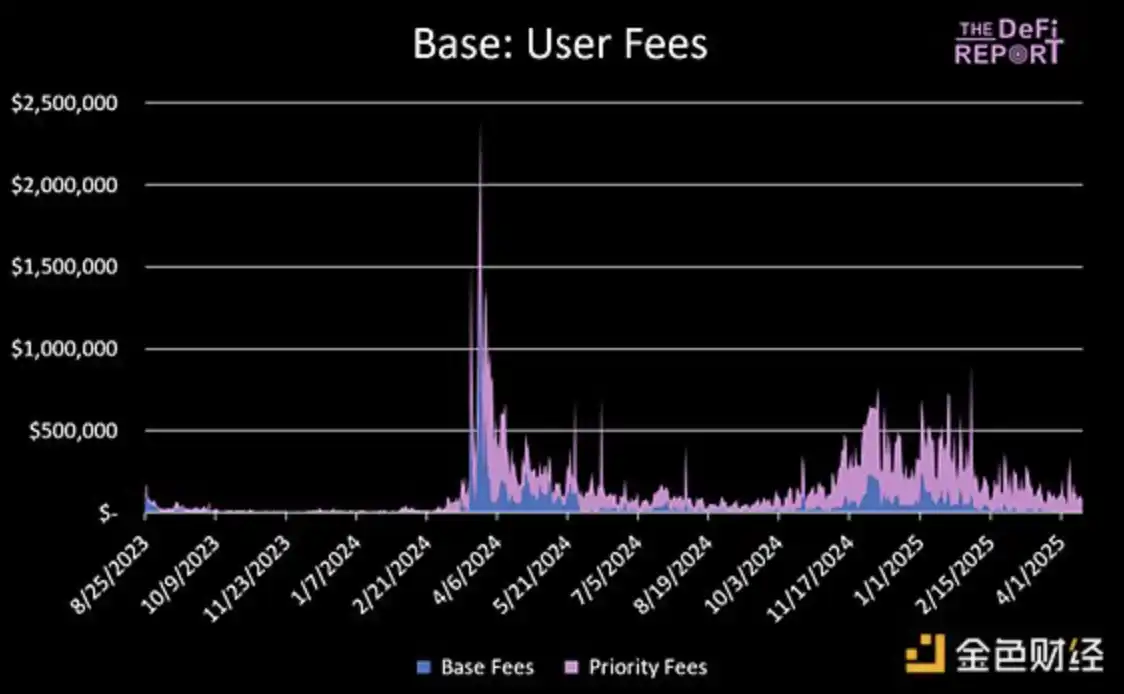
Since its inception, Base has accumulated $24.8 million in base fees and $81.9 million in priority fees. In 2024, Base's revenue ($74 million) accounted for 1.1% of Coinbase's total annual revenue.
Base is currently the fastest-growing and most profitable Ethereum L2, launched two years after its main competitor Arbitrum.
Base GDP
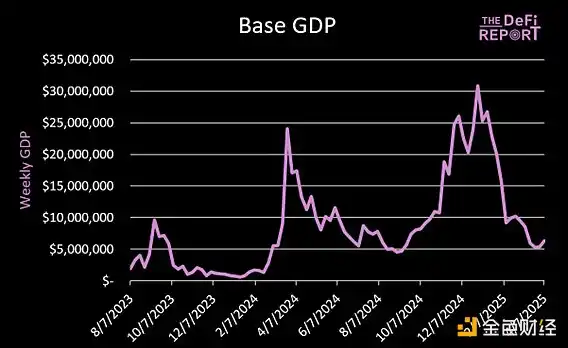
Base's on-chain applications have generated a total of $768 million in fees (cumulative "GDP"), with major contributors including DeFi protocols such as Uniswap and Aerodrome.
"GDP" measures the fees paid by end users to use on-chain applications (excluding gas fees).
Daily New Addresses
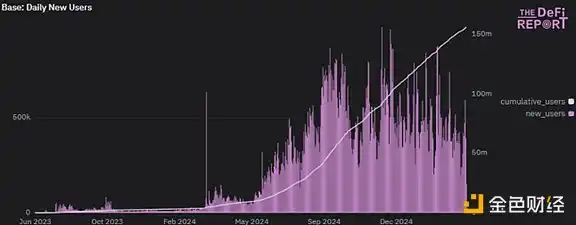
Over the past 30 days, Base has averaged 412,000 new addresses per day. Since its launch in August 2023, Base has attracted a cumulative 155 million interacting addresses. Base is actively onboarding new users to the Ethereum ecosystem.
Base Bridged ETH
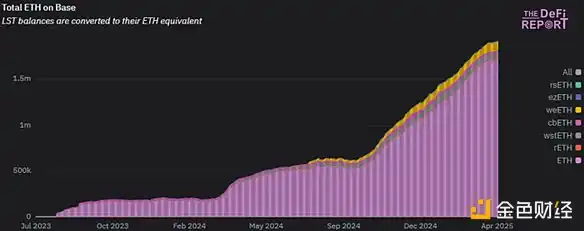
Currently, Base's layer has 1.917 million ETH (including LST), accounting for 1.6% of the circulating supply, creating new demand for ETH.
Daily Bridged Assets

Through native cross-chain bridges, $0.5-2 billion in assets flow between L1/L2 daily (ETH accounts for 80%). In the past 30 days, $5.03 billion in assets flowed back to Ethereum from Base. Over the last 90 days, $30 billion in assets flowed back to Ethereum from Base, confirming Ethereum's role as a cross-chain hub.
Stablecoin Supply
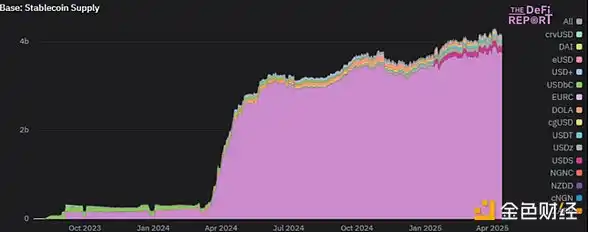
Base's on-chain stablecoin supply stands at $4.2 billion ($USDC accounts for 91%), with a total locked value of $9.9 billion, of which $6 billion is native assets and $3.3 billion are from Ethereum cross-chain. This has created more use cases for Ethereum.
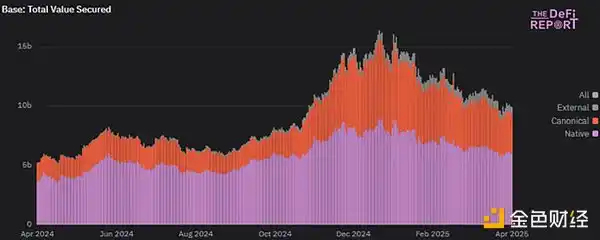
Base is currently valued at 9.9 billion US dollars. Of this value, 6 billion US dollars are from "native" assets, meaning these assets were issued on Base. 3.3 billion US dollars are from "canonical" assets, indicating these assets were bridged from Ethereum. 0.6 billion US dollars are considered "external" assets, implying these assets were bridged from other chains.
Likewise, Base has created net new demand for ETH through native tokenized assets.
In summary, in less than two years, Base has leveraged Ethereum to:
• Become the largest and fastest-growing L2, earning 106 million US dollars in user fees.
• Introduce 157 million new addresses to Ethereum (including some L1 user migrations).
• Build an app ecosystem generating 768 million US dollars in fees.
• Bridge 1.91 million ETH cross-chain, creating additional on-chain service demand.
• Increase stablecoin value by 4 billion US dollars (Coinbase holds approximately 50% of USDC).
• Issue 6 billion US dollars of native assets while introducing 3.3 billion US dollars of Ethereum assets.
We believe Ethereum has achieved a collaborative value of 1+1=3 in this case. But how has Ethereum itself benefited?
3. Base's Contribution to Ethereum's "Security Capture"
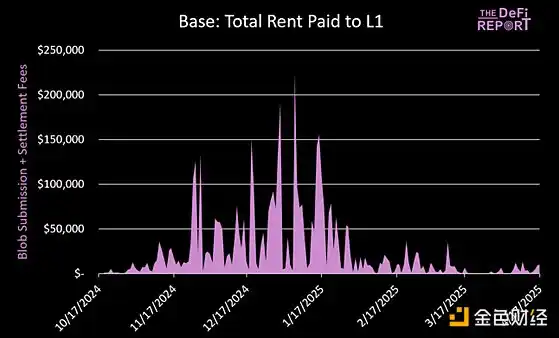
Base has cumulatively paid 4.5 million US dollars in L1 blob and settlement fees (which were burned), with an on-chain profit margin of 91% in the last six months (excluding off-chain costs). It is worth noting that Base has paid a total of 24 million US dollars in L1 fees, with 80% occurring before the EIP4844 implementation (cheaper blob), and our analysis does not include the earlier call data phase.
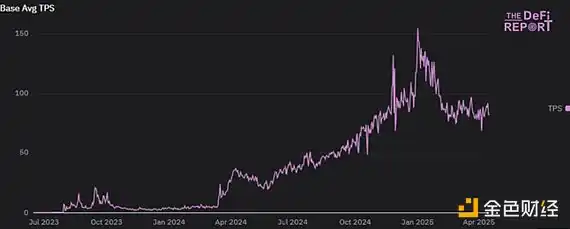
Currently, Base averages 93 TPS, effectively scaling Ethereum's capacity.
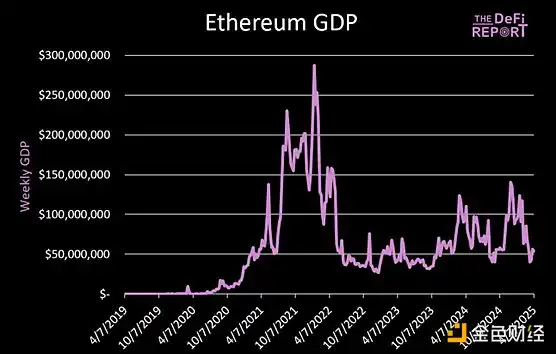
Since Base went live in August 2023, Ethereum's weekly GDP has grown by 75%, but is still 80% below the early 2022 peak. The current L1 app daily GDP is 57 million US dollars, while Base's weekly average app GDP reaches 6.8 million US dollars.
Back to the core question: Does Base "steal" Ethereum's GDP?
The answer is yes!
This is precisely the significance of the L2 roadmap. Top applications (such as Uniswap, Aave) are scaling on Base, while new projects (such as Aerodrome) are choosing Base directly over L1. User migration to L2 is causing a decrease in L1 fees and ETH burn, leading Ethereum to shift towards a more enterprise/B2B-oriented business model.
Only when L2 can't bridge the gap through blob fees in the future does this constitute an "issue" for Ethereum.
4. Base Growth Projection and ETH Value Capture
Based on current data, we believe Ethereum is investing in a long-term future through the L2 roadmap, sacrificing short-term GDP, fees, and ETH burn, with the hope that Base can scale, establish a replicable template (traditional finance?), and drive positive ecosystem development.
Current Situation Analysis:
• L2 currently processes approximately 165 TPS in total, needing to compete for blob space.
• 3-4 L2s consistently fill the current target of 3 blobs per block (maximum of 6), whenever this happens, L2s compete, driving fees up.
• The target blobs/block is currently 3 (maximum of 6), but next month, an upgrade through Pectra will increase it to 6 (maximum of 9 blobs/block). Hence, in the initial scenario analysis, we assume a target of 6 blobs, with a maximum of 9 blobs.
• We are using the Blob Simulator created by Tim Robinson.
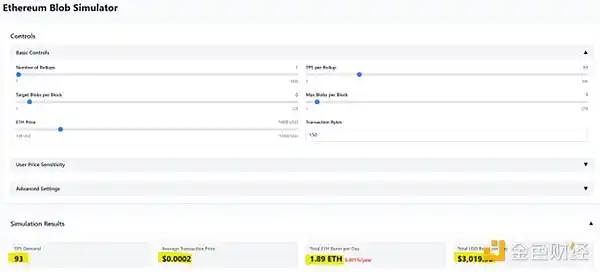
As seen in the above diagram, the current state has minimal impact on the Ethereum economy, with L2 averaging a fee of $0.0002.
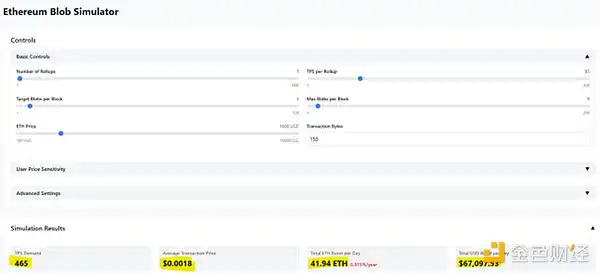
A 5x increase in Base TPS would result in slightly higher L2 fees, while bringing more value to Ethereum L1 (annualized $24.5 million).
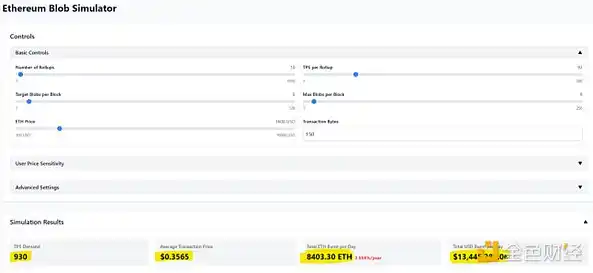
Increasing Base TPS by 10x would result in a 200x surge in L1 annual revenue to $4.9 billion (welcomed by validators). However, we have also created another issue: L2 average fee will rise to $0.35 (unacceptable).
The PeerDAS and Fusaka upgrades (expected in Q3/Q4 this year) will increase the blob reward per block to 12 (ultimate goal of 48, maximum cap of 72). Assuming a 10x increase in Base TPS and completion of the initial Fusaka upgrade:
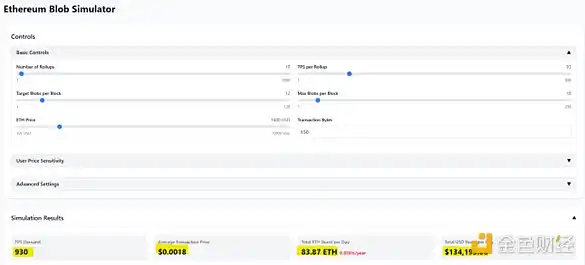
• L2 average fee can be kept at $0.0018
• L1 annual revenue $48.9 million
If Arbitrum and Optimism also achieve a simultaneous 10x expansion:
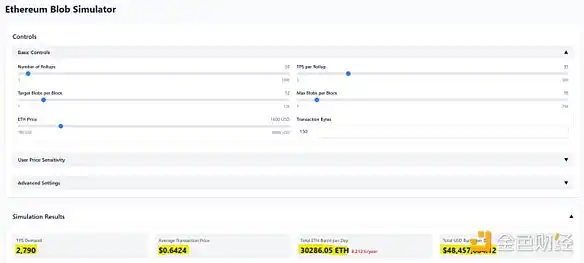
• L1 annual revenue could reach $17.7 billion (nearly double the 2021 peak)
• But once again, we have created a bottleneck, with average L2 cost per transaction rising to $0.64. This is not feasible.
Let's optimistically estimate that the target blob will increase to 24 in a year:
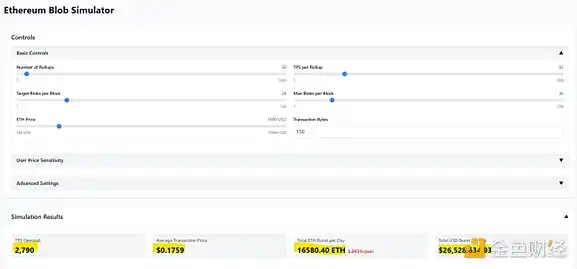
• L1 annual revenue will decrease to $9.6 billion
• L2 average fee remains at $0.17
To keep the L2 average fee below $0.02, we need 33 target blobs per block, at which point L1 annual revenue is only $1.4 billion—just matching the actual revenue from the past 365 days.
Summary:
We have tried to simplify the analysis model, aiming to clarify two core mechanisms: 1) The impact of L2 transactions per second (TPS) increase on blob pricing; 2) The transmission effect of an increased L1 target blob/block quantity on the Ethereum economic model and L2 user fees. In reality, we fully understand the dynamics and unpredictability of the market environment—there may be hundreds of L2s vying for blob space in the near future.
We are confident that L1 will still host a significant amount of on-chain activity, continue to generate fee revenue, and drive ETH burning. However, specific use cases and transaction scales are currently unclear.
Based on simulation results (assuming the three major L2s each reach a 10x TPS increase from the current Base), when the total L2 TPS reaches 2,790, even with the completion of the Pectra technology upgrade, the Ethereum network will still face overload pressure (at this point, L2 single transaction cost reaches $0.35).
In contrast, Solana has consistently processed 1,078 TPS over the past 90 days, with an average fee of only $0.016 (including base fee + priority fee), and the actual user fee is even lower—due to its network's dynamically priced transaction mechanism by transaction type, and its performance upgrade plan Firedancer has not yet been officially launched.
5. Conclusion
The saying "There is no perfect solution, only trade-offs" is particularly relevant here. Base quickly gained momentum through the L2 model, currently achieving ideal returns, but has also tied itself to the uncontrollable Ethereum scaling path, potentially facing "vendor lock-in" and technical debt risks.
Ethereum seems to have sacrificed L1 fees to attract enterprise clients, create ETH demand, and improve user experience. However, the sustainability of long-term economic relationships is questionable—scenario analysis shows that scalability bottlenecks may persist. If L2 cannot scale quickly, it may be necessary to issue more ETH to maintain validator rewards (after EIP4844, the ETH supply has changed from deflationary to potentially exceeding BTC).
We believe that Base is satisfied with the current situation, but if Ethereum's blob scaling is not effective, it may seek alternative solutions such as Celestia. Ethereum urgently needs to shift its culture from "values and identity" to an enterprise-oriented "security-as-a-service" business model.
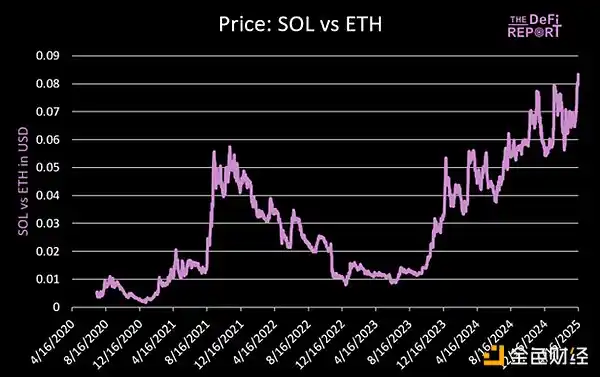
Returning to the original question: Has Standard Chartered Bank misjudged the "L2 J-curve" bottom? We believe that the fundamental structural decline of Ethereum will continue in the short term. Although the onboarding of traditional finance may improve market sentiment, there is a lack of fundamental improvement catalysts. The following chart shows that there is still a long way to go.
You may also like

SK Hynix Reportedly Plans U.S. ADR Listing as Early as August, With SEC Approval Possible in Late June
SK Hynix may pursue a U.S. ADR listing as early as August, with SEC approval reportedly possible in late June amid strong AI chip supply chain demand.

SpaceX vs Tesla vs xAI: Which Elon Musk Trade Has the Biggest Upside in 2026?

OpenAI Reveals It Has Confidentially Submitted an S-1 to the SEC, Keeping the Door Open for a Future IPO
On June 9, according to an OpenAI announcement, the company recently confidentially submitted a draft S-1 registration statement to the U.S. Securities and Exchange Commission (SEC), beginning the preliminary compliance process for a potential initial public offering. OpenAI said it chose to disclose this proactively because it expected the news might leak; however, the company has not yet set a specific listing timeline, and related arrangements may still take some time.

Latest research from 13 top universities including Cornell University: The current state, challenges, and misconceptions of the fusion of Crypto and AI
Deconstructing Anthropic: The Best AI Company, Possibly Also a Type of Organizational Invention
Apollo and Blackstone Reportedly Back $35 Billion Anthropic Chip Financing as Deal Details Remain Unclear
On June 9, according to currently available news alerts, Apollo and Blackstone Group participated in a $35 billion financing for an Anthropic “chip project.” Based on the original wording of the report, the funding has already been raised, but public information remains limited. The financing structure, use of proceeds, project entity, and whether Apollo and Blackstone participated through equity, debt, or project financing have not yet been disclosed.

Humanity Protocol Security Incident Escalates: More Than $31 Million Stolen From Related Addresses as Attacker Continues Selling H for ETH
On June 9, according to monitoring by Onchain Lens, more than $31 million has been stolen from addresses linked to Humanity Protocol, and the attack is still ongoing, with the hacker continuously swapping H tokens for ETH. Project founder Terence Kwok later confirmed the security incident on X, saying the issue involved a private key leak.

Bloomberg: As Bitcoin Weakens, Stablecoins and RWA Continue to Drive Expansion in Crypto Businesses
In June, Bloomberg reported that despite Bitcoin falling below $60,000 last week, wiping out about $235 billion in market value within seven days, and dropping close to 50% from last year’s peak, some core businesses in the crypto industry are still expanding, mainly in stablecoins, real-world asset tokenization (RWA), payments, and infrastructure. The report also noted that overall altcoin activity has contracted significantly: altcoin market capitalization has fallen from a peak of about $431 billion in November 2021 to around $170 billion, and among the tens of millions of tokens issued in recent years, fewer than 1,700 still maintain meaningful trading activity.

Galaxy Deep Research Report: How Hyperliquid's HIP-4 Upgrade Changes the Landscape of Prediction Markets?
Binance Research: RWA Market Expected to Expand Nearly 6x from Early 2025, with Public Equities and Onchain Payments Heating Up Together
In June, Binance Research said in its monthly market report that the real-world asset (RWA) market is expected to grow by about 589% from the beginning of 2025. Bond- and money market fund-related RWA expanded by about $6.5 billion, up 83% year over year, while publicly traded equity RWAs grew by about 422%. The report also noted that monthly crypto debit card transaction volume exceeded $747 million in May, up 48.6% year to date.

Japan to Assess a Framework for Yen Stablecoins and Crypto ETFs as Asia’s Compliant Payments Narrative Heats Up
Recently, according to the original report, Japan is considering the launch of yen stablecoins and cryptocurrency ETFs. Public information remains limited at this stage, and there is still no complete policy text, regulatory draft, or clear implementation timeline, so this is better characterized as a “policy discussion” rather than formal implementation. The original wording also noted that advancing stablecoin regulation in Asia is driving XRP usage and supporting growth in the XRPL ecosystem. However, based on currently available public information, there is not enough evidence to directly establish a clear causal relationship between this round of discussion in Japan and XRP or XRPL.

ZachXBT: Humanity private key leak and abnormal surge in H token should be viewed separately
On June 9, according to related disclosures, on-chain investigator ZachXBT posted an update on Humanity’s roughly $31 million security incident, saying that after further analyzing fund flows, he currently tends to believe the project team was not involved in an “inside job” or a self-staged attack. According to him, the official explanation about the private key leak was broadly accurate, but before the token unlock, the price of H had been artificially pushed higher, and the hacker later took advantage of that market environment; therefore, the private key leak and the earlier abnormal price pumping should be regarded as two separate and independent events. This reframing has shifted the market’s understanding of the nature of the incident. Earlier discussion around Humanity had focused on whether the team directly participated in the attack or used the security incident to cover up internal operations. ZachXBT’s latest remarks shift the focus from “whether it was self-theft” to “whether there were pre-unlock market structure issues.” He also questioned whether the team may have.

Morning Report | OpenAI has submitted an S-1 registration statement draft to the U.S. SEC; Morpho completes $175 million financing

Morning Report | BitMine increased its holdings by 126,971 ETH last week; trader Eugene announced his exit from the crypto market

Wang Chuan: How can one not feel anxious after the neighbor Old Wang made thirty times profit by investing in storage stocks? (Seven) - A quarter-century cycle
Cryptocurrency CEXs are flocking to sell US stocks, and traditional brokerages are facing an "uninvited guest."
$75 billion in foreign capital has fled, and South Korean retail investors have absorbed it all using leverage

Japan’s Three Megabanks Plan Joint Stablecoin Issuance in Fiscal 2026
MUFG, SMBC, and Mizuho reportedly plan to jointly issue fiat-pegged stablecoins in fiscal 2026, signaling Japan’s growing push into bank-led digital payment infrastructure.
SK Hynix Reportedly Plans U.S. ADR Listing as Early as August, With SEC Approval Possible in Late June
SK Hynix may pursue a U.S. ADR listing as early as August, with SEC approval reportedly possible in late June amid strong AI chip supply chain demand.
SpaceX vs Tesla vs xAI: Which Elon Musk Trade Has the Biggest Upside in 2026?
OpenAI Reveals It Has Confidentially Submitted an S-1 to the SEC, Keeping the Door Open for a Future IPO
On June 9, according to an OpenAI announcement, the company recently confidentially submitted a draft S-1 registration statement to the U.S. Securities and Exchange Commission (SEC), beginning the preliminary compliance process for a potential initial public offering. OpenAI said it chose to disclose this proactively because it expected the news might leak; however, the company has not yet set a specific listing timeline, and related arrangements may still take some time.
Latest research from 13 top universities including Cornell University: The current state, challenges, and misconceptions of the fusion of Crypto and AI
Deconstructing Anthropic: The Best AI Company, Possibly Also a Type of Organizational Invention
Apollo and Blackstone Reportedly Back $35 Billion Anthropic Chip Financing as Deal Details Remain Unclear
On June 9, according to currently available news alerts, Apollo and Blackstone Group participated in a $35 billion financing for an Anthropic “chip project.” Based on the original wording of the report, the funding has already been raised, but public information remains limited. The financing structure, use of proceeds, project entity, and whether Apollo and Blackstone participated through equity, debt, or project financing have not yet been disclosed.


