
How did Gate.io manage to break through besides Binance and OKX?

Source: Cointelegraph Chinese
The global cryptocurrency exchange industry has evolved into a multi-layered, differentiated competitive landscape. Based on market share, growth rate, and strategic positioning, major exchanges can now be classified into three categories: Giant Players, Challenger Types, and Stealthy Vanguard.
Giant Players
Binance
Binance currently stands as the world's most influential cryptocurrency exchange, maintaining the top spot in spot, derivatives, and user volume. By 2024, its spot market share reaches as high as 48.2%, indicating its platform token Binance Coin (BNB) enjoys a strong user base and ecosystem foundation. However, Binance's annual total market share has dropped from 42.2% to 32.7%, showing signs of marginal slowdown in user growth and share stability.
Challenger Types
OKEx (OKX)
OKEx has performed well in both the spot and derivatives markets. Last year, its spot trading volume reached $606 billion, ranking top three. However, in February this year, its operating company Aux Cayes FinTech Co was fined $505 million for violating U.S. anti-money laundering laws and is required to hire external compliance advisors by 2027.
Bybit
Bybit has risen rapidly in recent years, ranking second in spot trading share at 11.5% in 2024. Its growth is attributed to new token listings, low fee strategies, and market opportunities following FTX's collapse. In addition, Bybit has established strategic partnerships with blockchain projects such as Solana, TON, and Sui, driving the development of the Web3 ecosystem.
Stealthy Vanguard
Gate.io
Gate.io has earned users' trust through its continued investment in security and transparency. Since 2020, Gate.io has been one of the first exchanges to implement 100% reserve proof.
Furthermore, Gate.io has introduced zero-knowledge proof (zk-SNARK) technology, further enhancing the privacy and security of the reserve proof. The platform's reserves cover 209 digital assets, including mainstream coins such as Bitcoin (BTC), Ethereum (ETH), USDT, all achieving reserve rates of over 100%.
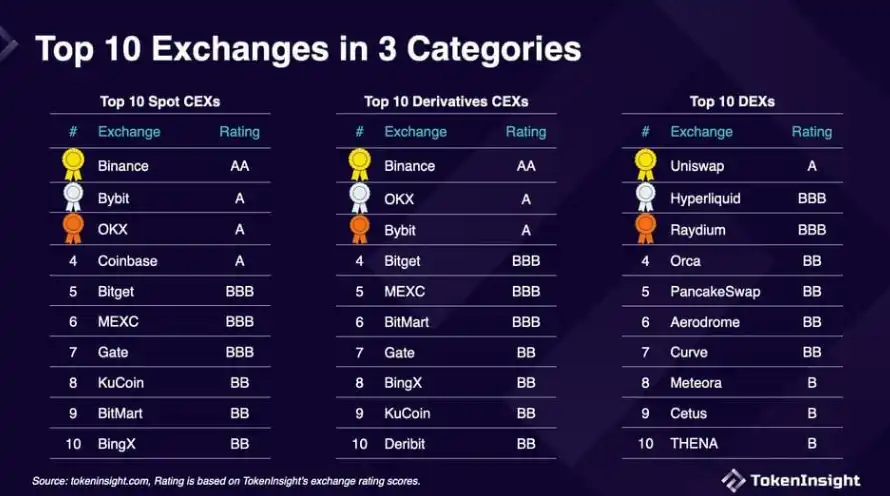
Cryptocurrency Exchange Market Landscape. Source: TokenInsight
Against the Odds: The Self-Revolution of Mid-tier Exchanges
Under the intense market frenzy and tightening regulations, mid-tier exchanges were once seen as the "forgotten part of the era." However, it is in this seemingly unsolvable game that many mid-tier platforms have proactively broken out, shattering the fate of "either the top or elimination." Instead of blindly imitating giants, they have sought their own space for survival and growth through differentiation, refined operations, expanding vertical user tracks, strengthening compliance, and parallel technological advancement.
Taking Gate.io as an example, its key breakthrough strategies and outcomes include:
Full Compensation Mechanism and Transparent Reserve
On April 23, during a system upgrade, Gate.io experienced fluctuations and activated a full compensation mechanism to ensure user rights were not affected. Chief Business Officer Kevin clearly stated in an AMA live broadcast that the platform would provide 100% compensation for any impacts caused by the upgrade, demonstrating the platform's firm commitment to user asset security.
As of January 17, Gate.io's total reserve value reached $10.328 billion, with a reserve ratio of 128.58%. The excess reserve scale reached $2.296 billion, with an excess reserve ratio of 28.58%, showing an increase of $450 million since December last year, a growth rate of 24.38%. The platform's reserve data has also been audited by the authoritative blockchain security company Hacken.
Product Innovation and Ecosystem Expansion
● New Coin Listings: Last year, Gate.io listed 873 new tokens, with 437 being exclusive premieres, providing users with a wide range of investment choices;
● Memecoin Market Layout: By launching dedicated Pilot and MemeBox, the platform attracted a large number of users to participate in this emerging market. Additionally, Gate.io has established a $50 million dedicated fund to support the thriving Memecoin market;
● TON Ecosystem Cooperation: Through a partnership with Telegram, Gate.io introduced the Gate Wallet Mini App and Mini App, attracting numerous TON ecosystem users. These applications have monthly active users exceeding 2.55 million and 1.4 million, respectively, further enhancing the platform's influence in the Web3 and blockchain ecosystem.
Diversified Brand Collaboration
In February this year, Gate.io announced a multi-year partnership with the F1 Red Bull Racing Team. Starting from the 2025 season, Gate.io's branding will appear on key areas of the Red Bull race car such as the rear wing, nose, headrest, wheel hubs, undertray, as well as on the team's uniform and four-time world champion Max Verstappen's helmet.
Compliance Expansion and Globalization Strategy
Gate.io has completed Virtual Asset Service Provider (VASP) registration in Argentina and is advancing compliance efforts in jurisdictions such as Gibraltar, the Bahamas, Hong Kong, Singapore, and the Middle East, laying the foundation for global expansion. Through the acquisitions of Asia-based Coin Master and Cyprus-based Sheer Markets, it has expanded its compliant operations in Asia and Europe.
The Future of Cryptocurrency Exchanges
Looking ahead, the outlook for cryptocurrency exchanges will greatly depend on their ability to adapt to a constantly evolving regulatory environment. As more countries establish their regulatory frameworks, exchanges prioritizing compliance may emerge as industry leaders. The interplay between regulation and innovation will drive the evolution of trading platforms, prompting them to enhance security, transparency, and user experience. Furthermore, with institutional interest in cryptocurrency rising, regulatory clarity will be key to attracting traditional investors. In this dynamically changing landscape, adaptability will be crucial for the success of cryptocurrency exchanges.
● Continual learning to keep up with regulatory dynamics;
● Innovative services to meet regulatory requirements and user needs;
● Establishing partnerships with regulatory bodies to ensure better compliance;
● Focusing on user experience to retain and attract more customers;
● Monitoring global trends to anticipate regulatory changes.
Original Article Link
You may also like

Pantera Capital Partner: How Tokenization is Restructuring the Private Equity and Early Investment Ecosystem?

New York Proposes Stricter Stablecoin Issuer Rules Aligned With Federal GENIUS Act
NYDFS proposed stricter stablecoin issuer rules aligned with the GENIUS Act, covering reserves, custody, redemption timelines, audits, and capital buffers.
Every exchange is a "Universal Exchange."

The counterattack of traditional finance: Alliance chains are quietly reviving

CryptoQuant Says Bitcoin Profitable Supply Is Near 45% Pressure Zone as On-Chain Data Points to Market Repricing
CryptoQuant said Bitcoin’s profitable supply is nearing the 45% pressure zone, signaling rising market stress, unrealized losses, and a possible on-chain repricing phase.

Bitcoin Falls Below 200-Week Moving Average as On-Chain Data Shows Over Half of Supply in Loss
Bitcoin dropped below its 200-week moving average as on-chain data showed over 50% of circulating supply is now in loss, signaling rising market stress.

CFTC Reportedly Plans New Prediction Market Rules Focused on Manipulation Risk and Public Interest Review
The CFTC is reportedly preparing new prediction market rules focused on manipulation risk, public interest review, and retail trader protections.

Meet the new WEEX trial fund—your gateway to greater profits

WEEX Labs Lands at Dutch Blockchain Week: A Disruptive Crypto × AI Conversation Sets Sail in Amsterdam

SK Hynix Reportedly Plans U.S. ADR Listing as Early as August, With SEC Approval Possible in Late June
SK Hynix may pursue a U.S. ADR listing as early as August, with SEC approval reportedly possible in late June amid strong AI chip supply chain demand.

SpaceX vs Tesla vs xAI: Which Elon Musk Trade Has the Biggest Upside in 2026?
OpenAI Reveals It Has Confidentially Submitted an S-1 to the SEC, Keeping the Door Open for a Future IPO
On June 9, according to an OpenAI announcement, the company recently confidentially submitted a draft S-1 registration statement to the U.S. Securities and Exchange Commission (SEC), beginning the preliminary compliance process for a potential initial public offering. OpenAI said it chose to disclose this proactively because it expected the news might leak; however, the company has not yet set a specific listing timeline, and related arrangements may still take some time.

Latest research from 13 top universities including Cornell University: The current state, challenges, and misconceptions of the fusion of Crypto and AI
Deconstructing Anthropic: The Best AI Company, Possibly Also a Type of Organizational Invention
Apollo and Blackstone Reportedly Back $35 Billion Anthropic Chip Financing as Deal Details Remain Unclear
On June 9, according to currently available news alerts, Apollo and Blackstone Group participated in a $35 billion financing for an Anthropic “chip project.” Based on the original wording of the report, the funding has already been raised, but public information remains limited. The financing structure, use of proceeds, project entity, and whether Apollo and Blackstone participated through equity, debt, or project financing have not yet been disclosed.

Humanity Protocol Security Incident Escalates: More Than $31 Million Stolen From Related Addresses as Attacker Continues Selling H for ETH
On June 9, according to monitoring by Onchain Lens, more than $31 million has been stolen from addresses linked to Humanity Protocol, and the attack is still ongoing, with the hacker continuously swapping H tokens for ETH. Project founder Terence Kwok later confirmed the security incident on X, saying the issue involved a private key leak.

Bloomberg: As Bitcoin Weakens, Stablecoins and RWA Continue to Drive Expansion in Crypto Businesses
In June, Bloomberg reported that despite Bitcoin falling below $60,000 last week, wiping out about $235 billion in market value within seven days, and dropping close to 50% from last year’s peak, some core businesses in the crypto industry are still expanding, mainly in stablecoins, real-world asset tokenization (RWA), payments, and infrastructure. The report also noted that overall altcoin activity has contracted significantly: altcoin market capitalization has fallen from a peak of about $431 billion in November 2021 to around $170 billion, and among the tens of millions of tokens issued in recent years, fewer than 1,700 still maintain meaningful trading activity.

Galaxy Deep Research Report: How Hyperliquid's HIP-4 Upgrade Changes the Landscape of Prediction Markets?
Pantera Capital Partner: How Tokenization is Restructuring the Private Equity and Early Investment Ecosystem?
New York Proposes Stricter Stablecoin Issuer Rules Aligned With Federal GENIUS Act
NYDFS proposed stricter stablecoin issuer rules aligned with the GENIUS Act, covering reserves, custody, redemption timelines, audits, and capital buffers.
Every exchange is a "Universal Exchange."
The counterattack of traditional finance: Alliance chains are quietly reviving
CryptoQuant Says Bitcoin Profitable Supply Is Near 45% Pressure Zone as On-Chain Data Points to Market Repricing
CryptoQuant said Bitcoin’s profitable supply is nearing the 45% pressure zone, signaling rising market stress, unrealized losses, and a possible on-chain repricing phase.
Bitcoin Falls Below 200-Week Moving Average as On-Chain Data Shows Over Half of Supply in Loss
Bitcoin dropped below its 200-week moving average as on-chain data showed over 50% of circulating supply is now in loss, signaling rising market stress.


