
From Wild Fundraising to Unwarranted Hype, What Is Happening to Crypto VCs?


Original Article Title: "Crypto VC in the Midst of Liquidity Anxiety: An Unfolding Imbalance"
Original Source: ChandlerZ, Foresight News
Waterdrop Capital partner Dashan admitted in a recent Space session that all four projects he had recently invested in had launched on Binance, but none had distributed tokens to investors according to the original investment agreement. Despite the token distribution terms being clearly outlined in the contract, after the project goes live, the agreement can be amended at will, and investors are almost unable to take any effective countermeasures.
He mentioned that the amendment to the agreement was not actually the project team's intention, but rather a longstanding unwritten rule of Binance, so he does not blame the project teams because they are also at a disadvantage in front of Binance. The current strategy is very clear: to persuade and help truly high-quality project teams to forgo token distribution and go directly to listing on a relatively clean and regulated market to showcase their value.
In traditional VC investments, rights protection based on contracts does not have the same practical binding force in the encrypted token investment structure. Due to exchanges leading circulation rules after token listing, on-chain asset allocation is not immediately bound by the traditional legal system, and investment agreements often lose their enforceability at critical junctures. In the current market environment, whether a project can gain access to a top exchange directly affects its overall survival, and the importance of agreement terms is marginalized in the face of actual interests. In order to get listed, project teams have to cooperate with exchanges in redesigning aspects such as release schedule, lock-up rules, token distribution ratios, etc. Investors, lacking on-chain governance rights and circulation discourse power, find themselves in a de facto rights disadvantage.
This statement reveals a deep-rooted crisis that the current crypto VC investment system is facing, namely a dilemma where the effectiveness of contracts, liquidity control, and exit mechanisms have completely failed.
Imbalance of Power: The New Relationship Among VCs, Projects, and Exchanges
In the industry's development over the past few years, the model of "project narrative construction - multi-round VC financing - top exchange token generation event (TGE)/listing" has gradually become mainstream. The hallmark of this model is that in the early stages, projects rely on professional VC institutions for funding, resource connection, and reputation endorsement, completing financing with gradually increasing valuations, with the ultimate goal usually being the initial token issuance and circulation on a large centralized exchange for early investors to exit.
In the previous multiple bull markets, crypto VCs, as core resources, held significant power in early-stage financing and token issuance design, playing a key role in driving rapid industry expansion and project incubation. In the last bull market, the position of project teams was enhanced, but VCs still had some dominance due to their large capital and liquidity empowerment such as Launchpad.
However, as the market enters a new adjustment period, liquidity in the altcoin space dries up, and the incentive structure between investors and projects shifts. Exchange power has reached unprecedented levels, becoming the absolute controller of liquidity, with key processes such as listing approval, token allocation, and circulation strategy concentrated in the hands of exchanges. This places projects in an extremely weak position during negotiations, even if they have signed detailed investment agreements. Faced with exchange-proposed changes to circulation conditions, project teams find it difficult to refuse, ultimately having to violate the original agreements with investors.
Exchanges have become the controllers of scarce resources, while VCs are gradually being marginalized, with their actual control capacity significantly reduced.
The "Prisoner's Dilemma" in Liquidity Contraction
The current dilemma faced by "VC coins" is not caused by a single factor.
After multiple rounds of funding, projects often have a high public market valuation at the time of Token Generation Event (TGE). This directly results in a high initial buy-in cost for secondary market investors, while also implying that early investors including VCs, the team, early supporters, etc., hold a large amount of low-cost chips and have a strong potential sell-off motive.
This expectation gap puts tokens under natural selling pressure after listing, with market participants potentially forming a consensus that "selling is the optimal strategy," triggering a negative feedback loop.
Furthermore, the token economy itself exacerbates the dilemma of VC coins.
During a bull market, many projects' token issuance models follow the high growth assumptions of the bull market, such as continuous market cap growth and sufficient liquidity to support gradual unlocking. However, in practice, many projects lack real revenue support, with DeFi relying on Ponzi schemes, GameFi relying on subsidies, NFTs relying on FOMO, and tokens completely losing intrinsic growth momentum.
Most importantly, tokens invested by VCs in the past could eventually be sold to new retail investors on the secondary market, forming a complete exit path. However, there are currently very few new retail investors on-chain and on exchanges, incremental funding is drying up, and VC mutual selling has become the norm.
Essentially, early investors, project teams, liquidity providers, and early users have become part of a zero-sum game within a closed loop, making it increasingly difficult to exit.
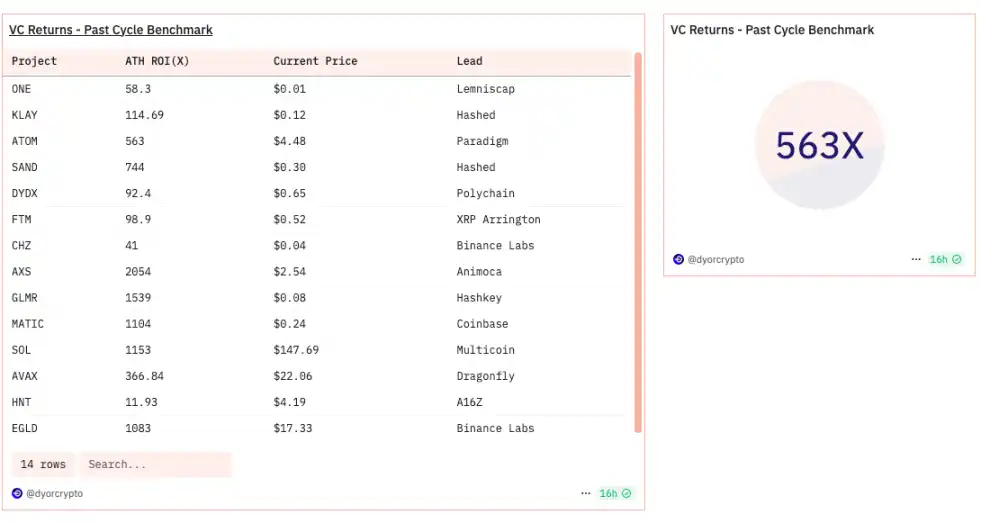
VC Return in the Previous Bull Market Cycle
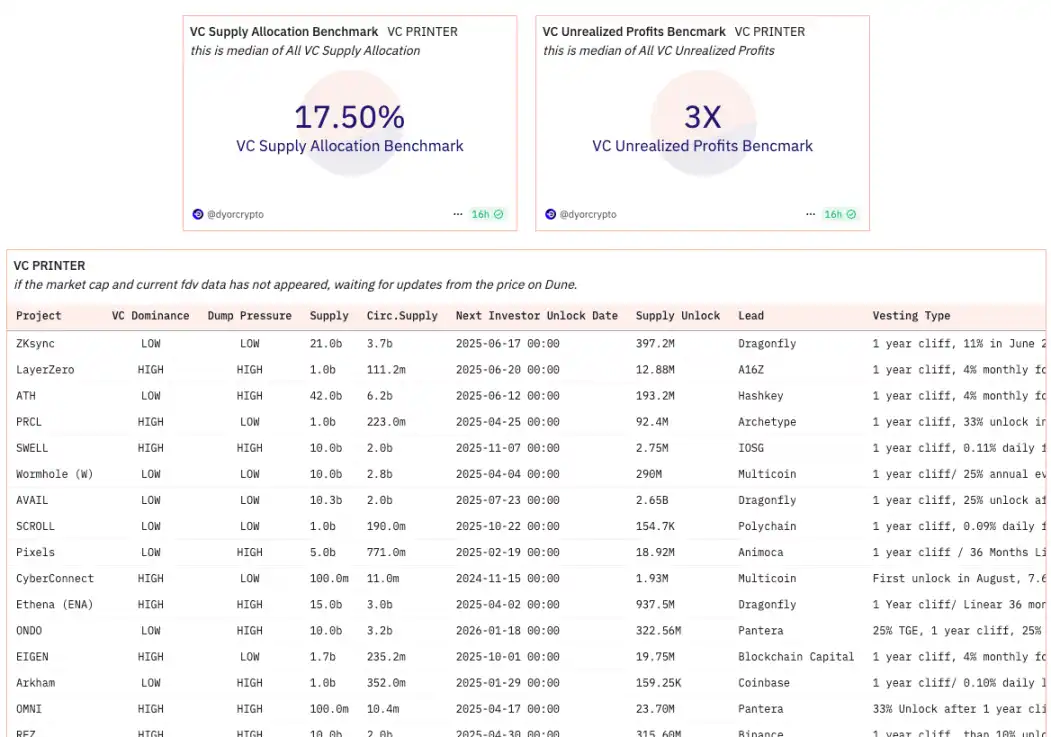
VC Return in the Current Cycle
For VC firms, the traditional strategy of relying on rapid TGEs to achieve high multiple exits is facing challenges, and the realization period of investment returns may lengthen, increasing uncertainty. This may prompt VCs to focus more on a project's long-term fundamentals, sustainable business models, reasonable valuations, and healthier tokenomic models when making investment decisions. Their role may also need to evolve from focusing on early-stage investment and driving listings to more in-depth post-investment management, strategic empowerment, and ecosystem development.
For project teams, there is a need to reassess their token issuance strategy and community relationships. Following the questioning of the "pump and dump" model, exploring a lower valuation starting point, a more equitable distribution mechanism, designing tokenomics that better incentivize long-term holders, as well as increasing operational transparency and strengthening accountability may be more worth exploring.
From a more macro perspective of industry development, the current challenges can be seen as an adjustment in the market's path to maturity. It has exposed issues accumulated during past rapid growth and may drive the formation of a more balanced, sustainable financing, and development ecosystem. This requires all market participants, including VCs, project teams, exchanges, investors, and even regulatory bodies, to collectively adapt to change, seeking to establish a new equilibrium between innovation incentives and risk control, efficiency, and fairness.
Original Article Link
You may also like

Mastercard Launches Agent Pay for AI, Plans to Record AI Agent Payment Authorizations on Polygon
Mastercard launched Agent Pay for AI, a new payment protocol designed to help AI agents make small payments such as pay-per-use access to data and APIs. The system plans to record human-granted AI agent permissions on Polygon, focusing on verifiable authorization, identity, and payment controls.

Curve Deploys Llamalend v2 on Optimism With 250,000 OP Incentives
Curve launched Llamalend v2 on Optimism with 250,000 OP incentives from the Optimism Foundation. The upgrade expands Llamalend beyond its earlier crvUSD-focused model, adding broader collateral support, LlamaRisk market reviews, and the ability to use Curve LP tokens as collateral.

Raydium Old Liquidity Pool Reportedly Exploited, With $1.34 Million Moved to Ethereum and Tornado Cash
An old Raydium liquidity pool was reportedly exploited for around $1.34 million in USDC, RAY, and wSOL, with the stolen funds bridged to Ethereum and deposited into Tornado Cash. The incident highlights the tail risks of legacy DeFi pools, old contracts, and cross-chain fund laundering paths.

Kalshi Executive Challenges “SBF Backed AI Unicorns” Narrative, Says Leopold Aschenbrenner Was Key Figure
Kalshi executive John Wang questioned the “SBF backed AI unicorns” narrative, saying Leopold Aschenbrenner was the key figure behind major AI investment decisions.

Pantera Capital Partner: How Tokenization is Restructuring the Private Equity and Early Investment Ecosystem?

New York Proposes Stricter Stablecoin Issuer Rules Aligned With Federal GENIUS Act
NYDFS proposed stricter stablecoin issuer rules aligned with the GENIUS Act, covering reserves, custody, redemption timelines, audits, and capital buffers.
Every exchange is a "Universal Exchange."

The counterattack of traditional finance: Alliance chains are quietly reviving

CryptoQuant Says Bitcoin Profitable Supply Is Near 45% Pressure Zone as On-Chain Data Points to Market Repricing
CryptoQuant said Bitcoin’s profitable supply is nearing the 45% pressure zone, signaling rising market stress, unrealized losses, and a possible on-chain repricing phase.

Bitcoin Falls Below 200-Week Moving Average as On-Chain Data Shows Over Half of Supply in Loss
Bitcoin dropped below its 200-week moving average as on-chain data showed over 50% of circulating supply is now in loss, signaling rising market stress.

CFTC Reportedly Plans New Prediction Market Rules Focused on Manipulation Risk and Public Interest Review
The CFTC is reportedly preparing new prediction market rules focused on manipulation risk, public interest review, and retail trader protections.

Meet the new WEEX trial fund—your gateway to greater profits

WEEX Labs Lands at Dutch Blockchain Week: A Disruptive Crypto × AI Conversation Sets Sail in Amsterdam
SK Hynix Reportedly Plans U.S. ADR Listing as Early as August, With SEC Approval Possible in Late June
SK Hynix may pursue a U.S. ADR listing as early as August, with SEC approval reportedly possible in late June amid strong AI chip supply chain demand.

SpaceX vs Tesla vs xAI: Which Elon Musk Trade Has the Biggest Upside in 2026?
OpenAI Reveals It Has Confidentially Submitted an S-1 to the SEC, Keeping the Door Open for a Future IPO
On June 9, according to an OpenAI announcement, the company recently confidentially submitted a draft S-1 registration statement to the U.S. Securities and Exchange Commission (SEC), beginning the preliminary compliance process for a potential initial public offering. OpenAI said it chose to disclose this proactively because it expected the news might leak; however, the company has not yet set a specific listing timeline, and related arrangements may still take some time.
Latest research from 13 top universities including Cornell University: The current state, challenges, and misconceptions of the fusion of Crypto and AI
Deconstructing Anthropic: The Best AI Company, Possibly Also a Type of Organizational Invention
Mastercard Launches Agent Pay for AI, Plans to Record AI Agent Payment Authorizations on Polygon
Mastercard launched Agent Pay for AI, a new payment protocol designed to help AI agents make small payments such as pay-per-use access to data and APIs. The system plans to record human-granted AI agent permissions on Polygon, focusing on verifiable authorization, identity, and payment controls.
Curve Deploys Llamalend v2 on Optimism With 250,000 OP Incentives
Curve launched Llamalend v2 on Optimism with 250,000 OP incentives from the Optimism Foundation. The upgrade expands Llamalend beyond its earlier crvUSD-focused model, adding broader collateral support, LlamaRisk market reviews, and the ability to use Curve LP tokens as collateral.
Raydium Old Liquidity Pool Reportedly Exploited, With $1.34 Million Moved to Ethereum and Tornado Cash
An old Raydium liquidity pool was reportedly exploited for around $1.34 million in USDC, RAY, and wSOL, with the stolen funds bridged to Ethereum and deposited into Tornado Cash. The incident highlights the tail risks of legacy DeFi pools, old contracts, and cross-chain fund laundering paths.
Kalshi Executive Challenges “SBF Backed AI Unicorns” Narrative, Says Leopold Aschenbrenner Was Key Figure
Kalshi executive John Wang questioned the “SBF backed AI unicorns” narrative, saying Leopold Aschenbrenner was the key figure behind major AI investment decisions.
Pantera Capital Partner: How Tokenization is Restructuring the Private Equity and Early Investment Ecosystem?
New York Proposes Stricter Stablecoin Issuer Rules Aligned With Federal GENIUS Act
NYDFS proposed stricter stablecoin issuer rules aligned with the GENIUS Act, covering reserves, custody, redemption timelines, audits, and capital buffers.


