
From BTC to SOL: A New Direction for Traditional Corporate Crypto Asset Allocation

Original Article Title: "After BTC, Traditional Companies Increasing SOL Holdings Is Becoming a Popular Trend"
Original Source: TechFlow by DeepTide
Has MicroStrategy added to its BTC holdings again today? This question seems to have become a significant barometer of the bullish sentiment in the crypto market. In 2020, this company ignited the trend of traditional companies investing in cryptocurrency, serving as a benchmark for many other traditional companies to embrace crypto assets across different industries.
However, the barometer of today may need to add a Solana to it. The recent popular trend is that traditional companies have also started increasing their SOL holdings through various means. From real estate and consumer goods to investment funds, an increasing number of companies from different industries are beginning to gradually include "SOL reserves" in their corporate investment considerations.
Since the big dip following the TRUMP Coin release, SOL's price had plummeted to around $95 at one point, but it has now rebounded to $150. Looking back at history, this is not the first time SOL has shown price resilience. After experiencing fluctuations, SOL may potentially become the next "Bitcoin" pursued by traditional companies. These early adopter companies are actively transitioning and positioning themselves in the rising profit expectations.
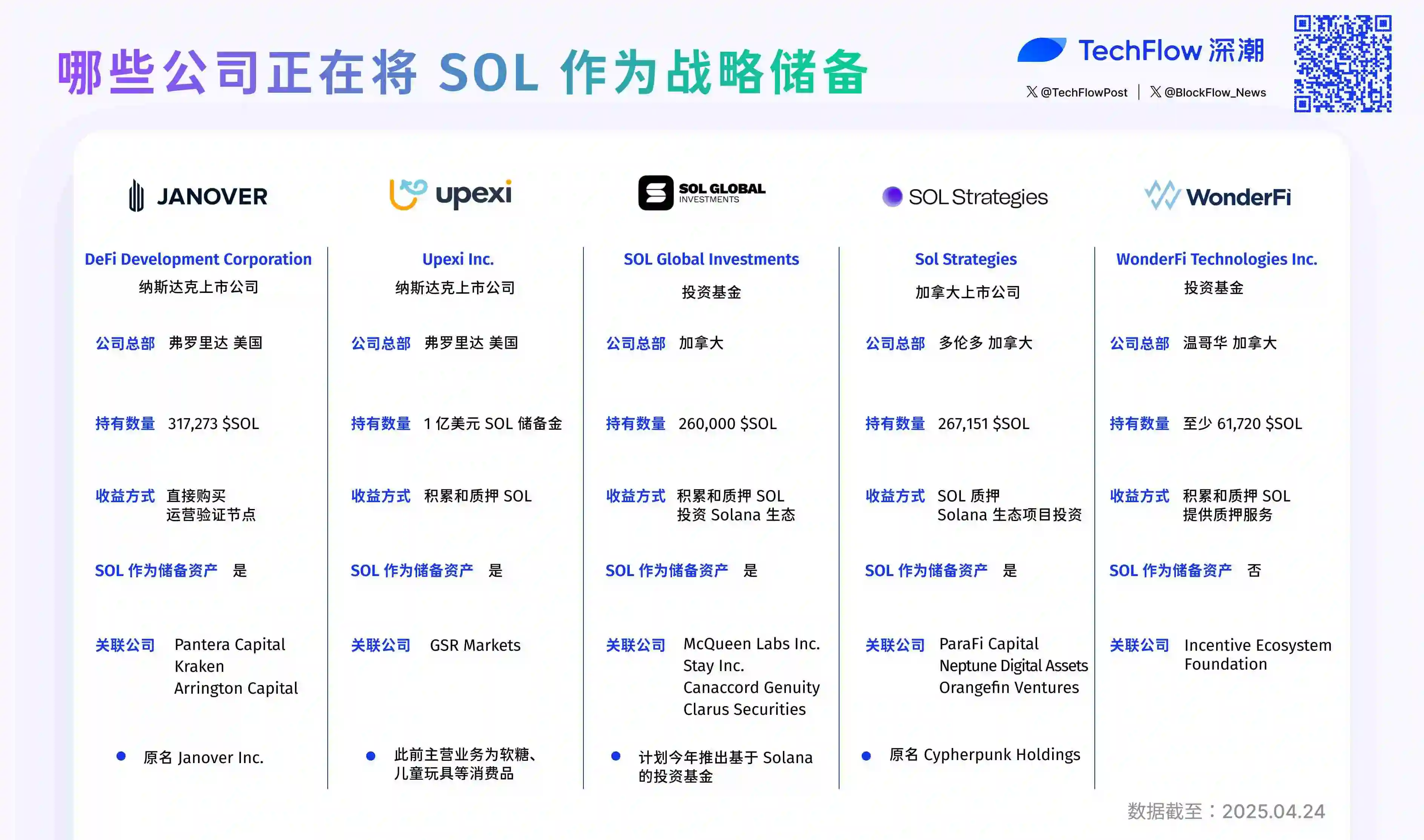
Janover Inc.: Cryptocurrency Team Reshaping Real Estate FinTech
Janover Inc. is a Nasdaq-listed financial technology company (ticker symbol: JNVR), headquartered in Boca Raton, Florida, focusing on commercial real estate loan matching. Founded in 2018, Janover connects borrowers (such as real estate developers, property owners, small business owners) with lenders through an AI-driven online platform, offering financing solutions for multi-family residential and commercial properties.
The company's business was previously affected by the downturn in the real estate market, but small business loan revenue has grown for two consecutive years. In July 2023, Janover raised $5.65 million through an IPO, ended the year with $5.1 million in cash reserves, had only 26 employees, positioning itself as a small yet innovation-driven FinTech company.
In April 2025, Janover announced a bold asset allocation strategy, adding 163,651.7 Solana (SOL) tokens worth approximately $21.2 million, becoming a typical example of a traditional industry's foray into the crypto market. This is not actually the first time the company has purchased SOL. Following this transaction, along with some previous purchases, Janover's total SOL holdings have reached 317,273 tokens, valued at around $48.2 million (including staking rewards).
On April 4, the company's board of directors approved the inclusion of SOL in the corporate treasury, and the transaction was completed through a market purchase on April 15. Janover plans to stake these tokens to earn a 5-7% annualized return and is considering operating a Solana network validation node to participate in ecosystem development. The source of funds for this initiative is the company's cash reserves and a $42 million convertible bond raised on April 7 from cryptocurrency industry institutions such as Pantera Capital and Kraken. Behind this move lies a deeper connection to the cryptocurrency industry.
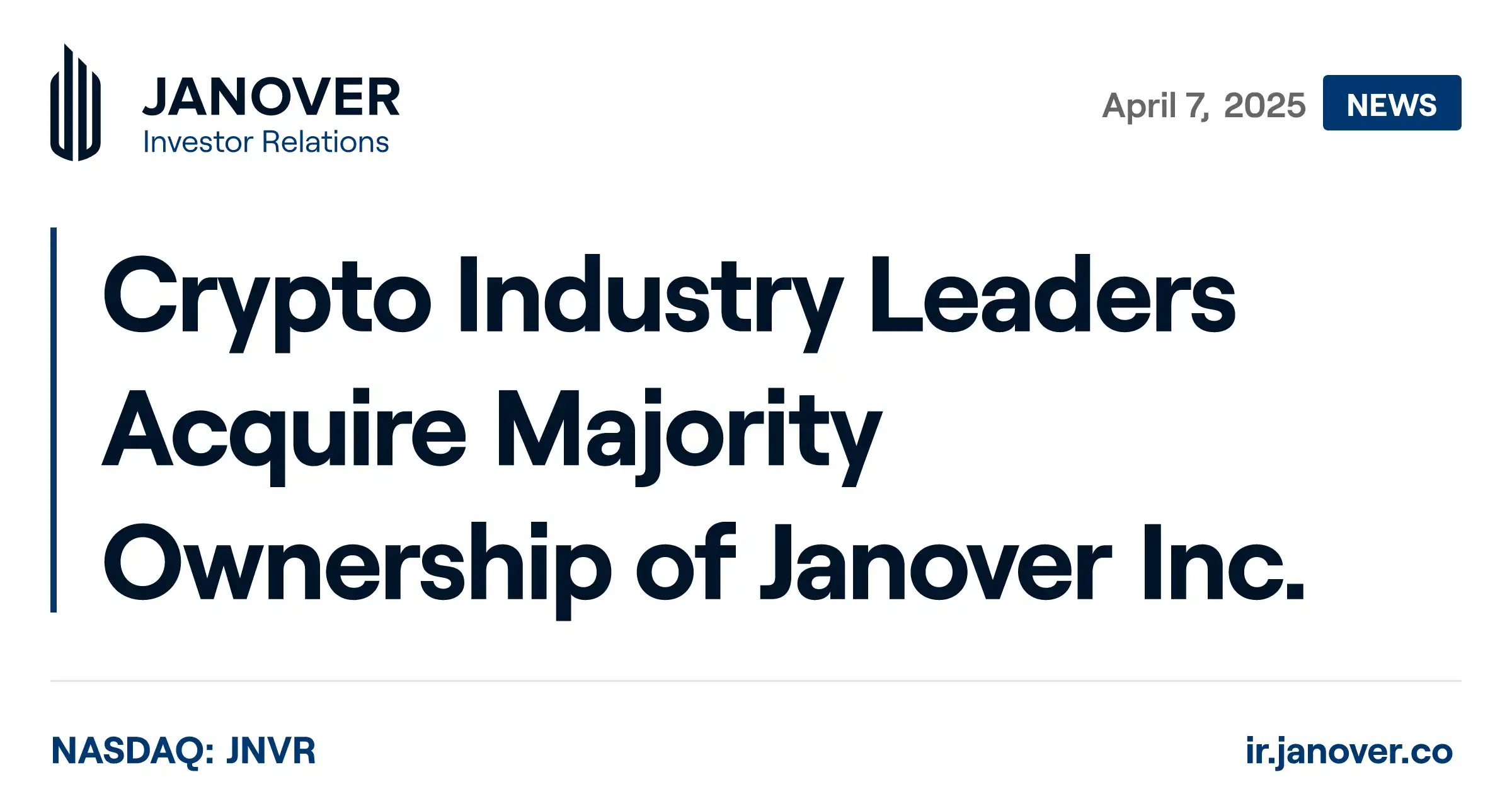
A news release posted on Janover Inc.'s official website reveals that a team composed of former Kraken members has acquired a majority stake in the company. As part of this transaction, the company's name and stock ticker will be changed in the future. The new name will be "DeFi Development Corporation."
The company's board of directors has made a financial decision to allocate a significant portion of the financial reserve on the balance sheet to digital assets, starting with Solana (SOL). The company will explore acquiring Solana validators and plans to acquire and stake SOL through them. The validator business seeks to acquire external equity and use the corresponding income to purchase more SOL.
Blake Janover, CEO of Janover, said, "I am very excited about this transaction creating value for shareholders and driving the company's future growth. I have spent a considerable amount of time learning all aspects of the DeFi ecosystem and found my vision aligned with the new leadership." So, rather than saying the company has embraced crypto, it's more accurate to say that people from the cryptocurrency industry have acquired the company, removing barriers to increasing SOL holdings.
SOL Global: Cryptocurrency Investment Pioneer
SOL Global Investments Corp. is a Toronto-based Canadian investment company focused on exploring the potential of cryptocurrency, blockchain, and emerging technologies. Founded in 2017, this publicly traded company on the Canadian Securities Exchange (symbol: SOL) is known for its bold alternative investment strategy, managing assets of approximately CAD 150 million, covering medical technology and digital assets.
In 2025, SOL Global further focused on Solana (SOL), solidifying its position as a pioneer in the cryptocurrency market by increasing its stake to 40,350 SOL (valued at approximately $8.7 million) and becoming a benchmark for traditional investment firms embracing the Solana ecosystem.
In January 2025, SOL Global announced a $18 million private placement to raise funds, with $10 million directly allocated to purchase SOL and the remaining funds allocated to DeFi and NFT projects within the Solana ecosystem. As of March, the company holds 40,350 SOL, of which approximately 60% is staked on the Solana network, earning a 6.26% annualized yield.
Recent reports indicate that SOL Global currently holds around 260,000 SOL. The company's CEO, Paul Kania, stated in a press release, "Our goal is to become a Solana powerhouse, offering a gateway for public market investors to participate directly in the Solana transformation opportunity."
SOL Global's Solana strategy goes beyond simply holding coins. Their investment portfolio includes standout projects in the Solana ecosystem such as the decentralized exchange Serum and the NFT platform Magic Eden, showcasing their ambitious involvement in ecosystem development. SOL Global also plans to launch a Solana-based investment fund by the end of 2025 to further amplify its impact. Unlike traditional investment firms, SOL Global's crypto-native DNA (with a team largely from the blockchain space) positions them effectively in the Solana frenzy.
SOL Strategies: A Seasoned Player with a New Name but Unchanged Core
Sol Strategies Inc., formerly known as Cypherpunk Holdings, is a publicly traded holding company on the Canadian Securities Exchange (symbol: HODL) that has been deeply involved in cryptocurrency investments since 2018. This investment veteran, founded in 1995, initially focused on privacy technologies (such as Tor and VPNs) before shifting to digital assets like Bitcoin and Ethereum post-2018, managing assets worth about CAD 60 million.
In September 2024, under the leadership of former Valkyrie Funds CEO Leah Wald, the company underwent a dramatic transformation: rebranding as Sol Strategies and fully pivoting towards Solana (SOL), becoming a pioneering case of a crypto investment entity tilting heavily towards the Solana ecosystem.

In February 2025, Sol Strategies announced holdings of 189,968 SOL, valued at approximately $40.89 million, making it one of the largest publicly known Solana investment entities. The company accumulated SOL through staggered purchases from October 2024 to January 2025, funded by their existing crypto asset portfolio (including a partial liquidation of Bitcoin) and a CAD 25 million private placement completed in November 2024.
As of now, public data shows that the company holds approximately 260,000 SOL. Sol Strategies not only hodls coins but also operates multiple Solana network validating nodes, participates in the consensus mechanism, and expects an annualized return of 6-8%. CEO Leah Wald stated, "Solana represents a high-growth opportunity and is a logical extension of our strategy. We offer a more actively engaged approach than an ETF."
Upexi Inc.: Consumer Goods Company's Crypto Adventure
Upexi Inc. (Nasdaq: UPXI) is a Nevada-based consumer goods company focused on data-driven brand development and distribution in areas such as health supplements, pet supplies, and children's toys. Founded in 2018, Upexi rapidly expanded through acquisitions and proprietary brand launches, achieving a 2024 revenue of $83 million, a 54% year-over-year growth, and establishing a presence in e-commerce and the Amazon platform. After going public on Nasdaq in 2023, the company had a market capitalization of approximately $120 million with around 150 employees, positioning itself as a mid-sized player in the consumer goods sector.
In 2025, this entirely unrelated-to-crypto enterprise invested nearly $100 million to acquire more Solana (SOL), becoming an unexpected star in the cross-industry crypto market. On April 21, 2025, Upexi announced a $100 million private placement intending to allocate $94.7 million to purchase SOL, establishing the Solana Corporate Treasury; the specific holding amount has not been disclosed. The financing was led by the crypto trading giant GSR Markets, demonstrating institutional confidence in Upexi's strategy.
Upexi stated that the SOL investment will be completed through phased market purchases, with the first phase expected to commence in May 2025. The company also plans to stake a portion of its SOL to earn a 5-7% annualized return. CEO Allan Marshall stated in the announcement, "This strategy will bring long-term value to shareholders, seize the growth opportunity in the crypto market, and maintain the core competitiveness of the consumer goods business."
Upexi's cross-industry move stems from management's positive view of crypto assets. At the end of 2024, the company brought on board a former Coinbase financial advisor to expedite crypto strategy formulation. As Upexi's consumer goods business is subject to e-commerce fluctuations, the SOL Treasury is seen as an innovative attempt to hedge traditional market risks.
WonderFi: Solana Expansion of a Digital Asset Platform
WonderFi Technologies Inc. is a leading Canadian digital asset platform operator headquartered in Vancouver, dedicated to providing cryptocurrency trading, custody, and investment services to retail and institutional clients. Established in 2019, WonderFi rapidly grew into a key player in the North American crypto market through the acquisitions of Coinsquare (one of Canada's largest crypto exchanges) and CoinSmart, managing over $1 billion CAD in assets in 2024 with over 1 million registered users.
The company is listed on the Canadian Securities Exchange (code: WNDR), with a market capitalization of approximately 280 million Canadian dollars and around 200 employees. In 2024, WonderFi will turn its attention to Solana (SOL), aiming to solidify its leading position in the cryptocurrency industry through increased holdings and ecosystem integration, becoming a key driver in mainstreaming Solana.
As of February 2024, WonderFi holds 61,720 SOL tokens, valued at around 8.4 million US dollars (based on the then SOL price of 136 US dollars), and plans to stake all tokens to receive a 5-7% annualized return. On January 16, 2025, the company further acquired Blade Labs, a Solana ecosystem tool developer, gaining its validation node technology and developer resources, with an investment of approximately 15 million Canadian dollars. WonderFi launched a SOL staking service through the Coinsquare platform, allowing users to directly participate in the Solana network, contributing 8.8 million Canadian dollars in staking asset revenue by the end of 2024.
WonderFi's Solana strategy stems from its strategic insight into the native cryptocurrency ecosystem. The acquisition of Blade Labs not only enhanced WonderFi's technological capabilities but also made it an active validator on the Solana network, with expected validation rewards of 2 million Canadian dollars in 2025.
Different Methods, Same Goal
Five companies adopted various approaches to increasing their SOL holdings in 2025, with reasons ranging from asset diversification to the varying potential of DeFi, but the actual goal is similar:
To seize the growth opportunity in the crypto market and maximize shareholder value. Implicit in this logic is the belief that SOL still has room for growth since no one wants to make a loss. As Bitcoin gradually becomes a consensus recognized by the outside world, the return on holding Bitcoin is gradually diluted; for smaller-scale or more aggressive traditional companies, holding SOL is more like an alpha strategy, while holding BTC becomes Beta.
Compared to the degens in the trenches, holding SOL is certainly a conservative choice; but compared to traditional businesses that earn hard-earned money, this choice may offer relatively higher odds. It is believed that more and more market participants will vote with their feet to speculate on the opportunity to share in the growth of the crypto market.
You may also like

Pantera Capital Partner: How Tokenization is Restructuring the Private Equity and Early Investment Ecosystem?

New York Proposes Stricter Stablecoin Issuer Rules Aligned With Federal GENIUS Act
NYDFS proposed stricter stablecoin issuer rules aligned with the GENIUS Act, covering reserves, custody, redemption timelines, audits, and capital buffers.
Every exchange is a "Universal Exchange."

The counterattack of traditional finance: Alliance chains are quietly reviving

CryptoQuant Says Bitcoin Profitable Supply Is Near 45% Pressure Zone as On-Chain Data Points to Market Repricing
CryptoQuant said Bitcoin’s profitable supply is nearing the 45% pressure zone, signaling rising market stress, unrealized losses, and a possible on-chain repricing phase.

Bitcoin Falls Below 200-Week Moving Average as On-Chain Data Shows Over Half of Supply in Loss
Bitcoin dropped below its 200-week moving average as on-chain data showed over 50% of circulating supply is now in loss, signaling rising market stress.

CFTC Reportedly Plans New Prediction Market Rules Focused on Manipulation Risk and Public Interest Review
The CFTC is reportedly preparing new prediction market rules focused on manipulation risk, public interest review, and retail trader protections.

Meet the new WEEX trial fund—your gateway to greater profits

WEEX Labs Lands at Dutch Blockchain Week: A Disruptive Crypto × AI Conversation Sets Sail in Amsterdam

SK Hynix Reportedly Plans U.S. ADR Listing as Early as August, With SEC Approval Possible in Late June
SK Hynix may pursue a U.S. ADR listing as early as August, with SEC approval reportedly possible in late June amid strong AI chip supply chain demand.

SpaceX vs Tesla vs xAI: Which Elon Musk Trade Has the Biggest Upside in 2026?
OpenAI Reveals It Has Confidentially Submitted an S-1 to the SEC, Keeping the Door Open for a Future IPO
On June 9, according to an OpenAI announcement, the company recently confidentially submitted a draft S-1 registration statement to the U.S. Securities and Exchange Commission (SEC), beginning the preliminary compliance process for a potential initial public offering. OpenAI said it chose to disclose this proactively because it expected the news might leak; however, the company has not yet set a specific listing timeline, and related arrangements may still take some time.

Latest research from 13 top universities including Cornell University: The current state, challenges, and misconceptions of the fusion of Crypto and AI
Deconstructing Anthropic: The Best AI Company, Possibly Also a Type of Organizational Invention
Apollo and Blackstone Reportedly Back $35 Billion Anthropic Chip Financing as Deal Details Remain Unclear
On June 9, according to currently available news alerts, Apollo and Blackstone Group participated in a $35 billion financing for an Anthropic “chip project.” Based on the original wording of the report, the funding has already been raised, but public information remains limited. The financing structure, use of proceeds, project entity, and whether Apollo and Blackstone participated through equity, debt, or project financing have not yet been disclosed.

Humanity Protocol Security Incident Escalates: More Than $31 Million Stolen From Related Addresses as Attacker Continues Selling H for ETH
On June 9, according to monitoring by Onchain Lens, more than $31 million has been stolen from addresses linked to Humanity Protocol, and the attack is still ongoing, with the hacker continuously swapping H tokens for ETH. Project founder Terence Kwok later confirmed the security incident on X, saying the issue involved a private key leak.

Bloomberg: As Bitcoin Weakens, Stablecoins and RWA Continue to Drive Expansion in Crypto Businesses
In June, Bloomberg reported that despite Bitcoin falling below $60,000 last week, wiping out about $235 billion in market value within seven days, and dropping close to 50% from last year’s peak, some core businesses in the crypto industry are still expanding, mainly in stablecoins, real-world asset tokenization (RWA), payments, and infrastructure. The report also noted that overall altcoin activity has contracted significantly: altcoin market capitalization has fallen from a peak of about $431 billion in November 2021 to around $170 billion, and among the tens of millions of tokens issued in recent years, fewer than 1,700 still maintain meaningful trading activity.

Galaxy Deep Research Report: How Hyperliquid's HIP-4 Upgrade Changes the Landscape of Prediction Markets?
Pantera Capital Partner: How Tokenization is Restructuring the Private Equity and Early Investment Ecosystem?
New York Proposes Stricter Stablecoin Issuer Rules Aligned With Federal GENIUS Act
NYDFS proposed stricter stablecoin issuer rules aligned with the GENIUS Act, covering reserves, custody, redemption timelines, audits, and capital buffers.
Every exchange is a "Universal Exchange."
The counterattack of traditional finance: Alliance chains are quietly reviving
CryptoQuant Says Bitcoin Profitable Supply Is Near 45% Pressure Zone as On-Chain Data Points to Market Repricing
CryptoQuant said Bitcoin’s profitable supply is nearing the 45% pressure zone, signaling rising market stress, unrealized losses, and a possible on-chain repricing phase.
Bitcoin Falls Below 200-Week Moving Average as On-Chain Data Shows Over Half of Supply in Loss
Bitcoin dropped below its 200-week moving average as on-chain data showed over 50% of circulating supply is now in loss, signaling rising market stress.


