
Ethereum's Crossroads: To Fork or Not to Fork?


Original Title: "Ethereum Crossroads: To Pivot or to Persevere?"
Original Source: Biteye
ETH/BTC hits a five-year low, the old ecosystem is leaving, the new narrative is absent—Ethereum is trapped in the middle ground of technical upgrades and value dilution.
The Ethereum Guard is still talking about ideals, while reality is settling faith.
This time, we won't talk about emotions, only judgments: Is holding ETH still worthwhile? What are the arguments of the bulls and the bears?
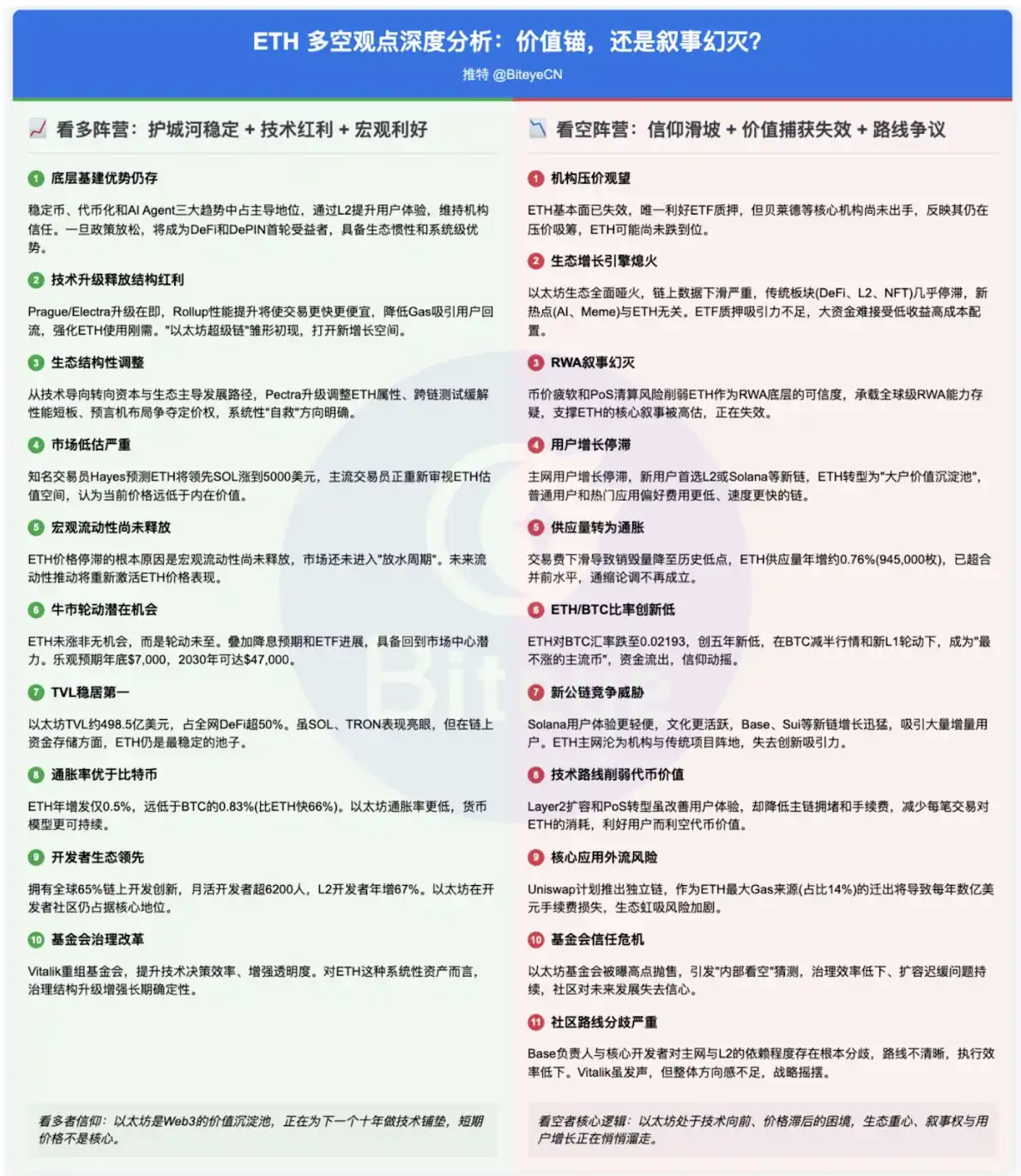
Part One: Bullish Camp - Network Security + Technical Dividend + Macro Tailwinds
Although Ethereum's price has not taken off, bullish views believe that the long-term value of ETH is still gradually accumulating. The ecosystem's fundamentals are solid, technical upgrades are advancing, and macro expectations are gradually improving, providing threefold support.
1. Ethereum Remains the Absolute Center of Infrastructure: Bitwise CIO @Matt_Hougan pointed out that stablecoins, tokenization, and AI Agents are all dominated by ETH. As long as Ethereum can achieve a better user experience through Layer 2 without losing its original position in institutions' hearts, the future is very optimistic, leaning towards a bullish attitude. Saul Rejwan, Managing Partner at Masterkey, predicts that once policies relax, ETH will be the first-round beneficiary of DeFi and DePIN. @BTW0205 believes that although the short term is bearish, in the medium to long term, Ethereum still possesses ecological inertia and systemic advantages. As long as it can reshape its value model and drive the new narrative, a comeback is still possible.
2. Ongoing Technical Upgrades Continue to Release Structural Dividends: The Prague/Electra upgrade is imminent, and Rollup performance improvements will make ETH faster, cheaper, and more open. Gas reduction attracts more users back and also strengthens the necessity of using ETH. Bulls believe the market has not yet priced in these structural optimizations. @binji_x also believes that the outline of an "Ethereum superchain" has emerged, poised to open up new growth opportunities.
3. Ecosystem Structural Adjustment Signals: @feifan7686 believes that Ethereum is transitioning from a technology-driven to a capital and ecology-dominated development path. The Pectra upgrade adjusts ETH's properties, cross-chain testing alleviates performance bottlenecks, and oracle layout fights for pricing power, all part of a systematic "self-rescue" around capital structure and ecological discourse. Although it may be difficult to immediately reflect in prices in the short term, the direction is clear, overall tending towards a bullish view.
4. Secondary Trader Calls Out "ETH Undervalued": Renowned crypto analyst @rovercrc and prominent trader, former BitMEX CEO @CryptoHayes, both tweeted, pointing out that ETH is undervalued in the market. Hayes even predicted: ETH will surpass SOL and rise to $5000. Although these views are radical, they reflect mainstream traders reassessing ETH's valuation space.
5. Macro Liquidity-Driven Impact: @0xVeryBigOrange believes that regardless of how much technical or ecosystem discussion surrounds Ethereum, the fundamental reason for the current price stagnation is one—macro liquidity has not yet been unleashed. It's not that ETH is lacking, the entire market has not entered the "liquidity release cycle" yet.
6. Potential Opportunity for Bull Market Rotation: ETH has not surged not because it lacks opportunity, but the rotation has not yet come to it. Coupled with the interest rate cut expectations and ETF progress, ETH has the potential to move from the periphery back to the center. DigitalCoinPrice estimates that in an optimistic scenario, it could reach $7,000 by the end of the year, and in the long term, it could reach up to $47,000 by 2030.
7. TVL Maintains First Place, On-Chain Funds Still Holding ETH: Ethereum currently has a TVL of $498.5 billion, accounting for over half of the total DeFi network. While Solana and Tron have shown impressive performance, when it comes to "on-chain money," ETH is still the most stable pool.
8. Lower Inflation Rate, Supply Model Superior to BTC: ETH's annual issuance is only 0.5%, much lower than BTC's 0.83% (BTC is 66% faster than ETH). This view emphasizes that Ethereum's inflation rate is much lower than Bitcoin's, making its monetary model more sustainable.
9. Leading Developer Ecosystem Scale: Venture capital firm Electric Capital released its annual report stating that ETH accounts for 65% of global on-chain developer innovation activity, with over 6200 active developers per month, and L2 developers experiencing a 67% annual growth rate. These data indicate that Ethereum still holds a core position in the developer community.
10. Foundation Reform Enhances Governance Expectations: Vitalik announced the restructuring of the foundation to improve technical decision-making efficiency and enhance transparency. For an asset like ETH, governance structure upgrades mean long-term certainty enhancement.
In summary, the bullish camp believes that Ethereum is the value reservoir of Web3, laying the technical groundwork for the next decade, with short-term price not being the core focus.
II. Bearish Camp: Crisis of Faith + Value Capture Failure + Roadmap Disputes
The core viewpoint of the bearish camp is: the times have changed, ETH lags behind competitors in terms of price movement, structure, efficiency, and narrative, the technical roadmap has failed to translate into token value, and the ecosystem is facing fragmentation.
1. Institutional Viewpoint Suggests ETH Has Yet to Bottom Out: @jason_chen998 believes that the fundamentals of Ethereum have deteriorated, with the current only positive factor being the ETF staking, but core institutions such as BlackRock have not yet entered the market, indicating they are still suppressing the price to accumulate, suggesting that ETH may not have bottomed out. Overall, the sentiment leans bearish.
2. ETH Ecosystem Has Lost Its Growth Engine: @Loki_Zeng believes that the Ethereum ecosystem experienced a comprehensive standstill in Q1 2025, with on-chain data plummeting significantly, traditional sectors (DeFi, L2, NFT) almost stagnant, and new trends (AI, Meme) unrelated to ETH. The previously highly anticipated ETF staking benefit has failed to attract significant interest, as large funds find it difficult to accept the low returns and high costs of this allocation logic. Overall, it is believed that ETH lacks substantial growth momentum, leaning bearish.
3. RWA Narrative Disillusionment, Ethereum May Not Be the Optimal Solution: @yuyue_chris questions Ethereum's actual capabilities in the RWA track. Although ETH has long been seen as the "secure settlement layer" for real-world assets, its weak price performance and the liquidation risks stemming from the PoS mechanism are eroding its credibility as the underlying RWA layer. Overall, the belief is that Ethereum's ability to support global-scale RWA is questionable, with the RWA narrative overestimating its role, leaning bearish.
4. On-Chain Growth Slows Down: @PANewsCN researcher @wsy2021111 mentioned in a December 2024 commentary that ETH's mainnet user growth stagnated over the past year, with a significant number of new users opting for L2 or Solana and other new chains. In his view, Ethereum is transitioning into a "reservoir of value for whales," while ordinary small-scale users and emerging popular applications prefer chains with lower fees and faster transaction speeds. This viewpoint highlights the pressure Ethereum faces in terms of user growth.
5. Supply Enters an Inflationary State: Due to the continuous decline in network transaction fees, Ethereum's daily burn rate has dropped to a historic low. This has led to a significant decrease in ETH's expected burn rate, resulting in an annual supply increase of approximately 0.76%, or a yearly addition of about 945,000 ETH. Currently, Ethereum's overall supply has surpassed pre-merge levels.
6. ETH/BTC Ratio Hits Five-Year Low: On March 31, analyst James Van Straten stated that the ETH to BTC exchange rate dropped to 0.02193, hitting a five-year low. Amid the BTC halving rally and new L1 rotation, ETH has become the "least appreciating major coin," experiencing gradual fund outflows and wavering faith.
7. Rise of New Public Chains such as Solana Intensifies ETH Competition: Solana offers a lighter user experience and a more vibrant culture, attracting a large number of incremental users and developers. Chains like Base and Sui have seen active growth, while the Ethereum mainnet has gradually transformed into a realm for institutions and traditional projects, losing its appeal to young projects.
8. Technical Roadmap Scrutiny: Empowerment or Value Erosion? Investor John Pfeffer suggests that Ethereum's current technical roadmap benefits users but undermines the token's value. Layer 2 scaling and the shift to PoS will reduce mainnet congestion and fees, improving on-chain experience but reducing ETH's burn per transaction.
9. Outflow of Core Applications: Rumors within the industry suggest that Uniswap plans to launch an independent chain by the end of 2024. Uniswap is the largest source of Gas on ETH, accounting for over 14%. If it migrates chains, ETH could lose hundreds of millions of dollars in annual fees and a significant burn source, intensifying the risk of ecosystem drain.
10. Foundation Accused of Top-Level Take Profits, Governance Trust Questioned: By the end of 2024, the Ethereum Foundation was exposed to high-point selling, sparking speculations of "internal bearishness." Combined with issues like poor governance efficiency and slow scaling, the community has lost confidence in future development.
11. Clear Community Roadmap Divergence: Base's Jesse Pollak and core developer Dankrad Feist fundamentally disagree on the mainnet's and L2's reliance level, leading to a lack of roadmap clarity and decreased execution efficiency. While Vitalik has spoken out, the overall direction lacks clarity, resulting in strategic oscillation.
In conclusion, the core logic of the bearish view is that Ethereum is currently trapped in a situation where it is advancing technologically but lagging in price, while the ecosystem's focus, narrative control, and user growth are silently slipping away.
III. So, What Judgment Should Be Made Now?
Based on the above long and short factors, we can conduct the following comprehensive analysis starting from the mindset and decisions of holders:
1. Holder Focusing on Long-Term Value
If you believe that ETH represents the future infrastructure of Crypto, with the most extensive developer community, the strongest DeFi ecosystem, and a continuously evolving technical roadmap, and that developers, funds, and the structural narrative have not collapsed, and it is still the core anchor chain of new narratives (DePIN, AI Agent, RWA), then holding or even gradually accumulating more during this time and waiting for the next cycle is a logical choice.
2. Holder Focusing on Medium-Term Profit and Having a Higher Risk Aversion
At this moment, moderately reducing your ETH position may be more in line with your strategy. After all, many of the mentioned bullish factors are more likely to gradually materialize in the medium to long term, while in the short term, ETH may continue to fluctuate or even weaken. The competitive landscape and value dilemma mentioned in bearish arguments are not issues that can be resolved in one or two quarters.
You may consider reducing your position at this time, holding a core position flexibly for readjustment, adding more after the ETH trend becomes clear, or engaging in moderate swing trading to improve capital efficiency. A neutral strategy may involve holding part of your core position (to avoid missing out on potential breakouts) while using another part of your funds for swing trading or allocating to other assets to hedge the opportunity cost of holding ETH.
3. Holder Concerned About Short-Term Performance, Certainty, or Doubtful About Ethereum's Roadmap
Exercising caution is also a wise choice. You may consider partially closing out most of your position on rebounds while continuing to monitor key indicators of the Ethereum ecosystem (such as on-chain activity). If there are significant signals of fundamental improvement in the future or new narratives emerge, then timely readjustment may be necessary.
Risk Disclaimer: The above is for informational purposes only and not investment advice.
This article is a contributed submission and does not represent the views of BlockBeats.
You may also like

Cryptocurrency CEXs are flocking to sell US stocks, and traditional brokerages are facing an "uninvited guest."

Will the SpaceX IPO Hurt Bitcoin? Here's What Traders Are Watching
Foreign selling in the South Korean stock market accelerates, with cumulative net sales reportedly reaching $75 billion this year
On June 9, The Kobeissi Letter, citing Goldman Sachs data, reported that global investors are selling South Korean stocks at an unusually rapid pace. In the latest trading session, foreign investors sold about $801 million worth of Kospi constituent stocks again; total foreign outflows last week reached about $10 billion, and the market has been in net foreign selling on nearly every trading day over the past month. According to the data cited in the report, foreign investors have sold about $75 billion worth of South Korean stocks so far this year. Meanwhile, South Korean retail and institutional investors together recorded roughly $69 billion in net buying over the same period, suggesting that the market’s main buying support has come from domestic capital rather than returning overseas funds. The information currently disclosed still mainly comes from The Kobeissi Letter’s retelling and Goldman Sachs data summaries, while public details on the statistical period and the specific definition of “selling” remain relatively limited.

Fortune Warns of Strategy’s Financing Structure Risks as Bitcoin Premium Narrows
Fortune warned that Strategy’s Bitcoin treasury model faces growing financing risks as MSTR’s net asset premium narrows and preferred stock dividend pressure increases.

Ferrari Challenge Le Mans: Carl Moon to Dominate in WEEX Livery

Sahara AI Responds to SAHARA’s Sharp Drop: No Contract or Product Security Issues Found, Internal Investigation Underway
Sahara AI responded to SAHARA’s 60% price drop, saying no token contract or product security issues have been found and an internal investigation is underway.

WEEX Deposit/Withdrawal Dynamic Island: Your Asset Status, Always in Sight

Scaling Crypto Derivatives: The Digital Asset Infrastructure Behind High-Volume Trading
In the fast-moving digital asset ecosystem, derivatives platforms face an extreme architectural test. High-leverage futures markets demand more than just standard security—they require absolute operational precision, zero-latency matching engines, and ironclad structural scalability, all while navigating intense market volatility.
As global platforms scale to meet these demands, the industry is shifting away from rigid, monolithic setups toward a more agile, "decoupled" infrastructure philosophy.
The Blueprint for High-Volume Copy TradingFor elite global exchanges like WEEX (founded in 2018), this architectural choice becomes critical when scaling high-volume retail features like social copy trading. When thousands of users automatically mirror the real-time strategies of elite traders simultaneously, it triggers sudden, monumental spikes in concurrent transactional volume.
To prevent execution latency or settlement bottlenecks during these peak volatility events, a platform's primary engine must remain entirely dedicated to risk management, copy-trade synchronization, and order matching.
The Architectural Rule: New-generation platforms must separate front-end user execution engines from heavy backend infrastructural overhead to eliminate operational friction.
By separating these layers, platforms can maintain complete sovereignty over their trading environments and user experiences while strategically aligning with institutional-grade infrastructure ecosystems. This strategic framework allows modern exchanges to leverage advanced Digital Asset Custody infrastructure such as Cobo’s behind the scenes, ensuring that backend wallet management scales elastically alongside trading spikes.
Capitalizing on Market Momentum and 400× LeverageIn a derivatives arena where platforms offer up to 400× leverage on perpetual contracts, capital efficiency and market agility are core business metrics. To capture market momentum, an exchange needs the ability to rapidly expand its asset offerings, supporting everything from legacy crypto assets to sudden, trending altcoins across a massive library of trading pairs.
Adopting a flexible, scalable Wallet-as-a-Service (WaaS) solution such as Cobo’s could completely rewrite the development timeline for high-growth exchanges. Instead of spending months of engineering capital building out custom backend wallet architectures for every new blockchain network, platforms can deploy localized infrastructure in days.
This agility allows platforms to instantly scale their listings to over a thousand trading pairs without compromising security or delaying time-to-market. It mirrors the exact operational advantages seen during high-velocity market events, similar to how advanced wallet infrastructure empowers platforms during sudden asset surges; allowing exchanges to pass that speed and liquidity directly to their global user base.
A Mature Foundation for GrowthThe synergy between trusted infrastructure ecosystems and global trading platforms represents the natural evolution of a maturing crypto market. As WEEX continues to scale its global spot and derivatives offerings for over 6 million users, adopting robust backend paradigms proves that platforms no longer have to compromise between cutting-edge trading velocity and uncompromised structural security.

Morning Report | BitMine increased its holdings by 126,971 ETH last week; trader Eugene announced his exit from the crypto market

Wang Chuan: How can one not feel anxious after the neighbor Old Wang made thirty times profit by investing in storage stocks? (Seven) - A quarter-century cycle

Get Paid to Onboard? Try WEEX’s New Homepage with Rewards for Registration, Deposit & Trade

WEEX Custom Layout: Build Your Perfect Trading Workspace in Seconds

See “Buy Walls” & “Sell Walls” Instantly: WEEX Launches the Depth Chart for Smarter Trades

What Is Quick Trade on WEEX? 2 Ways WEEX Ends Chart-Panel Jumping
Morning News | Five major virtual asset platforms in South Korea have experienced 57 incidents of hacking and system failures in six years; Grayscale submits registration application for Canton ETF

Should we escape the peak? The principle of the tail-end market in the stock market

RootData: May 2026 Cryptocurrency Exchange Transparency Research Report

Founder of Baixing.com: My Experience with Claude Code in Fourteen Points
Cryptocurrency CEXs are flocking to sell US stocks, and traditional brokerages are facing an "uninvited guest."
Will the SpaceX IPO Hurt Bitcoin? Here's What Traders Are Watching
Foreign selling in the South Korean stock market accelerates, with cumulative net sales reportedly reaching $75 billion this year
On June 9, The Kobeissi Letter, citing Goldman Sachs data, reported that global investors are selling South Korean stocks at an unusually rapid pace. In the latest trading session, foreign investors sold about $801 million worth of Kospi constituent stocks again; total foreign outflows last week reached about $10 billion, and the market has been in net foreign selling on nearly every trading day over the past month. According to the data cited in the report, foreign investors have sold about $75 billion worth of South Korean stocks so far this year. Meanwhile, South Korean retail and institutional investors together recorded roughly $69 billion in net buying over the same period, suggesting that the market’s main buying support has come from domestic capital rather than returning overseas funds. The information currently disclosed still mainly comes from The Kobeissi Letter’s retelling and Goldman Sachs data summaries, while public details on the statistical period and the specific definition of “selling” remain relatively limited.
Fortune Warns of Strategy’s Financing Structure Risks as Bitcoin Premium Narrows
Fortune warned that Strategy’s Bitcoin treasury model faces growing financing risks as MSTR’s net asset premium narrows and preferred stock dividend pressure increases.
Ferrari Challenge Le Mans: Carl Moon to Dominate in WEEX Livery
Sahara AI Responds to SAHARA’s Sharp Drop: No Contract or Product Security Issues Found, Internal Investigation Underway
Sahara AI responded to SAHARA’s 60% price drop, saying no token contract or product security issues have been found and an internal investigation is underway.


