
Due to the trade war, Trump lost over 5 billion dollars in a week

Since April 3 when Trump announced the imposition of "reciprocal tariffs" on major trading partners including China, Japan, Vietnam, and others, global stock markets have started to experience varying degrees of turbulence—a historic stock market crash in the U.S. After the policy announcement, Nasdaq futures saw a one-day drop of 4.7%, S&P 500 futures dropped 5%, and DJIA futures plummeted by as much as 1822 points. As of April 9, the S&P 500 index had fallen by 18.9% from its February high, causing a $5.8 trillion market cap wipeout, marking the most severe four-day consecutive decline since 1950; Tech stocks became the "hardest-hit area" in this stock disaster, with Apple's stock price plunging 23% in four days, and the combined market cap of seven major tech giants such as Microsoft and Nvidia evaporating by $1.65 trillion. This impact directly stemmed from the risk of supply chain disruption—Apple's 75% of components rely on Asia for production, creating immense tariff cost pressure; Bloomberg data shows that the total global stock market capitalization shrank by $10 trillion, with the Vietnamese stock market plunging by over 6% in a single day, the Nikkei 225 index plummeting nearly 3%, and the three major European stock indices all dropping by over 1%.
In the midst of global investors' heartache, Trump himself could not escape unscathed from this global crash.
Personal Wealth Hit by a $500 Million "Backlash"
According to Forbes' report on April 8, when Trump announced a massive tariff plan on April 2, his net worth was estimated at $4.7 billion. However, in less than a week, his assets fell to $4.2 billion, evaporating $500 million in a week. The largest portion of his personal wealth loss came from his Trump Media and Technology Group company, whose stock price has dropped by about 5% since April 3. Trump holds 114.75 million shares, causing a total asset loss of about $170 million just from this holding.
In addition, Trump also holds a significant amount of shares in tech giants. According to the Federal Election Commission (FEC) regulations, presidential candidates must submit a personal financial disclosure report by May 15 each year, covering their assets, liabilities, sources of income, including stock investments, etc. As a presidential candidate, Trump is required to comply with this regulation for disclosure purposes. His latest disclosed report for the year 2024 shows that Trump holds stocks in Apple, Microsoft, Nvidia, Amazon, Alphabet (Google), Meta Platforms, Berkshire Hathaway, PepsiCo, JPMorgan, and others, with values ranging from $100,000 to $1,000,000, where the holdings in Apple, Microsoft, and Nvidia are all valued at over $500,000. The total value of the aforementioned shares alone ranges from $2.25 million to $4.75 million. If Trump has not significantly altered his stock positions in the 8 months following the disclosure, the crash will have a considerable impact on his net worth.
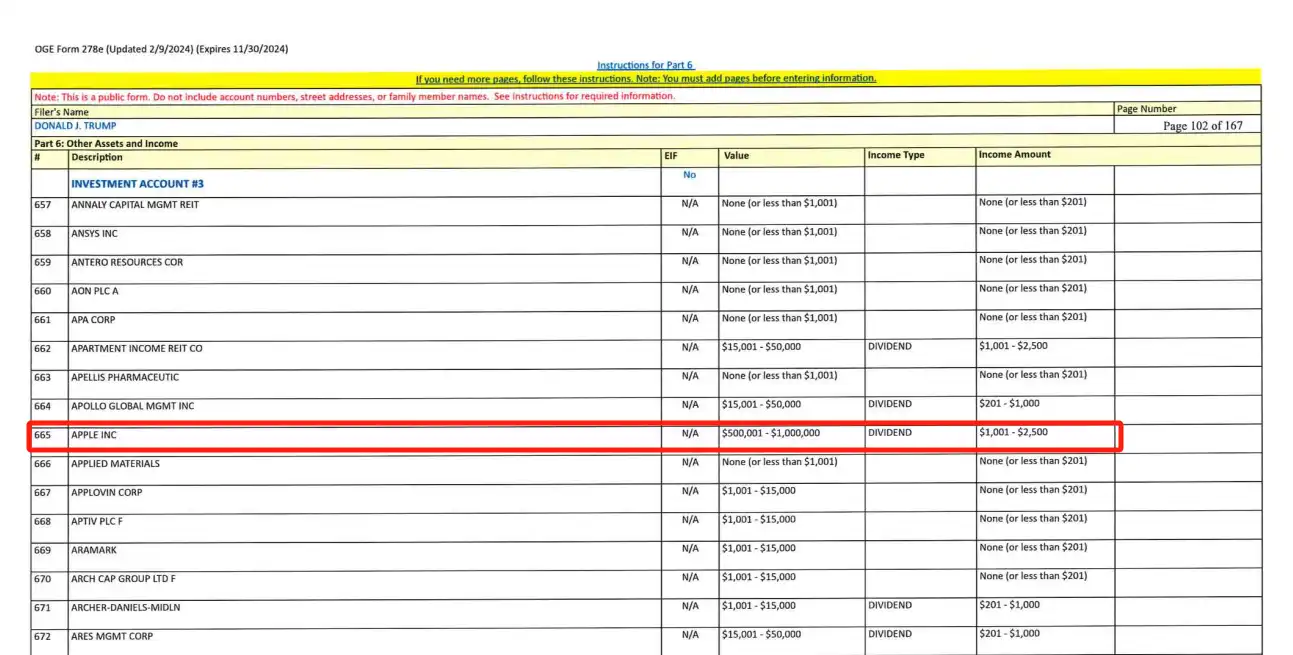
Image Source: Personal Financial Disclosure Report of Donald Trump
In addition, the real estate asset portfolio held by the U.S. President also shrank during this period, from $660 million to $570 million, a decrease of approximately $90 million. His golf-related assets also suffered losses, as many golf balls, clubs, and apparel sold in the pro shop relied on imports.
Furthermore, Trump's family crypto project WLFI incurred a huge loss due to an ETH transaction. On April 9, according to Lookonchain's monitoring, a wallet suspected to be related to WLFI sold 5,471 ETH at an average price of $1,465, receiving $8.01 million. This address had previously spent about $210 million to buy 67,498 ETH at an average price of $3,259. The current mark-to-market loss is approximately $125 million.
World's Richest Individuals Experience Billions in Losses
The Guardian reported that following Trump's announcement of tariff hikes on April 3, by the close of trading on April 4, the world's top 500 billionaires collectively lost $536 billion over the first two days of stock market trading. This marked the largest two-day wealth loss ever recorded by the Bloomberg Billionaires Index. Several billionaires who supported or participated in Trump's January inauguration suffered varying degrees of wealth reduction, with Elon Musk, Mark Zuckerberg, and others being among the most affected. The following image shows the real-time Bloomberg Billionaires Index (as of April 9).
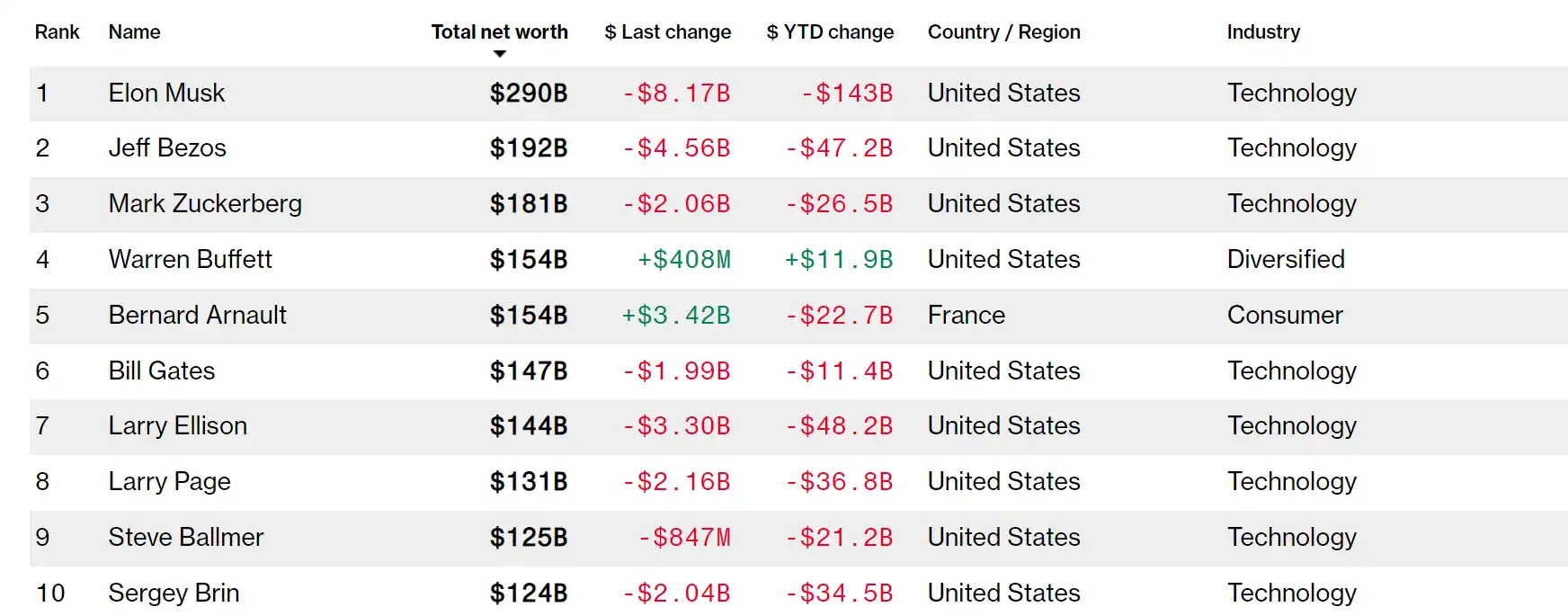
Image of Bloomberg Billionaires Ranking on April 9
The world's richest person and CEO of Tesla, Musk, has seen a significant decline in wealth since becoming a prominent and controversial figure in the Trump administration. His wealth took the hardest hit, with a net asset loss of $31 billion by last Friday's close due to a stock price plunge. From the beginning of this year until now, Musk's wealth has shrunk by about $143 billion, yet he still holds the title of the world's richest person with a net worth of $290 billion.
Facebook founder and owner of Instagram and WhatsApp, Zuckerberg, suffered the second-largest loss, totaling over $27 billion. The net worth of this global third richest person is estimated at $181 billion, heavily impacted by the sharp decline in Meta's market value. As the tariff war particularly hit tech companies hard, Meta's stock fell by nearly 14% in two days. Many of the world's largest companies rely on the Asian market for manufacturing, computer chips, and IT services, and Asia is one of the countries where Trump's tariffs are most severe. Just weeks before Trump took office, Zuckerberg made a notable "Trump pivot" regarding Meta. So far this year, his personal wealth has evaporated by over $26.5 billion.
Amazon founder and Washington Post owner Jeff Bezos saw a two-day loss of $235 billion, ranking third on the list. As the world's leading importer of goods, Amazon's market value has already shrunk by billions of dollars this year. Chinese sellers occupy over 50% of Amazon's third-party marketplace, and its cloud services business heavily relies on technology produced by Asian manufacturers. In February this year, Bezos' $10 billion climate and biodiversity fund stopped funding one of the world's most important climate certification organizations, with some seeing this move as a "surrender" to Trump and his anti-climate action stance. Bezos is the world's second-richest person, with an estimated net worth of $1920 billion, of which $472 billion has evaporated this year.
Despite experiencing a two-day plunge, not all billionaires have seen a reduction in their net worth. Buffett, the savvy chairman and largest shareholder of investment company Berkshire Hathaway, has seen his wealth rise to $154 billion this year. While his fortune did suffer a $25.7 billion loss during the two-day stock market crash, his net worth has increased by $119 billion year-to-date.
Trump's tariff policy is a high-risk experiment that tightly binds personal political agendas to the financial markets. Trump and other world's richest individuals saw massive wealth evaporation in just a few days, not only exposing the conflict of interest between policymakers and the capital markets but also revealing the self-contradiction of "protectionism" in the era of globalization — when politicians try to build walls with tariffs, the first to collapse is often their own wealth empire. For investors, this storm once again confirms an iron rule: in a highly interconnected global market, no one can truly stand alone.
You may also like

Japan’s Three Megabanks Plan Joint Stablecoin Issuance in Fiscal 2026
MUFG, SMBC, and Mizuho reportedly plan to jointly issue fiat-pegged stablecoins in fiscal 2026, signaling Japan’s growing push into bank-led digital payment infrastructure.

Humanity Discloses H Token Dual-Chain Attack Details, With Losses on Ethereum and BSC Exceeding $36 Million
Humanity said the H token attack across Ethereum and BSC caused more than $36 million in losses after leaked ProxyAdmin keys enabled malicious contract upgrades and token minting.

White House Discusses CLARITY Act With Law Enforcement Ahead of Senate Vote
The White House discussed the CLARITY Act with law enforcement ahead of a Senate vote, focusing on illicit finance risks and developer protections.

$75 billion in foreign capital has fled, and South Korean retail investors have absorbed it all using leverage

Bitcoin Trading Guide 2026: Strategies for Experienced Traders

What Is XAUT and PAXG? Why Tokenized Gold Is Booming in 2026

Cryptocurrency CEXs are flocking to sell US stocks, and traditional brokerages are facing an "uninvited guest."

Will the SpaceX IPO Hurt Bitcoin? Here's What Traders Are Watching
Foreign selling in the South Korean stock market accelerates, with cumulative net sales reportedly reaching $75 billion this year
On June 9, The Kobeissi Letter, citing Goldman Sachs data, reported that global investors are selling South Korean stocks at an unusually rapid pace. In the latest trading session, foreign investors sold about $801 million worth of Kospi constituent stocks again; total foreign outflows last week reached about $10 billion, and the market has been in net foreign selling on nearly every trading day over the past month. According to the data cited in the report, foreign investors have sold about $75 billion worth of South Korean stocks so far this year. Meanwhile, South Korean retail and institutional investors together recorded roughly $69 billion in net buying over the same period, suggesting that the market’s main buying support has come from domestic capital rather than returning overseas funds. The information currently disclosed still mainly comes from The Kobeissi Letter’s retelling and Goldman Sachs data summaries, while public details on the statistical period and the specific definition of “selling” remain relatively limited.

Fortune Warns of Strategy’s Financing Structure Risks as Bitcoin Premium Narrows
Fortune warned that Strategy’s Bitcoin treasury model faces growing financing risks as MSTR’s net asset premium narrows and preferred stock dividend pressure increases.

Ferrari Challenge Le Mans: Carl Moon to Dominate in WEEX Livery

Sahara AI Responds to SAHARA’s Sharp Drop: No Contract or Product Security Issues Found, Internal Investigation Underway
Sahara AI responded to SAHARA’s 60% price drop, saying no token contract or product security issues have been found and an internal investigation is underway.

WEEX Deposit/Withdrawal Dynamic Island: Your Asset Status, Always in Sight
Scaling Crypto Derivatives: The Digital Asset Infrastructure Behind High-Volume Trading
In the fast-moving digital asset ecosystem, derivatives platforms face an extreme architectural test. High-leverage futures markets demand more than just standard security—they require absolute operational precision, zero-latency matching engines, and ironclad structural scalability, all while navigating intense market volatility.
As global platforms scale to meet these demands, the industry is shifting away from rigid, monolithic setups toward a more agile, "decoupled" infrastructure philosophy.
The Blueprint for High-Volume Copy TradingFor elite global exchanges like WEEX (founded in 2018), this architectural choice becomes critical when scaling high-volume retail features like social copy trading. When thousands of users automatically mirror the real-time strategies of elite traders simultaneously, it triggers sudden, monumental spikes in concurrent transactional volume.
To prevent execution latency or settlement bottlenecks during these peak volatility events, a platform's primary engine must remain entirely dedicated to risk management, copy-trade synchronization, and order matching.
The Architectural Rule: New-generation platforms must separate front-end user execution engines from heavy backend infrastructural overhead to eliminate operational friction.
By separating these layers, platforms can maintain complete sovereignty over their trading environments and user experiences while strategically aligning with institutional-grade infrastructure ecosystems. This strategic framework allows modern exchanges to leverage advanced Digital Asset Custody infrastructure such as Cobo’s behind the scenes, ensuring that backend wallet management scales elastically alongside trading spikes.
Capitalizing on Market Momentum and 400× LeverageIn a derivatives arena where platforms offer up to 400× leverage on perpetual contracts, capital efficiency and market agility are core business metrics. To capture market momentum, an exchange needs the ability to rapidly expand its asset offerings, supporting everything from legacy crypto assets to sudden, trending altcoins across a massive library of trading pairs.
Adopting a flexible, scalable Wallet-as-a-Service (WaaS) solution such as Cobo’s could completely rewrite the development timeline for high-growth exchanges. Instead of spending months of engineering capital building out custom backend wallet architectures for every new blockchain network, platforms can deploy localized infrastructure in days.
This agility allows platforms to instantly scale their listings to over a thousand trading pairs without compromising security or delaying time-to-market. It mirrors the exact operational advantages seen during high-velocity market events, similar to how advanced wallet infrastructure empowers platforms during sudden asset surges; allowing exchanges to pass that speed and liquidity directly to their global user base.
A Mature Foundation for GrowthThe synergy between trusted infrastructure ecosystems and global trading platforms represents the natural evolution of a maturing crypto market. As WEEX continues to scale its global spot and derivatives offerings for over 6 million users, adopting robust backend paradigms proves that platforms no longer have to compromise between cutting-edge trading velocity and uncompromised structural security.

Morning Report | BitMine increased its holdings by 126,971 ETH last week; trader Eugene announced his exit from the crypto market

Wang Chuan: How can one not feel anxious after the neighbor Old Wang made thirty times profit by investing in storage stocks? (Seven) - A quarter-century cycle

Get Paid to Onboard? Try WEEX’s New Homepage with Rewards for Registration, Deposit & Trade
WEEX Custom Layout: Build Your Perfect Trading Workspace in Seconds
Japan’s Three Megabanks Plan Joint Stablecoin Issuance in Fiscal 2026
MUFG, SMBC, and Mizuho reportedly plan to jointly issue fiat-pegged stablecoins in fiscal 2026, signaling Japan’s growing push into bank-led digital payment infrastructure.
Humanity Discloses H Token Dual-Chain Attack Details, With Losses on Ethereum and BSC Exceeding $36 Million
Humanity said the H token attack across Ethereum and BSC caused more than $36 million in losses after leaked ProxyAdmin keys enabled malicious contract upgrades and token minting.
White House Discusses CLARITY Act With Law Enforcement Ahead of Senate Vote
The White House discussed the CLARITY Act with law enforcement ahead of a Senate vote, focusing on illicit finance risks and developer protections.
$75 billion in foreign capital has fled, and South Korean retail investors have absorbed it all using leverage
Bitcoin Trading Guide 2026: Strategies for Experienced Traders
What Is XAUT and PAXG? Why Tokenized Gold Is Booming in 2026


