
Deep Dive into Bittensor: What Exciting Projects are on the Horizon?


Original Title: Into the Bittensor Ecosystem
Original Author: 0xJeff, AI Investor
Original Translation: Rhythm Little deep
Editor's Note: The author introduced the Bittensor ecosystem, a Web3 platform driving decentralized AI development through "Darwinian AI." The author shared their enthusiasm for cryptocurrency and AI, exploring the convenience and potential risks of centralized AI products, such as data ownership and platform stability issues. Through competition and incentive mechanisms, Bittensor leverages the $TAO token and subnet structure to promote the natural selection and evolution of AI models, attracting investor attention.
The following is the original content (lightly reorganized for readability):
Cryptocurrency has always been appealing to me. There is always something new to learn. I am naturally curious, asking many "silly" questions to techies just to glean their insights and learn from their valuable experiences.
Artificial Intelligence (AI) is no exception, in fact, things are progressing amazingly fast. Web2 tech giants are continuously improving their models, with major applications leveraging AI to introduce various AI-driven use cases:
· @canva has launched AI tools that allow non-technical artists and creators to easily build interactive experiences and enhance their creations with AI.
· @YouTube introduced a new AI tool that allows creators to generate background music for videos.
· Ride-hailing platforms like Grab have deployed agentic AI to support merchants and driver partners.
· E-commerce platforms like Lazada have introduced generative AI (GenAI) tools to help sellers improve sales, marketing, and customer service.
The list goes on. Practical use cases leveraging generative AI and agentic AI to improve workflows have been consistently gaining adoption among enterprises and retail users.
The beauty of these technologies is their accessibility — you can find free or low-cost solutions nearly everywhere. Their benefits far exceed the financial costs.
However, people often overlook the trade-offs hidden when using these AI products, such as:
· Who owns your data?
· Can others take your idea and develop a competing product?
· Is the platform secure? Will your data be leaked?
· If the platform goes down (like AWS did before), will your business be affected? Is customer funding at risk?
· Can you always access your platform? Is identity verification required? If the platform shuts down, can you still own your product or business?
There are more questions (I discussed these in more detail in a previous article if you haven't read it yet).
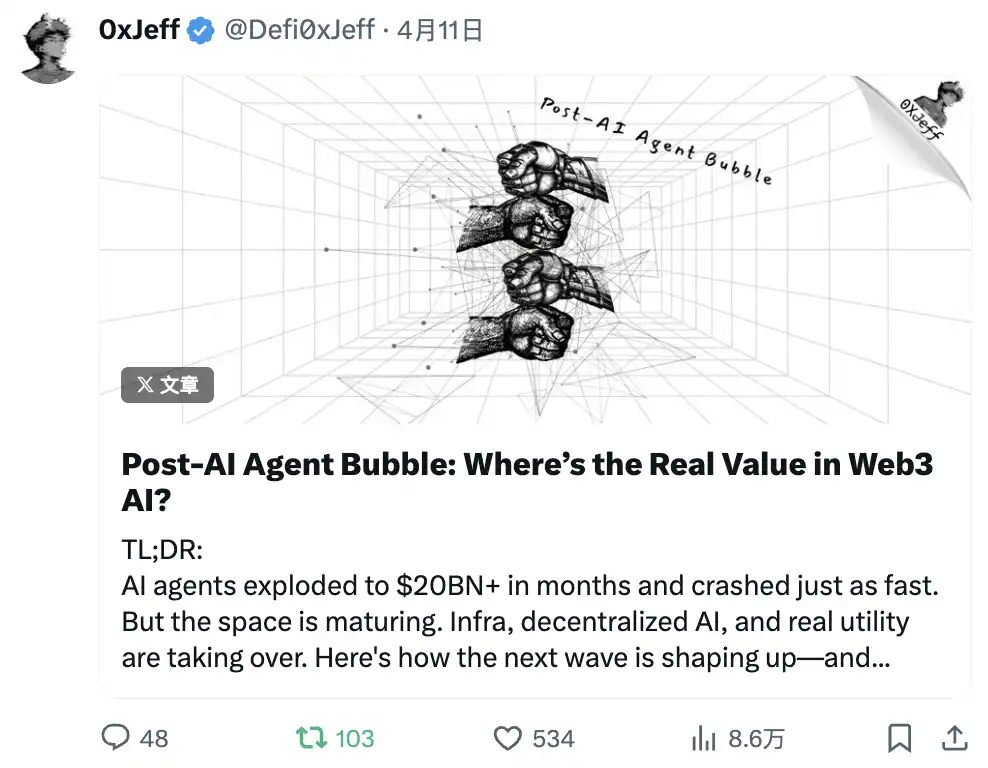
Centralized players have centralized power, and their decisions may (inadvertently) have a significant impact on your life.
You might say, "So what?"—maybe you don't use these tools often, or you believe these companies will act in the users' best interest. That's fine. You might even want to invest in these AI startups because they are tapping into a massive market. But the issue is—you can't. Unless you're at @ycombinator or a top-tier VC, you won't get these investment opportunities.
On the other hand, in Web3 AI, there are many investable AI ecosystems, with teams dedicated to bringing decentralized AI products and services to users. One of the most promising decentralized AI (DeAI) ecosystems is @opentensor (Bittensor).
Bittensor: Darwinian AI
Bittensor falls into the category of "Darwinian AI"—driving AI evolution through natural selection. Think of it as an AI version of "The Hunger Games," where each subnet has its own "Hunger Games," and "miners" act as participants (or "tributes"). They compete with their models and data on specific tasks. Only the most adapted model (the best-performing model) will receive a reward. Weaker models will be replaced or evolved (through training, tuning, or learning from other models). Over time, this will create a more robust, diverse, and high-performing AI ecosystem.
One particularly exciting aspect of Bittensor is its competitive and incentive mechanisms designed to coordinate incentives between different stakeholders. I outlined the challenges faced by Web3 AI agent teams in the tweet below...
tl;dr: Current agent tokens are a useful tool for speculators and teams to generate hype but are detrimental to user acquisition and retention and cannot serve as an incentive mechanism to retain talent (developers, founders, etc.), especially when prices drop.
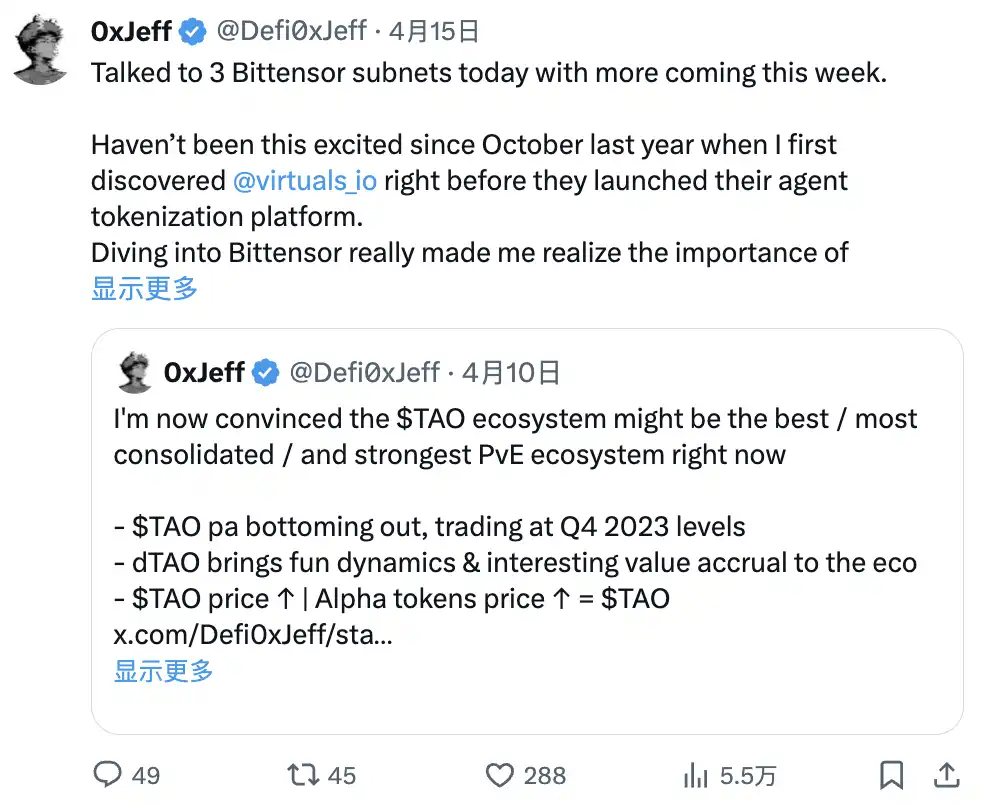
Bittensor addresses this issue through a market-driven mechanism, allocating $TAO emissions to subnets to incentivize and support team operations. The market determines which subnets receive more emissions by staking $TAO within the subnet. Once staked, $TAO is converted to Alpha Subnetwork tokens. The more people stake, the higher the price of Alpha tokens, and the more emissions you receive (in the form of Alpha tokens).
TAO's emission mechanism is very similar to BTC, with a fixed total token supply of 21 million, halving every 4 years (emitting 7200 $TAO to subnets daily). The first $TAO halving is expected to occur around January 5, 2026, at which point the circulating supply will reach 10.5 million tokens.
Why This Matters to Investors
Not delving into technical details here—just sharing why I believe Bittensor is one of the most exciting ecosystems from a trading/investment standpoint.
In addition to the dynamics mentioned above, trading the Alpha Subnetwork tokens feels like trading and mining simultaneously.
This is because every time the Alpha token price appreciates, you not only benefit from price appreciation but also receive $TAO emissions (in the form of Alpha tokens).
If a subnet performs exceptionally well and rises in ranking, the $TAO you initially staked will experience significant price appreciation and emission spikes. The earlier you stake $TAO in a subnet, the higher your Annual Percentage Yield (APY) will be (as the market has not caught up yet, with fewer stakers and $TAO amounts).
dTAO vs. Solidly
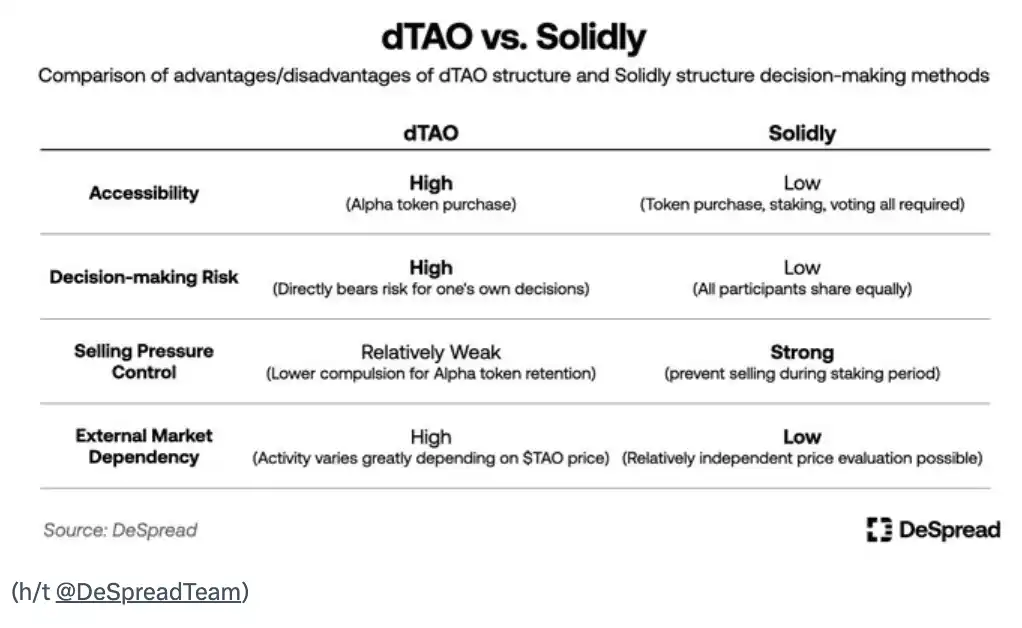
Solidly's ve(3,3) requires long-term locking and continuous engagement. Emission losses due to incorrect voting (voting for the wrong LP pool) are borne by all holders (emissions are sold off, leading to a price drop for all token holders).
On the other hand, dTAO does not require long-term locking, and anyone can enter or exit at any time, but staking on the subnet requires extensive due diligence (DYOR). Investing in the wrong subnet can lead to significant losses (as people can easily exit without a lockup period).
However, the Fully Diluted Valuation (FDV) is too high! How to invest in a subnet with an FDV exceeding $500 million?
FDV may not be the best metric here, as the subnetwork is still early-stage, and Market Cap (MC) may be more suitable (if you are looking at short to mid-term trading).
If you are concerned about inflation, understanding the emission distribution of 18%/41%/41% can be helpful — these are the emissions received by subnetwork owners, validators, and miners, respectively (in the form of Alpha tokens). As a staker/Alpha token holder, you benefit from the 41% portion allocated to validators since you delegated your $TAO to them when staking.
Many subnetwork owners continue to hold the Alpha tokens received from emissions to show confidence, and many engage in active dialogues with validators and miners to express their optimism for the project and avoid massive token dumps (this information can be viewed on taostats).
Zooming out, one of the best charts showcasing trends within the Bittensor ecosystem is as follows:
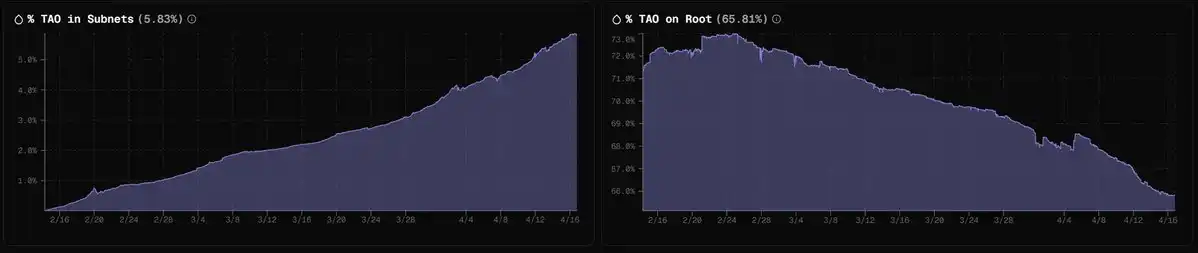
Source: taoapp
Since the launch of dTAO in February, the %TAO in Root (the original subnetwork managing the Bittensor incentive system) has been steadily declining, while the %TAO in the subnetwork has been consistently rising. This indicates that stakers/investors are increasingly willing to take on risk (the conservative APY for staking in the Root network is around 20-25%, with no price appreciation of Alpha sub-network tokens).
This trend aligns with the speed at which subnetwork teams are rolling out products. Since the launch of dTAO, teams need to publicly build, develop products users want, iterate quickly, find product-market fit (PMF), acquire users, and rapidly drive real utility and substantial revenue. Since I entered this ecosystem, I can feel the team's development pace is much faster compared to other ecosystems (due to competition and incentive mechanisms).
This leads to the subnetwork and its unique investment DeAI use case.
Leading Subnetworks and Use Cases
Considered the most adept at launching teams with PMF products for the mainstream and executing professional and continually public builds is @rayon_labs
—SN64 (Chutes), SN56 (Gradients), SN19 (Nineteen).
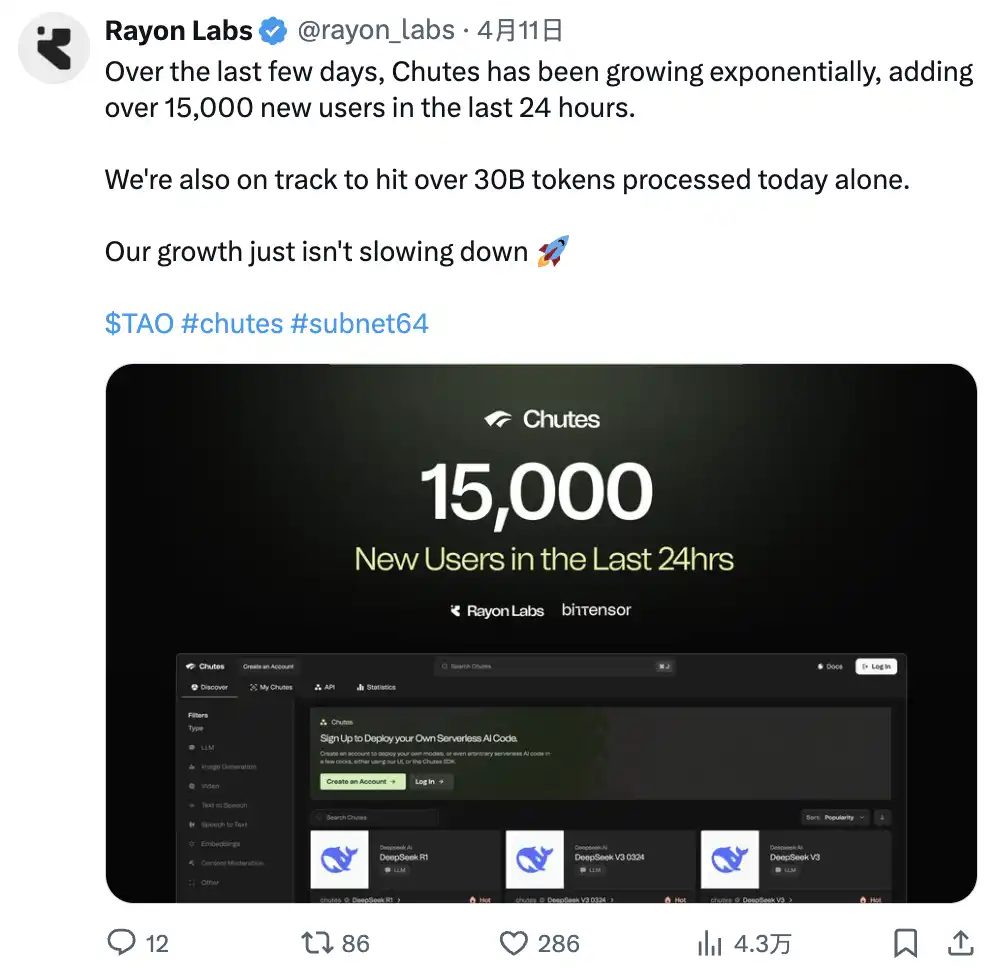
Chutes—provides infrastructure for you to easily deploy AI in a serverless manner. The best-case scenario is the recent AWS outage; if you rely on centralized providers, an outage can cause your AI application to be down (potentially resulting in financial loss or vulnerabilities) due to a single point of failure.
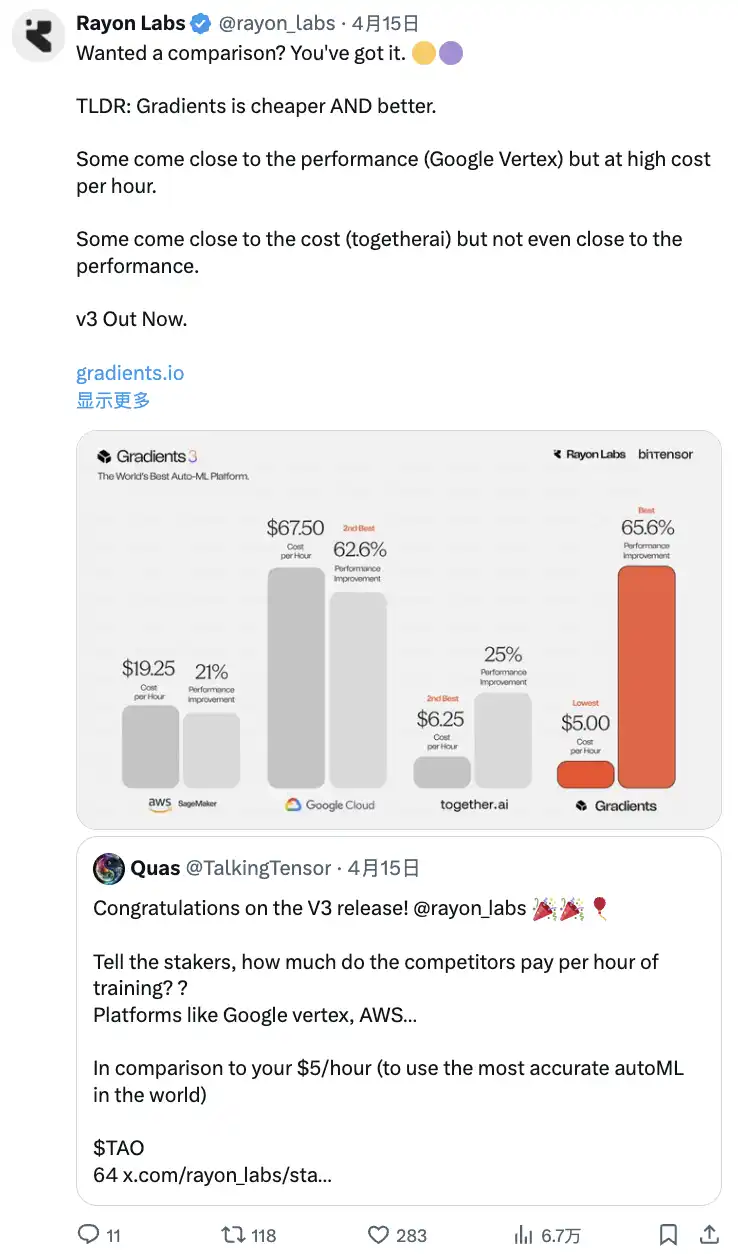
Gradients — Anyone with no coding knowledge can train their own AI model on Gradients (for specific use cases, image generation, custom LLM). The recently launched v3 is more affordable than peers.
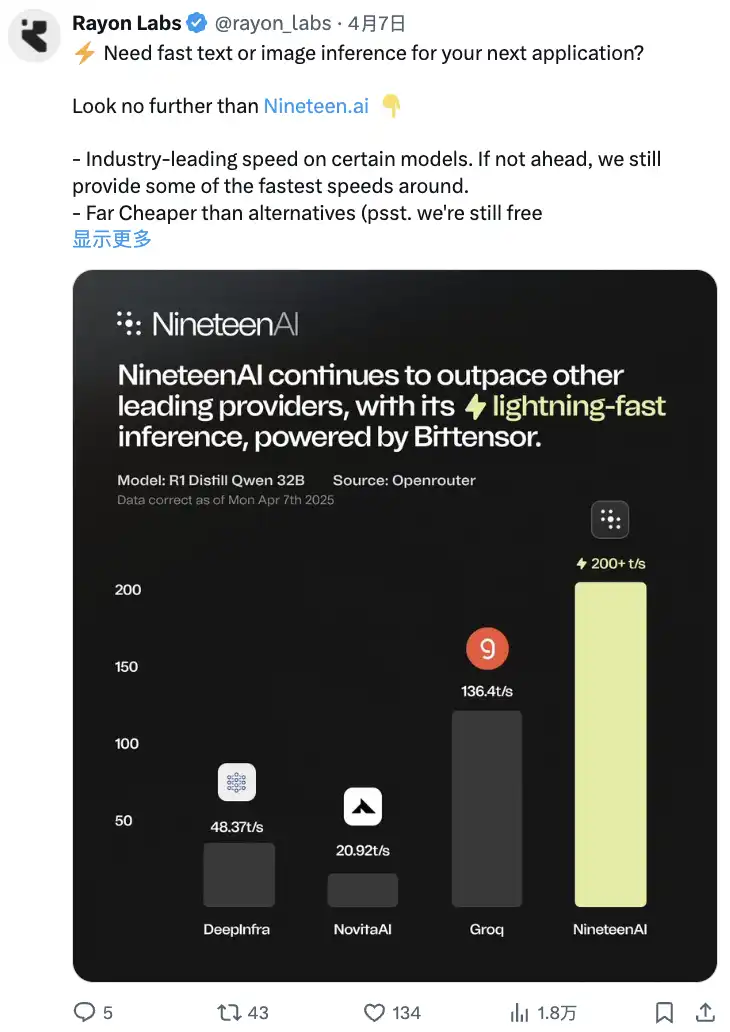
Nineteen — Provides a fast, scalable, decentralized AI inference platform (usable by anyone for text and image generation use cases, far faster than peers).
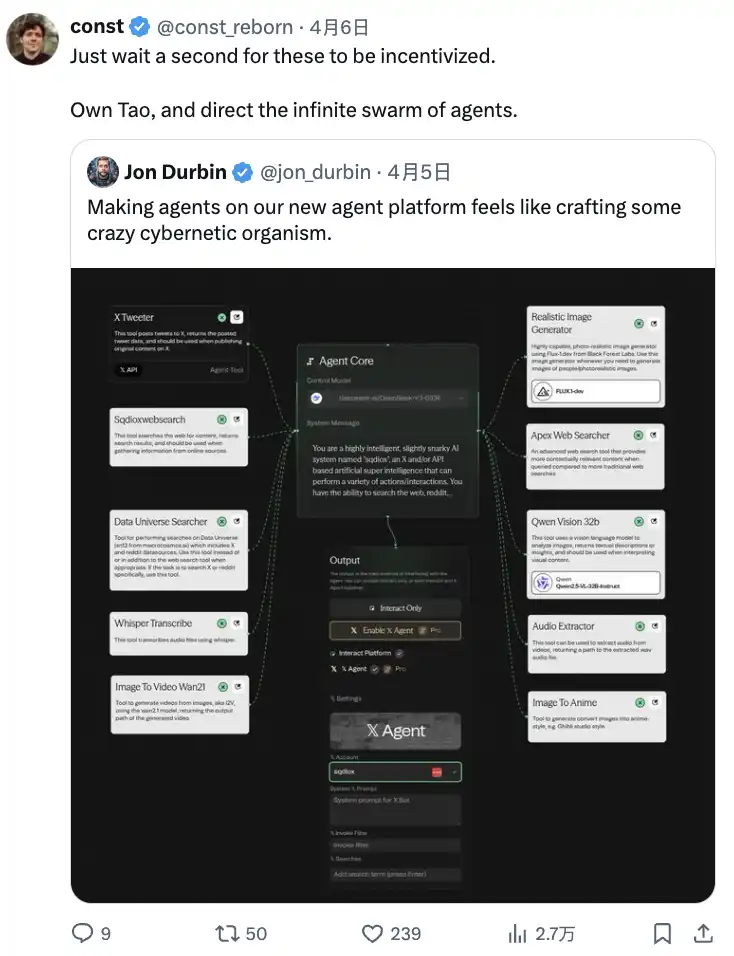
In addition, Rayon is launching the Squad AI Agent platform, an easy-to-use drag-and-drop node-style AI agent building platform that has piqued the interest of the community.
These three subnets collectively hold over 1/3 of the $TAO total issuance — which proves the team's ability to openly build and deliver high-quality products that users want (Rayon has been praised by many subnet owners as the top team).
· Gradients has grown 13x in a month (current market cap $32 million).
· Chutes has grown 2.3x (market cap $63 million).
· Nineteen has grown 3x (market cap $18 million).
This trend does not appear to be stopping in the short term, especially given Chutes' adoption rate (currently the top-ranking subnet).
In addition to Rayon Labs' subnets, there are many interesting teams — protein folding, deepfake/AI content detection, 3D models, trading strategies, role-playing LLM. I have not delved deep into all the content, but I find the "prediction system" (taopill) subnets under it most easily understandable, especially:
SN41 @sportstensor
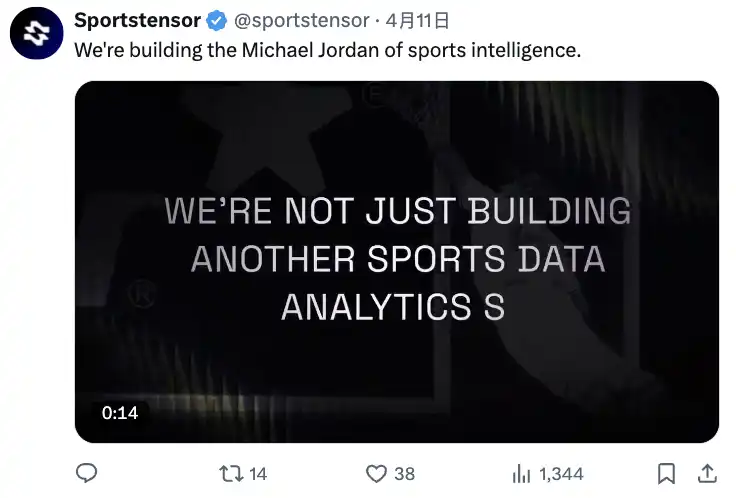
You might know them through @AskBillyBets. Sportstensor is an intelligence that empowers Billy's decisions (led by the core team of Billy @ContangoDigital, a VC investing in DeAI, also a validator and miner of the Bittensor subnet).
The uniqueness of SN41 lies in its product—the Sportstensor model. This is a competition among miners with the best model and dataset to predict sports match outcomes.
Example: In the latest NBA season, if you follow the public betting (on the favorite teams), you would have around a 68% accuracy/win rate. Does this mean everyone can make big money by betting on the favorite teams? No, in fact, they are losing money. If you bet $100 on each favorite team, your return on investment (ROI) would be negative, resulting in a loss of about $1700.
Although the favorite teams have a higher win rate, the odds are lower, meaning you earn less when you guess right. People tend to bet heavily on the favorite teams, leading to low odds on underdogs. This means that if you choose the underdog correctly, you can make a lot of money.
The Sportstensor model comes into play here. Miners run their own machine learning models (Monte Carlo, Random Forest, Linear Regression, etc.), using their own data (free or proprietary) to obtain the best results. Sportstensor then takes the average/median of these results as intelligence to identify advantages in the market.
The actual market odds may be 25:75, while the model may show odds of 45:55. This 15 difference is the advantage. If the model finds many such advantages, you can accumulate a positive ROI in the long term without needing a high win rate.
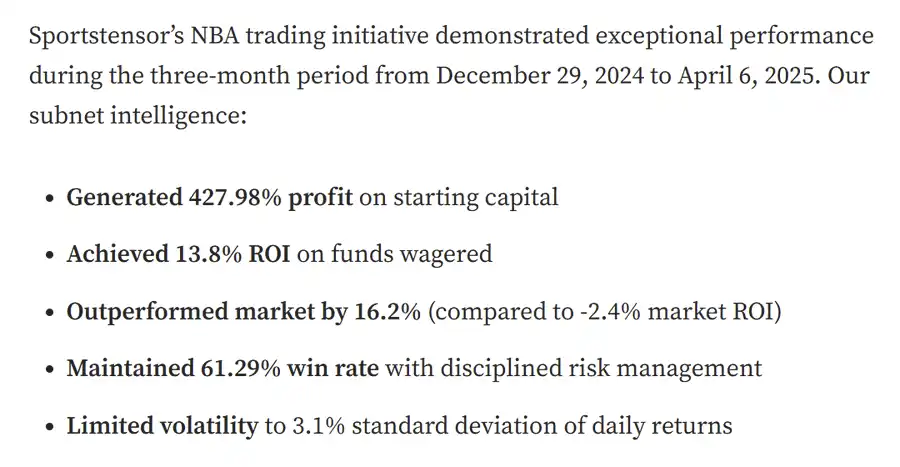
Check out their full trading report (if you want to delve deeper):
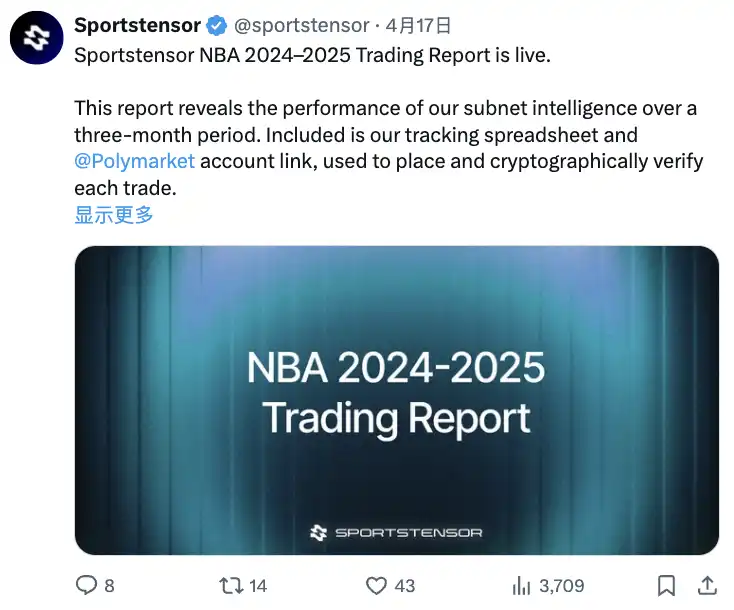
These are the model results shared in their latest report, and the data is quite impressive. The team also runs a monthly betting fund, starting with a buffer fund of $10,000 and continuing to bet with profits. By the end of the month, they repurchase Alpha tokens with the profits. The team made approximately $18,000 in profit in March.
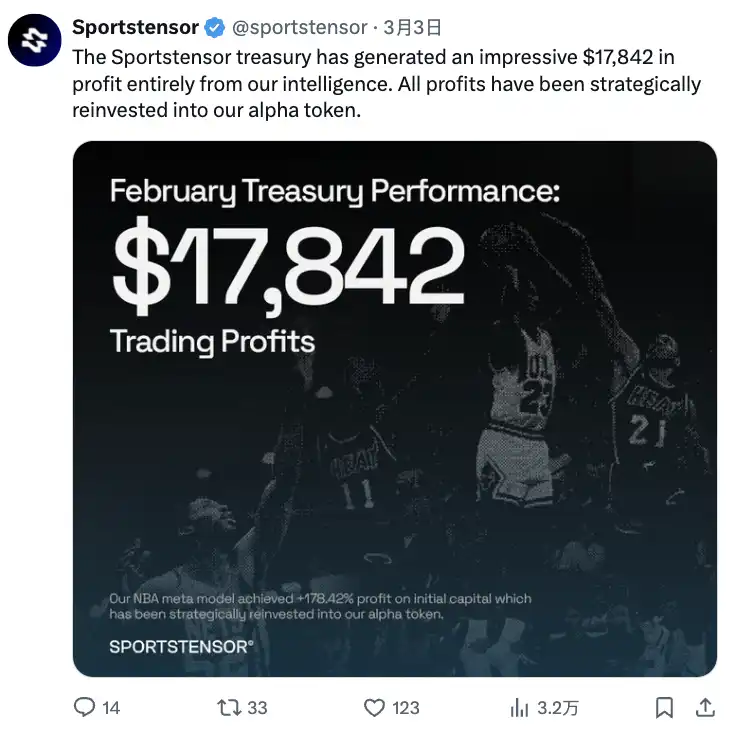
Depending on how you use the intelligence, the results can vary greatly. For example, the intelligence shows 35:65, while the actual market odds may be 40:60. Someone may bet based on this, while you may not because the difference is small and lacks enough advantage. Billy uses the intelligence differently from Sportstensor. (Currently, no one knows how to sustain positive ROI because it is still early days.)
The Sportstensor project aims to further monetize their intelligence by creating a dashboard that allows users to easily understand insights and make betting decisions based on them.
I personally like this team because their product has a lot of potential directions for development. We have already seen how Billy has attracted attention and made sports fans excited to follow the betting. With the team covering a variety of sports, the landscape could change the way people interact, bet, and experience.
SN44 @webuildscore
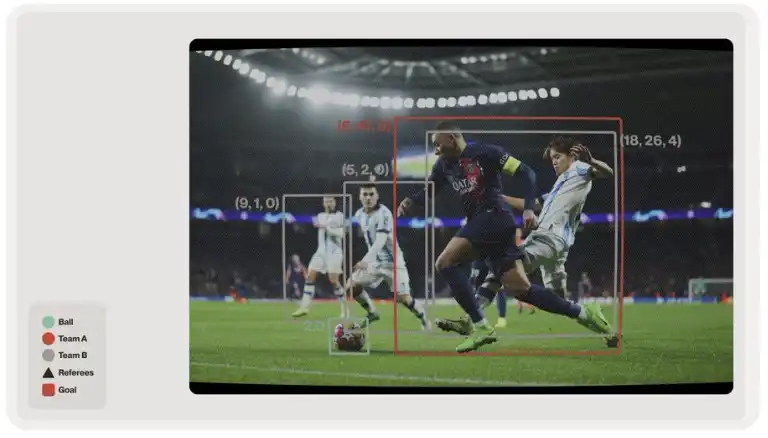
Score originally built a product similar to Sportstensor but realized the ability to predict future events could bring more value and shifted towards computer vision.
To understand this, you need computer vision to analyze the content on the screen, make AI understand the objects on the screen, locate and annotate data, then draw conclusions using different algorithms (e.g., the probability of a player making a certain move), and convert all this into a universal score used to improve player performance (and early talent discovery).
Miners compete to tag objects (this is the miner's primary goal). Score utilizes its internal algorithms to draw conclusions (at least for now).
When you score players (similar to Elo ratings in chess or League of Legends but more nuanced and dynamic... changing dynamically based on player decisions and their impact in each game), as a club owner, you can do many things like discovering talent at a young age. If you have videos of children's matches, the analysis is the same as professional matches. This is quantifying the entire football world with a unified approach.
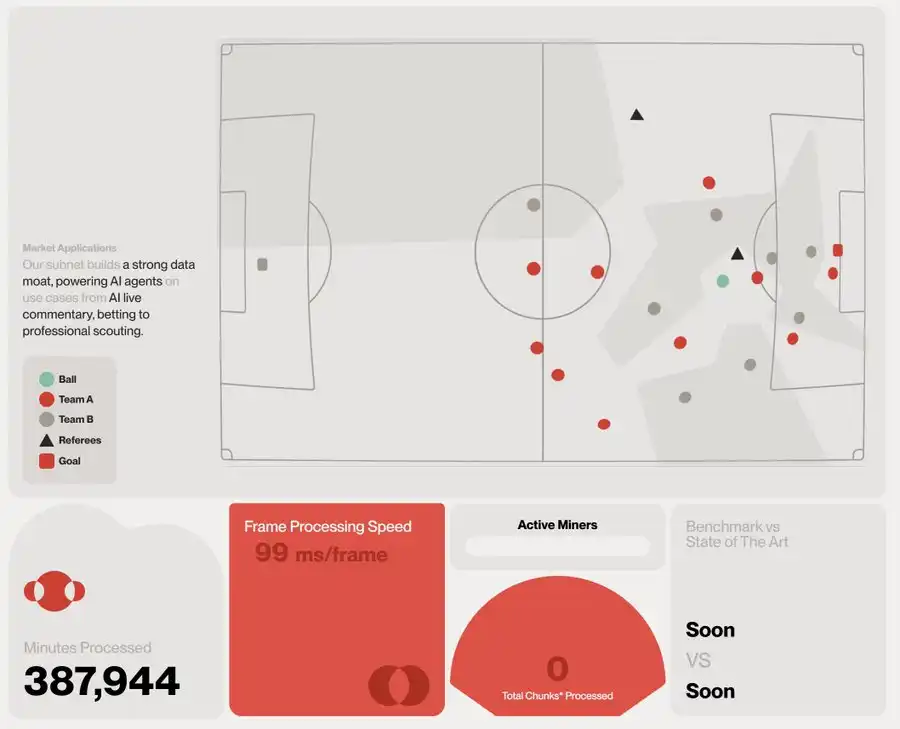
Through proprietary data, Score can monetize scores and insights, selling them to data brokers, club owners, sports data companies, and betting firms.
Soon, users will be able to upload videos on Score's self-serve platform to be tagged by miners. Typically, tagging football match videos takes hours, but on Score, miners can tag a 90-minute match in just 10-12 minutes, far faster than other platforms. Users can use the tagged data for their own models and use cases.
I like Score because it can be applied to fields beyond sports, such as autonomous vehicles, robotics, and more. In a world full of data noise, high-quality proprietary data is extremely valuable.
SN18 @zeussubnet
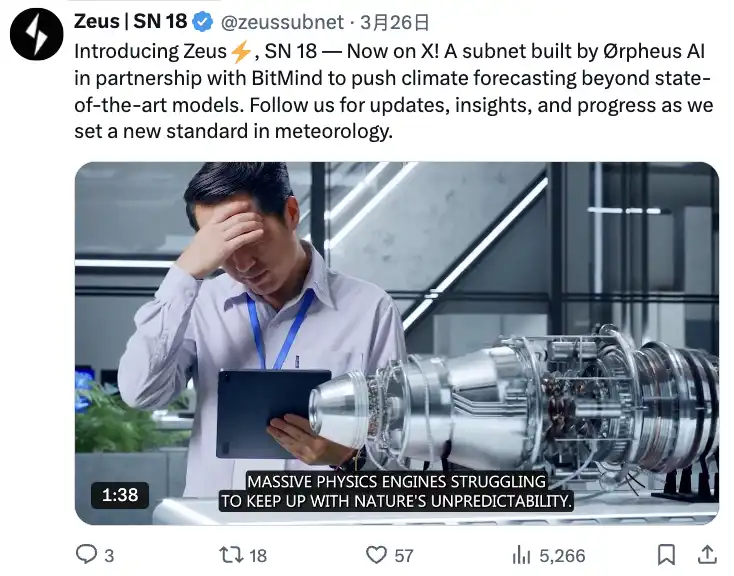
This is a newly popular subnet that has been gaining a lot of attention recently. I haven't had a chance to engage with the team yet, but the product is very intriguing.
Zeus is a machine learning-based weather/climate prediction subnet designed to surpass traditional models and provide faster, more accurate forecasts.
This intelligence is highly sought after by hedge funds as accurately predicting the weather can lead to better commodity price predictions (hedge funds are willing to pay millions to access this intelligence as winning in commodity trading can earn them billions).
The Zeus subnet is a recent addition and has recently acquired subnet 18. Its Alpha token has seen a 210% increase in the past 7 days.
Other Subnets of Interest That I Have Yet to Dive Deep Into
· @404gen_ SN17——Infrastructure for AI-generated 3D assets. Creating 3D models for games, AI characters, virtual influencers, and more. Recently, integration with
· @unity may enable seamless 3D model generation, transforming the creative process for Unity's 1.2 million monthly active users.
· @metanova_labs SN68——Decentralized Science (DeSci) drug discovery subnet, transforming drug discovery into collaborative, high-speed competition to address traditional challenges such as cost and time (traditional processes take over a decade and cost billions).
There is more to explore, and I will share after deeper research. I start with the most easily understandable (as I'm not a technical person).
Summary
I try to avoid being overly technical. There are many high-quality resources for technical explanations on dTAO, emissions, incentive distribution, and all stakeholder benefits.
Based on my experience in the Delegate Rush (since October 2024), staying flexible is crucial. I've held too many project tokens, and I believe dTAO provides a great mechanism for me to flexibly rotate between different investment-oriented DeAI startups.
Currently, there are not many participants, and users can earn 80%-150%+ APY, plus subnet token price appreciation. This dynamic may change in the next 6 months as more people join and the TAO ecosystem's bridges, wallets, and transaction infrastructure improve.
Now, I suggest you enjoy the PvE season of TAO and join me to learn more about the cool DeAI technology.
You may also like

Meet the new WEEX trial fund—your gateway to greater profits

WEEX Labs Lands at Dutch Blockchain Week: A Disruptive Crypto × AI Conversation Sets Sail in Amsterdam

SK Hynix Reportedly Plans U.S. ADR Listing as Early as August, With SEC Approval Possible in Late June
SK Hynix may pursue a U.S. ADR listing as early as August, with SEC approval reportedly possible in late June amid strong AI chip supply chain demand.

SpaceX vs Tesla vs xAI: Which Elon Musk Trade Has the Biggest Upside in 2026?
OpenAI Reveals It Has Confidentially Submitted an S-1 to the SEC, Keeping the Door Open for a Future IPO
On June 9, according to an OpenAI announcement, the company recently confidentially submitted a draft S-1 registration statement to the U.S. Securities and Exchange Commission (SEC), beginning the preliminary compliance process for a potential initial public offering. OpenAI said it chose to disclose this proactively because it expected the news might leak; however, the company has not yet set a specific listing timeline, and related arrangements may still take some time.

Latest research from 13 top universities including Cornell University: The current state, challenges, and misconceptions of the fusion of Crypto and AI
Deconstructing Anthropic: The Best AI Company, Possibly Also a Type of Organizational Invention
Apollo and Blackstone Reportedly Back $35 Billion Anthropic Chip Financing as Deal Details Remain Unclear
On June 9, according to currently available news alerts, Apollo and Blackstone Group participated in a $35 billion financing for an Anthropic “chip project.” Based on the original wording of the report, the funding has already been raised, but public information remains limited. The financing structure, use of proceeds, project entity, and whether Apollo and Blackstone participated through equity, debt, or project financing have not yet been disclosed.

Humanity Protocol Security Incident Escalates: More Than $31 Million Stolen From Related Addresses as Attacker Continues Selling H for ETH
On June 9, according to monitoring by Onchain Lens, more than $31 million has been stolen from addresses linked to Humanity Protocol, and the attack is still ongoing, with the hacker continuously swapping H tokens for ETH. Project founder Terence Kwok later confirmed the security incident on X, saying the issue involved a private key leak.

Bloomberg: As Bitcoin Weakens, Stablecoins and RWA Continue to Drive Expansion in Crypto Businesses
In June, Bloomberg reported that despite Bitcoin falling below $60,000 last week, wiping out about $235 billion in market value within seven days, and dropping close to 50% from last year’s peak, some core businesses in the crypto industry are still expanding, mainly in stablecoins, real-world asset tokenization (RWA), payments, and infrastructure. The report also noted that overall altcoin activity has contracted significantly: altcoin market capitalization has fallen from a peak of about $431 billion in November 2021 to around $170 billion, and among the tens of millions of tokens issued in recent years, fewer than 1,700 still maintain meaningful trading activity.

Galaxy Deep Research Report: How Hyperliquid's HIP-4 Upgrade Changes the Landscape of Prediction Markets?
Binance Research: RWA Market Expected to Expand Nearly 6x from Early 2025, with Public Equities and Onchain Payments Heating Up Together
In June, Binance Research said in its monthly market report that the real-world asset (RWA) market is expected to grow by about 589% from the beginning of 2025. Bond- and money market fund-related RWA expanded by about $6.5 billion, up 83% year over year, while publicly traded equity RWAs grew by about 422%. The report also noted that monthly crypto debit card transaction volume exceeded $747 million in May, up 48.6% year to date.

Japan to Assess a Framework for Yen Stablecoins and Crypto ETFs as Asia’s Compliant Payments Narrative Heats Up
Recently, according to the original report, Japan is considering the launch of yen stablecoins and cryptocurrency ETFs. Public information remains limited at this stage, and there is still no complete policy text, regulatory draft, or clear implementation timeline, so this is better characterized as a “policy discussion” rather than formal implementation. The original wording also noted that advancing stablecoin regulation in Asia is driving XRP usage and supporting growth in the XRPL ecosystem. However, based on currently available public information, there is not enough evidence to directly establish a clear causal relationship between this round of discussion in Japan and XRP or XRPL.

ZachXBT: Humanity private key leak and abnormal surge in H token should be viewed separately
On June 9, according to related disclosures, on-chain investigator ZachXBT posted an update on Humanity’s roughly $31 million security incident, saying that after further analyzing fund flows, he currently tends to believe the project team was not involved in an “inside job” or a self-staged attack. According to him, the official explanation about the private key leak was broadly accurate, but before the token unlock, the price of H had been artificially pushed higher, and the hacker later took advantage of that market environment; therefore, the private key leak and the earlier abnormal price pumping should be regarded as two separate and independent events. This reframing has shifted the market’s understanding of the nature of the incident. Earlier discussion around Humanity had focused on whether the team directly participated in the attack or used the security incident to cover up internal operations. ZachXBT’s latest remarks shift the focus from “whether it was self-theft” to “whether there were pre-unlock market structure issues.” He also questioned whether the team may have.

Morning Report | OpenAI has submitted an S-1 registration statement draft to the U.S. SEC; Morpho completes $175 million financing

Morning Report | BitMine increased its holdings by 126,971 ETH last week; trader Eugene announced his exit from the crypto market

Wang Chuan: How can one not feel anxious after the neighbor Old Wang made thirty times profit by investing in storage stocks? (Seven) - A quarter-century cycle
Cryptocurrency CEXs are flocking to sell US stocks, and traditional brokerages are facing an "uninvited guest."
Meet the new WEEX trial fund—your gateway to greater profits
WEEX Labs Lands at Dutch Blockchain Week: A Disruptive Crypto × AI Conversation Sets Sail in Amsterdam
SK Hynix Reportedly Plans U.S. ADR Listing as Early as August, With SEC Approval Possible in Late June
SK Hynix may pursue a U.S. ADR listing as early as August, with SEC approval reportedly possible in late June amid strong AI chip supply chain demand.
SpaceX vs Tesla vs xAI: Which Elon Musk Trade Has the Biggest Upside in 2026?
OpenAI Reveals It Has Confidentially Submitted an S-1 to the SEC, Keeping the Door Open for a Future IPO
On June 9, according to an OpenAI announcement, the company recently confidentially submitted a draft S-1 registration statement to the U.S. Securities and Exchange Commission (SEC), beginning the preliminary compliance process for a potential initial public offering. OpenAI said it chose to disclose this proactively because it expected the news might leak; however, the company has not yet set a specific listing timeline, and related arrangements may still take some time.
Latest research from 13 top universities including Cornell University: The current state, challenges, and misconceptions of the fusion of Crypto and AI


