
Coinbase: What Is the Crypto Market Watching?






Original Title: Weekly: Business as Usual?
Original Source: Coinbase
Original Translation: Tao Zhu, Golden Finance
Summary
· Last week, both the cryptocurrency and traditional risk markets remained subdued as participants focused on the upcoming tariffs effective on April 2.
· Regulatory tailwinds for U.S. cryptocurrency remained strong. President Trump emphasized a focus on U.S. dominance at a digital asset summit, and the U.S. Securities and Exchange Commission hosted the first of five cryptocurrency special working group roundtable meetings on March 21.
· This week was significant for stablecoins. The House released a draft of the Stablecoin Act, World Liberty Financial plans to launch a stablecoin backed by U.S. Treasuries, Fidelity Investments is testing a USD-linked stablecoin, and Wyoming's multi-chain WYST entered the testnet.
Last week, trading in both cryptocurrency and traditional risk markets was subdued as participants awaited the tariffs effective on April 2. Nonetheless, on March 27, President Trump announced a 25% tariff on all imported cars, escalating market anxiety further by imposing reciprocal tariffs on trading partners. Despite this, the market performed relatively well, but we believe this was largely due to short-covering rather than fundamental trading. The spot and futures trading volume for BTC, ETH, and SOL on global centralized exchanges remained lackluster, although this is typically a time when we see month-end portfolio rebalancing adding liquidity.
Another technical factor driving broader market activity was GameStop's announcement of issuing $1.3 billion in zero-coupon convertible senior notes maturing in 2030, to be used for future purchases of Bitcoin for its treasury. Over the past few months, several publicly traded companies (apart from Strategy, formerly MicroStrategy) have announced Bitcoin acquisitions, including Metaplanet, Solidion Technology, and Semler Scientific.
Meanwhile, regulatory tailwinds for cryptocurrency remained strong – especially in the U.S., as symbolized by President Trump's speech at a digital asset summit last week, where he emphasized the focus on U.S. dominance in the field and drew attention to ongoing work on stablecoin and market structure legislation.
Related to this, the U.S. Securities and Exchange Commission (SEC) hosted the first of five roundtable discussions on March 21, focusing on the conditions under which certain digital assets would be classified as securities. These discussions may form the framework of a crypto market structure bill, with further discussions on custody, tokenization, DeFi, and other topics set to take place before June 2025. The Senate recently passed a resolution (70 votes in favor) to repeal the IRS's DeFi reporting rule, awaiting approval from President Trump.
Stablecoins and Multi-Chain
Regarding stablecoins, the House of Representatives released the full text of the Stablecoin Transparency and Accountability to Build Better Ledger Economic (STABLE) Act on March 26, outlining the preliminary direction of the forthcoming legislation. It is noteworthy that the act prohibits paying interest or returns to stablecoin holders and prohibits the creation of new algorithmic stablecoins (i.e., collateralized stablecoins) for two years. The act also outlines reserve and transparency requirements for issuers and establishes an approval process for entities seeking to issue new tokens.
Meanwhile, many other new stablecoins have made progress. World Liberty Financial announced plans to launch its own treasury-backed stablecoin. Fidelity Investments is testing a stablecoin (though its launch plans have not been confirmed yet), and Wyoming is entering the testing phase of its Wyoming Stable Token (WYST). We believe Wyoming's stablecoin launch strategy is particularly interesting as it underscores that while the focus is currently on Ethereum, tokenization may evolve into a multi-chain phenomenon in the long run.
Wyoming has partnered with LayerZero as its token issuance partner to launch WYST contracts on the Avalanche, Solana, Ethereum, Arbitrum, Optimism, Polygon, and Base testnets. Likewise, BlackRock has extended its on-chain treasury fund BUIDL to the Solana blockchain—joining Aptos, Arbitrum, Avalanche, Ethereum, Optimism, and Polygon, expanding the networks where investors can access its products.
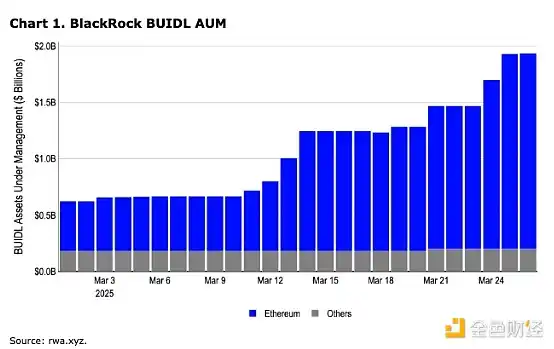
Interest in tokenized treasury funds has been rapidly increasing, with $1.3 billion in additional AUM flowing into BUIDL this month (totaling $1.9 billion). While most of the current interest and liquidity are concentrated on Ethereum (90% of BUIDL's total supply is on Ethereum), branching out preemptively to different blockchain networks suggests that issuers may be willing to follow users and liquidity if the adoption pattern shifts.
Cryptocurrency and Traditional Asset Overview
Coinbase Exchange and CES Insights
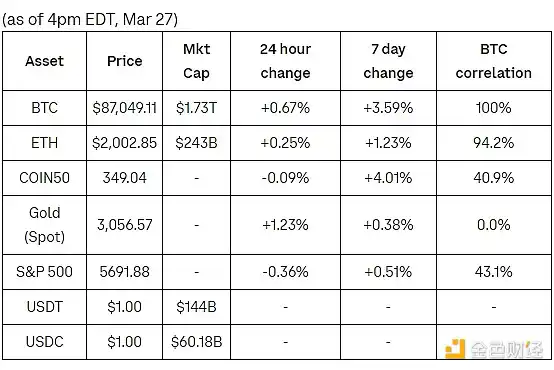
The cryptocurrency market witnessed a rebound. It has continued to correlate with the US stock market, with BTC reclaiming the key 200-day moving average. The Coin 50 Index also saw an uptick but remains in a downtrend, reflecting relative weakness in other cryptocurrencies. Unless there is unexpected economic data released, we expect range-bound volatility to persist at least until April 2, the deadline for President Trump's tariff imposition.
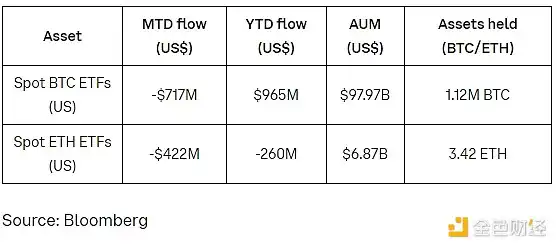
Single-digit perpetual funding, recent highs in stablecoin AUM, and short-term futures basis screening have highlighted low positions as traders patiently await further data before adding meaningful risk. Historically, April, May, and June have been challenging months for cryptocurrency assets, so maintaining a lower position may prove to be a prudent strategy.
Coinbase Platform Trading Volume (USD)
Trading Volume Segmented by Asset on the Coinbase Platform
Funding Rate
Week Ahead Preview
You may also like

Ferrari Challenge Le Mans: Carl Moon to Dominate in WEEX Livery

Sahara AI Responds to SAHARA’s Sharp Drop: No Contract or Product Security Issues Found, Internal Investigation Underway
Sahara AI responded to SAHARA’s 60% price drop, saying no token contract or product security issues have been found and an internal investigation is underway.

WEEX Deposit/Withdrawal Dynamic Island: Your Asset Status, Always in Sight

Scaling Crypto Derivatives: The Digital Asset Infrastructure Behind High-Volume Trading
In the fast-moving digital asset ecosystem, derivatives platforms face an extreme architectural test. High-leverage futures markets demand more than just standard security—they require absolute operational precision, zero-latency matching engines, and ironclad structural scalability, all while navigating intense market volatility.
As global platforms scale to meet these demands, the industry is shifting away from rigid, monolithic setups toward a more agile, "decoupled" infrastructure philosophy.
The Blueprint for High-Volume Copy TradingFor elite global exchanges like WEEX (founded in 2018), this architectural choice becomes critical when scaling high-volume retail features like social copy trading. When thousands of users automatically mirror the real-time strategies of elite traders simultaneously, it triggers sudden, monumental spikes in concurrent transactional volume.
To prevent execution latency or settlement bottlenecks during these peak volatility events, a platform's primary engine must remain entirely dedicated to risk management, copy-trade synchronization, and order matching.
The Architectural Rule: New-generation platforms must separate front-end user execution engines from heavy backend infrastructural overhead to eliminate operational friction.
By separating these layers, platforms can maintain complete sovereignty over their trading environments and user experiences while strategically aligning with institutional-grade infrastructure ecosystems. This strategic framework allows modern exchanges to leverage advanced Digital Asset Custody infrastructure such as Cobo’s behind the scenes, ensuring that backend wallet management scales elastically alongside trading spikes.
Capitalizing on Market Momentum and 400× LeverageIn a derivatives arena where platforms offer up to 400× leverage on perpetual contracts, capital efficiency and market agility are core business metrics. To capture market momentum, an exchange needs the ability to rapidly expand its asset offerings, supporting everything from legacy crypto assets to sudden, trending altcoins across a massive library of trading pairs.
Adopting a flexible, scalable Wallet-as-a-Service (WaaS) solution such as Cobo’s could completely rewrite the development timeline for high-growth exchanges. Instead of spending months of engineering capital building out custom backend wallet architectures for every new blockchain network, platforms can deploy localized infrastructure in days.
This agility allows platforms to instantly scale their listings to over a thousand trading pairs without compromising security or delaying time-to-market. It mirrors the exact operational advantages seen during high-velocity market events, similar to how advanced wallet infrastructure empowers platforms during sudden asset surges; allowing exchanges to pass that speed and liquidity directly to their global user base.
A Mature Foundation for GrowthThe synergy between trusted infrastructure ecosystems and global trading platforms represents the natural evolution of a maturing crypto market. As WEEX continues to scale its global spot and derivatives offerings for over 6 million users, adopting robust backend paradigms proves that platforms no longer have to compromise between cutting-edge trading velocity and uncompromised structural security.

Morning Report | BitMine increased its holdings by 126,971 ETH last week; trader Eugene announced his exit from the crypto market

Wang Chuan: How can one not feel anxious after the neighbor Old Wang made thirty times profit by investing in storage stocks? (Seven) - A quarter-century cycle

Get Paid to Onboard? Try WEEX’s New Homepage with Rewards for Registration, Deposit & Trade
WEEX Custom Layout: Build Your Perfect Trading Workspace in Seconds

See “Buy Walls” & “Sell Walls” Instantly: WEEX Launches the Depth Chart for Smarter Trades

What Is Quick Trade on WEEX? 2 Ways WEEX Ends Chart-Panel Jumping
Morning News | Five major virtual asset platforms in South Korea have experienced 57 incidents of hacking and system failures in six years; Grayscale submits registration application for Canton ETF

Should we escape the peak? The principle of the tail-end market in the stock market

RootData: May 2026 Cryptocurrency Exchange Transparency Research Report

Founder of Baixing.com: My Experience with Claude Code in Fourteen Points

Yang Ge Gary: Agent Economics and AI Microeconomics
When reasoning becomes a scarce resource, who captures its value?

Jensen Huang dramatically "rescues" the South Korean stock market

Stablecoins vs Deposit Tokens: On the surface, they seem like opposing sides, but in reality, they are interconnected
Ferrari Challenge Le Mans: Carl Moon to Dominate in WEEX Livery
Sahara AI Responds to SAHARA’s Sharp Drop: No Contract or Product Security Issues Found, Internal Investigation Underway
Sahara AI responded to SAHARA’s 60% price drop, saying no token contract or product security issues have been found and an internal investigation is underway.
WEEX Deposit/Withdrawal Dynamic Island: Your Asset Status, Always in Sight
Scaling Crypto Derivatives: The Digital Asset Infrastructure Behind High-Volume Trading
In the fast-moving digital asset ecosystem, derivatives platforms face an extreme architectural test. High-leverage futures markets demand more than just standard security—they require absolute operational precision, zero-latency matching engines, and ironclad structural scalability, all while navigating intense market volatility.
As global platforms scale to meet these demands, the industry is shifting away from rigid, monolithic setups toward a more agile, "decoupled" infrastructure philosophy.
The Blueprint for High-Volume Copy TradingFor elite global exchanges like WEEX (founded in 2018), this architectural choice becomes critical when scaling high-volume retail features like social copy trading. When thousands of users automatically mirror the real-time strategies of elite traders simultaneously, it triggers sudden, monumental spikes in concurrent transactional volume.
To prevent execution latency or settlement bottlenecks during these peak volatility events, a platform's primary engine must remain entirely dedicated to risk management, copy-trade synchronization, and order matching.
The Architectural Rule: New-generation platforms must separate front-end user execution engines from heavy backend infrastructural overhead to eliminate operational friction.
By separating these layers, platforms can maintain complete sovereignty over their trading environments and user experiences while strategically aligning with institutional-grade infrastructure ecosystems. This strategic framework allows modern exchanges to leverage advanced Digital Asset Custody infrastructure such as Cobo’s behind the scenes, ensuring that backend wallet management scales elastically alongside trading spikes.
Capitalizing on Market Momentum and 400× LeverageIn a derivatives arena where platforms offer up to 400× leverage on perpetual contracts, capital efficiency and market agility are core business metrics. To capture market momentum, an exchange needs the ability to rapidly expand its asset offerings, supporting everything from legacy crypto assets to sudden, trending altcoins across a massive library of trading pairs.
Adopting a flexible, scalable Wallet-as-a-Service (WaaS) solution such as Cobo’s could completely rewrite the development timeline for high-growth exchanges. Instead of spending months of engineering capital building out custom backend wallet architectures for every new blockchain network, platforms can deploy localized infrastructure in days.
This agility allows platforms to instantly scale their listings to over a thousand trading pairs without compromising security or delaying time-to-market. It mirrors the exact operational advantages seen during high-velocity market events, similar to how advanced wallet infrastructure empowers platforms during sudden asset surges; allowing exchanges to pass that speed and liquidity directly to their global user base.
A Mature Foundation for GrowthThe synergy between trusted infrastructure ecosystems and global trading platforms represents the natural evolution of a maturing crypto market. As WEEX continues to scale its global spot and derivatives offerings for over 6 million users, adopting robust backend paradigms proves that platforms no longer have to compromise between cutting-edge trading velocity and uncompromised structural security.
Morning Report | BitMine increased its holdings by 126,971 ETH last week; trader Eugene announced his exit from the crypto market
Wang Chuan: How can one not feel anxious after the neighbor Old Wang made thirty times profit by investing in storage stocks? (Seven) - A quarter-century cycle


