
Bull Market Returns, Can Ethereum's Pectra Upgrade Turn the Tide?


Original Article Title: Ethereum's Path Forward
Original Article Author: @YashasEdu
Original Article Translation: zhouzhou, BlockBeats
Editor's Note: Ethereum is facing fierce competition from new public chains like Solana, with the price not hitting a new all-time high and activity decreasing. The Pectra upgrade and the RISC-V proposal aim to improve scalability, reduce costs, and maintain security and compatibility. Meanwhile, Solana is rapidly rising with its high efficiency and low cost, challenging Ethereum's position.
The following is the original content (slightly reorganized for better readability):
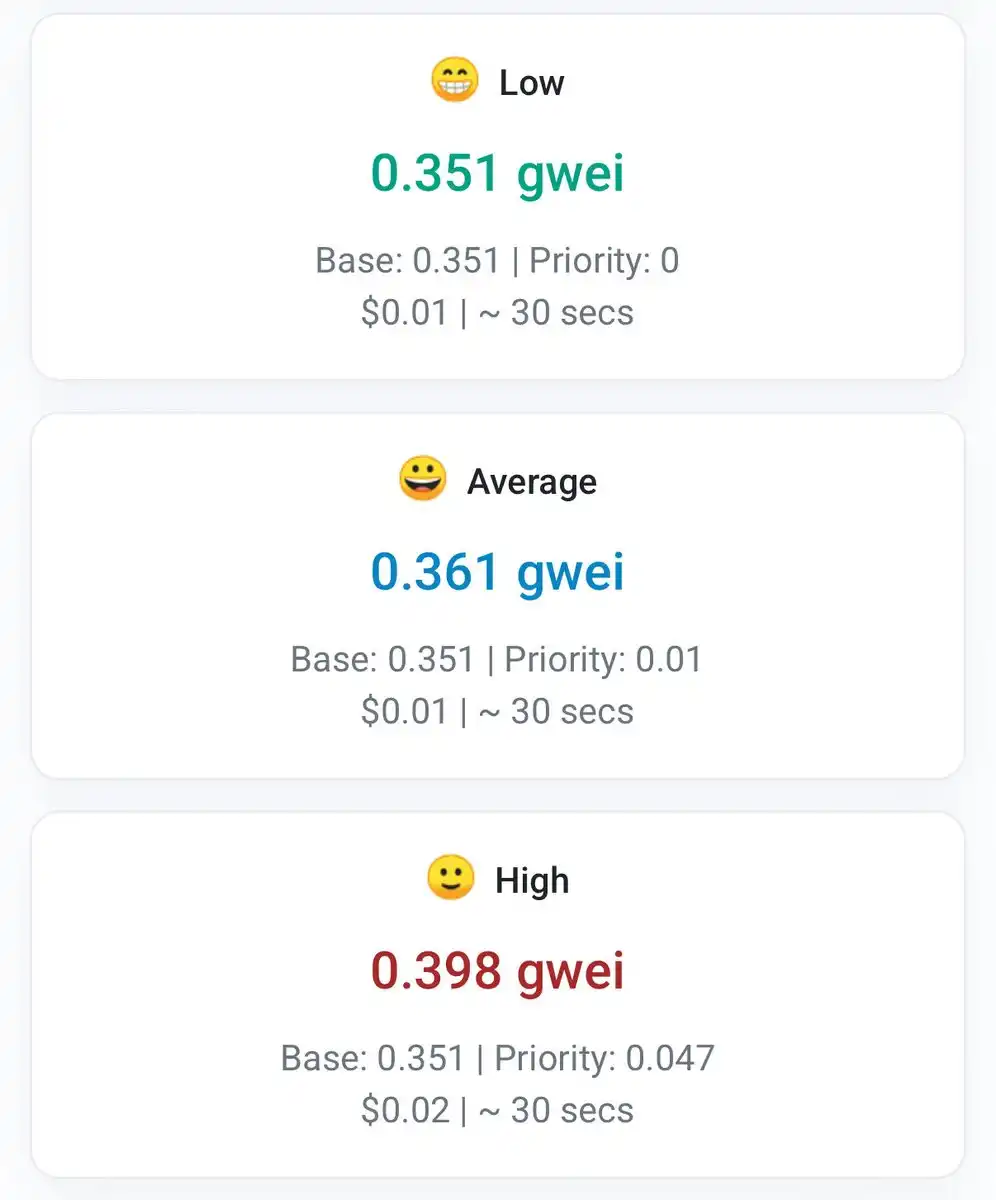
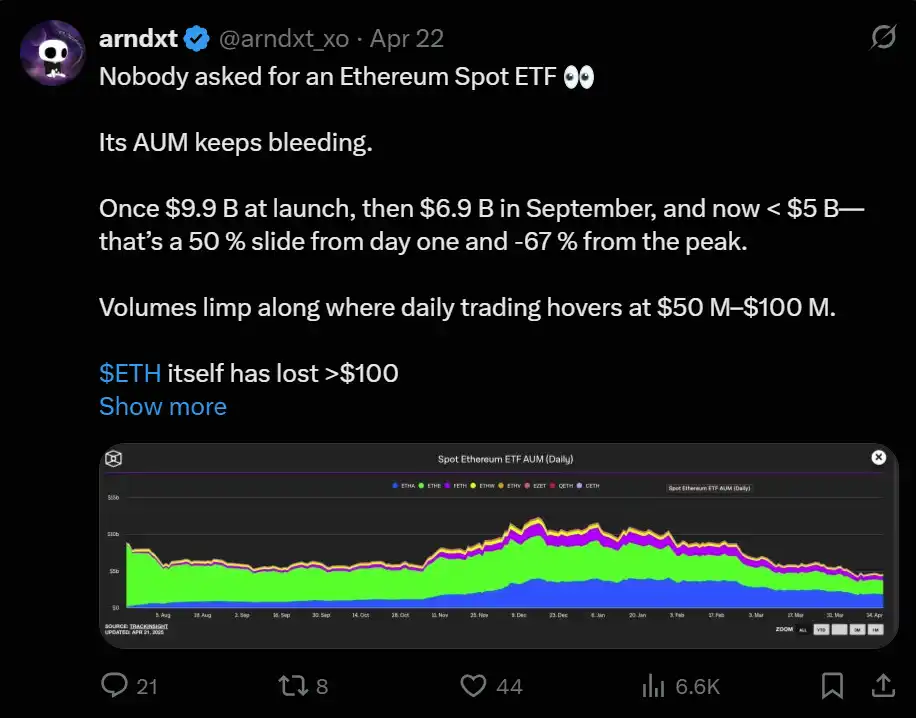
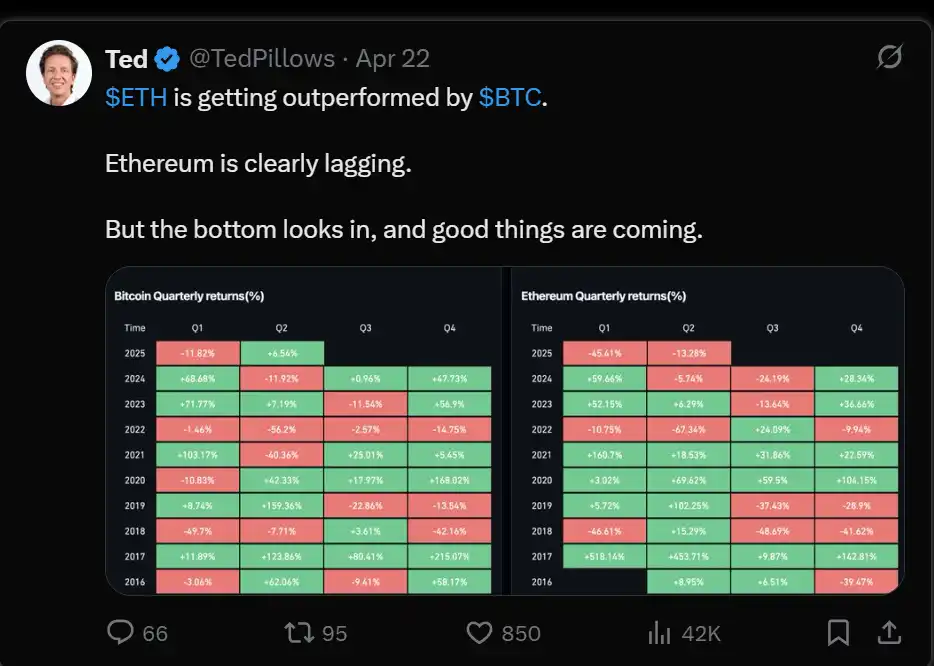
Ethereum has not seen a new all-time high in price in 2025, with the ETH/BTC exchange rate hitting a five-year low (0.02), and narratives of L2 and re-staking competition have not effectively boosted its value. At the same time, transaction fees have also dropped to the lowest level since 2020, with an average of only $0.36 per transaction.
With a surge in @solana users (daily active users reaching 3.25 million, while Ethereum is only at 410,000), daily transaction volume is far ahead (35.99 million transactions vs Ethereum's 1.13 million transactions), making many people curious: where will this world's second-largest chain go from here?
Two major upgrades that could reshape Ethereum's future
1. Upcoming Pectra Upgrade
2. Vitalik's proposal to use RISC-V technology to replace the existing EVM
Pectra Upgrade (Expected to launch on May 7, 2025)
The Pectra upgrade combines the two updates that were originally separate (the "Prague" for the execution layer and the "Electra" for the consensus layer) into a comprehensive upgrade, consisting of a total of 11 EIPs, with the goal of improving Ethereum's scalability, efficiency, and security.
Three Core Improvements of Pectra
1. Enhanced Scalability
Introducing PeerDAS and Verkle Trees technology, significantly enhancing transaction processing capability
Optimizing data storage to reduce node operating costs
Hash tree technology speeds up network synchronization
2. Lower Transaction Costs
Reduced network congestion is expected to lead to a substantial decrease in Gas fees
EIP-7702 enables account abstraction, allowing users to pay Gas with stablecoins rather than just ETH
Batch transactions and custom security features improve wallet experience
3. Enhanced Staking Mechanism
EIP-7251 increases the maximum staking amount for each validator from 32 ETH to 2048 ETH, promoting institutional participation and reducing operating costs
EIP-6110 migrates staking processing for validators to the execution layer, reducing validator activation time by approximately 48 hours
RISC-V Proposal (Long-Term Disruption?)
Vitalik recently proposed a more radical idea: replacing the Ethereum Virtual Machine (EVM) with RISC-V technology, which would fundamentally change how Ethereum executes smart contracts.
What is RISC-V?
RISC-V is an open-source Instruction Set Architecture (basically the language that tells a processor how to execute commands).
Unlike Ethereum's exclusive EVM, RISC-V's advantages include:
Fully open-source and free
Widely used in mainstream computing hardware
More suitable for complex computations
More friendly to zero-knowledge proof (zk) technology
Why Replace EVM?
1. Substantial Performance Improvement:
RISC-V is expected to increase execution efficiency by 100 times.
Transaction fees will significantly decrease.
Private transactions and cross-chain functionality will become more feasible.
2. Better Support for ZK Technology:
The current zkEVM system must first convert EVM instructions to RISC-V before generating zero-knowledge proofs, resulting in a computation burden 100 to 1000 times heavier.
Native support for RISC-V will bypass this conversion step.
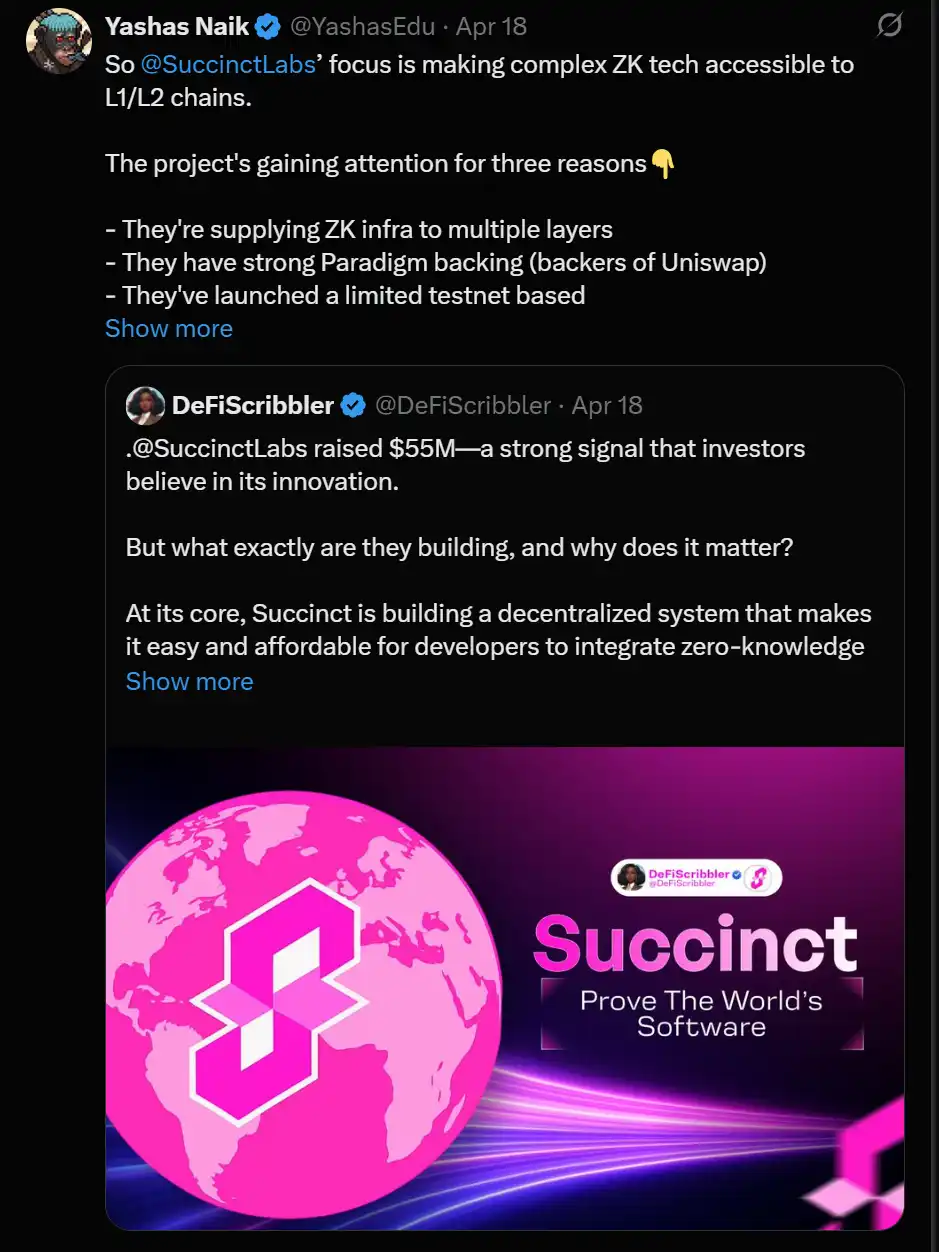
For example, @SuccinctLabs' zkVM (SP1) can directly run smart contracts using RISC-V.
Summary: In the current context where L2 narratives and re-staking fervor have failed to drive ETH performance, the Pectra upgrade and RISC-V plan may be Ethereum's new "breakthrough" key points. The former is a practical update for short-term efficiency improvements and fee reductions, while the latter is a long-term revolution of the underlying structure of smart contracts.
3. Developer Continuity:
Developers can still use Solidity or Vyper to write smart contracts
These languages only need to target RISC-V as a new backend
The user experience will see almost no significant changes
4. Implementation Timeline:
This is not an immediate implementation change. Vitalik's proposal represents a long-term vision, expected to:
Be gradually implemented, taking approximately 2-3 years
Maintain the old system (EVM interpreter) during the transition period
Ultimately make Ethereum competitive with efficient chains like Solana and Monad
What Does This Mean for Ethereum's Future?
Ethereum is facing a survival challenge: while maintaining its leading position as the primary smart contract platform, it must address the performance bottlenecks that some emerging blockchains have successfully overcome.
The Pectra upgrade addresses the urgent issues in staking, transaction costs, and user experience, while the RISC-V proposal focuses on Ethereum's fundamental execution architecture, aiming to provide a technical foundation for competing with faster public chains while retaining its security and decentralized advantages.
For users, these changes ultimately mean
Increased transaction processing speed
Lower fees
More possibilities for new applications (such as on-chain AI, privacy features)
Better scalability without sacrificing security
By advancing performance enhancement plans while preserving compatibility with existing applications, Ethereum is attempting to evolve without abandoning its core principles and ecosystem.
However, whether these changes are enough to maintain its market position in the face of faster-growing competitors remains to be seen.
If not Ethereum, then who? The latest data shows that the competitive landscape is undergoing significant changes. While the top ten DeFi protocols still operate on Ethereum, we have also seen warning signals of its diminishing lead.
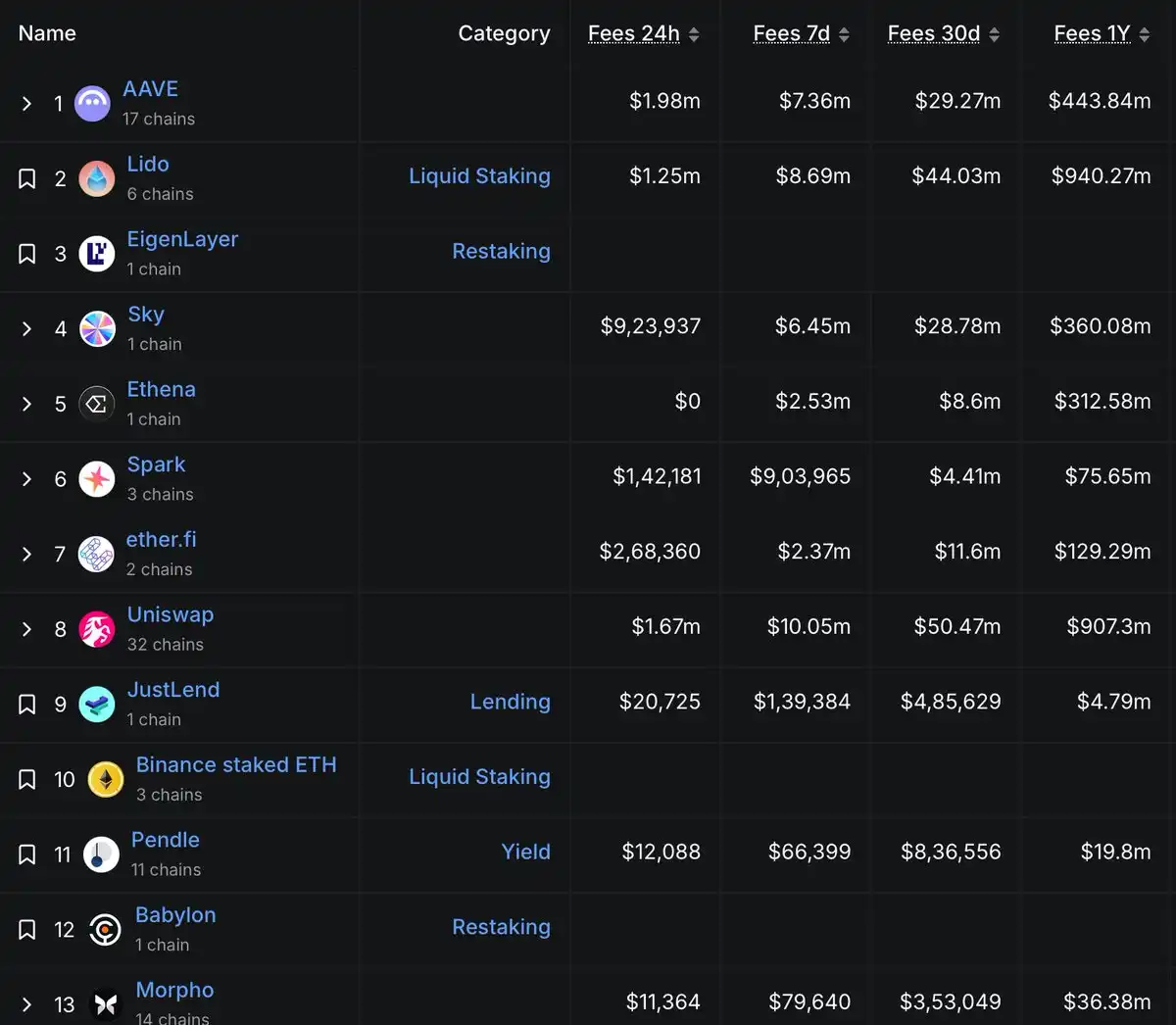
Projects like @jito_sol and @JupiterExchange are rapidly growing on other chains, and @convergeonchain (Ethena's RWA public chain) has completely moved away from the Ethereum ecosystem. These dynamics indicate that Ethereum's leading position is not set in stone, raising a key question.
What future technological breakthroughs does Ethereum need to maintain its competitiveness?
According to @nansen_ai's data, Solana recently surpassed Ethereum in total staked value (a significant milestone for the SOL ecosystem), indicating that institutions' confidence in Solana's staking infrastructure is rapidly growing.
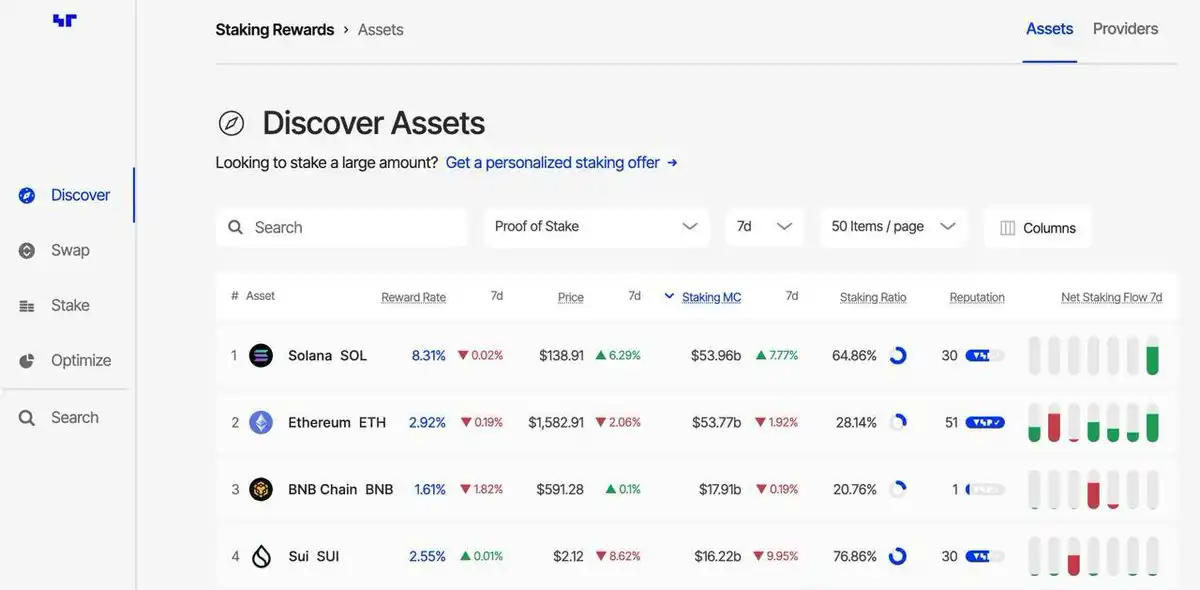
At the same time, Solana outperformed all other blockchains in first-quarter 2025 revenue performance while still maintaining extremely low transaction fees. This combination of "high revenue + low user cost" showcases Solana's efficient economic model.
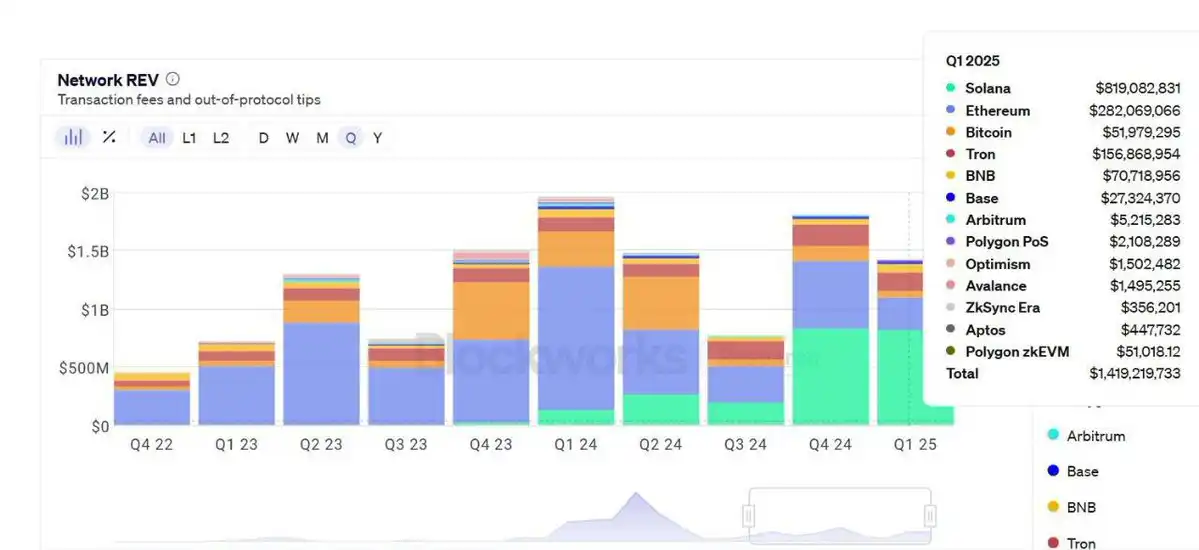
These advancements undoubtedly put greater pressure on Ethereum's technological roadmap. Despite the Pectra upgrade and the potential RISC-V transition aimed at addressing Ethereum's scalability and cost issues, Solana, with its current architecture, continues to attract market attention and share.
Source: Original Article Link
You may also like

Pantera Capital Partner: How Tokenization is Restructuring the Private Equity and Early Investment Ecosystem?

New York Proposes Stricter Stablecoin Issuer Rules Aligned With Federal GENIUS Act
NYDFS proposed stricter stablecoin issuer rules aligned with the GENIUS Act, covering reserves, custody, redemption timelines, audits, and capital buffers.
Every exchange is a "Universal Exchange."

The counterattack of traditional finance: Alliance chains are quietly reviving

CryptoQuant Says Bitcoin Profitable Supply Is Near 45% Pressure Zone as On-Chain Data Points to Market Repricing
CryptoQuant said Bitcoin’s profitable supply is nearing the 45% pressure zone, signaling rising market stress, unrealized losses, and a possible on-chain repricing phase.

Bitcoin Falls Below 200-Week Moving Average as On-Chain Data Shows Over Half of Supply in Loss
Bitcoin dropped below its 200-week moving average as on-chain data showed over 50% of circulating supply is now in loss, signaling rising market stress.

CFTC Reportedly Plans New Prediction Market Rules Focused on Manipulation Risk and Public Interest Review
The CFTC is reportedly preparing new prediction market rules focused on manipulation risk, public interest review, and retail trader protections.

Meet the new WEEX trial fund—your gateway to greater profits

WEEX Labs Lands at Dutch Blockchain Week: A Disruptive Crypto × AI Conversation Sets Sail in Amsterdam

SK Hynix Reportedly Plans U.S. ADR Listing as Early as August, With SEC Approval Possible in Late June
SK Hynix may pursue a U.S. ADR listing as early as August, with SEC approval reportedly possible in late June amid strong AI chip supply chain demand.

SpaceX vs Tesla vs xAI: Which Elon Musk Trade Has the Biggest Upside in 2026?
OpenAI Reveals It Has Confidentially Submitted an S-1 to the SEC, Keeping the Door Open for a Future IPO
On June 9, according to an OpenAI announcement, the company recently confidentially submitted a draft S-1 registration statement to the U.S. Securities and Exchange Commission (SEC), beginning the preliminary compliance process for a potential initial public offering. OpenAI said it chose to disclose this proactively because it expected the news might leak; however, the company has not yet set a specific listing timeline, and related arrangements may still take some time.

Latest research from 13 top universities including Cornell University: The current state, challenges, and misconceptions of the fusion of Crypto and AI
Deconstructing Anthropic: The Best AI Company, Possibly Also a Type of Organizational Invention
Apollo and Blackstone Reportedly Back $35 Billion Anthropic Chip Financing as Deal Details Remain Unclear
On June 9, according to currently available news alerts, Apollo and Blackstone Group participated in a $35 billion financing for an Anthropic “chip project.” Based on the original wording of the report, the funding has already been raised, but public information remains limited. The financing structure, use of proceeds, project entity, and whether Apollo and Blackstone participated through equity, debt, or project financing have not yet been disclosed.

Humanity Protocol Security Incident Escalates: More Than $31 Million Stolen From Related Addresses as Attacker Continues Selling H for ETH
On June 9, according to monitoring by Onchain Lens, more than $31 million has been stolen from addresses linked to Humanity Protocol, and the attack is still ongoing, with the hacker continuously swapping H tokens for ETH. Project founder Terence Kwok later confirmed the security incident on X, saying the issue involved a private key leak.

Bloomberg: As Bitcoin Weakens, Stablecoins and RWA Continue to Drive Expansion in Crypto Businesses
In June, Bloomberg reported that despite Bitcoin falling below $60,000 last week, wiping out about $235 billion in market value within seven days, and dropping close to 50% from last year’s peak, some core businesses in the crypto industry are still expanding, mainly in stablecoins, real-world asset tokenization (RWA), payments, and infrastructure. The report also noted that overall altcoin activity has contracted significantly: altcoin market capitalization has fallen from a peak of about $431 billion in November 2021 to around $170 billion, and among the tens of millions of tokens issued in recent years, fewer than 1,700 still maintain meaningful trading activity.

Galaxy Deep Research Report: How Hyperliquid's HIP-4 Upgrade Changes the Landscape of Prediction Markets?
Pantera Capital Partner: How Tokenization is Restructuring the Private Equity and Early Investment Ecosystem?
New York Proposes Stricter Stablecoin Issuer Rules Aligned With Federal GENIUS Act
NYDFS proposed stricter stablecoin issuer rules aligned with the GENIUS Act, covering reserves, custody, redemption timelines, audits, and capital buffers.
Every exchange is a "Universal Exchange."
The counterattack of traditional finance: Alliance chains are quietly reviving
CryptoQuant Says Bitcoin Profitable Supply Is Near 45% Pressure Zone as On-Chain Data Points to Market Repricing
CryptoQuant said Bitcoin’s profitable supply is nearing the 45% pressure zone, signaling rising market stress, unrealized losses, and a possible on-chain repricing phase.
Bitcoin Falls Below 200-Week Moving Average as On-Chain Data Shows Over Half of Supply in Loss
Bitcoin dropped below its 200-week moving average as on-chain data showed over 50% of circulating supply is now in loss, signaling rising market stress.


