
Bitcoin Surges 7%, Is the "Digital Gold" Narrative Back?


Waking up to a surge in Bitcoin price to over $93,000 driven by optimism in the improvement of US-China trade relations, with a 24-hour gain of over 7%. However, according to a report by CryptoQuant, on-chain data shows that the market fundamentals still exhibit vulnerability, and BTC is facing a key resistance level.
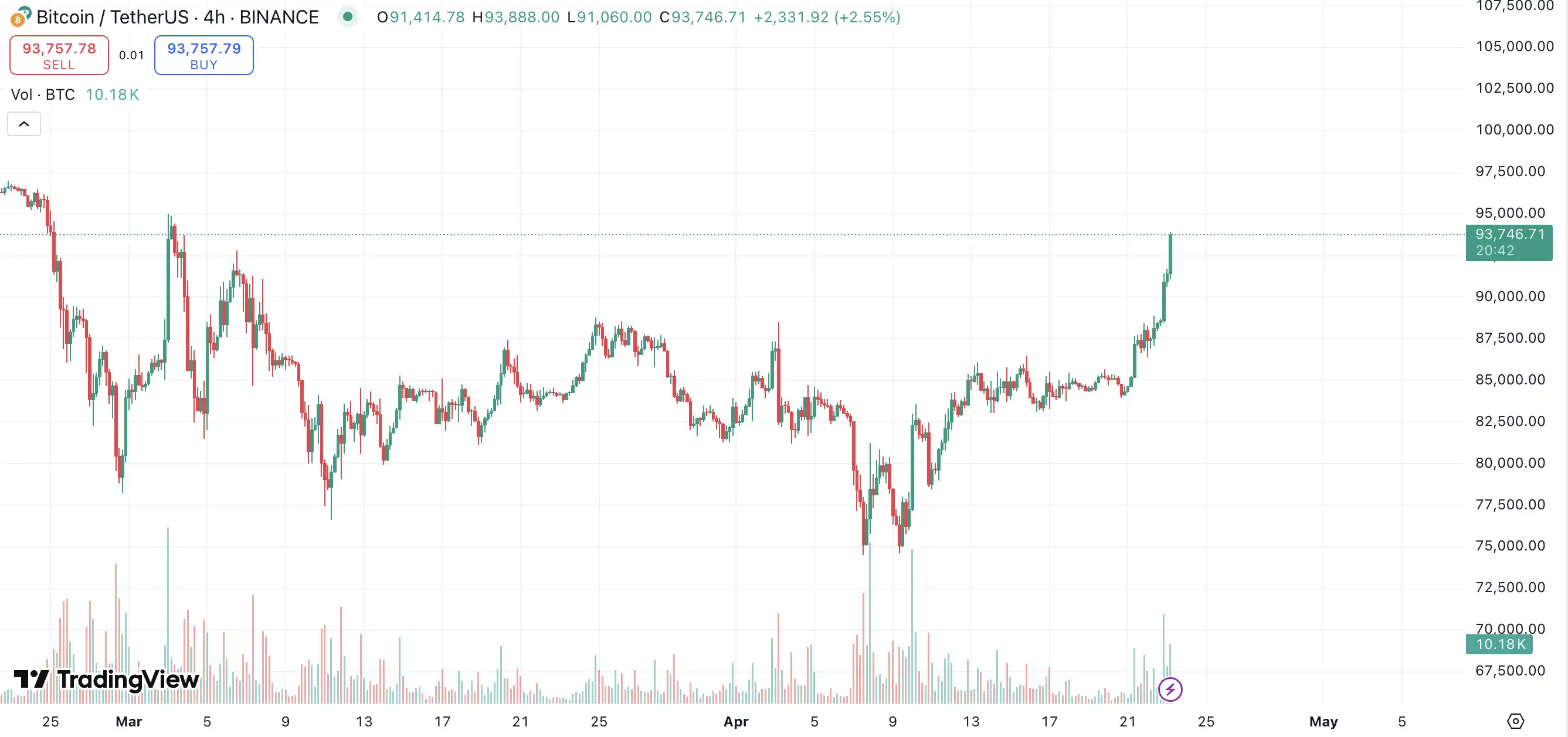
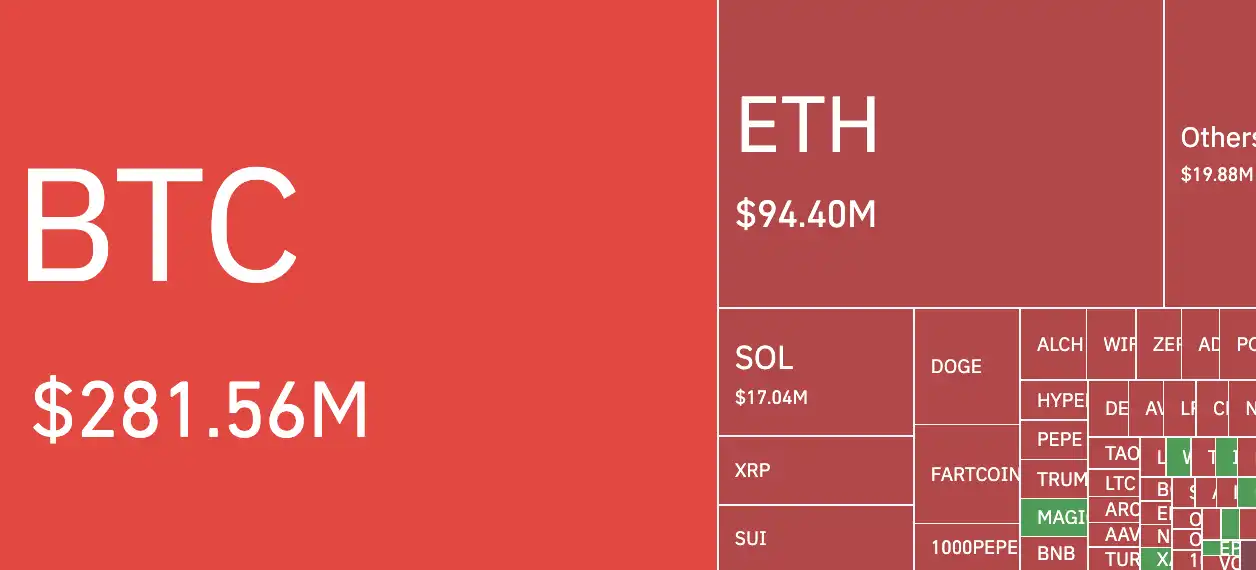
According to Coinglass data, there have been $490 million in liquidations across the network in the past 12 hours, with $450 million in short liquidations.
Meanwhile, gold saw a significant pullback from its intraday high of $3,500, dropping by 1%. The world's largest gold ETF--SPDR Gold Trust--saw a reduction of 11.47 tons in holdings compared to the previous day, with current holdings at 947.70 tons.
This rally is not merely a short-term reaction to the warming of US-China trade relations but more like a risk repricing under multiple macro signals. In this storm of policy maneuvering and safe-haven demand, Bitcoin is once again seen as a capital "safe harbor," with its price surge possibly being a preemptive response to future inflation, US dollar credit, and global geopolitical shifts.
Is Tariff Reversal Sustainable?
The primary reason for Bitcoin's recent surge is attributed to the Trump administration's shift in tariff policy.
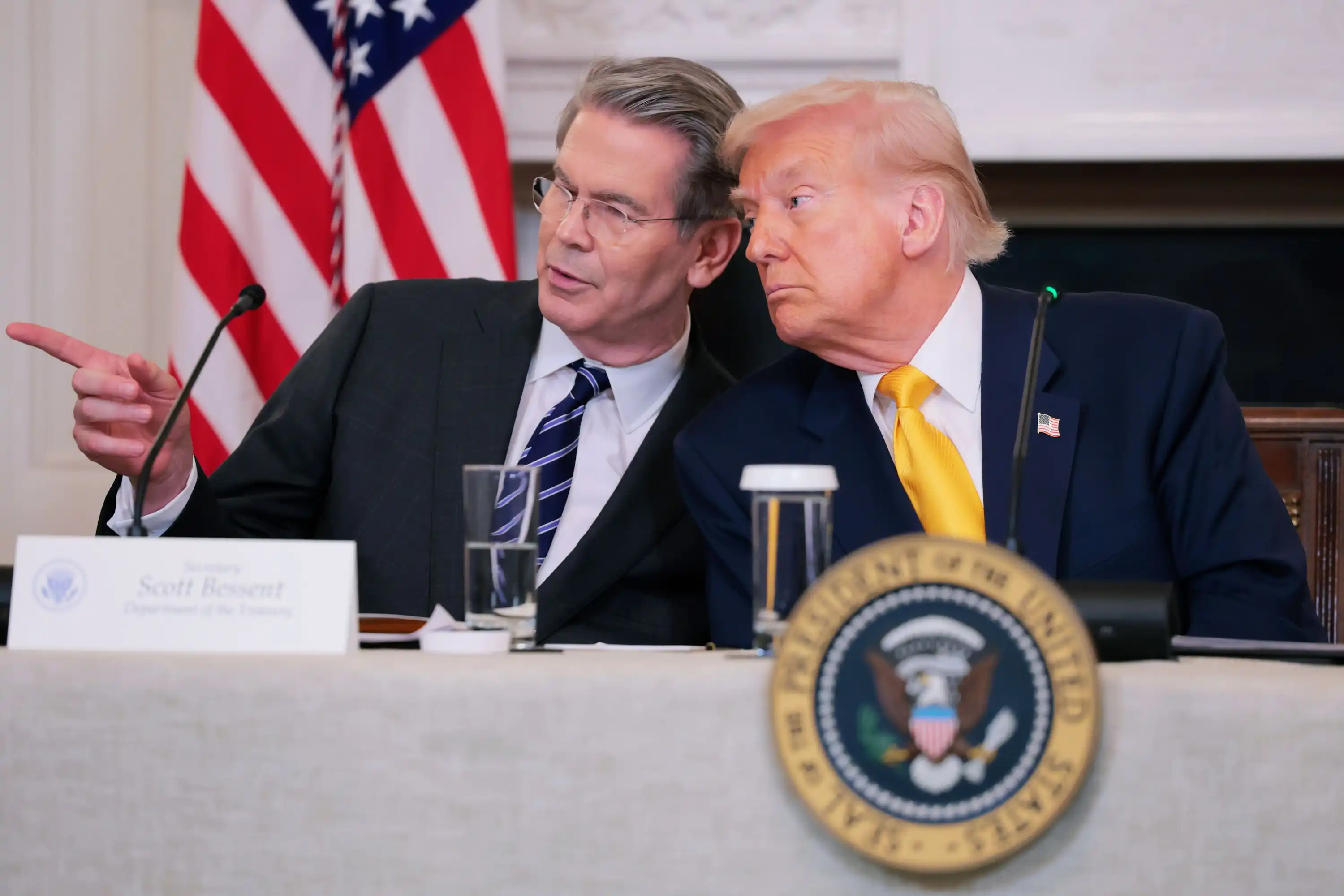
Yesterday, US Treasury Secretary Benson, in a closed-door meeting at JPMorgan, told investors that the current tariff standoff with China is unsustainable. He expects a "thaw" to occur "in the near future" and described the current situation as a "trade embargo." However, he also warned that reaching a more comprehensive agreement between the US and China may still take several years.
Subsequently, President Trump stated to the media at the White House that the US tariffs on China "will be significantly reduced from the current 145% level," easing concerns of further escalation in the trade war.
Currently, the Trump administration has engaged in trade negotiations with Japan, India, South Korea, the EU, Canada, Mexico, and other countries. White House Press Secretary Caroline Levitt stated that the Trump administration has received 18 trade agreement proposals from other countries and added, "All parties involved want to see a trade agreement reached."
However, despite this, Trump has not publicly indicated intentions to repeal the "10% base tariff" he has set. He continues to insist that other countries should lower their own import duties and eliminate various non-tariff barriers, which the US views as hindrances to American exports.
Bitcoin Decoupling from Traditional Finance
According to the International Monetary Fund's (IMF) April 2025 World Economic Outlook report, the U.S. economic growth forecast for this year has been revised down to 1.8% from 2.7%, and the inflation outlook has been raised from 1.9% to 3%. The report also predicts a broader global economic slowdown. Less than an hour after the report was released, Bitcoin surged to its highest level in seven weeks, breaking the $90,000 mark.
Some analysts have pointed out that Bitcoin's recent performance supports the view that it is decoupling from the trends of traditional finance and tech stocks. Patrick Liou, Vice President of Institutional Sales at Gemini, stated that Bitcoin's modest "deviation" reflects investors' cautious stance in the face of U.S. political and macroeconomic risks, especially President Trump's recent criticism of the Federal Reserve's monetary policy and the progress of post-war trade negotiations.
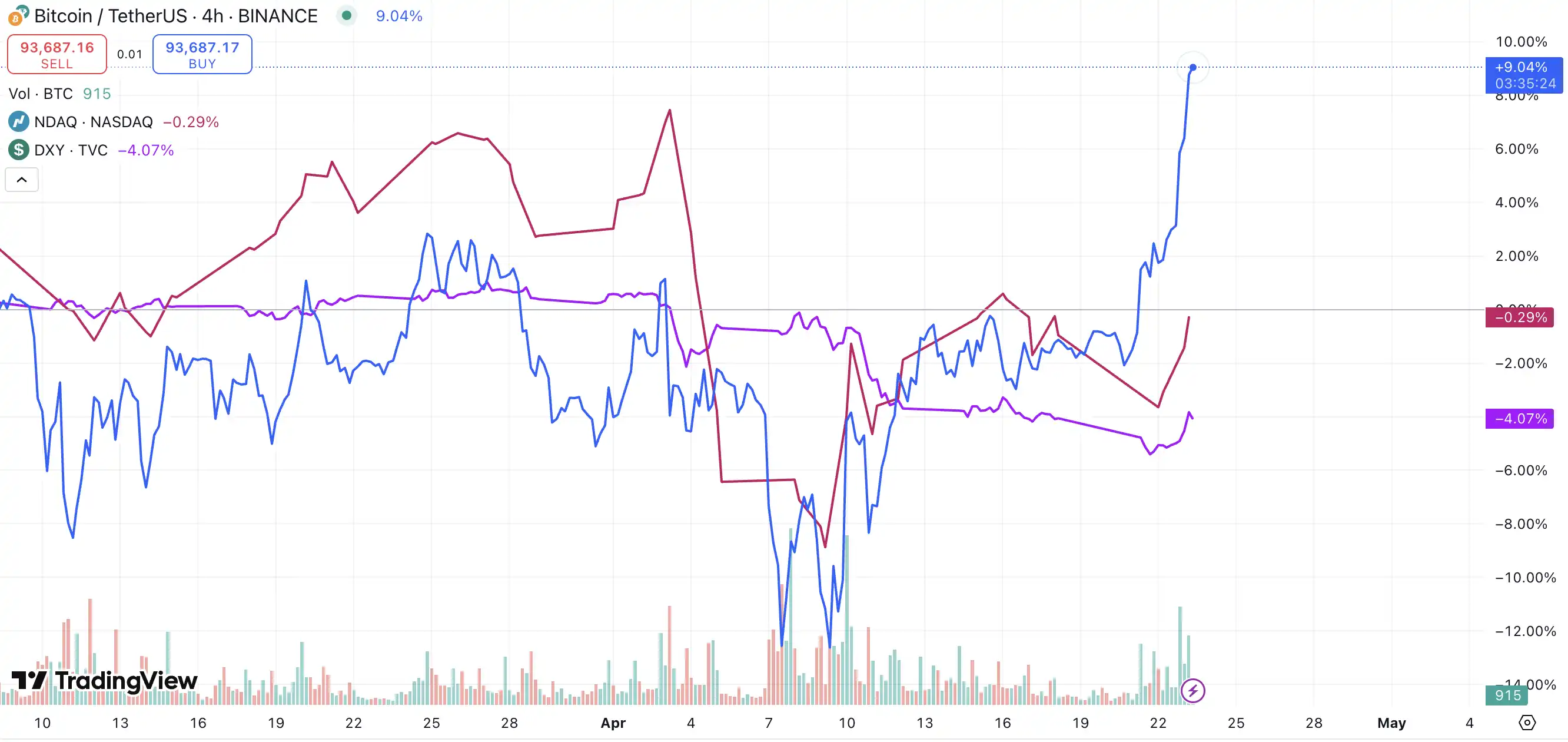
BTC vs. Nasdaq and USD Index Comparison Chart
"We noticed the true 'decoupling' signs began to emerge on Sunday evening," said Patrick Liou. "Considering Trump's increasingly strong language towards the Fed and the unfolding trade agreement negotiations post-'Liberation Day,' investors are in a risk-off mode when evaluating the U.S. market. Interestingly, one of the directions of fund rotation is towards Bitcoin, and we can clearly see Bitcoin exhibiting a distinct decoupling trend from U.S. stocks and the dollar."
Following the Western Easter holiday, the stock market saw a pullback on Monday, but Bitcoin rallied against the trend, following gold's strong performance. The Bitcoin spot ETF recorded a net inflow of $381.4 million that day, the highest single-day inflow since the end of January, further demonstrating the strong demand for Bitcoin in the market.
Analysts at QCP Capital pointed out that the soaring gold price, weakening dollar, and institutional funds flowing into Bitcoin have jointly supported the argument that "Bitcoin is decoupling." "Bitcoin's resilience in overnight trading further strengthens the decoupling market narrative," the QCP analysts stated. "As funds shift towards safe-haven and inflation-resistant assets, Bitcoin and gold are becoming the biggest beneficiaries of fund flight from the dollar risk.
While analysts from QCP Capital and Bernstein emphasize the attractiveness of Bitcoin as a safe-haven asset, Jake O., an OTC trader at Wintermute, cautioned that this "decoupling" phenomenon may be broken after a dollar rebound.
「As I mentioned yesterday, I believe that this current market surge is mainly driven by the weakening of the US Dollar. If this is indeed the case, once the DXY stabilizes, the decoupling of Bitcoin from the US stock market may be difficult to sustain. This is the most crucial variable this week, and this assumption has not yet been truly tested.」
Trump Has No Intention to Fire Powell
On April 22, as Trump criticized Federal Reserve Chair Powell as a "total loser" on Truth Social, and called for an immediate rate cut, even considering dismissal, the market was concerned that the Fed's independence was compromised. The US Dollar Index (DXY) quickly fell below 98, hitting a nearly three-year low.
Analysts at Bitunix stated that if US political pressure persists, it could undermine the legal framework of the Federal Reserve, prompting global funds to accelerate their search for safe havens. This could also accelerate the move of funds from the US Dollar to assets such as Bitcoin and stablecoins, which have anti-censorship and anti-seizure properties.
However, last night, ECB President Lagarde stated in an interview: "Both Powell and I are used to political pressure, and I have great respect for them, believing that Powell will not be dismissed." Citigroup's Chief Economist stated that Trump will not fire Federal Reserve Chair Powell, and "this boundary will not be crossed."
Therefore, Trump's lack of intention to fire Powell has also maintained the stability of the global financial market order. But if Trump does indeed fire Federal Reserve Chair Powell as rumored, the US Dollar Index and US stocks will face further downward pressure, while Bitcoin and gold will become the mainstream choice for safe-haven funds.
You may also like

CFTC Reportedly Plans New Prediction Market Rules Focused on Manipulation Risk and Public Interest Review
The CFTC is reportedly preparing new prediction market rules focused on manipulation risk, public interest review, and retail trader protections.

Meet the new WEEX trial fund—your gateway to greater profits

WEEX Labs Lands at Dutch Blockchain Week: A Disruptive Crypto × AI Conversation Sets Sail in Amsterdam

SK Hynix Reportedly Plans U.S. ADR Listing as Early as August, With SEC Approval Possible in Late June
SK Hynix may pursue a U.S. ADR listing as early as August, with SEC approval reportedly possible in late June amid strong AI chip supply chain demand.

SpaceX vs Tesla vs xAI: Which Elon Musk Trade Has the Biggest Upside in 2026?
OpenAI Reveals It Has Confidentially Submitted an S-1 to the SEC, Keeping the Door Open for a Future IPO
On June 9, according to an OpenAI announcement, the company recently confidentially submitted a draft S-1 registration statement to the U.S. Securities and Exchange Commission (SEC), beginning the preliminary compliance process for a potential initial public offering. OpenAI said it chose to disclose this proactively because it expected the news might leak; however, the company has not yet set a specific listing timeline, and related arrangements may still take some time.

Latest research from 13 top universities including Cornell University: The current state, challenges, and misconceptions of the fusion of Crypto and AI
Deconstructing Anthropic: The Best AI Company, Possibly Also a Type of Organizational Invention
Apollo and Blackstone Reportedly Back $35 Billion Anthropic Chip Financing as Deal Details Remain Unclear
On June 9, according to currently available news alerts, Apollo and Blackstone Group participated in a $35 billion financing for an Anthropic “chip project.” Based on the original wording of the report, the funding has already been raised, but public information remains limited. The financing structure, use of proceeds, project entity, and whether Apollo and Blackstone participated through equity, debt, or project financing have not yet been disclosed.

Humanity Protocol Security Incident Escalates: More Than $31 Million Stolen From Related Addresses as Attacker Continues Selling H for ETH
On June 9, according to monitoring by Onchain Lens, more than $31 million has been stolen from addresses linked to Humanity Protocol, and the attack is still ongoing, with the hacker continuously swapping H tokens for ETH. Project founder Terence Kwok later confirmed the security incident on X, saying the issue involved a private key leak.

Bloomberg: As Bitcoin Weakens, Stablecoins and RWA Continue to Drive Expansion in Crypto Businesses
In June, Bloomberg reported that despite Bitcoin falling below $60,000 last week, wiping out about $235 billion in market value within seven days, and dropping close to 50% from last year’s peak, some core businesses in the crypto industry are still expanding, mainly in stablecoins, real-world asset tokenization (RWA), payments, and infrastructure. The report also noted that overall altcoin activity has contracted significantly: altcoin market capitalization has fallen from a peak of about $431 billion in November 2021 to around $170 billion, and among the tens of millions of tokens issued in recent years, fewer than 1,700 still maintain meaningful trading activity.

Galaxy Deep Research Report: How Hyperliquid's HIP-4 Upgrade Changes the Landscape of Prediction Markets?
Binance Research: RWA Market Expected to Expand Nearly 6x from Early 2025, with Public Equities and Onchain Payments Heating Up Together
In June, Binance Research said in its monthly market report that the real-world asset (RWA) market is expected to grow by about 589% from the beginning of 2025. Bond- and money market fund-related RWA expanded by about $6.5 billion, up 83% year over year, while publicly traded equity RWAs grew by about 422%. The report also noted that monthly crypto debit card transaction volume exceeded $747 million in May, up 48.6% year to date.

Japan to Assess a Framework for Yen Stablecoins and Crypto ETFs as Asia’s Compliant Payments Narrative Heats Up
Recently, according to the original report, Japan is considering the launch of yen stablecoins and cryptocurrency ETFs. Public information remains limited at this stage, and there is still no complete policy text, regulatory draft, or clear implementation timeline, so this is better characterized as a “policy discussion” rather than formal implementation. The original wording also noted that advancing stablecoin regulation in Asia is driving XRP usage and supporting growth in the XRPL ecosystem. However, based on currently available public information, there is not enough evidence to directly establish a clear causal relationship between this round of discussion in Japan and XRP or XRPL.

ZachXBT: Humanity private key leak and abnormal surge in H token should be viewed separately
On June 9, according to related disclosures, on-chain investigator ZachXBT posted an update on Humanity’s roughly $31 million security incident, saying that after further analyzing fund flows, he currently tends to believe the project team was not involved in an “inside job” or a self-staged attack. According to him, the official explanation about the private key leak was broadly accurate, but before the token unlock, the price of H had been artificially pushed higher, and the hacker later took advantage of that market environment; therefore, the private key leak and the earlier abnormal price pumping should be regarded as two separate and independent events. This reframing has shifted the market’s understanding of the nature of the incident. Earlier discussion around Humanity had focused on whether the team directly participated in the attack or used the security incident to cover up internal operations. ZachXBT’s latest remarks shift the focus from “whether it was self-theft” to “whether there were pre-unlock market structure issues.” He also questioned whether the team may have.

Morning Report | OpenAI has submitted an S-1 registration statement draft to the U.S. SEC; Morpho completes $175 million financing

Morning Report | BitMine increased its holdings by 126,971 ETH last week; trader Eugene announced his exit from the crypto market

Wang Chuan: How can one not feel anxious after the neighbor Old Wang made thirty times profit by investing in storage stocks? (Seven) - A quarter-century cycle
CFTC Reportedly Plans New Prediction Market Rules Focused on Manipulation Risk and Public Interest Review
The CFTC is reportedly preparing new prediction market rules focused on manipulation risk, public interest review, and retail trader protections.
Meet the new WEEX trial fund—your gateway to greater profits
WEEX Labs Lands at Dutch Blockchain Week: A Disruptive Crypto × AI Conversation Sets Sail in Amsterdam
SK Hynix Reportedly Plans U.S. ADR Listing as Early as August, With SEC Approval Possible in Late June
SK Hynix may pursue a U.S. ADR listing as early as August, with SEC approval reportedly possible in late June amid strong AI chip supply chain demand.
SpaceX vs Tesla vs xAI: Which Elon Musk Trade Has the Biggest Upside in 2026?
OpenAI Reveals It Has Confidentially Submitted an S-1 to the SEC, Keeping the Door Open for a Future IPO
On June 9, according to an OpenAI announcement, the company recently confidentially submitted a draft S-1 registration statement to the U.S. Securities and Exchange Commission (SEC), beginning the preliminary compliance process for a potential initial public offering. OpenAI said it chose to disclose this proactively because it expected the news might leak; however, the company has not yet set a specific listing timeline, and related arrangements may still take some time.


