
Bitcoin Breaks $94,000: Reversal or Rebound? | Trader's Insight


Under the dual catalyst of a signal of easing tensions in U.S.-China trade and temporary relief in uncertainty surrounding the Fed's policies, Bitcoin has surged above $94,000 in the short term, once again igniting the market's enthusiasm for the "digital gold."
Related Reading: "Bitcoin Soars 7%, Is the 'Digital Gold' Narrative Back?"
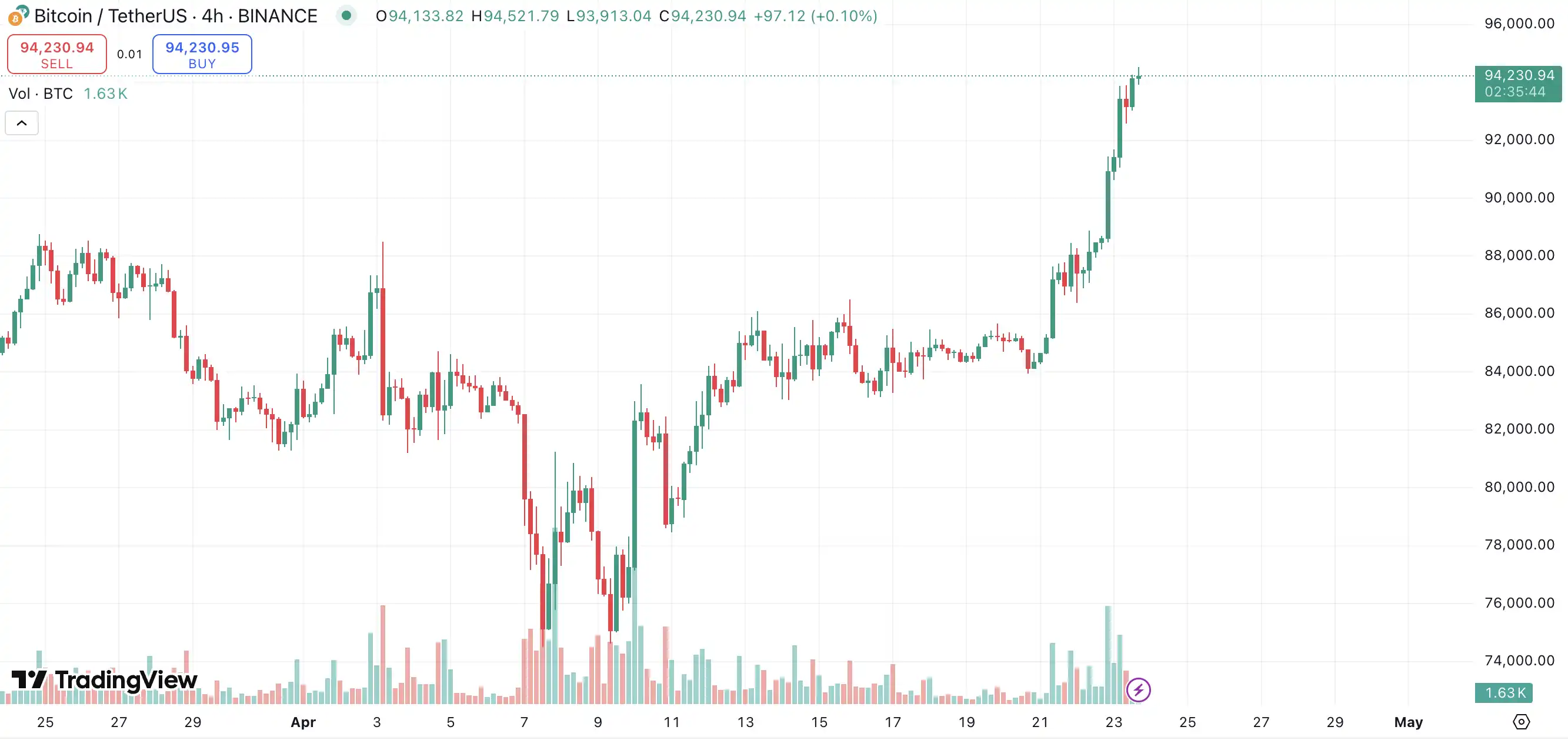
This rally is not only a short-term response of the market to the warming of U.S.-China trade relations but more like a risk repricing under the superimposition of multiple macro signals. In this storm where policy games and hedging demands are intertwined, Bitcoin is once again seen as a capital "safe haven," with its price surge perhaps being a market's preemptive response to future inflation, U.S. dollar credit, and global geopolitical changes.
However, whether this round of price surge is the starting point of a structural reversal or a stage rebound driven by policy games remains a subject of significant market divergence.
On the one hand, both the funding and policy side have released positive signals of "risk repricing." The Trump administration's softened stance on tariff policies, the temporary "hands-off" approach to Powell, and Wall Street's high-profile participation in Bitcoin funds are all seen as the manifestation of the shifting roles between traditional safe-haven assets and digital assets. Institutions like QCP and Matrixport view Bitcoin's recent rise as an active price adjustment under a macro trend change, pointing out that funds are flowing from traditional assets like gold into the crypto market.
On the other hand, some technical analysts and seasoned traders remain cautious, believing that the current rally has not yet provided the structural confirmation needed for a trend reversal. From wave patterns, RSI indicators to liquidity-heavy areas, the signals of long and short positions are complexly intertwined, and the current market situation is closer to a strong rebound rather than a trend reversal. Consistent technical judgments emphasize that only if Bitcoin effectively breaks above $95,000 and stabilizes, a new round of bullish trend may be initiated.
Institutional Analysis
QCP Capital released its daily market analysis, stating that Cantor, SoftBank, Tether, and Bitfinex have jointly launched a bold Bitcoin acquisition fund named 21 Capital (tentative name). This move comes at a time when there is a decisive change in the U.S. policy stance, with the Trump administration leaning towards supporting the "digital gold" narrative, providing momentum to the cryptocurrency market.
Bitcoin has successfully surpassed the $90,000 psychological barrier. Meanwhile, gold has slipped by 6%, highlighting investors' renewed interest in risk assets and clearly showing a flow of funds into digital assets.
Institutional investors are no longer just testing the waters of cryptocurrency but diving in headfirst. As the Strategy strategy gradually fades away, 21 Capital is poised to become a new benchmark of cryptocurrency belief.
Macro risks still exist, but a key uncertainty seems to have been alleviated. Trump stated that there are currently no plans to replace Federal Reserve Chairman Powell, helping the U.S. long-term bond yields to slightly rebound and reducing a significant tail risk.
While the bond market remains stable, the U.S. stock market continues to hold at record highs, reflecting a more moderate and cautious market response. However, the overall outlook is far from simple. Trade frictions, geopolitical tensions, and regulatory uncertainties continue to cast a shadow over the market. Investors navigate in a rapidly changing environment, remaining highly sensitive to the next possible turning point.
Due to the recent warming of the market, speculative trading activity has increased, and open futures contracts have grown. Although Bitcoin has not yet broken through the key level of $95,000, as concerns about Trump's tariff comments diminish, the likelihood of this level being surpassed in the future is increasing. Bitcoin's current trend shows a certain upward trajectory.
CICC: High tariffs may trigger a "recession-style" rate cut by the Federal Reserve
Consider two scenarios: one where negotiations between the U.S. and its trade partners lack substantial progress, and 90 days later, the effective U.S. tariff rate remains high, with the income effect prevailing, leading to weakened economic demand prompting the Fed to cut rates starting from July, with a cumulative rate cut of up to 100 basis points for the year.
The other scenario is where negotiations are successful, tariffs are reduced, demand shocks under substitution effects are relatively mild, but inflation pressures are more sustainable, and the Fed may delay its easing pace, only making a slight rate cut once in December. For the market, even though monetary easing comes earlier in the first scenario, this "recession-style" rate cut reflects deteriorating economic fundamentals and may actually suppress risk assets.
Macro Insight
Last night, the market saw a significant surge, accompanied by three relaxations from the Trump administration:
1. At 11:59 PM; Bessent spoke at a closed-door meeting with J.P. Morgan investors, stating that the current situation is unsustainable and a de-escalation with China will happen soon, allowing the market to "breathe a sigh of relief." Chinese concept stocks soared, gold dipped slightly, and the Nasdaq rose. The Treasury Secretary deliberately chose to make a "private" statement to investors within a Wall Street investment bank like J.P. Morgan, demonstrating a high level of attention to market sentiment, allowing the most sensitive capital market participants to digest and position themselves before the formal announcement.
2. Around 1 AM, Politico reported that completing the negotiation may take several months. At this time, the White House laid the groundwork: White House Press Secretary Levitt said in a press conference that Trump is laying the foundation for a trade agreement with China, and the relationship with China is moving in the right direction. Levitt also stated that Trump "has the right to express dissatisfaction with the Fed" and its chairman Powell, believing that some of the Fed's actions are politically motivated.
3. At 5 AM, Trump said U.S. tariffs on China will be "substantially" reduced from the current 145% level, and tariffs will not drop to zero. China will be very pleased with the final tariff rate. Trump also said he has no intention of firing Powell and hopes to see him more proactive on the rate-cutting issue.
The three relaxations gradually pushed the market upwards. As discussed the day before yesterday, looking ahead, in the next week or two, the market will most likely continue to oscillate upwards as in the past two weeks. Because Trump and Bessent are still pushing for negotiations, the market still has expectations for a new trade agreement. At the same time, there are signs of desensitization to tariffs, so short-term sentiment recovery is also a driving force for the upside.
Sure enough, when Trump eases up, the market can't hold back. Although many friends are calling for a bullish return, I'm not sure if my perception is correct. Even now, I still feel that we are not quite at the point of a "bull return." Especially for the overall risk market, liquidity constraints still exist. I still believe that this is a rebound rather than a reversal. Of course, I may not be right.
Additionally, I don't think it's the right time to go short at the moment. Even though I believe it's just a rebound, I won't open a position during non-U.S. stock trading hours. I'll wait to see the reaction of U.S. investors after the U.S. stock market opens.
Furthermore, I want to reiterate that the trading difficulty in April is still significant. A high trading difficulty does not necessarily mean a price drop. It indicates that the long and short game is more complex, and many of the reasons for this game stem from event-driven sources, especially the biggest uncertainty of Trump.
An increase in difficulty does not equate to a bearish view. I am concerned that some friends may not understand this. I have explained this issue multiple times. If you have poor reading comprehension, don't blame me. Whether the difficulty in the second quarter is high or not no longer needs me to say. The volatility due to Trump's remarks is self-evident, not to mention the GDP data at the end of the month.
Technical Analysis
1. Qualitative: Before breaking through the previous high and forming an obvious continuous five-wave upward impulse wave, any uptrend should be considered a rebound rather than a reversal;
2. Waves: Currently, Bitcoin has completed three upward segments, with the first segment from 74508 to 86496, the second segment from 86496 to 83950, and the third segment from 83950 to the current level. The third segment is approaching a 1:1 ratio compared to the first segment, and it has reached the lower boundary of the M-shaped top formation;
3. Indicators: On the daily and sub-daily levels (12H-1H), the RSI indicator is overbought.
Regarding Bitcoin's price movement, even though there was a temporary signal of topping out around 7 a.m. on the 1-hour timeframe, it was quickly broken by subsequent strong bullish momentum. The price retraced without breaking below the 1-hour MA7, showing strength, and the overall range contracted upward without any divergence correction demand.
There was no sign of a topping-out signal even on the 4-hour chart. The hourly trend is overall strong, considering the current risk market conditions, there is likely to be a wave of upward movement after the U.S. stock market opens tonight. In the short term, there is temporarily no significant resistance nearby on the upside, so one must closely monitor short-term topping-out signals.
A topping-out signal on the upside and a bottoming-out signal on the downside follow the same logic. A rapid breakthrough accompanied by a long shadow, the second candle lower than the previous high but higher than the previous low, then first confirm the 1-hour topping-out/bottoming-out signal, and so on for the 4-hour and daily levels. For example, in the current market situation, there was an initial topping-out signal around 7 a.m., but the subsequent market continued to fluctuate upward, breaking the topping-out signal. There was no such signal on the 4-hour chart. Therefore, assuming the macro trend remains unchanged, the technical outlook still favors an oscillating uptrend.
The expected oscillating uptrend path was quickly invalidated, as the accelerated rally came sooner than anticipated! BTC directly nailed the orange line at the 4h average pressure level, wiping out almost all liquidity in the current range in the futures market...
Now, the key supply area is the range of 93k to 95k.
Since the price entered the orange average pressure zone, it's not quite realistic to attempt large-scale long positions in the short term, as that would be lifting the sedan chair for my trend-long positions.
However, short-term long positions can still be made with confidence. Unlike bear markets, uptrends often see a V-shaped rebound after acceleration. After acceleration, uptrends tend to establish a high-level range, continuously testing new highs upward until demand weakens, leading to a pullback.
In the short term, with the rapid rise of the channel, the upper boundary of the oscillation channel represented by the yellow line may become a potential retracement target (89k to 90k). In subsequent pullbacks, as long as the price does not fall below the yellow line and returns to within the oscillation channel, there will always be hope to break through 95,000.
As for the scenario where the retracement falls below the yellow line, let's wait until it actually happens.
The current market situation may have exceeded many people's expectations, but if you observe the price rebound from the bottom, followed by a consolidation phase with shrinking volume, and today's accelerated surge, this is a clear 2-stage ABC pattern, where the rise of A is approximately equal to the increase of C.
Therefore, subjectively, when the orange line coincides with the supply area, the price faces significant pressure and is unlikely to shoot up all at once. A moderate retracement and oscillation to absorb short-side liquidity, gradually grinding upwards, and absorbing supply could potentially lead to the final breakthrough.
Again, emphasize that the current market trend, in my view, is still a rebound, not a reversal. The price action more closely resembles oscillation within the 95k to 78k range;
So, when the price approaches the upper boundary of the range, try to refrain from chasing long positions in the long term. Only when the price definitively consolidates above the orange line and 95,000, could it be deemed the start of a stronger uptrend.
Although I have been tricked by such a false breakout before, I certainly won't preconceive that it will definitely fake out at 95k and then tumble; it's always best to take it step by step and see how it plays out!
$BTC Technical Analysis Bullish Signal: Am I Bullish Again?
Technically speaking, or more precisely: from a trend structure perspective, BTC has shown a clear bullish signal on the daily chart.
Since I started operating on Twitter last December, I have been bearish all the way until now. As a dedicated bear, I feel it is necessary to come out and write an analysis,
to discuss my views on the upcoming market.
Previously, I shared my views on the S&P 500, and I introduced the "123 Rule" in the article. Interested readers can refer to it. At this moment, on the BTC daily chart, during yesterday's surge, it completed the "1." According to the 123 Rule, a trend reversal needs to meet 1, 2, 3, and the current BTC price has broken the previous Lower High (88.8K) to set a Higher High.
Next, if it can meet: "2: pullback without breaking the previous low, setting a Higher Low" + "3: set a new Higher High," then from the perspective of the 123 Rule, the trend reversal can be basically confirmed.
However, it must be emphasized that the above arguments are all based on the "technical" perspective.
As mentioned in the weekly reports I share, STH-RP has always been a major checkpoint to return to a bullish trend. The analytical logic of STH-RP can be referenced in this article.
Currently, the position of STH-RP is around 92,571. The current price has slightly surpassed STH-RP, and whether it can firmly hold this position will be the focus in the coming days. In addition, as mentioned in last week's report, from the perspective of URPD, it can also resonate with the viewpoint of STH-RP:
Currently, the information provided by URPD is as follows:
➡️ An accumulation of approximately 1.35 million BTC in the 81K to 85K range
➡️ 93 K still has a large amount of trapped chips above (detailed data can be seen in the weekly report)
Among them, the chips from 81 K to 85 K, are at least for now, mostly bought by relatively indecisive "short-term holders."
Therefore, when the price moves away from this range, these short-term holders will have a willingness to sell; at the same time, if the future price reaches the upper STH-RP position,
in addition to facing the suppression effect of STH-RP itself, there may also be a "deleveraging demand" for the trapped chips at 93 K.
Based on the above, the conclusions are as follows:
1️⃣ The position of STH-RP is the dividing line of the long and short trends, resonating with the perspective of URPD
2️⃣ If a strong breakthrough is not possible, it may create a disadvantageous situation for the bulls
3️⃣ If a strong breakthrough occurs, the bulls may take a leading position
In addition, if a real breakthrough is achieved, the accumulation range of 81-85 K, if not quickly consumed, may become a strong support for the bulls.
You may also like

New York Proposes Stricter Stablecoin Issuer Rules Aligned With Federal GENIUS Act
NYDFS proposed stricter stablecoin issuer rules aligned with the GENIUS Act, covering reserves, custody, redemption timelines, audits, and capital buffers.

Every exchange is a "Universal Exchange."

The counterattack of traditional finance: Alliance chains are quietly reviving

CryptoQuant Says Bitcoin Profitable Supply Is Near 45% Pressure Zone as On-Chain Data Points to Market Repricing
CryptoQuant said Bitcoin’s profitable supply is nearing the 45% pressure zone, signaling rising market stress, unrealized losses, and a possible on-chain repricing phase.

Bitcoin Falls Below 200-Week Moving Average as On-Chain Data Shows Over Half of Supply in Loss
Bitcoin dropped below its 200-week moving average as on-chain data showed over 50% of circulating supply is now in loss, signaling rising market stress.

CFTC Reportedly Plans New Prediction Market Rules Focused on Manipulation Risk and Public Interest Review
The CFTC is reportedly preparing new prediction market rules focused on manipulation risk, public interest review, and retail trader protections.

Meet the new WEEX trial fund—your gateway to greater profits

WEEX Labs Lands at Dutch Blockchain Week: A Disruptive Crypto × AI Conversation Sets Sail in Amsterdam

SK Hynix Reportedly Plans U.S. ADR Listing as Early as August, With SEC Approval Possible in Late June
SK Hynix may pursue a U.S. ADR listing as early as August, with SEC approval reportedly possible in late June amid strong AI chip supply chain demand.

SpaceX vs Tesla vs xAI: Which Elon Musk Trade Has the Biggest Upside in 2026?
OpenAI Reveals It Has Confidentially Submitted an S-1 to the SEC, Keeping the Door Open for a Future IPO
On June 9, according to an OpenAI announcement, the company recently confidentially submitted a draft S-1 registration statement to the U.S. Securities and Exchange Commission (SEC), beginning the preliminary compliance process for a potential initial public offering. OpenAI said it chose to disclose this proactively because it expected the news might leak; however, the company has not yet set a specific listing timeline, and related arrangements may still take some time.

Latest research from 13 top universities including Cornell University: The current state, challenges, and misconceptions of the fusion of Crypto and AI
Deconstructing Anthropic: The Best AI Company, Possibly Also a Type of Organizational Invention
Apollo and Blackstone Reportedly Back $35 Billion Anthropic Chip Financing as Deal Details Remain Unclear
On June 9, according to currently available news alerts, Apollo and Blackstone Group participated in a $35 billion financing for an Anthropic “chip project.” Based on the original wording of the report, the funding has already been raised, but public information remains limited. The financing structure, use of proceeds, project entity, and whether Apollo and Blackstone participated through equity, debt, or project financing have not yet been disclosed.

Humanity Protocol Security Incident Escalates: More Than $31 Million Stolen From Related Addresses as Attacker Continues Selling H for ETH
On June 9, according to monitoring by Onchain Lens, more than $31 million has been stolen from addresses linked to Humanity Protocol, and the attack is still ongoing, with the hacker continuously swapping H tokens for ETH. Project founder Terence Kwok later confirmed the security incident on X, saying the issue involved a private key leak.

Bloomberg: As Bitcoin Weakens, Stablecoins and RWA Continue to Drive Expansion in Crypto Businesses
In June, Bloomberg reported that despite Bitcoin falling below $60,000 last week, wiping out about $235 billion in market value within seven days, and dropping close to 50% from last year’s peak, some core businesses in the crypto industry are still expanding, mainly in stablecoins, real-world asset tokenization (RWA), payments, and infrastructure. The report also noted that overall altcoin activity has contracted significantly: altcoin market capitalization has fallen from a peak of about $431 billion in November 2021 to around $170 billion, and among the tens of millions of tokens issued in recent years, fewer than 1,700 still maintain meaningful trading activity.

Galaxy Deep Research Report: How Hyperliquid's HIP-4 Upgrade Changes the Landscape of Prediction Markets?
Binance Research: RWA Market Expected to Expand Nearly 6x from Early 2025, with Public Equities and Onchain Payments Heating Up Together
In June, Binance Research said in its monthly market report that the real-world asset (RWA) market is expected to grow by about 589% from the beginning of 2025. Bond- and money market fund-related RWA expanded by about $6.5 billion, up 83% year over year, while publicly traded equity RWAs grew by about 422%. The report also noted that monthly crypto debit card transaction volume exceeded $747 million in May, up 48.6% year to date.
New York Proposes Stricter Stablecoin Issuer Rules Aligned With Federal GENIUS Act
NYDFS proposed stricter stablecoin issuer rules aligned with the GENIUS Act, covering reserves, custody, redemption timelines, audits, and capital buffers.
Every exchange is a "Universal Exchange."
The counterattack of traditional finance: Alliance chains are quietly reviving
CryptoQuant Says Bitcoin Profitable Supply Is Near 45% Pressure Zone as On-Chain Data Points to Market Repricing
CryptoQuant said Bitcoin’s profitable supply is nearing the 45% pressure zone, signaling rising market stress, unrealized losses, and a possible on-chain repricing phase.
Bitcoin Falls Below 200-Week Moving Average as On-Chain Data Shows Over Half of Supply in Loss
Bitcoin dropped below its 200-week moving average as on-chain data showed over 50% of circulating supply is now in loss, signaling rising market stress.
CFTC Reportedly Plans New Prediction Market Rules Focused on Manipulation Risk and Public Interest Review
The CFTC is reportedly preparing new prediction market rules focused on manipulation risk, public interest review, and retail trader protections.


