
Bear Market New Chain's 14x God Tier Coin, How to Play Bigcoin?

The GameFi project Bigcoin just launched on the "Penguin Chain" Abstract the day before yesterday. In fact, this project has garnered a lot of discussion in the English-speaking community since its inception in the English-speaking world. A look at the price chart makes it clear why:
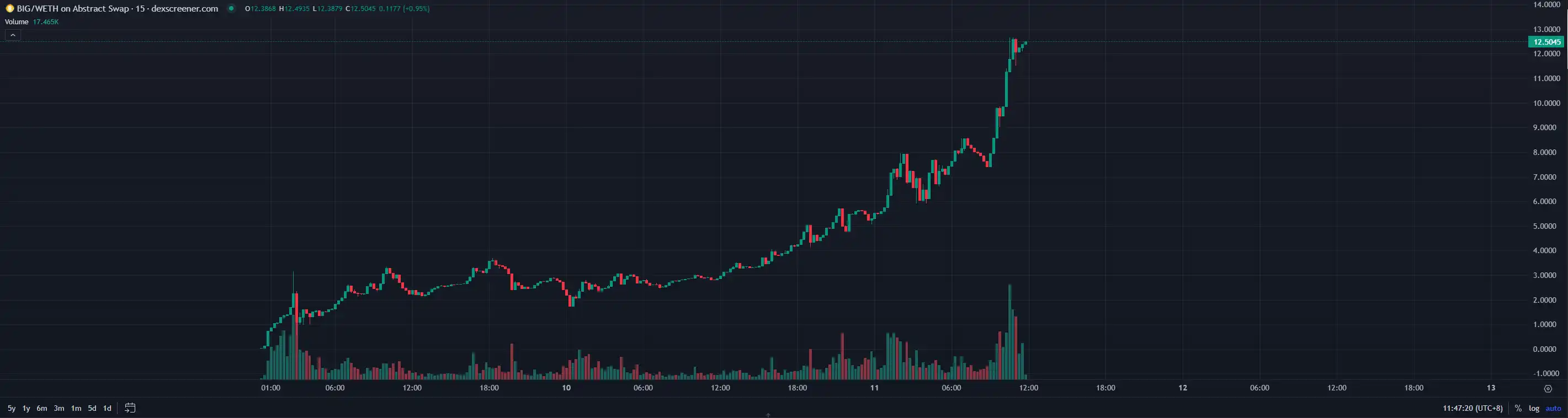
At the beginning, foreigners jokingly called it a "Pixiu scheme." Looking at the extended timeline, it has been a consistent upward trend.
Starting from yesterday, the enthusiasm for this project has gradually spread to the Chinese community. How exactly does this project work? In an environment where GameFi/blockchain games have not been a major market focus for a long time, how did it, as a "mining coin" produced by GameFi, stand out and skyrocket 12 times?
Mechanism Introduction
You can tell from the project's name, Bigcoin, that its mechanism is broadly based on mimicking Bitcoin mining.
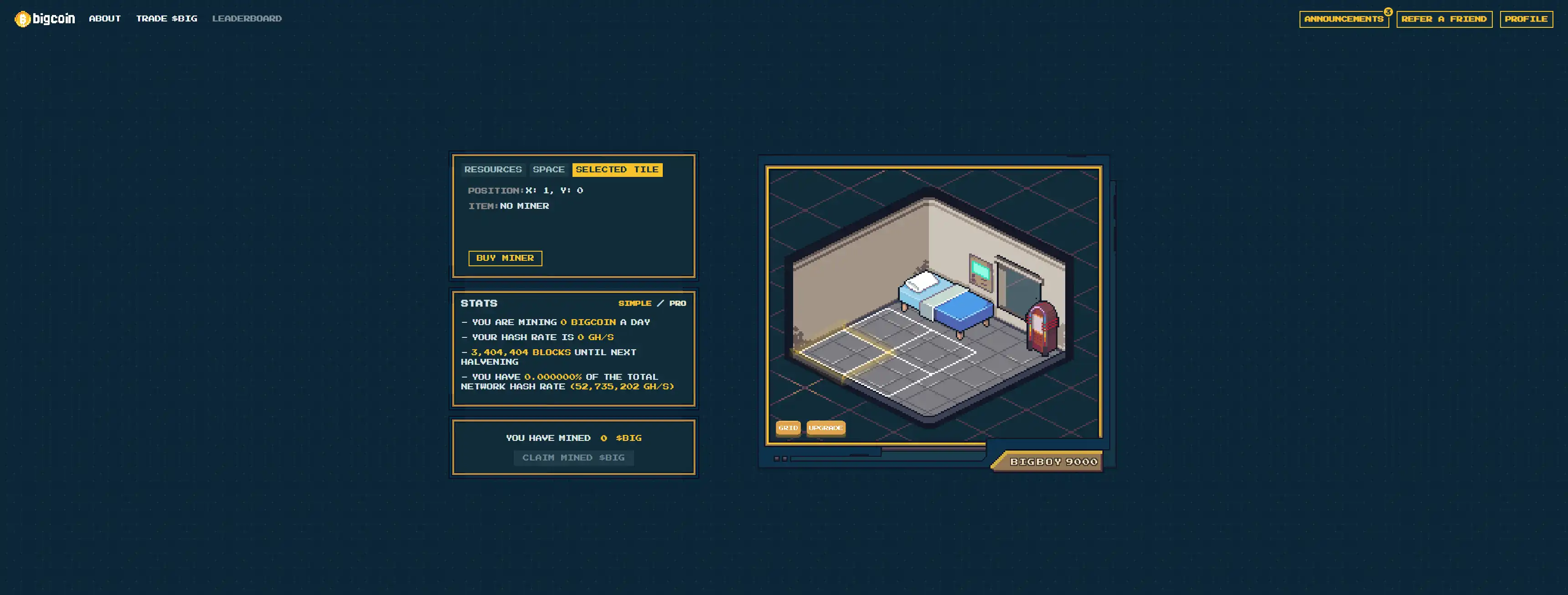
Bigcoin has a total supply just like Bitcoin of 21 million coins, with an initial block reward of 2.3 $BIG. Every 4.2 million Abstract network blocks, the reward halves once, approximately every 53.5 days. Of course, in reality, the "mining" process is not actually using real computational power like Bitcoin; this is simply a process within a virtual game.
Upon entering the game, players need to spend 0.01 ETH to buy a "mine" to start playing. Buying a "mine" comes with a free "miner," and following the game's instructions to deploy the miner in the mine will start producing the in-game currency $BIG. Every block, all players will definitely receive a $BIG reward, and the reward formula is "Player Hashpower/Total Hashpower of All Players * Block Reward."
If you want to mine faster, you must spend $BIG. Although the initial "mine" has 4 slots for placing miners, it only has 28 power units, which can only support 2 of the cheapest "Raspberry Pro" miners priced at 20 $BIG to operate.
Therefore, to earn more $BIG in the game, you not only need to spend $BIG to buy higher-level "miners" to increase your "hashpower," but also upgrade your "mine" to be able to place more and higher-level "miners." Mine upgrades will have a 24-hour cooldown in the future.
All $BIG used for in-game upgrades will have 75% burned, and 2.5% of the mined coins will be distributed as a commission reward.
Highlights
If the game simply copied the Bitcoin mining concept without any changes, it would be quite boring. However, it incorporates many clever ideas that introduce a lot of unpredictable variables to make the gameplay more interesting than just "mining in a game."
The game introduces a "mining machine elimination mechanism." Similar to the history of Bitcoin mining development, old mining machines will be phased out by newer, more powerful ones. In the game, mining machines will also dynamically adjust based on the game's output. In yesterday's update, old mining machines could be sold at 90% of the purchase price, allowing players to exchange them for new machines or take profits.
Of course, this profit-taking mentioned here has a strong first-mover advantage. For example, the author of this text bought two 80 $BIG mining machines when the game was just launched, and at that time, the price of $BIG was only around $1. When the author redeems 154 $BIG today, the price of $BIG has risen to $5.5. In the long run, defining this as a "free exit mechanism" is more reasonable because the price fluctuation of $BIG is hard to predict, and as more players enter the game and halving events occur, the $BIG produced at the same cost will decrease.
The project team clearly came prepared. When the game was first launched, the entry cost was 0.005 ETH, perhaps to avoid an influx of too many "freeloaders," the entry cost was raised. Also, the cost of upgrading the mining farm for the first time yesterday was 1600 $BIG, but after the update, it was adjusted to 70 $BIG. This adjustment may compensate for early adopters who upgraded early; otherwise, those whales who spent 1600U upgrading the mining farm would be at a loss.
The game also has a "Prop Shop," and it is currently unknown what effect purchasing items from it and placing them in the mining farm will have.
Lastly, this project has received noticeable support from Abstract's official team. Before the game went live, the official Abstract account was already paying attention to it. Luca Netz not only appeared in the comments section of Bigcoin's tweet but also directly tweeted about the project:

Strategy
Overall, this is a whale's game. Naturally, the strategy for whales is to reinvest to maximize $BIG production. For whales, besides profiting from $BIG, there is an expectation of harvesting a large amount of Abstract XP (related to future Abstract token airdrops). A similar case is On-chain Heroes, where previously, the leading figure @0xtsider received a reward of 84994 XP within a week. At that time, to participate in On-chain Heroes, one needed to spend at least 0.5 ETH to purchase an NFT for in-game staking.
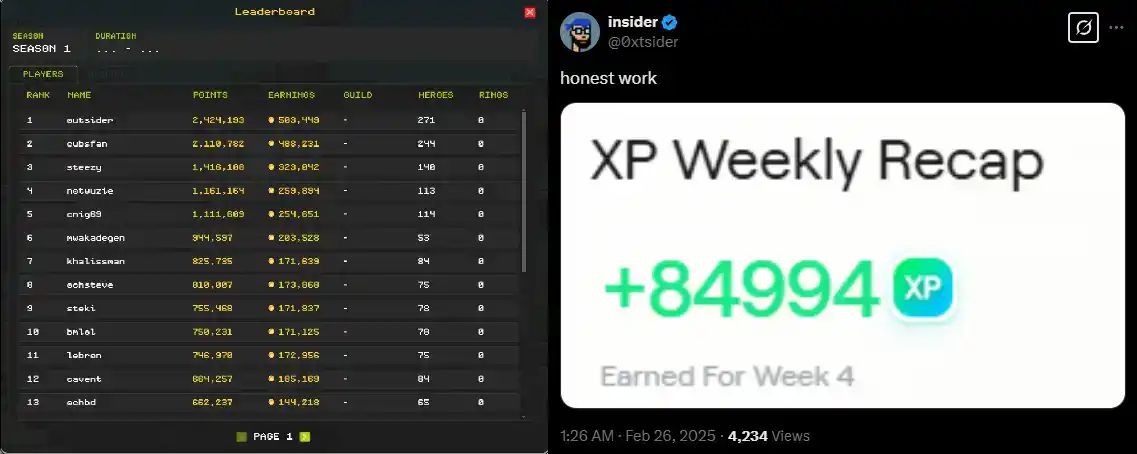
The distribution mechanism of Abstract XP is opaque, but the official team will allocate XP based on the weekly activity of ecosystem applications. Currently, the $BIG pool holds nearly 640 ETH, and the trading volume in just 2 days has reached close to $11 million. With the high activity levels leading up to the start of On-chain Heroes Season 2, Bigcoin is very likely to have the highest XP allocation weight.
For ordinary retail investors, a more suitable strategy would be to enter with the lowest possible cost, use free mining machines to break even, and also earn some Abstract XP.
However, it is crucial to note that to earn Abstract XP, you must use the Abstract Global Wallet (AGW) to connect and participate in the game. This is not a browser extension wallet but a web-based wallet. You can register using an email address or link through extension wallets like MetaMask to register. (Official Website Link)
Conclusion
Abstract's development strategy on this chain is very different in the current market. While other chains may encourage users to participate in testnets or issue bundled token NFTs for hype, Abstract can be said to be an "attention development-oriented" chain, focusing mainly on "live streaming" and GameFi.
The user base of Abstract consists mainly of English-speaking NFT players. Although the NFT assets on this chain perform mediocrely, the older NFT player community tends to be more interested in things that have been carefully crafted, even though they know the "game" very well. This is the key to the success that On-chain Heroes and the current Bigcoin have achieved on Abstract, attracting attention in the market.
Through numerous GameFi/Blockchain Game projects, the Chinese community has captured more of the previous blockchain game players and airdrop interactive players. If the chain conducts a TGE in mid-year, the author still holds relatively high expectations for its market performance.
You may also like

Morning Report | BitMine increased its holdings by 126,971 ETH last week; trader Eugene announced his exit from the crypto market

Wang Chuan: How can one not feel anxious after the neighbor Old Wang made thirty times profit by investing in storage stocks? (Seven) - A quarter-century cycle

Cryptocurrency CEXs are flocking to sell US stocks, and traditional brokerages are facing an "uninvited guest."

$75 billion in foreign capital has fled, and South Korean retail investors have absorbed it all using leverage

Japan’s Three Megabanks Plan Joint Stablecoin Issuance in Fiscal 2026
MUFG, SMBC, and Mizuho reportedly plan to jointly issue fiat-pegged stablecoins in fiscal 2026, signaling Japan’s growing push into bank-led digital payment infrastructure.

Humanity Discloses H Token Dual-Chain Attack Details, With Losses on Ethereum and BSC Exceeding $36 Million
Humanity said the H token attack across Ethereum and BSC caused more than $36 million in losses after leaked ProxyAdmin keys enabled malicious contract upgrades and token minting.
White House Discusses CLARITY Act With Law Enforcement Ahead of Senate Vote
The White House discussed the CLARITY Act with law enforcement ahead of a Senate vote, focusing on illicit finance risks and developer protections.

Bitcoin Trading Guide 2026: Strategies for Experienced Traders

What Is XAUT and PAXG? Why Tokenized Gold Is Booming in 2026

Will the SpaceX IPO Hurt Bitcoin? Here's What Traders Are Watching

Foreign selling in the South Korean stock market accelerates, with cumulative net sales reportedly reaching $75 billion this year
On June 9, The Kobeissi Letter, citing Goldman Sachs data, reported that global investors are selling South Korean stocks at an unusually rapid pace. In the latest trading session, foreign investors sold about $801 million worth of Kospi constituent stocks again; total foreign outflows last week reached about $10 billion, and the market has been in net foreign selling on nearly every trading day over the past month. According to the data cited in the report, foreign investors have sold about $75 billion worth of South Korean stocks so far this year. Meanwhile, South Korean retail and institutional investors together recorded roughly $69 billion in net buying over the same period, suggesting that the market’s main buying support has come from domestic capital rather than returning overseas funds. The information currently disclosed still mainly comes from The Kobeissi Letter’s retelling and Goldman Sachs data summaries, while public details on the statistical period and the specific definition of “selling” remain relatively limited.

Fortune Warns of Strategy’s Financing Structure Risks as Bitcoin Premium Narrows
Fortune warned that Strategy’s Bitcoin treasury model faces growing financing risks as MSTR’s net asset premium narrows and preferred stock dividend pressure increases.

Ferrari Challenge Le Mans: Carl Moon to Dominate in WEEX Livery

Sahara AI Responds to SAHARA’s Sharp Drop: No Contract or Product Security Issues Found, Internal Investigation Underway
Sahara AI responded to SAHARA’s 60% price drop, saying no token contract or product security issues have been found and an internal investigation is underway.

WEEX Deposit/Withdrawal Dynamic Island: Your Asset Status, Always in Sight
Scaling Crypto Derivatives: The Digital Asset Infrastructure Behind High-Volume Trading
In the fast-moving digital asset ecosystem, derivatives platforms face an extreme architectural test. High-leverage futures markets demand more than just standard security—they require absolute operational precision, zero-latency matching engines, and ironclad structural scalability, all while navigating intense market volatility.
As global platforms scale to meet these demands, the industry is shifting away from rigid, monolithic setups toward a more agile, "decoupled" infrastructure philosophy.
The Blueprint for High-Volume Copy TradingFor elite global exchanges like WEEX (founded in 2018), this architectural choice becomes critical when scaling high-volume retail features like social copy trading. When thousands of users automatically mirror the real-time strategies of elite traders simultaneously, it triggers sudden, monumental spikes in concurrent transactional volume.
To prevent execution latency or settlement bottlenecks during these peak volatility events, a platform's primary engine must remain entirely dedicated to risk management, copy-trade synchronization, and order matching.
The Architectural Rule: New-generation platforms must separate front-end user execution engines from heavy backend infrastructural overhead to eliminate operational friction.
By separating these layers, platforms can maintain complete sovereignty over their trading environments and user experiences while strategically aligning with institutional-grade infrastructure ecosystems. This strategic framework allows modern exchanges to leverage advanced Digital Asset Custody infrastructure such as Cobo’s behind the scenes, ensuring that backend wallet management scales elastically alongside trading spikes.
Capitalizing on Market Momentum and 400× LeverageIn a derivatives arena where platforms offer up to 400× leverage on perpetual contracts, capital efficiency and market agility are core business metrics. To capture market momentum, an exchange needs the ability to rapidly expand its asset offerings, supporting everything from legacy crypto assets to sudden, trending altcoins across a massive library of trading pairs.
Adopting a flexible, scalable Wallet-as-a-Service (WaaS) solution such as Cobo’s could completely rewrite the development timeline for high-growth exchanges. Instead of spending months of engineering capital building out custom backend wallet architectures for every new blockchain network, platforms can deploy localized infrastructure in days.
This agility allows platforms to instantly scale their listings to over a thousand trading pairs without compromising security or delaying time-to-market. It mirrors the exact operational advantages seen during high-velocity market events, similar to how advanced wallet infrastructure empowers platforms during sudden asset surges; allowing exchanges to pass that speed and liquidity directly to their global user base.
A Mature Foundation for GrowthThe synergy between trusted infrastructure ecosystems and global trading platforms represents the natural evolution of a maturing crypto market. As WEEX continues to scale its global spot and derivatives offerings for over 6 million users, adopting robust backend paradigms proves that platforms no longer have to compromise between cutting-edge trading velocity and uncompromised structural security.

Get Paid to Onboard? Try WEEX’s New Homepage with Rewards for Registration, Deposit & Trade
WEEX Custom Layout: Build Your Perfect Trading Workspace in Seconds
Morning Report | BitMine increased its holdings by 126,971 ETH last week; trader Eugene announced his exit from the crypto market
Wang Chuan: How can one not feel anxious after the neighbor Old Wang made thirty times profit by investing in storage stocks? (Seven) - A quarter-century cycle
Cryptocurrency CEXs are flocking to sell US stocks, and traditional brokerages are facing an "uninvited guest."
$75 billion in foreign capital has fled, and South Korean retail investors have absorbed it all using leverage
Japan’s Three Megabanks Plan Joint Stablecoin Issuance in Fiscal 2026
MUFG, SMBC, and Mizuho reportedly plan to jointly issue fiat-pegged stablecoins in fiscal 2026, signaling Japan’s growing push into bank-led digital payment infrastructure.
Humanity Discloses H Token Dual-Chain Attack Details, With Losses on Ethereum and BSC Exceeding $36 Million
Humanity said the H token attack across Ethereum and BSC caused more than $36 million in losses after leaked ProxyAdmin keys enabled malicious contract upgrades and token minting.


